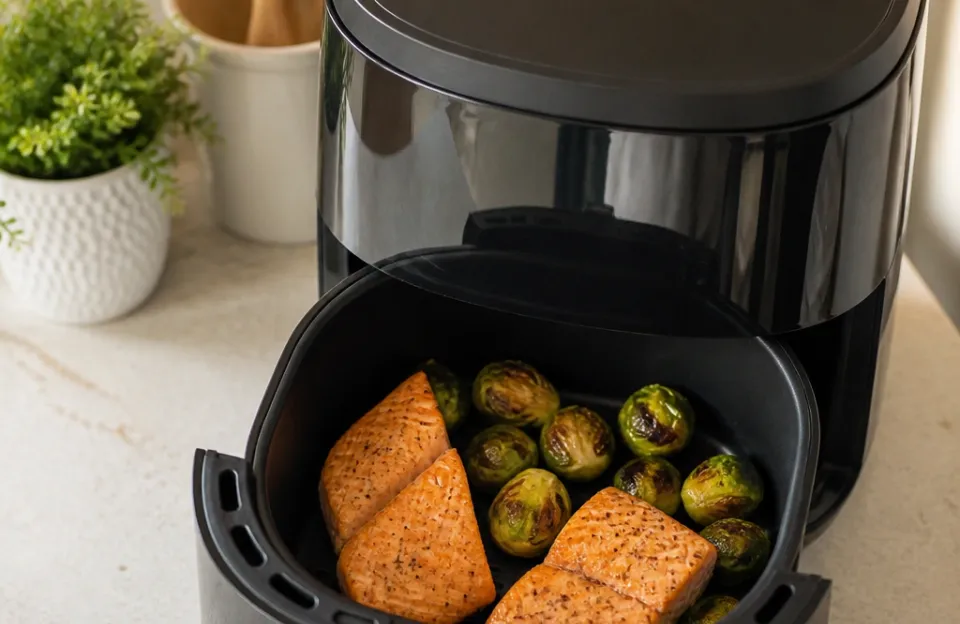
A convection oven or a convection toaster oven is your closest substitute for an air fryer, because all three crisp food by moving hot air rapidly across the surface. If you do not have a fan-assisted oven, a broiler, a hot skillet, a deep fryer or a microwave crisper tray can each get you part of the way there, as long as you adjust temperature, timing and technique. Whichever route you choose, a food thermometer is what confirms the food is actually safe to eat, not the color of the crust.
The Short Answer: Your Best Air Fryer Substitutes
Air fryers are essentially countertop convection ovens, and they cook food faster while using less energy than a full-size oven. That single fact explains the whole substitution list: anything that pushes hot air or hot oil across the food’s surface can brown and crisp it.
| Method | Relative crispness | Capacity | Best for |
|---|---|---|---|
| Convection oven | Closest match | Largest | Family-size batches, whole trays of vegetables |
| Convection toaster oven | Close match | Medium | Smaller batches, single portions |
| Standard oven plus broiler | Good top browning | Large | Melting, charring, finishing |
| Stovetop pan frying | High, contact-driven | Small | Cutlets, chicken pieces, quick sears |
| Deep frying | Highest | Small to medium | Maximum crunch, battered foods |
| Microwave crisper tray | Light browning | Very small | Reheating a slice or a pastry |
Typical air fryer recipes run at 350 °F to 400 °F for 5 to 25 minutes, which gives you a useful starting range when you translate a recipe to another appliance.
How Rapid Hot Air Actually Cooks Your Food
An air fryer is airtight and keeps hot air circulating quickly around the food, and that moving air is what dries the surface and produces crispness. The same principle applies in any oven with a working convection fan.
Two practical consequences follow. First, crowding defeats the method, because overcrowding blocks air circulation and can leave food unevenly cooked or underdone. Second, a microwave is a poor imitation of this process: its oven air stays at room temperature, so food surfaces rarely brown or crisp the way they do in a hot-air oven.
Using a Convection Oven Setting for Crispy Results
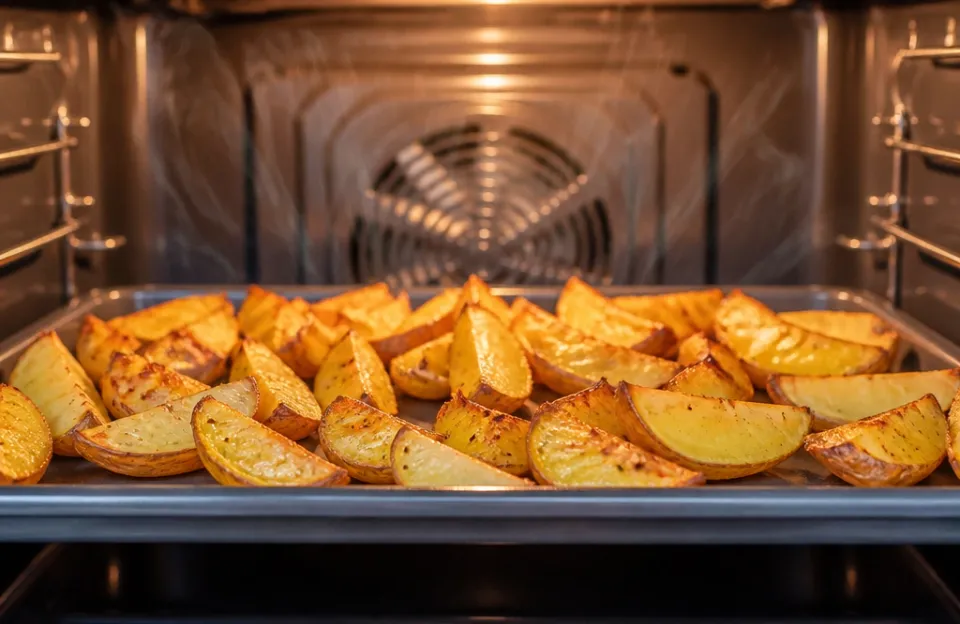
If your oven has a convection or “fan” setting, use it. Air fryers are countertop convection ovens, so the cooking mechanism is the same one.
A commonly cited conversion guideline is to drop the temperature by about 25 °F and shorten the cooking time by roughly 25 percent when moving a conventional recipe to convection. Treat that as a starting point rather than a rule: it is a widespread rule of thumb, and exact adjustments vary by appliance and recipe, so check doneness early the first time. Arrange food in a single layer with space between pieces, because crowding blocks the airflow that does the crisping.
This setting also handles dishes that need a long, even roast. If you normally air fry roasting root vegetables, a convection oven does the same job on a larger scale.
Getting Similar Texture from a Toaster Oven
A convection toaster oven has more room than a pod-style air fryer, so you can cook larger pieces and more food at once and spread it out for better airflow and more even cooking. In an independent comparison test, a pod-style air fryer cooked chicken wings, frozen fries and Brussels sprouts faster and crispier than a convection toaster oven, while the toaster oven offered more capacity and more versatility.
Use the toaster oven when you want to cook a larger quantity or a piece of food that will not fit in a basket. Expect a slightly longer cook and a somewhat less aggressive crust than a pod-style air fryer, and note that airflow design differs between models, so results are not identical across brands.
Modifying Recipes for a Standard Oven Without a Fan
A standard oven without a fan still works, but it browns more slowly because nothing is actively stripping moisture from the surface. Raise the temperature modestly, use a dark or heavy baking sheet, and leave gaps between pieces so steam can escape. Finish under the broiler if the top needs more color.
This approach suits sturdy dishes that benefit from steady radiant heat rather than a fast blast of air. A dense bake such as cooking a dense meatloaf is a good example of a recipe that adapts well to a conventional oven with a small temperature bump.
Deep Frying When You Want Maximum Crunch
Deep frying is the method air frying was designed to imitate, and it delivers the crunchiest result of anything on this list. It also carries the most risk, because deep frying oil can reach temperatures above 400 °F, and at that heat you need serious precautions to avoid burns or a fire.
Measure oil temperature with a thermometer and hold it steady. USDA FSIS guidance lists approximate times and temperatures for common foods: chicken pieces at 375 °F for 13 to 20 minutes, chicken fingers at 350 °F for 6 to 8 minutes, fish fillets at 320 °F for 3 to 5 minutes, and shrimp at 320 °F for 4 to 6 minutes. Oils with high smoke points that FSIS recommends for deep frying include olive, peanut, canola, corn, grapeseed, safflower, sunflower and vegetable oil.
Three safety rules matter more than any timing chart. Never leave a fryer unattended, because frying is fast enough that food can blacken and become a fire hazard within minutes. Never use water on a grease fire; instead use a kitchen fire extinguisher or cover the fryer with a metal lid, and call 911 immediately if a grease fire occurs. Do not test internal temperature while the food is submerged in hot oil, because the reading will be inaccurate; lift it out first. For the same reason, do not overcrowd the basket.
After frying, refrigerate leftovers within 2 hours, or within 1 hour if the ambient temperature is above 90 °F. Never pour used oil down the sink, since it congeals with water and can back up your sink, septic system or public sewer.
Pan Frying and Searing on the Stovetop
A stovetop pan gives you direct contact heat, which browns food faster than air alone. Preheat the pan properly, use just enough oil to coat the surface, and leave space between pieces so they sear instead of steam. Work in batches for anything larger than a single layer.
Exact oil temperatures and times for pan frying were not verified against an official source, so rely on visual and tactile cues plus a thermometer for doneness rather than a fixed number. Pan frying works well for foods with a relatively flat surface that can sit against the metal, such as searing chicken pieces.
Broiling for Top-Down High Heat
A broiler is an intense overhead heat source, not a convection device, so it browns and chars a surface rather than cooking food evenly through. It is best used as a finishing step: cook the food through with another method, then slide it under the broiler for color and crunch.
Because official broiler temperature and timing guidance was not available, follow your appliance manual for rack position and settings, and stay close to the oven. Broilers can take a surface from golden to burnt in under a minute.
Microwaving with a Crisper Tray
Microwaves cook unevenly and can leave cold spots where harmful bacteria survive, so test food with a thermometer in several places rather than assuming it is done. They also do not normally brown or crisp food, because the air inside the oven stays at room temperature while only the food itself heats.
A crisper tray aims to solve that browning problem by converting microwave energy into surface heat, but specific preheating and material-compatibility instructions were not verified against an official source, so follow the tray manufacturer’s directions exactly. General microwave safety still applies: use heatproof glass, glass-ceramic, oven cooking bags or most paper plates and towels, and prefer white, unprinted paper for better safety. Stir, rotate or turn food midway through cooking, and allow the standing time the recipe specifies, because cooking continues during that rest. Follow recipe or package directions for standing time, since durations vary by food.
Safe Internal Temperatures for Every Method
No appliance setting guarantees doneness. A food thermometer does. These are the USDA safe minimum internal temperatures, and they apply no matter which of the methods above you use.
| Food | Safe minimum internal temperature |
|---|---|
| Fish and shellfish | 145 °F |
| Whole cuts of beef, pork, veal and lamb | 145 °F with a 3-minute rest |
| Ground meats | 160 °F |
| Ground meat and sausage | 160 °F |
| All poultry, including ground poultry and stuffing | 165 °F |
| Leftovers and casseroles | 165 °F |
| Casseroles containing meat or poultry | 165 °F |
| Egg dishes such as frittata or quiche | 160 °F |
Raw eggs should be cooked until yolk and white are firm. Seafood such as shrimp, lobster, crab and scallops should be cooked until the flesh is pearly or white and opaque; clams, oysters and mussels until the shells open during cooking. Leftovers should be refrigerated within 2 hours to stay out of the Danger Zone between 40 °F and 140 °F, where foodborne bacteria multiply quickly. FoodSafety.gov publishes the same safe minimum internal temperatures and rest times for reference Cook to a Safe Minimum Internal Temperature.
One product-specific exception is worth knowing: raw, stuffed breaded chicken breast products should not be cooked in an air fryer at all, and manufacturer cooking instructions should always be followed. If you are moving recipes between appliances rather than within one, compare like with like and check the internal temperature rather than the clock.
Which Foods Work Best with Which Method
Frozen snacks and fries. A convection toaster oven has the space to spread a single layer, which is what frozen fries and nuggets need for even browning. If you are converting a recipe that was written for a countertop unit, remember that typical air fryer temperatures run 350 °F to 400 °F for 5 to 25 minutes, so start near the lower end of the time range and check early.
Chicken wings. Deep frying at 375 °F for 13 to 20 minutes gives the crunchiest skin. A convection oven is the next best option, and spreading the wings out so air reaches every surface is the key step. For wing-specific timing, this guide to getting the skin extra crunchy is useful context even if you are cooking in a full-size oven.
Vegetables. A convection oven or convection toaster oven handles a full tray of vegetables well, since the fan keeps the moisture moving away from the surface. A pod-style air fryer will still cook them faster and crisper in a single-layer batch.
Bacon. Pan frying or a sheet pan in a convection oven gives you control and avoids the smoke that comes from a very hot broiler. Using a dedicated guide to how long the strips need is a reasonable starting point, but confirm doneness by appearance and texture rather than the air fryer timer alone.
Delicate items such as fish and seafood. Broiling is a poor fit here because the top cooks long before the center does. Pan frying or a convection oven gives gentler, more even heat, and the internal temperature is your doneness check. A reference on preparing delicate seafood helps with timing, but the thermometer still governs.
Situations Where Swapping Methods Falls Short
No substitute matches an air fryer exactly, and a few gaps are worth knowing before you commit.
- Crispness ceiling. In a controlled comparison, a pod-style air fryer beat a convection toaster oven on speed and crispness for wings, frozen fries and Brussels sprouts, even though the toaster oven won on capacity and versatility.
- Batch size. You cannot solve a capacity limit with a longer cook. Overcrowding any of these appliances blocks air circulation and causes uneven or undercooked food.
- Model-to-model variation. Airflow design differs between convection toaster oven models, so the same recipe can behave differently in two similar-looking ovens. Expect to test.
- Recipes written for a pod. Recipes developed for a basket-style air fryer do not translate with a single fixed conversion factor, because appliance thermostats, fan behavior and load size all shift the result. Start with the standard air fryer range of 350 °F to 400 °F and 5 to 25 minutes, then adjust.
- Conversion guidance is approximate. The 25 °F and 25 percent reduction for convection is a commonly used guideline, not a verified universal standard, so it should guide your first attempt rather than dictate it.
Picking the Right Tool from Your Kitchen
Here is the decision rule, in order:
- Larger batches or a whole tray? Use a convection oven, or a convection toaster oven if the batch is smaller.
- Maximum crunch, and you are willing to manage hot oil? Deep fry at the FSIS times and temperatures, with the safety measures above.
- Quick browning on an already-cooked dish? Finish under the broiler, watching closely.
- A small portion that just needs re-crisping? A pan, a toaster oven or a microwave crisper tray can each do the job.
- Any method at all. Confirm the food’s internal temperature with a thermometer before serving, and refrigerate leftovers within 2 hours.
The honest summary is that a convection oven gets you closest to air fryer results at scale, a convection toaster oven gets you close in a smaller footprint, deep frying beats everything on crunch and demands the most care, and the stovetop, broiler and microwave crisper tray each solve a narrower problem well. Match the method to the food and the batch size, then let the thermometer make the final call.