A single basket air fryer cooks everything in one shared space, while a dual basket model splits the cooking area into two separate drawers that run at different temperatures and times. If you cook for one or two people and mostly heat up single items like fries or chicken pieces, a single basket keeps things simple. If you regularly try to serve a full dinner with a protein and a side dish at the same time, a dual basket saves you from juggling timers and swapping trays halfway through.
Choosing between single vs dual basket air fryers comes down to three things: how many people you feed, what you usually cook, and how much counter space you have. The rest of this article breaks down the real differences in capacity, cooking speed, cleanup, and daily use so you can pick the right setup for your kitchen.
How Single vs Dual Basket Air Fryers Actually Differ
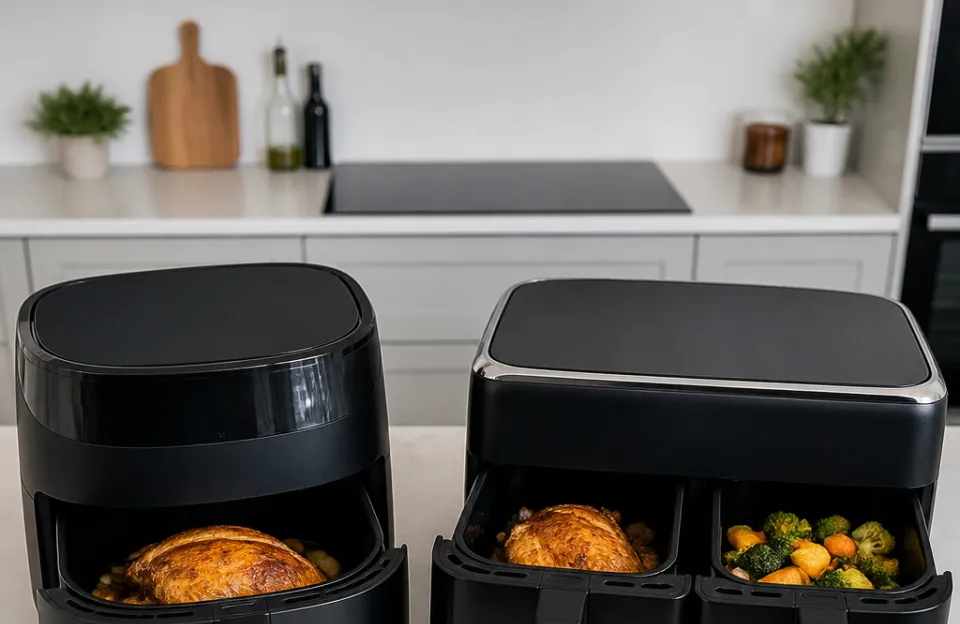
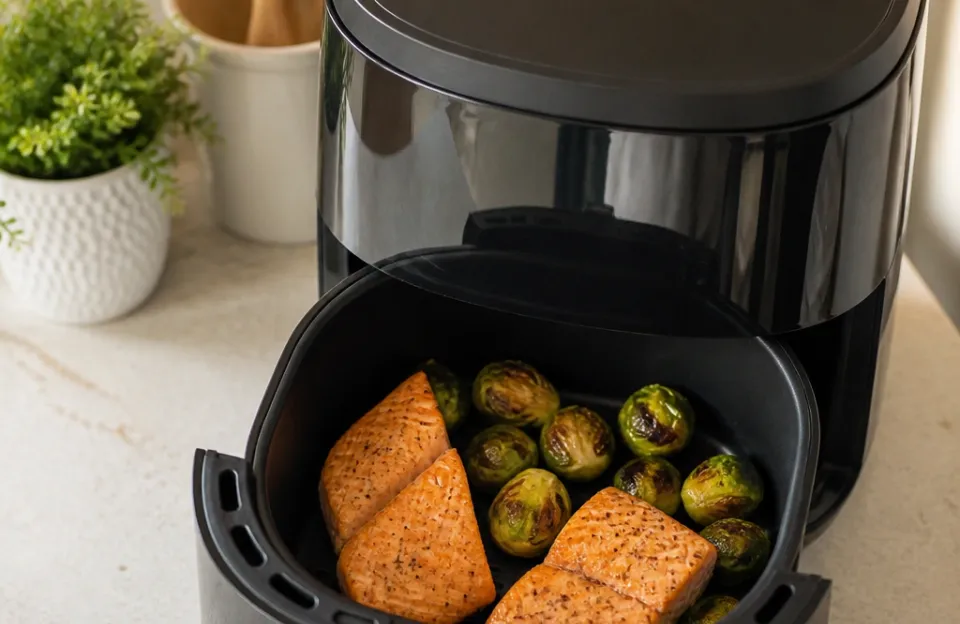
The core difference is physical separation. A single basket unit has one large drawer with one heating element and one fan circulating hot air over all the food inside. You set one temperature and one timer.
Everything in that drawer gets the exact same treatment.
A dual basket air fryer contains two smaller drawers. Each drawer has its own heating element and fan. You can roast vegetables at 400 degrees Fahrenheit in the left drawer while cooking salmon at 350 degrees in the right drawer.
Most dual models include a sync function that calculates the different cooking times and finishes both drawers at the exact same moment.
This physical split changes how you plan meals. In a single basket, cooking a main dish and a side requires batch cooking. You finish the chicken, remove it, then add the potatoes.
Or you crowd them together, which lowers the air circulation and leads to soggy spots. We've covered exactly how long root vegetables need when cooked solo, but mixing them with heavy proteins in one drawer changes those times. A dual basket removes that compromise entirely.
Counter Space and Physical Footprint
Dual basket air fryers are wider. A typical single basket model takes up about 12 to 14 inches of width on your counter. A dual basket model usually stretches 15 to 18 inches wide because it houses two drawers side by side.
Both types tend to be around 12 to 15 inches deep.
If you have a small kitchen or limited counter space near an outlet, that extra width matters. Some compact single basket models fit under standard cabinets easily. Larger dual models might require you to pull them forward to open the drawers fully without hitting the backsplash.
Always measure the depth needed for the drawer to slide out completely before buying.
Total Capacity Versus Usable Space
Manufacturers list total capacity in quarts. A single basket might be advertised as 6 quarts. A dual basket might be listed as 8 quarts total, meaning two 4-quart drawers.
That total number can be misleading if you don't think about how food actually fits.
In a 6-quart single basket, you can lay out a large batch of french fries in a relatively even layer. In an 8-quart dual basket, you only have two 4-quart spaces. You cannot spread a massive batch of fries across both drawers unless you want to run them at the exact same settings, which defeats the purpose of having two zones.
For large batches of a single item, a big single basket often holds more usable volume than a dual model with the same total quart rating.
| Attribute | Single Basket | Dual Basket |
|---|---|---|
| Typical Width | 12 to 14 inches | 15 to 18 inches |
| Total Capacity Range | 2 to 10+ quarts | 6 to 10+ quarts (split) |
| Independent Temp Zones | One | Two |
| Sync Finish Function | N/A | Standard on most models |
| Best Batch Size | Large single items | Smaller mixed meals |
Cooking Speed and Heat Distribution
Air fryers work by moving very hot air rapidly around food. The size of the chamber directly affects how fast that air heats up and how evenly it circulates.
Smaller chambers heat up faster. Because a single drawer in a dual basket unit is physically smaller than a large single basket, it reaches its target temperature slightly quicker. This means preheating takes less time, sometimes just two or three minutes instead of five.
However, cooking speed depends heavily on crowding. If you pack a 4-quart drawer completely full of chicken thighs, the air cannot circulate properly. The food will steam instead of crisp.
Getting that perfect crunch on poultry requires leaving space between pieces. A single 6-quart basket gives you more surface area for a large batch, allowing better airflow than cramming that same amount of food into two smaller drawers.
Dual basket models handle mixed meals faster overall. Even if the individual drawers take the same amount of time to cook their contents, running them simultaneously cuts your total active cooking time in half compared to doing two batches back-to-back in a single basket.
Temperature Control for Different Foods
Different foods require different temperatures for safe and tasty results. The USDA recommends cooking poultry to a minimum internal temperature of 165°F, which usually requires a higher air fryer setting, while delicate fish fillets do better at lower heat to prevent drying out. Checking official USDA food safety guidelines is always smart when adjusting cooking methods.
In a single basket, you are locked into one temperature. If you try to cook a thick piece of meat and thin vegetable slices together, one will burn before the other is done. You either compromise on the temperature or accept uneven results.
Dual baskets solve this completely. You can set the left drawer to 390°F for getting bacon perfectly rendered and the right drawer to 350°F for something that scorches easily. This independent control is the primary reason people upgrade from a single basket.
Daily Use Scenarios Where One Type Wins
Picking the right style depends on your actual eating habits rather than spec sheets. Here is how they perform in common situations.
Feeding One or Two People Quickly
For solo cooking or couples who eat the same thing, a single basket is usually enough. If you are reheating leftovers, roasting a couple of chicken breasts, or making a quick side dish, one drawer does the job without taking up extra counter space.
Small single basket models in the 2 to 4-quart range are highly efficient for this. They draw less power and clean up in seconds. There is no reason to pay for a second zone if you never use it.
Preparing Full Dinners With Sides
Families or anyone who wants a complete meal ready at once benefits heavily from a dual basket. Cooking a protein in one drawer and a starch or vegetable in the other means everything hits the plate hot.
The sync finish button on most dual models handles the math for you. You input the time and temp for both drawers, press sync, and the machine delays the start of the faster-cooking item so both finish together. This is incredibly useful when timing salmon alongside lighter sides that cook much faster.
Without dual zones, you end up babysitting the appliance and plating cold food.
Meal Prep and Large Batches
If you spend Sunday afternoons cooking large batches of food for the week, a large single basket often works better. When you need to roast three pounds of vegetables or cook a dozen wings at once, you want maximum uninterrupted floor space inside the drawer.
Splitting a large batch across two small drawers means running two identical cycles, which wastes the main benefit of the dual zone setup. For pure volume of a single recipe, look for a single basket in the 6 to 10-quart range. Many people who focus on batch cooking specific proteins prefer one large cavity over two divided ones.
Cleaning and Upkeep Differences
More parts mean more washing. A single basket air fryer has one drawer and one crisper plate or rack inside it. After cooking, you wash those two pieces.
Most modern versions have nonstick coatings that wipe clean quickly, though some larger baskets can be awkward to fit in a small sink.
A dual basket model has two drawers and two crisper plates. That is four pieces to wash every time you use both zones. If you only used one side, you still have to manage the bulkier base unit.
The drawers themselves are smaller, which makes them easier to handle in the sink, but the sheer number of parts adds up over a week of daily cooking.
Grease management also differs. In a single basket, grease drips to one bottom tray. In a dual basket, grease collects in two separate areas.
If you cook something fatty in one drawer and something dry in the other, you only have to scrub the greasy one. But if both drawers get dirty, your cleanup time essentially doubles. Keeping any countertop appliance running well requires wiping down the heating elements periodically, and dual models have two sets of elements to check.
Power Draw and Energy Use
Air fryers generally use between 1400 and 1800 watts. A single basket model typically sits around 1500 watts. A dual basket model might pull 1700 to 1800 watts when both zones are running at maximum heat.
Running a dual basket uses more electricity per minute than a single basket. However, because you are cooking two things at once instead of running a single basket twice in a row, the total energy used for a full meal is often lower with the dual model.
You also need to consider your kitchen's electrical circuits. Older homes sometimes have 15-amp circuits in the kitchen. An 1800-watt appliance draws about 15 amps on its own.
If you plug a dual basket air fryer into the same circuit as a running microwave or coffee maker, you might trip the breaker. Single basket models that draw 1400 watts leave a bit more headroom on shared circuits.
Price Ranges and What You Pay For
Single basket air fryers cover a massive price range. Basic mechanical dial models start very cheap, while digital models with preset programs cost more. You are paying primarily for build quality, digital controls, and brand reputation.
Dual basket models start at a higher baseline price because the internal engineering is more complex. You are paying for two heating elements, two fans, and the microchip logic required to run the sync finish function. Expect to pay noticeably more for a reliable dual basket than for a comparable single basket from the same manufacturer.
If budget is tight and you only need to cook one item at a time, a single basket delivers the exact same crisping technology for less money. The premium for a dual basket only pays off if you actively use both zones regularly. Exploring different countertop cooker styles can help you see where the pricing tiers fall based on hardware complexity.
Which Setup Fits Your Kitchen Routine
If you live alone, cook simple meals, or have very limited counter space, a single basket air fryer is the practical choice. It does everything an air fryer is supposed to do without taking up extra room or costing more upfront. Pick a size that matches your typical portion sizes.
A 4 to 6-quart single basket handles almost anything a small household throws at it.
If you cook for a family, frequently make dinners with distinct components, or hate waiting for batch two to finish, go with a dual basket. The ability to run two temperatures simultaneously and have everything finish together changes how you use the appliance. It shifts from a snack maker to a primary dinner tool.
Just verify your counter width and electrical circuit can handle it before bringing one home.
Frequently Asked Questions
Can I cook two different meats at the same time in a dual basket?
Yes, as long as each drawer is set to the correct temperature for that specific meat. Keep raw poultry away from foods that won't reach high internal temperatures to avoid cross-contamination risks. The sealed nature of the separate drawers prevents juices from mixing, which is safer than trying to cook two different raw proteins in a single shared basket.
Is a single basket air fryer better for baking?
A single large basket often provides better results for baking items like cakes or breads because it offers a wider, uninterrupted surface area. Dual baskets are narrow, which limits the size of baking pans that fit inside. If you plan to bake frequently, check the interior dimensions of the drawer against your bakeware before buying.
Do dual basket air fryers take longer to preheat?
No, the individual drawers in a dual basket are smaller than a large single basket, so they usually reach their target temperature faster. Running both drawers simultaneously does not slow down the preheat process, as each zone operates independently with its own heating element.
Which type is easier for someone new to air frying?
A single basket is simpler to learn. You only manage one temperature and one timer. Dual baskets introduce concepts like sync cooking and matching finish times, which adds a slight learning curve.
Once you understand the sync button, however, dual models become very straightforward.
Does food taste different between the two types?
The cooking mechanism is identical, so food tastes the same assuming the temperature and time settings are correct. Any difference in texture usually comes from overcrowding. If you force too much food into a small dual drawer, it won't crisp as well as it would spread out in a large single basket.
Are replacement parts harder to find for dual baskets?
Crisper plates and replacement drawers are widely available for popular brands of both types. Because dual baskets have two of everything, you might need to replace parts twice as often if you use both sides daily. Stick to established brands that sell replacement accessories directly to avoid issues down the road.
Deciding Before You Buy
The debate over single vs dual basket air fryers comes down to your actual cooking habits. Don't buy a dual zone model just because it sounds advanced if you only ever reheat pizza rolls or cook single batches of fries. The extra width and cost won't improve your meals.
On the flip side, if you are constantly fighting the clock trying to get a main dish and a side finished together, a dual basket solves a real problem. Measure your counter, check your outlets, and match the hardware to the way you actually eat.