You’ve spent hours prepping the brisket, setting the vents, and managing the blue smoke, only to cut into a slab of meat that’s either tough as a brick or dangerously underdone. That sinking feeling is enough to make any backyard cook frustrated. It usually happens because you relied on a clock or a finger poke instead of a precise internal temperature reading.
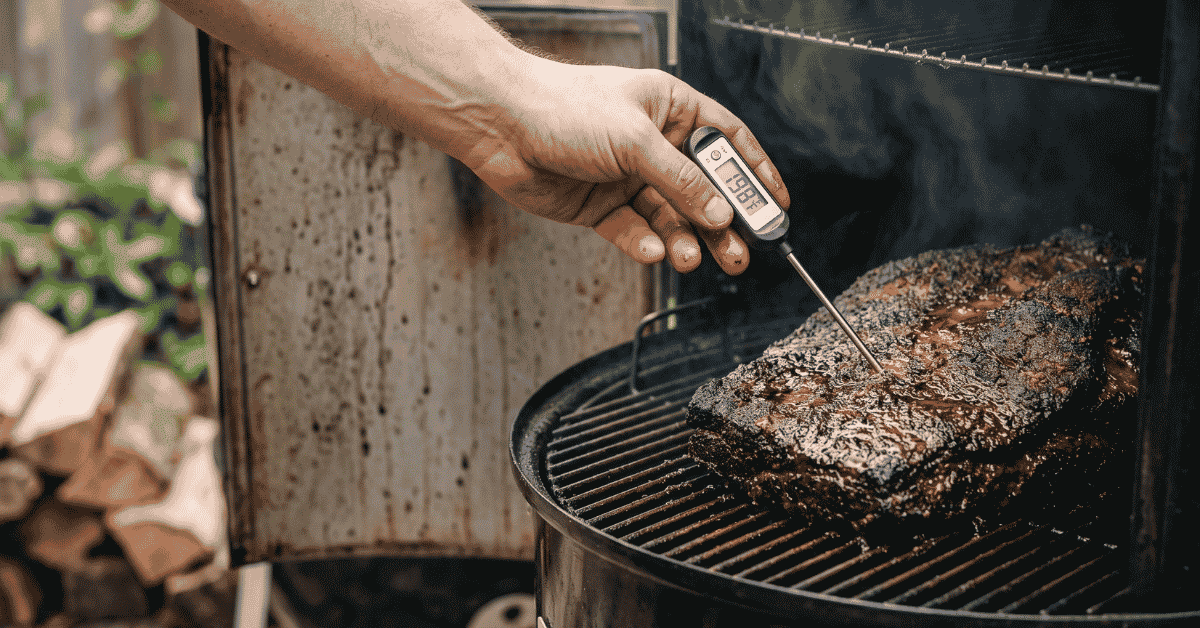
Quick Answer: To use a meat thermometer when smoking meat, insert the probe into the thickest part of the muscle, away from bone or heavy fat pockets. For long cooks like brisket or pork shoulder, leave a remote probe in the meat throughout the process to track the “stall” and pull the meat at exactly the target temperature. Always verify the final temp with a separate instant-read thermometer before resting.
Why Temperature Accuracy Defines Good BBQ
Temperature is the only metric that truly tells you when smoked meat is safe and tender. Unlike high-heat grilling, smoking relies on the slow breakdown of connective tissues like collagen. This process doesn’t happen at a specific time; it happens at a specific internal heat range, usually between 195°F and 205°F for classic BBQ cuts.
Relying on “minutes per pound” is a recipe for failure because every piece of meat has a different water content and fat density. Even the humidity in the air or the type of wood you use can change how fast a roast cooks. A thermometer removes the guesswork by showing you exactly what is happening inside the muscle fibers.
The Role of the “Stall”
When you smoke large cuts like pork butt, you’ll hit a point where the temperature tops rising, often around 150°F to 160°F. This is called the stall. It happens because moisture evaporates from the surface of the meat, cooling it down as fast as the smoker heats it up.
Without a leave-in thermometer, many beginners think their smoker has died or their meat is “stuck,” leading them to crank up the heat and ruin the texture. Monitoring this phase helps you decide when to wrap the meat in foil or butcher paper to push through.
Food Safety Standards
Beyond taste, safety is the primary goal. According to USDA guidelines, poultry must reach 165°F to be safe, while fresh pork and beef should hit at least 145°F followed by a rest. When smoking, you almost always go well past these minimums for texture, but the thermometer identifies the “danger zone” (40°F to 140°F) where bacteria grow fastest.
You want to see your meat move through this zone steadily.
Types of Thermometers for the Smoker
Not all thermometers are built for the low-and-slow environment of a smoker. You generally need two different tools to get the best results: one for constant monitoring and one for quick spot-checks.
Leave-in Remote Probes
These consist of a heat-resistant wire and a metal probe that stays in the meat for the entire duration of the smoke. The wire runs out of the smoker to a digital display or connects to your phone via Bluetooth or Wi-Fi. This is your primary tool for tracking the progress of long cooks without opening the lid.
Opening the smoker lid (often called “peeking”) drops the ambient temperature significantly, adding 15 to 20 minutes to your cook time every time you do it.
Instant-Read Thermometers
These are handheld devices designed for a quick measurement. You poke the meat, get a reading in two seconds or less, and pull it out. These are vital for the end of the cook.
Since a leave-in probe only measures one specific spot, an instant-read leaf allows you to check three or four different areas of a brisket to make sure the whole thing is “probe-tender.”
Ambient Pit Probes
Many high-end digital thermometers come with a clip to attach a probe to the grill grate. This measures the temperature of the air exactly where the meat is sitting. Don’t trust the thermometer built into the lid of your smoker; those are often off by 50 degrees or more because they are located too high up and away from the cooking surface.
Proper Probe Placement
Placement is the most common place people slip up. If you put the sensor in the wrong spot, you’ll get a false reading that leads to dry or undercooked food.
-
Find the Deepest Point: Aim for the center of the thickest part of the muscle. For a turkey breast, this is the deep middle. For a brisket, it’s the center of the “flat” or the thickest part of the “point.”
-
Avoid the Bone: Bone conducts heat differently than meat. If your probe touches a bone, the temperature reading will be artificially high, leading you to pull the meat before it’s actually done.
-
Stay Out of the Fat: Large pockets of fat also skew the data. Fat doesn’t hold heat the same way as muscle, and a probe buried in a fat cap won’t give you an accurate look at the protein.
-
Parallel Insertion: Whenever possible, insert the probe from the side rather than the top. This keeps more of the probe inside the meat, which helps prevent the metal from conducting outside air heat into the sensor.
Step-by-Step: Using Your Thermometer During a Smoke
Using the tool correctly starts before you even light the charcoal. Following a consistent routine ensures you don’t end up with a dead battery or a failed sensor mid-cook.
Phase 1: Pre-Cook Calibration
Before you start, check your thermometer’s accuracy. You can do this by sticking it in a glass of crushed ice and a little water. It should read 32°F.
If it’s off by more than a degree or two, most digital models have a “cal” button to reset them. This is especially important at the start of the season or if you haven’t used the tool in a few months.
Phase 2: Setting Your Alerts
If you’re using a digital remote thermometer, set two alerts. Set one for your “target temperature” (e.g., 203°F for brisket) and one for your “wrap temperature” (usually 160°F). This allows you to go about your day without hovering over the smoker.
The alarm will tell you when it’s time to take action.
Phase 3: The Insertion
Wait until the smoker has stabilized at your target cooking temp (usually 225°F to 275°F) before putting the meat in. Once the meat is on the grate, insert your leave-in probe. Loop the wire so it doesn’t touch the direct flame or the hottest parts of the metal walls, as this can melt the braided shield.
Phase 4: The Final Check
When your remote alarm goes off, don’t just take the meat off the smoker. Use your instant-read thermometer to check multiple spots. On a pork shoulder, check the area near the shoulder blade and the center.
The thermometer should slide in with almost no resistance, some call this “like butter.” If one spot reads 203°F but another reads 190°F, you need to keep cooking.
Managing Multiple Probes
If you are smoking more than one item, such as two chickens or three racks of ribs, don’t assume they are cooking at the same rate. Every piece of meat is unique. If you only have one leave-in probe, put it in the smallest piece first so you know when to take the first item off.
Then, move the probe to the next largest piece. Better yet, use a multi-channel transmitter that allows you to monitor up to four probes at once.
Edge Cases and Variance
There are times when the standard rules don’t apply, and you have to adjust your thermometer strategy based on what you’re cooking.
Thin Cuts (Ribs and Flank Steaks)
Ribs are too thin for a leave-in probe. The bones are too close together, and the probe would likely pop out or touch wood/metal. For ribs, you rely almost entirely on an instant-read thermometer or visual cues like the “bend test.” When checking ribs with an instant-read, try to get the tip of the probe into the meat between the bones without poking through the other side.
Cold Weather Smoking
If you are smoking in the winter, your thermometer wires are at risk. Extreme cold can make the insulation brittle. Moreover, the temperature difference between the inside of the smoker and the outside air can cause condensation inside some probe handles.
Always dry your probes thoroughly and store them inside the house, not in the garage or grill cabinet.
High-Altitude Cooking
At high altitudes, water evaporates at a lower temperature. This means your “stall” will happen earlier, and your final pull temp might need to be a few degrees lower than what a recipe suggests for sea level. If you’re at 5,000 feet, a brisket might be perfectly tender at 198°F instead of 203°F.
Common Mistakes to Avoid
-
Leaving the probe in the fire: Professional probes are rated for high heat, but they have limits. Most can handle 500°F, 700°F. If you are doing a “reverse sear” where you smoke then char the meat over an open flame, remove the probes before the high-heat phase.
-
submerging the wires: When cleaning your probes, never dunk the entire wire in the sink. Water can get into the junction where the wire meets the metal probe, causing the sensor to short out. Use a damp, soapy cloth to wipe the metal probe only.
-
Pulling meat based on “visuals” only: A dark crust (bark) can form early if you use a lot of sugar in your rub. It might look done at 150°F, but the inside will be tough. Always check the numbers.
-
Trusting the dial thermometer: The round analog thermometers on the front of smoker doors are notoriously cheap. They use a bimetal coil that reacts slowly and is often placed far from the cooking grate. Treat these as a “vibe check” only, not a source of truth.
Quick Temperature Guide for Smoked Meats
Meat Type Target Internal Temp Why?
Brisket 201°F – 205°F Renders the tough connective tissue.
Pork Butt/Shoulder 195°F – 205°F High heat allows for easy shredding.
Poultry (Whole) 165°F USDA safety standard for killing bacteria.
Pork Loin 145°F Lean meat dries out if cooked like a shoulder.
Beef Ribs 203°F – 206°F Similar to brisket, needs high heat to soften.
Frequently Asked Questions
Can I leave my instant-read thermometer inside the smoker?
No. Instant-read thermometers are plastic-clad and not designed for constant heat. They will melt or the electronics will fry within minutes.
Only use leave-in probes made of high-temp stainless steel and braided wire for the duration of the cook.
Where should I probe a whole turkey when smoking?
Insert the probe into the thickest part of the breast, making sure the tip does not touch the rib bone. You should also spot-check the thigh with an instant-read, as dark meat usually needs to hit 175°F to lose its chewy texture, even though 165°F is the “safe” mark.
Why is my thermometer reading “HHH” or “LLL”?
This usually means the probe is damaged or the wire has a short. “HHH” often appears if the probe was exposed to temperatures above its rating (like a grease flare-up). “LLL” could mean the probe is not plugged in all the way or the internal sensor is broken.
Do I need to clean the probe between checking different meats?
Yes. If you use an instant-read to check a raw chicken and then use it on a nearly-finished roast, you risk cross-contamination. Wipe the probe with an alcohol pad or a cloth dipped in a sanitizing solution between every use.
Worth Remembering
A meat thermometer is the most important tool in your BBQ arsenal, more so than the smoker itself or the wood you choose. By using a leave-in probe to monitor the journey and an instant-read to verify the destination, you ensure every meal is both safe and succulent. Remember to always aim for the thermal center of the meat, avoid the bones, and treat your probes with care by keeping the wires dry.
If you master these basics, you’ll stop guessing and start producing competition-quality results every time you fire up the pit.