You’ve got a thick steak on the grill and the guests are starving. You poke the meat with your sensor, but the numbers on the screen crawl up one degree at a time. By the time it finally hits the target, you’re worried the meat has overcooked just while you were waiting for the display to stop moving.
Quick Answer: Most modern digital instant-read thermometers take between 2 and 5 seconds to provide an accurate reading. Analog dial thermometers are much slower, often requiring 15 to 30 seconds to stabilize. For the best food safety and texture, you should wait until the digital readout stays still for at least one full second.
The science behind thermometer response times
Every meat thermometer uses a physical sensor that must reach “thermal equilibrium” with the food. This means the tip of the probe has to get exactly as hot as the juices surrounding it before the display shows the true temperature.
The speed of this process depends on the technology inside the device. Older styles use mechanical parts that expand slowly when heated. Newer digital versions use electronic sensors that react almost instantly to tiny changes in heat.
If you pull the probe out before the numbers stop climbing, you might undercook your meal by 10 degrees or more, which poses a safety risk.
Thermistor vs. Thermocouple technology
Digital thermometers usually fall into two categories: thermistors and thermocouples. A thermistor is common in mid-range kitchen tools and typically takes 3 to 6 seconds to land on a final number. They are accurate but have a slight delay as the heat moves through the protective casing.
Thermocouples are the gold standard for professional chefs. They use two different wires joined at the very tip to measure heat through electrical resistance. These can often give you a perfect reading in 2 seconds or less.
Because they are so fast, they are perfect for checking thin foods like burgers or fish fillets where every second counts.
The slow pace of analog dial thermometers
Bimetallic coil thermometers (the ones with the large round clock-style face) are the slowest tools in the kitchen. They rely on a metal coil that physically twists as it warms up. According to USDA food safety guidelines, these often need to be inserted at least two inches deep and held for nearly half a minute to be reliable.
If you are looking for how long should a meat thermometer take to get an accurate reading, these will always be at the bottom of the list for speed.
How to get a faster reading on any device
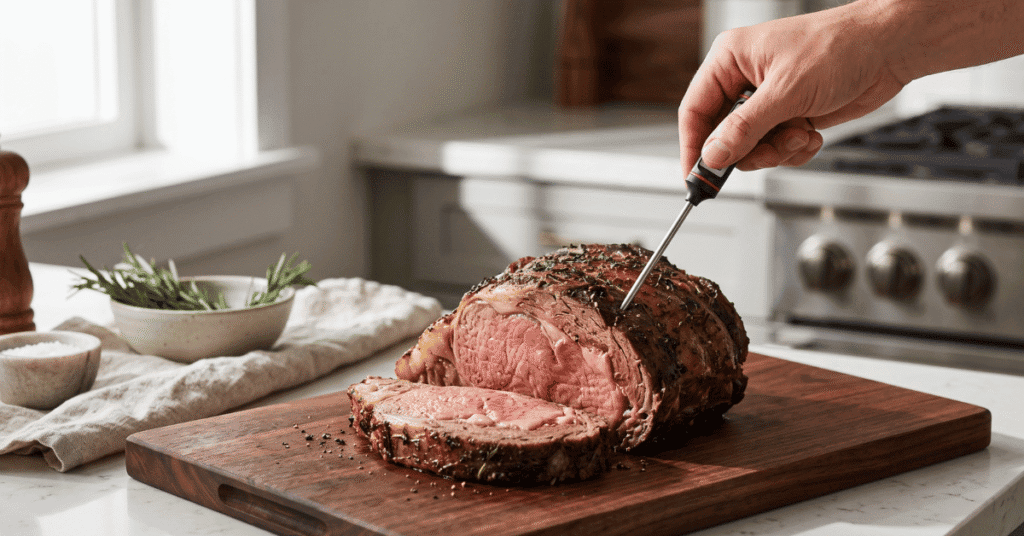
You can speed up your check-ins by changing how you handle the probe. If the metal is already warm from a previous check, it will reach the target temp faster. However, the most important factor is placement.
- Aim for the center: The “cold spot” of any meat is the very middle of the thickest part.
- Avoid the “bone jump”: Touching a bone will give you a false, high reading because bone conducts heat faster than muscle.
- Keep it clean: Carbon buildup or dried juices on the probe can insulate the sensor, making it take longer to “feel” the heat.
- Check the “dimple”: On many dial thermometers, there is a small notch on the stem. The entire area from the tip to that notch must be inside the meat to work correctly.
Factors that change the wait time
Not every piece of meat reacts the same way to a probe. The density and moisture content of what you’re cooking can change how long you have to stand there waiting for a beep or a steady number.
Cold starts and frozen centers
If you are checking a roast that is still slightly frozen in the middle, the thermometer has to fight against a massive temperature delta. The metal probe loses heat to the frozen core while trying to gain it from the cooked outer layers. This “tugging” at the sensor can make the digital display jump around for an extra few seconds.
Thin vs. Thick cuts
For a thick brisket, a 5-second wait is no big deal. But for a thin skirt steak or a scallop, a slow thermometer is a liability. By the time a 20-second dial thermometer registers the heat, the thin protein has moved from medium-rare to well-done.
This is why pros prefer the 2-second thermocouple for high-heat, fast-cooking items.
Common mistakes when timing your reading
Many people get frustrated with their tools because they aren’t using them as intended. Avoiding these blunders will make your “how long should a meat thermometer take to get an accurate reading” worries disappear.
- Pulling too early: If the numbers are still moving, the reading is wrong. Wait for total stillness.
- Checking through the oven door: Every second the oven door is open, the air temp drops. If your thermometer takes 15 seconds, you’ve lost 50 degrees of oven heat.
- Ignoring calibration: If a thermometer is out of whack, it might never “settle” on a number, or it might settle on the wrong one. You can check this by sticking it in a glass of crushed ice and water; it should hit 32°F (0°C) almost immediately.
- Misjudging the depth: If the sensor isn’t deep enough, it’s measuring a mix of meat temp and air temp, which confuses the sensor and slows down the result.
Response times by thermometer type
| Thermometer Type | Average Wait Time | Best Used For |
|---|---|---|
| Thermocouple Digital | 1–3 Seconds | Steaks, fish, thin cuts |
| Thermistor Digital | 3–6 Seconds | General home cooking, chicken |
| Leave-in Probe | Continuous | Large roasts, Thanksgiving turkey |
| Bimetallic Dial | 15–30 Seconds | Large pots of liquid or thick roasts |
Frequently asked questions
Why does my digital thermometer keep climbing?
This usually happens because the heat from the outer layers of the meat is migrating toward the center. It can also mean you’ve pushed the probe too far through and it’s picking up the heat from the pan or the air on the other side.
Is a 10-second thermometer too slow for steak?
For a thick-cut ribeye, 10 seconds is acceptable. However, for a thin steak over a 500-degree flame, 10 seconds is a long time. You risk burning your hand and overcooking the meat.
Do leave-in thermometers provide instant readings?
No, leave-in probes are designed to stay in the meat the whole time. They give a “live” feed, but they are generally slower to react to sudden changes than a handheld instant-read tool.
Can I trust the reading if I only insert the tip?
Only if you have a digital “reduced tip” probe. Most thermocouples measure from the very point. However, dial thermometers often measure an average of the first two inches, so just the tip will give a highly inaccurate, low reading.
Worth remembering
The goal of using a thermometer isn’t just to stay safe, it’s to eat better food. If you find yourself waiting more than 10 seconds for a reading, it might be time to move from an analog dial to a digital thermistor or thermocouple. A fast reading keeps the heat in the grill and the moisture in your meat.
If you use a slower tool, just remember to start checking your temps about 5 to 10 degrees before you think the meat is actually done to account for that lag time.