Nothing ruins a morning cup faster than pulling a sour, watery shot because your coffee grinder won't crush the beans fine enough. The fix usually comes down to cleaning oily burrs, adjusting the calibration dial, or replacing worn metal parts. Blade grinders simply lack the power to reach true espresso fineness, so burr wear or built-up residue is almost always the real culprit.
Why Your Beans Stay Too Coarse
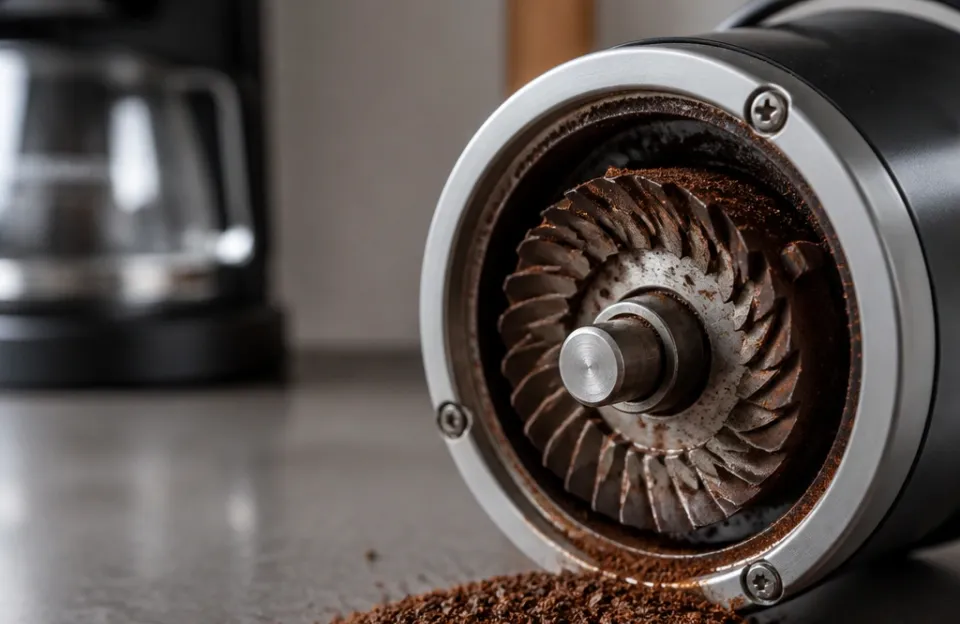
Coffee grinders fail to produce fine grounds for three main reasons. First, old coffee oils coat the burrs. This sticky layer acts like a cushion.
It stops the metal teeth from pinching the beans tight enough. Second, the burrs themselves get dull over time. Sharp edges turn into flat spots after grinding hundreds of pounds of beans.
Third, the factory zero point drifts out of place. The dials shift slightly during shipping or heavy daily use.
Blade models chop beans with a spinning propeller. They rely on how long you hold the button. Even if you run them for a full minute, they leave large chunks mixed with dust.
You cannot force a blade model to give you uniform fine grounds. Burr models crush beans between two textured plates. They offer actual control over the gap size.
If your burr model leaves grounds too chunky, something inside needs attention.
Dark roast beans also cause problems. They release far more oil than light roasts. That extra grease clogs the exit chute quickly.
A blocked chute traps coarse grounds and forces them back through the burrs unevenly. Switching to a lighter roast often reveals whether the machine is truly broken or just choked up. Keeping your countertop appliances clean applies everywhere in the kitchen, much like routine upkeep prevents long-term buildup on other daily machines.
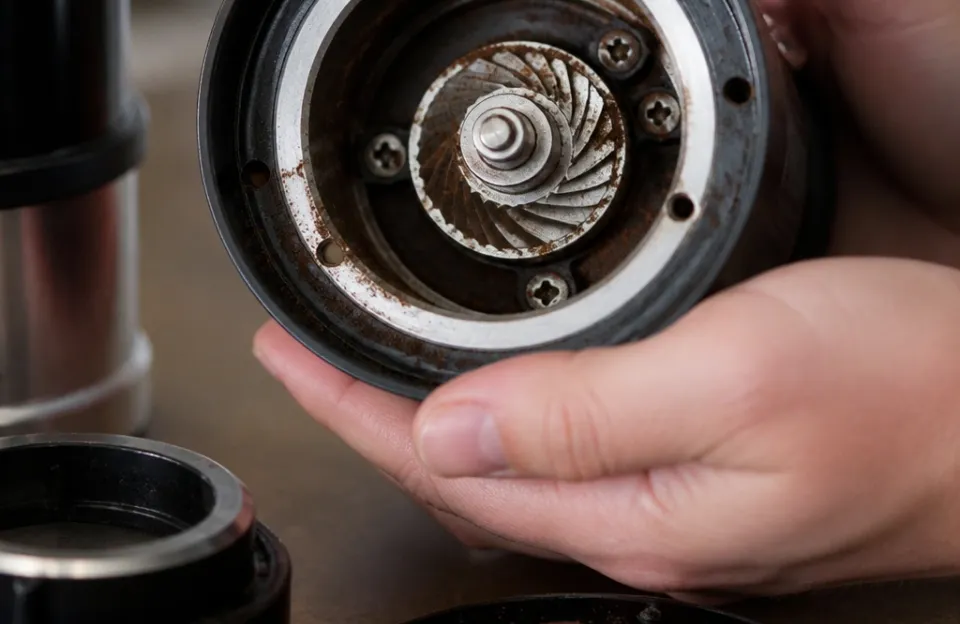
Oily Burrs Block Fine Grounds
Coffee beans contain natural fats. Dark roasts push those fats to the surface. When you grind oily beans, the fat smears across the steel or ceramic burrs.
Over a few weeks, this smear hardens. It fills in the tiny grooves meant to catch and crush the beans.
A smooth burr slides past the bean instead of biting it. The bean slips through the gap without breaking down fully. You end up with boulders in your portafilter.
Wiping the outside of the hopper does nothing for this problem. You have to take the top burr out completely.
Unplug the machine first. Never skip this step. Lift the hopper off.
Twist the upper burr carrier counter-clockwise until it pops free. Look at the teeth underneath. If they look shiny and wet, oil is your main issue.
Use a stiff nylon brush to scrub the teeth. Dry paper towels work well to wipe away the loosened grease. Avoid water on steel burrs, as moisture causes instant rust.
Ceramic burrs handle a quick rinse better, but must dry totally before going back in.
Run a handful of raw white rice through the unit after brushing. The rice starch absorbs leftover oil deep in the chute. Throw that rice powder away immediately.
Do not brew with it. Doing this once a month keeps the gap clear. Clear gaps mean tighter crushing.
Tighter crushing means finer grounds.
Dull Teeth Cannot Crush Small Enough
Burrs are consumable parts. They do not last forever. Steel burrs typically handle about 500 to 1,000 pounds of coffee before losing their bite.
Ceramic burrs last a bit longer, but they chip easily if a small rock hides in your bean bag.
Dull burrs tear the bean instead of snapping it. Tearing creates wildly uneven sizes. You will see large flakes mixed with fine dust.
No matter how tight you turn the dial, the biggest flakes stay too big for espresso. Pressurized baskets might hide this flaw, but standard baskets will pour way too fast. Knowing which brewing setup you own dictates exactly how sharp your burrs need to be.
Check the manufacturer's spec sheet for your specific model's lifespan. Some brands sell replacement sets for under thirty dollars. Swapping them takes ten minutes with a screwdriver.
Pull the old set out, drop the new one in, and recalibrate. You will hear a sharper crunch immediately. The motor will sound less strained too.
Fresh teeth pull less current because they slice cleanly rather than mashing stubbornly.
If your model uses flat burrs, both discs must be replaced together. Mixing an old bottom disc with a new top disc ruins alignment. Conical burrs usually come as a matched pair as well.
Buy the exact part number listed in your manual. Off-brand replacements rarely fit the threading correctly.
The Zero Point Shifted Out Of Place
Every burr grinder has a "zero point." This is the exact spot where the top and bottom burrs physically touch. Manufacturers set this at the factory. But vibrations from daily grinding can shift the adjustment ring over time.
When the zero point moves outward, the lowest setting on your dial is no longer the true lowest setting. You turn the knob all the way down, but the burrs still sit too far apart. The grounds come out looking like sand instead of powdered sugar.
Fixing this requires manual recalibration. Remove the hopper and the top burr. Look for the threaded collar holding the burr carrier.
Turn that collar clockwise by hand until the burrs gently touch. You will feel slight resistance. Stop turning right there.
Do not force them tight against each other, or the motor will stall later.
Once they touch, back the collar off by one or two clicks. That tiny gap is your new true zero. Put the top burr back.
Reattach the hopper. Now test the grind. Your finest setting should finally produce espresso-ready powder.
Many home baristas never realize their dial numbers mean nothing until they reset this physical baseline.
Blade Grinders Hit A Hard Limit
Some folks try to get fine espresso grounds from a cheap blade unit. These machines cost under twenty dollars. They use a single spinning metal blade at the bottom of a plastic cup.
Physics works against you here. The blade only hits beans near the center. Beans stuck at the top bounce around untouched.
To get everything fine, you have to run the motor for a long time. But running it that long generates massive friction heat. Heat cooks the coffee oils before water ever touches them.
The result tastes burnt and bitter, even if the particles look small.
Pulsing the button helps slightly. Shake the whole unit between short bursts. This moves the big chunks down toward the blade.
Still, you will never achieve the uniform texture needed for a proper espresso puck. Water finds the path of least resistance. In a bed of mixed boulders and dust, water rushes past the big pieces and stalls in the dust.
You get sour and bitter flavors in the same sip.
If you want true fine grounds, you need a burr mechanism. There is no workaround for a blade model. Save it for grinding spices or chopping nuts.
Leave coffee to tools built specifically for the job.
Static Clump Tricks The Eye
Sometimes your grinder actually produces fine grounds, but static electricity glues them together. Coffee dust carries a strong electrical charge after passing through fast-spinning burrs. These charged particles stick to the plastic chute walls.
They also clump into little balls in your dosing cup.
You tap the cup, and these clumps roll around like pebbles. You assume the grind is too coarse. In reality, the individual particles are tiny.
They are just glued together by static. Humid kitchens suffer less from this. Dry winter air makes it much worse.
The Ross Droplet Technique fixes this instantly. Take a wooden chopstick or spoon handle. Dip the very tip in plain water.
Stir your whole beans with that damp tip right before grinding. You only need a fraction of a drop. That tiny bit of moisture kills the static charge entirely.
The grounds fall loose and fluffy into your cup. You will clearly see how fine they really are.
Do not pour water directly into the hopper. Too much moisture swells the beans and clogs the burrs permanently. Just one damp stir does the trick.
This simple habit changes how the grounds behave in the portafilter. Loose fine grounds tamp evenly. Clumpy fine grounds leave empty channels.
Motor Speed Alters Particle Size
Grinders spin at different speeds. High-speed models rip through beans fast. Low-speed models chew slowly.
Fast motors create more heat and more static. They also tend to shatter beans into random shapes rather than cutting them neatly.
If your high-speed unit struggles to hit a fine setting without choking, the motor might be bogging down. Listen to the pitch while grinding. A healthy motor hums at a steady tone.
A struggling motor drops in pitch and whines. When it whines, the burrs slow down. Slow burrs crush poorly.
They push half-broken beans through the gap instead of reducing them fully.
Feeding beans slower helps here. Don't dump a full hopper load at once for ultra-fine settings. Let gravity feed them steadily.
Some units include a reducer insert for the hopper neck. Use it when dialing down for espresso. Slower feed rates keep the RPMs stable.
Stable RPMs yield consistent particle sizes.
Low-speed models cost more upfront. They use heavier gearboxes to maintain torque at low revolutions. According to standards tracked by groups like the Specialty Coffee Association, consistent particle distribution matters more than almost any other variable for extraction.
Slow motors naturally support that consistency without overheating the grounds.
Checking For Broken Internal Parts
Plastic gears strip out over years of use. If your grinder suddenly stopped grinding fine after making a weird noise, a tooth likely snapped off the drive gear. The burrs still spin, but they wobble.
A wobbling burr creates an uneven gap. One side stays tight while the other opens wide. Beans escape through the wide side uncrushed.
Take the unit apart if you feel comfortable doing so. Look at the plastic drive coupler connecting the motor shaft to the burr carrier. Check for missing teeth or hairline cracks.
Replacement couplers are cheap and widely available online.
Also inspect the adjustment threads. Grease packed into the threads can stop the collar from turning all the way down. Clean the threads with a toothbrush and apply a tiny dab of food-safe grease.
The collar should glide smoothly to its lowest point. Mechanical blockages masquerade as poor grind quality constantly.
Dialing In After The Fix
Once you clean, calibrate, or replace parts, you must re-dial your recipe. Your old settings are now useless. Start coarser than you think you need.
Pull a shot. Time it. If it gushes out in fifteen seconds, tighten the dial one click.
Try again.
Chasing the right flow rate takes patience after major maintenance. Keep your dose weight identical every time. Change only the grind size.
Moving two variables at once hides the real problem. Weigh your dry grounds on a gram scale. Aim for the same output liquid weight too.
Consistency in measurement proves whether your mechanical fix actually worked.
Common Questions About Stubborn Coarse Grounds
Why does my expensive grinder still leave chunks?
Even premium models collect oil. If you haven't brushed the burrs in six months, they are coated. Price does not prevent grease buildup.
Take it apart and scrub the teeth.
Can I wash my burrs in the sink?
Steel burrs rust quickly if washed with water. Only use dry brushes or specialized cleaning tablets. Ceramic burrs tolerate water, but must dry completely for twenty-four hours before reassembly.
Moisture trapped inside ruins the next batch of coffee.
Does freezing beans help them grind finer?
Cold beans shatter more cleanly than warm ones. Freezing reduces the flexibility of the bean structure. They snap into smaller, more uniform pieces.
However, you must grind them straight from the freezer. Letting them thaw creates condensation that clogs the chute instantly.
How often should I replace the burrs?
For daily home use, expect three to five years from steel burrs. Commercial use eats them in months. Watch your shot times.
If you constantly have to adjust finer to maintain a thirty-second pour, the metal is wearing flat.
Will grinding salt sharpen my burrs?
No. Salt is abrasive. Running rock salt through the unit scratches the precision surfaces.
It makes them duller faster. Stick to dry rice or branded cleaning pellets designed specifically for coffee equipment.
My dial turns past the finest mark, what happened?
The stopping tab broke off. Most dials have a physical plastic tab preventing the burrs from touching and destroying the motor. If that tab snaps, you can turn the dial infinitely.
The burrs might be crashing into each other, causing loud squealing. Stop using it immediately and order a replacement adjustment ring.
Is a finer grind always better for espresso?
No. Too fine blocks water entirely. The pump chokes.
You get dripping instead of flowing. You want fine enough to create resistance, but open enough to let hot water pass through in roughly twenty-five to thirty seconds. Finding that middle ground requires working burrs that produce uniform sizes.
Can humidity change my grind size overnight?
Yes. Coffee grounds absorb moisture from humid air. Swollen grounds pack tighter in the basket.
A setting that poured perfectly yesterday might choke today. Adjust one click coarser on damp mornings. This has nothing to do with the grinder failing.
It is just the environment changing the bean density. Paying attention to these environmental shifts is just as important as measuring your space accurately before buying any new kitchen appliance.
Why does my grinder smell burnt when set to fine?
The motor is straining against tightly packed beans. Friction builds extreme heat. This scorches the coffee oils mid-grind.
If it happens constantly, your motor lacks the torque for espresso-level fineness. Consider upgrading to a model with a higher wattage rating or a geared reduction system.
Do cleaning tablets actually work?
Yes. They absorb oils and push out stale grounds. Run them through once a month.
Discard the first two batches of coffee afterward, as the tablet residue tastes terrible. They save you from fully disassembling the unit every single week.
My grounds clump only on the finest setting, is it broken?
Clumping at ultra-fine sizes is normal physics. Tiny particles hold static charges easily. They stick together due to surface tension and electrical attraction.
Use the single drop of water trick mentioned earlier. Break the clumps with a dosing needle before tamping. The grinder is doing its job; static is just interfering with the output.
Should I align my burrs manually?
Factory alignment is usually sufficient for home brewers. Shimming burrs with foil washers is an advanced modification. It guarantees the top and bottom discs sit perfectly parallel.
Parallel discs yield fewer boulders. But misaligned shims cause the burrs to scrape and destroy themselves. Only attempt shimming if you fully understand your model's assembly diagram.