You’re staring at the grill while the flames lick the edges of your expensive digital probe. Or maybe you left your candy thermometer resting against the bottom of a heavy pot. Suddenly, the screen flickers, or the dial jumps to a reading that makes no sense.
You wonder if a tool built specifically to measure heat can actually be killed by it.
Quick Answer: Yes, excessive heat can permanently damage most thermometers. Digital models often fail when their internal electronics or plastic casings melt, while analog dial thermometers can lose calibration if their bimetal coils are overextended. Even high-heat probes have limits, and exceeding them usually results in a dead sensor or “HH” error code.
Why Heat Kills Temperature Tools
It seems like a contradiction, but thermometers have strict thermal limits just like any other electronic or mechanical device. Most kitchen and industrial thermometers are designed to measure the heat of the food or liquid, not necessarily the environment around it. For example, a meat thermometer is meant to stay in a 165°F chicken breast, but the air inside your 500°F grill can easily melt its housing.
Physical parts expand when they get hot. In a digital thermometer, the tiny soldered connections on the circuit board can soften or snap if the unit gets too hot. In manual dial versions, the metal spring that moves the needle can be stretched beyond its “elastic limit.” Once that happens, the metal won’t spring back to its original shape, and your readings will never be accurate again.
Digital Sensor Fatigue
Digital thermometers use a component called a thermistor or a thermocouple in the tip. These sensors are incredibly sensitive. When they hit temperatures above their rated capacity, often around 572°F (300°C) for consumer probes, the insulation around the wires can disintegrate.
This leads to a short circuit. If you see an “Err” or “LO/HI” message that won’t go away, the high heat has likely fried the sensor’s ability to send a steady electrical signal.
The Problem with Plastic and Glue
Many thermometers use plastic screens or glued seals to keep moisture out. Heat is a solvent for these materials. A common way thermometers “die” isn’t through the sensor failing, but through the casing warping.
Once the seal is broken, steam from your cooking gets inside the display. This fogs up the screen or shorts out the battery, effectively ending the tool’s life.
How to Check for Heat Damage
If you suspect your thermometer has been “cooked,” you need to verify its accuracy before you trust it with your next meal. You don’t need a lab to do this. You can use physics to see if the heat caused a calibration shift.
- The Ice Bath Test: Fill a glass with crushed ice and just enough water to fill the gaps. Stir it and let it sit for a minute. Submerge your probe at least two inches deep without touching the sides. It should read exactly 32°F (0°C).
- The Boiling Water Test: Bring a pot of distilled water to a rolling boil. Submerge the probe. At sea level, it should read 212°F (100°C). Note that if you live at a high altitude, water boils at a lower temperature, so check your local elevation.
- Physical Inspection: Look for “bubbling” on the wire insulation or a discolored, browned look on the plastic housing. Look for a “stuck” needle on analog gauges; if it doesn’t return to room temperature when sitting on the counter, the internal coil is likely warped.
Different Thermometers and Their Limits
Not all thermometers handle heat the same way. The context in which you use them determines how likely they are to fail.
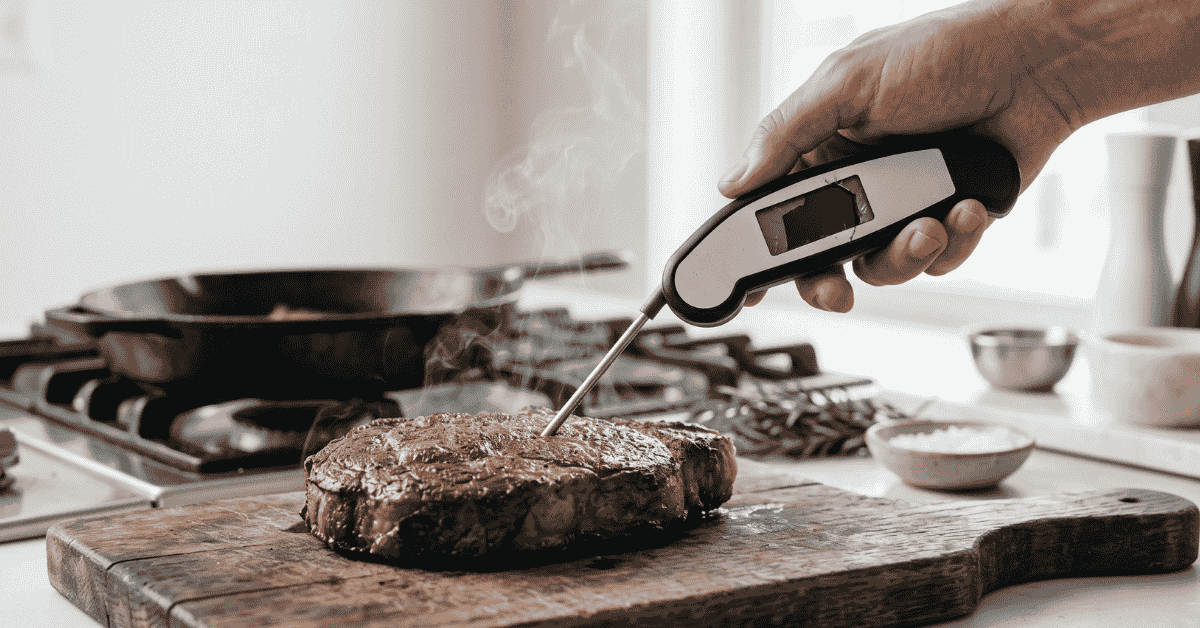
- Instant-Read Digitals: These are the most vulnerable. They are designed for quick “in-and-out” checks. Leaving one of these inside a closed oven or grill for even sixty seconds can melt the plastic face.
- Leave-In Probes: These have metal-braid cables designed to withstand oven temperatures. However, the “transitional” point, where the wire meets the metal probe, is a weak spot. If that junction is exposed to direct flame or temperatures above 600°F, the internal fiberglass insulation fails.
- Infrared (IR) Guns: These never touch the heat, but their internal sensors are very sensitive to ambient temperature. If you leave an IR gun sitting on a hot grill side-shelf, the internal components will drift, causing the laser to give false readings until the unit cools down.
- Glass/Candy Thermometers: These are built for high heat, but they suffer from “thermal shock.” If you take a hot glass thermometer and rinse it under cold water, the glass can shatter instantly.
Edge Cases and Exceptions
There are a few scenarios where heat “damage” is actually temporary. For instance, some industrial thermocouples can be “re-calibrated” after a high-heat event. However, for 99% of home cooks and hobbyists, a damaged thermometer is a safety hazard.
If an analog thermometer is knocked out of sync, many have a nut on the back that allows you to manually reset the dial. Digital versions rarely offer this. Once the chip is cooked, it’s done.
Another edge case involves “sooting.” Sometimes a probe isn’t broken, but carbon buildup from a smoky grill has insulated the tip. Giving it a thorough scrub with a green scouring pad might bring your fast response times back.
Common Mistakes to Avoid
- Closed Lid Cooking: Leaving an instant-read thermometer in the meat while you close the grill lid. The ambient heat trapped inside will melt the unit in minutes.
- Flare-up Exposure: Positioning a leave-in probe wire directly over a grease flare-up. Fire is significantly hotter than the air in the grill; temperatures in a flame can exceed 2,000°F, which melts stainless steel braids instantly.
- Dishwasher Heat: Using the “high-temp scrub” or “heated dry” cycle on a thermometer that isn’t waterproof. The heat expands the air inside, pushes out the seals, and lets water in.
- Touching the Pan: Testing the temperature of oil or sugar while letting the probe tip touch the bottom of the metal pan. The pan bottom is much hotter than the liquid and can flash-fry the sensor.
Frequency Asked Questions
Can I fix a thermometer that got too hot?
Typically, no. If it’s a digital unit with a warped screen or a fried sensor, the cost of repair exceeds the cost of a new one. If it’s an analog dial, you can try the “adjustment nut” on the back using an ice bath, but the metal coil may never be as responsive or linear as it was when new.
Why does my thermometer say “HH” after I used it on the grill?
“HH” or “HI” usually means the temperature has exceeded the maximum range the device can calculate. If this message stays on the screen after the probe has cooled down, it means the high heat has created a permanent short circuit in the sensor.
How hot is too hot for a meat thermometer?
Most digital meat thermometers are rated for internal food temperatures up to 212°F, but their probes can often handle up to 572°F. However, the plastic body of the thermometer usually can’t handle anything over 120°F (basically, if it’s too hot for your hand to hold, it’s too hot for the plastic body).
Does heat damage the battery?
Yes. If the battery compartment gets hot, the battery can leak acid or swell. This can ruin the metal contacts inside the device.
If you accidentally overheated your thermometer, always pop the battery door to check for leaks or deformation.
Worth Remembering
A thermometer is a precision instrument, not a piece of cookware. Treat it like a piece of electronics rather than a spatula. To keep yours accurate, keep the digital display away from direct steam and never leave a probe wire draped over a direct flame.
According to NIST (National Institute of Standards and Technology), even small deviations in temperature measurement can lead to safety issues in food handling, so if your thermometer fails the ice bath test after a heat event, it is time to replace it.