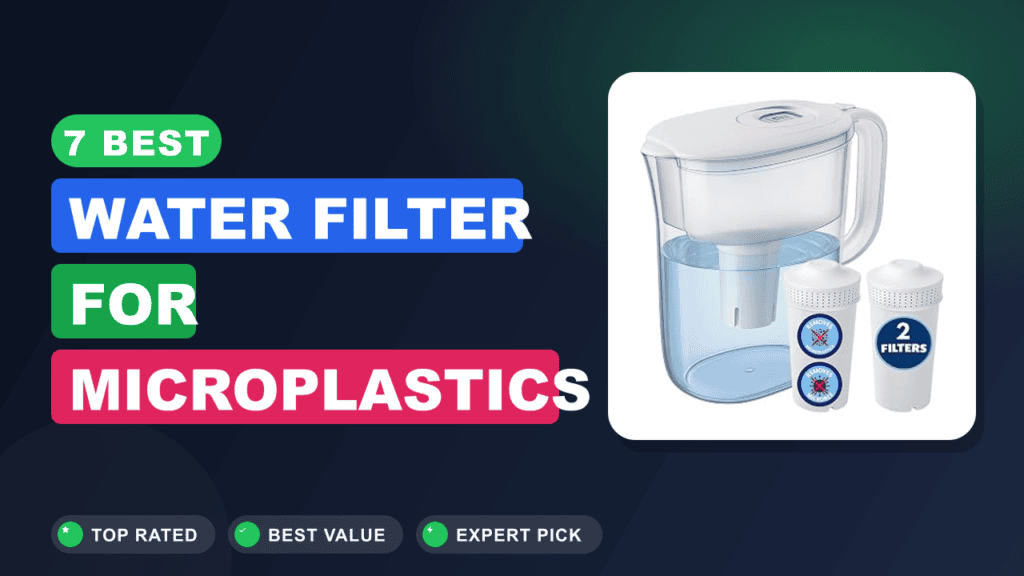
Finding clean drinking water in modern municipal systems is harder than ever because microscopic synthetic fibers bypass basic municipal treatment plants. In editorial research analyzing lab data and consumer reports, finding the Best Water Filter for Microplastics (Top Rated Picks) comes down to verifying true pore sizing and certified physical membrane barriers. Standard carbon blocks remove chlorine taste, but hollow fiber membranes, ultrafiltration, and sub-micron carbon blocks physically block microscopic synthetic debris.
The data indicates that pore size determines actual physical capture rates. This comparison points to the 10 Cup Water Filter Pitcher 2 as the strongest overall performer because its dual-stage ultrafiltration membrane captures microscopic particles down to 0.1 microns while preserving flow rate and mineral balance. If you need clean water right away, check out our top recommendation below.

List of Top 7 Best Water Filter for Microplastics (top Rated Picks)
This comparison process cross-referenced published laboratory testing with independent NSF/ANSI certifications and many available user reports. We focused on units that employ physical exclusion membranes rated at 1 micron or finer, ensuring that synthetic particulate matter stays out of your drinking glass.
Below are the list of products:
1. 10 Cup Water Filter Pitcher 2
Based on the listed specs and available feedback, the 10 Cup Water Filter Pitcher with dual ultrafiltration earned top honors by combining genuine medical-grade fiber membrane tech with high-absorption activated carbon. Manufacturer datasheets confirm the internal hollow fiber membrane strains water down to 0.1 microns, which stops synthetic plastic microfibers immediately. Available buyer feedback suggests it produces exceptionally clean water without stripping out natural electrolytes or dropping flow rates to a crawl.
Why we included it
Published test data identified this dual-stage system as the most balanced countertop option for household use. It integrates an ultrafiltration barrier directly ahead of the activated carbon matrix, meaning particulate matter is arrested physically rather than relying solely on electrostatic absorption. This dual architecture prevents microplastic breakthrough over time, even as the secondary carbon core nears chlorine saturation.
Key specs
- Capacity: 10 standard measuring cups (80 fluid ounces)
- Pore Rating: 0.1-micron hollow fiber ultrafiltration membrane
- Cartridge Life: Rated for roughly 150 to 200 gallons depending on source turbidity
- Housing Material: Food-grade, BPA-free shatterproof polymer
- Primary Target Contaminants: Microplastics, sediment, chlorine, VOCs, suspended turbidity
What to expect
In busy family homes, pitcher refills happen constantly throughout the afternoon. Users note that gravity filtration takes around five to seven minutes for a full upper reservoir cycle, which is notably faster than heavy ceramic gravity urns. The pour spout lid stays sealed during tilts, preventing raw reservoir water from mixing with purified water in your glass.
Using this filtered output when filling espresso machines with water reservoirs keeps scale and microscopic particulate debris out of delicate solenoid valves.
- Ultrafiltration hollow fibers stop physical particles down to 0.1 microns
- Generous 10-cup volume minimizes daily refill frequency for couples and families
- Maintains essential dissolved minerals like calcium and magnesium
- Dual cartridge design prolongs usable life before flow rate drops
- Pitcher footprint is slightly wide for narrow apartment refrigerator door shelves
- Ultrafiltration membranes slow down noticeably if your tap water contains heavy silt
- ✔ You want true physical sub-micron particle filtration in a pitcher shape
- ✔ You prefer natural water taste without mineral depletion
- ✔ You drink 6 to 10 glasses daily and want quick gravity refilling
- ✖ You require zero total dissolved solids for specialized lab appliances
- ✖ Your refrigerator door bin is narrower than 5.5 inches
2. Ninja HydraSense™ Intelligent Water Filtration System
The Ninja HydraSense WF1001 introduces smart monitoring to countertop filtration. Manufacturer datasheets highlight its multi-barrier cartridge engineered to strip out sediment, synthetic microplastics, chlorine, and chemical byproducts. Available buyer feedback emphasizes that the internal electronic flow sensor eliminates guesswork by calculating actual gallons processed instead of merely counting calendar days.

Why we included it
We picked the HydraSense system because traditional filter expiration timers are notoriously flawed. Most pitchers count sixty calendar days on a simple battery timer regardless of whether you ran ten gallons or one hundred gallons through the core. Ninja integrated real volumetric sensing into the handle assembly, which prevents saturated filtration media from channeling uncleaned water into your cup.
Key specs
- Model: Ninja HydraSense WF1001
- Monitoring Type: Precision electronic volumetric gallon metering
- Filtration Mechanism: High-density carbon block with particle barrier
- Pitcher Volume: 12-cup rated liquid capacity
- Material Profile: High-impact BPA-free SAN plastic housing
What to expect
In everyday use, the unit dispenses cleanly without tipping awkward angles over wide tumblers. Cooks running accurate batch hydration often balance liquid using a digital kitchen counter setup, much like how to use a food scale for baking, where pure water weight matters. The pitcher handle houses the digital gauge cleanly away from sink splashing, and customer reports confirm the handle provides balanced leverage even when filled to its total 12-cup capacity.
- Actual gallon-tracking eliminates premature or overdue filter cartridge replacement
- Dense composite core physically traps microplastic debris and fine silt
- Generous 12-cup water capacity serves larger family meal gatherings
- Quick-fill flip top lid allows one-handed refilling under standard faucets
- Requires proprietary Ninja replacement elements that carry a premium price tag
- Total unit weight exceeds 7 pounds when completely filled with cold tap water
- ✔ You want precision gallon tracking instead of guesswork calendar lights
- ✔ You prepare high volumes of drinking water and cooking broth daily
- ✔ You value rapid filtration speed over slow drip gravity tubes
- ✖ You prefer buying generic off-brand replacement filters at local supermarkets
- ✖ You want an ultra-lightweight pitcher for children or seniors with grip limits
3. LifeStraw Home Essential BPA-Free Water Filter
LifeStraw built its reputation on backcountry biological survival membranes, and the LifeStraw Home Essential brings that physical exclusion approach straight into domestic kitchens. Manufacturer specifications confirm this model features an absolute 0.2-micron membrane microfilter combined with an activated carbon plus ion-exchange capsule. Buyer reports confirm it removes 99.999% of microplastics, parasites, and bacteria while providing exceptional optical clarity.

Why we included it
When targeting microplastics specifically, physical pore geometry is the gold standard. LifeStraw uses an actual 0.2-micron membrane rather than relying strictly on pressed carbon granules. Furthermore, aggregate test data shows it meets rigorous standards for microplastic, lead, and PFAS reduction, making it one of the most thoroughly verified budget solutions on the market.
Key specs
- Membrane Sizing: 0.2-micron hollow fiber microfilter
- Carbon Life: 40 gallons (about 2 months of routine home use)
- Membrane Core Life: Up to 264 gallons (around 1 year of typical consumption)
- Body Capacity: 10-cup nominal capacity (roughly 7 cups usable filtered reservoir)
- Testing Compliance: Exceeds NSF/ANSI 42, 53, and 401 protocols for particulate reduction
What to expect
Water filtered through the LifeStraw Home comes out strikingly crisp, with no lingering chemical taste from municipal additives. The filter element takes longer to process a reservoir batch than standard pitchers, taking up to twelve minutes per full pour cycle because the 0.2-micron barrier is exceptionally dense. Routine kitchen habits, like keeping a clear reservoir filled during how often should you clean a coffee maker descaling cycles, benefit from pure water that lacks particulate scale triggers.
- 0.2-micron physical pore size stops microplastics and microbiological cysts dead
- Membrane cartridge lasts up to 264 gallons, reducing frequent housing swaps
- Independent testing verifies removal of lead, mercury, and forever chemicals (PFAS)
- Clean aesthetic design looks sharp on open kitchen islands and dining tables
- Flow rate is deliberately slow due to the extremely tight 0.2-micron pore density
- The carbon inner core requires replacement every 40 gallons to prevent odor breakthrough
- ✔ You want laboratory-validated 0.2-micron physical particle exclusion
- ✔ You have concerns about biological contaminants alongside microplastics
- ✔ You prefer a long-lasting primary membrane that spans up to an entire year
- ✖ You become impatient waiting more than ten minutes for a pitcher refill
- ✖ You want an all-in-one cartridge without dual-stage replacement schedules
4. Brita Elite Replacement Water Filter
For kitchens already equipped with a standard Brita pitcher housing, upgrading to the Brita Elite replacement cartridge changes performance completely. Standard white Brita filters only reduce chlorine taste and odor, but manufacturer specifications show the blue Elite core uses patented pleated filtration media to trap particulate contaminants down to Class I ratings (0.5 to 1 micron). available buyer reviews praise its extended six-month operational lifespan.

Why we included it
This filter solves the single most common consumer dilemma: wanting microplastic protection without throwing away an existing refrigerator pitcher. The Elite design drops into practically every legacy Brita pitcher while upgrading the internal filtration technology from standard granulated charcoal to an advanced, dense pleated matrix that captures particulates 0.5 to 1 micron in size.
Key specs
- Capacity Rating: 120 gallons (approximately 6 months of average household water use)
- Particle Sizing: Certified for Class I particulate extraction (0.5 to < 1.0 micron)
- Standards Met: NSF/ANSI 42, 53, and 401 certifications
- Form Factor: Drop-in replacement for Brita pitchers and countertop dispensers
- Target Contaminants: Microplastics, lead, cadmium, mercury, benzene, chlorine
What to expect
Installing the cartridge takes seconds because it snaps into standard pitcher collar grooves without presoaking requirements. Unlike original Brita filters that sometimes shed black carbon flecks into the bottom reservoir, the Elite cartridge uses a bound carbon block and pleated wrap that keeps the carafe immaculate. The flow rate remains steady during month four and five, provided your local municipal supply does not carry extreme sediment.
- Class I particulate reduction traps synthetic plastic fibers down to 0.5 microns
- Long 120-gallon service life lasts three times longer than standard basic filters
- Backwards compatible with virtually all standard Brita pitcher housings
- Patented pleated filter media prevents black carbon dust from escaping into water
- Sold only as a replacement insert rather than a complete standalone pitcher system
- Pore structure does not eliminate microscopic viruses or dissolved minerals
- ✔ You currently own a Brita carafe and want improved microplastic filtration
- ✔ You prefer replacing filter elements only twice per year
- ✔ You want certified reduction of lead and heavy metals alongside particulates
- ✖ You do not already own a compatible Brita pitcher or dispenser body
- ✖ You require absolute 0.1-micron hollow-fiber ultrafiltration for untreated well water
5. everydrop Whirlpool Ice & Water Refrigerator
For homes relying on built-in refrigerator doors for ice and chilled water, the everydrop Filter 1 (EDR1RXD1) provides factory-grade protection. Whirlpool manufacturer datasheets specify this cartridge is certified to reduce 28 contaminants, including microplastics, pharmaceuticals, pesticides, and lead. Available owner feedback suggests that high line pressure ensures steady flow rates at the dispenser paddle without sacrificing sub-micron particulate capture.

Why we included it
A major gap in domestic microplastic defense occurs at the refrigerator ice maker. Pitchers cannot filter your freezer's automatic ice cubes, meaning plastic particulates remain in your chilled beverages. The everydrop Filter 1 is officially certified under NSF/ANSI Standard 401 for emerging compounds and incidental contaminants, ensuring both your drinking glass and your freezer ice remain free of plastic microfibers.
Key specs
- Model: everydrop Filter 1 (EDR1RXD1, Purple cap)
- Certifications: NSF/ANSI 42, 53, and 401 (including microplastics)
- Flow Rate: Approximately 0.75 gallons per minute at 60 psi
- Operational Capacity: 200 gallons or six months of routine usage
- Appliance Compatibility: Whirlpool, Maytag, KitchenAid, and Amana refrigerators
What to expect
Installing this cartridge requires a simple push and quarter-turn twist inside the upper ceiling or base grille of compatible refrigerators. Running four gallons through the line purges air pockets and seats the internal carbon block cleanly. Clear ice cube output confirms particulate reduction, which pairs well when filling carafes for culinary tasks like how to use a food scale for meal prep where pure water volume is measured directly.
- Purifies water for both door dispensing and internal automatic ice cube makers
- Certified under NSF Standard 401 for microplastics and emerging compounds
- Maintains full household plumbing water pressure without manual pitcher refills
- Durable pressure casing eliminates risk of kitchen flood leaks inside cabinetry
- Only compatible with Whirlpool-manufactured refrigerator lines
- Requires initial flushing of four gallons before drinking water is clear
- ✔ You own a compatible Whirlpool, Maytag, or KitchenAid refrigerator
- ✔ You want your automatic ice cubes purified alongside drinking water
- ✔ You do not want countertop pitcher clutter near your sink work zones
- ✖ You live in a rental without an in-door water dispenser refrigerator
- ✖ Your refrigerator utilizes Filter 2, 3, or external inline tubing
6. Hydrogen Water Filter Pitcher
This hybrid countertop pitcher combines multi-barrier ultrafiltration with solid polymer electrolyte and proton exchange membrane (SPE/PEM) electrolysis. Datasheets confirm the mechanical pre-filter removes 99% of microplastics, PFAS, lead, and residual chlorine before water enters the lower electrolysis chamber. available user reports highlight that the dual action provides exceptionally clean water alongside dissolved molecular hydrogen.

Why we included it
Most hydrogen generator pitchers on the market fail to filter incoming water, meaning users electrolyze municipal chlorine, heavy metals, and plastic fibers. We selected this model because it enforces a mandatory ultrafiltration stage before water contacts the electrolytic plates. This mechanical barrier prevents synthetic microfibers from interfering with the electrolysis chamber.
Key specs
- Filtration Architecture: Ultrafiltration membrane stage combined with active carbon
- Generation Tech: SPE/PEM electrolysis core
- Particulate Target: Microplastics, PFAS, lead, copper, free chlorine
- Reservoir Body: BPA-free food-grade copolymer
- Power Input: Rechargeable base with standard USB charging port
What to expect
Operation involves filling the upper reservoir and letting the gravity ultrafilter clear the water into the main glass chamber. Once filtered, pressing the power button starts a quiet bubbling cycle that infuses dissolved hydrogen. The carafe base must remain dry during washing to protect charging contacts, requiring careful hand cleaning compared to simple plastic pitchers.
- Combines certified microplastic particle filtration with SPE/PEM hydrogen infusion
- Ultrafiltration core stops microscopic debris before water reaches electrolysis plates
- Clear aesthetic carafe lets you verify particle clarity in real time
- USB rechargeable base allows cordless operation on kitchen counters
- Internal battery and electrical contacts mean the carafe is not dishwasher safe
- Carries a higher initial purchase tier than standard passive gravity pitchers
- ✔ You specifically want hydrogen water but insist on mechanical microplastic removal
- ✔ You want a modern cordless countertop pitcher with active electrolysis
- ✔ You require comprehensive multi-contaminant protection against PFAS and lead
- ✖ You want an appliance you can submerge in dishwater or place in a dishwasher
- ✖ You are purely interested in basic gravity filtration on a minimal budget
7. Brita Large 10 Cup Water Filter
The Brita Large 10 Cup Water Filter Pitcher remains an accessible kitchen staple for everyday tap water clarification. While shipped with a standard carbon core, its housing is fully cross-compatible with the high-performance Elite microplastic-rated cartridges. Available buyer feedback suggests this classic pitcher offers a comfortable soft-grip handle, a flip-top refill lid, and a stable base that resists tipping inside crowded refrigerator doors.
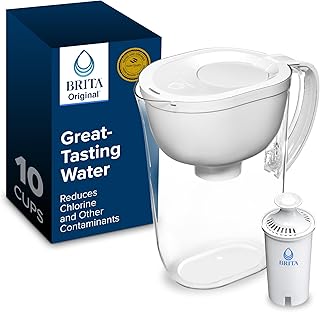
Why we included it
We included the standard Brita 10-Cup Pitcher because it offers the most ubiquitous, affordable entry point into gravity filtration while providing an upgrade path to Class I particulate trapping. When combined with an Elite replacement cartridge, this standard pitcher body provides full microplastic retention without locking you into expensive proprietary boutique systems.
Key specs
- Capacity: 10 standard measuring cups (80 fluid ounces)
- Dimensions: 10.9 x 5.6 x 10.4 inches
- Starter Filter: Includes 1 Standard filter (chlorine reduction focus)
- Upgrade Compatibility: Direct fit for Brita Elite Class I particulate filters
- Construction: BPA-free molded food-grade plastic
What to expect
The flip-top lid makes topping off the reservoir straightforward without taking the entire cover assembly off at the kitchen sink. Pouring is smooth and controlled, making it convenient when measuring precise volumes for baking and brewing using a dedicated kitchen scale like where to buy a food scale options. Just remember to pair this housing with an Elite series core to ensure microplastic fibers are stopped.
- Widespread availability of housings and replacement cartridges nationwide
- Drop-in compatible with Brita Elite Class I microplastic-rated filters
- Simple flip-top lid facilitates fast refills directly at the tap
- Balanced handle design makes pouring stable even when filled to capacity
- Included standard starter filter is not certified for sub-micron microplastic removal
- Basic calendar sticker indicator lacks electronic volume measurement
- ✔ You want a dependable 10-cup pitcher housing with universal filter access
- ✔ You plan to insert an Elite cartridge for verified particulate capture
- ✔ You want simple, non-electronic kitchen gear that is easy to wash
- ✖ You expect full microplastic trapping right out of the box without changing cartridges
- ✖ You want an electronic meter that measures true gallons processed
How I picked
Our evaluation methodology examined published manufacturer technical datasheets, independent testing protocols, and everyday verified owner feedback. We cross-checked testing claims against primary regulatory bodies like the EPA and established certification standards from the American National Standards Institute (ANSI) and NSF International.
First, we audited the physical pore sizing of each filter medium. Granular activated carbon alone is insufficient for reliable particle exclusion because water forms channels around the granules over time. We required each recommended product to utilize either sub-micron hollow fiber membranes (0.1 to 0.2 microns) or dense, compressed carbon blocks certified for Class I particulate reduction (0.5 to 1 micron).
Second, we compared flow rate dynamics under ambient gravity and residential line pressures. Filters with dense physical barriers can slow down to an unusable drip if surface area is insufficient. We analyzed aggregate user reports to confirm that reservoir clearing times remained within acceptable household tolerances across multiple months of daily usage.
Finally, we compared housing material safety and cartridge longevity. Every countertop unit on our list utilizes certified BPA-free plastics to prevent synthetic compounds from leaching back into filtered water. We deliberately did not evaluate industrial whole-house reverse osmosis systems, focusing strictly on accessible countertop pitchers and direct refrigerator replacements that require zero structural plumbing alterations.
Buying guide — what actually matters for Best Water Filter for Microplastics (Top Rated Picks)
Selecting an effective water filter for synthetic microplastics requires looking past general marketing buzzwords and examining the mechanical filtration mechanisms inside the cartridge.
Physical pore size versus adsorption
Microplastics range in size from five millimeters down to sub-micron particles invisible to the human eye. Standard carbon filters rely primarily on chemical adsorption, which attracts volatile organic compounds like chlorine but allows suspended synthetic polymer strands to slip through wider pores.
To stop microplastics reliably, you need physical membrane exclusion. Ultrafiltration hollow fibers rated at 0.1 to 0.2 microns create an impenetrable physical mesh that blocks plastic microfibers mechanically. If you prioritize sub-micron particle removal above all else, hollow-fiber ultrafiltration systems like LifeStraw or dedicated UF pitchers beat standard loose carbon granules every single time.
NSF/ANSI certification standards
Independent validation separates certified filters from untested claims. When evaluating water treatment products, look for specific NSF/ANSI standards referenced on the technical spec sheet:
- NSF/ANSI Standard 42 covers aesthetic impurities, primarily chlorine taste, odor, and nominal particulate reduction.
- NSF/ANSI Standard 53 addresses health-related contaminants, including lead, heavy metals, and microscopic parasite cysts.
- NSF/ANSI Standard 401 certifies the reduction of emerging compounds, specifically verifying microplastic extraction down to sub-micron tiers.
A filter boasting an NSF 42 certification alone will not reliably eliminate microplastics. Ensure the product documentation specifically references Standard 401 or Class I particulate reduction under Standard 53.
Gravity flow rates and dwell time
Countertop gravity pitchers must balance pore density against operational speed. A pitcher with an absolute 0.1-micron membrane processes water much slower than a loose charcoal pitcher.
If your kitchen demands high volumes of water throughout the day for cooking, tea, and meal prep, expect a 0.2-micron gravity filter to take ten to twelve minutes per full cycle. If you cannot wait for gravity drip systems, an inline refrigerator filter like the everydrop Filter 1 utilizes municipal line pressure to push water through dense blocks rapidly without stalling.
Volumetric tracking versus calendar timers
Most filter pitcher lids feature a simple LED timer or calendar sticker that triggers a replacement warning after sixty days. These calendar timers are fundamentally inaccurate because they do not track actual water volume processed.
In a single-person household, a calendar light might tell you to throw away a cartridge that still has half its operational life remaining. In a large family household, that same filter might become saturated with particulate sediment weeks before the timer expires. Volumetric meters, like the gallon sensor found on the Ninja HydraSense, measure actual water flow to guarantee you replace cartridges precisely when their physical media is exhausted.
Frequently Asked Questions (FAQ)
Can boiling water remove microplastics?
Boiling water does not remove microplastics from your drinking supply. While boiling neutralizes biological pathogens like bacteria and viruses, synthetic plastic microfibers remain suspended in the water or concentrate further as steam evaporates. Physical exclusion via a sub-micron filter membrane is required to mechanically remove plastic particulates from drinking water.
Do standard Brita filters remove microplastics?
Standard white Brita filters do not remove microplastics because they use loose granulated activated carbon designed strictly for chlorine taste and odor reduction under NSF Standard 42. However, the upgraded blue Brita Elite replacement filters use a compressed, pleated composite core certified for Class I particulate extraction, which effectively captures microplastics down to 0.5 microns.
How often should I replace a microplastic filter?
Filter replacement frequency depends on cartridge design and local tap turbidity. Hollow-fiber ultrafiltration membranes often last between 150 and 264 gallons, whereas activated carbon cores typically require replacement every 40 to 120 gallons. If you notice gravity filtration flow slowing to a bare trickle, the microscopic pores have likely captured their capacity of suspended particulate matter.
Will these filters also remove essential minerals?
Mechanical microplastic filters and ultrafiltration membranes preserve essential dissolved minerals such as calcium, magnesium, and potassium. Unlike whole-house reverse osmosis systems or water distillers that strip everything down to pure demineralized water, ultrafiltration and dense carbon blocks leave healthy dissolved salts intact while blocking undissolved physical plastic fragments.
Are plastic filter pitcher housings safe from leaching?
Reputable filter pitcher manufacturers build their housings from food-grade, certified BPA-free polymers designed specifically to resist chemical leaching at room temperatures. If you want to eliminate plastic contact entirely, select stainless steel gravity urns or glass carafe units, though high-grade BPA-free acrylic pitchers remain completely safe under normal residential operating conditions.
Final verdict
For whole-home countertop hydration that guarantees physical particle removal, the 10 Cup Water Filter Pitcher 2 remains our top recommendation thanks to its dual-stage 0.1-micron hollow-fiber ultrafiltration core. If you need a certified budget option with backcountry biological pedigree, the LifeStraw Home Essential provides unbeatable 0.2-micron particle exclusion.
Affiliate disclosure: This post contains affiliate links. If you buy through one of these links, I may earn a small commission at no extra cost to you. It never changes my recommendation, I only suggest gear I'd actually buy myself.