An air fryer grill pan is a ridged accessory that fits inside your air fryer basket to create char marks and drain excess fat away from food. It mimics outdoor grilling by elevating meat above pooled grease while allowing hot air to circulate underneath for even cooking. Not every air fryer needs one, and not every grill pan fits every machine, so checking compatibility and material safety matters more than brand loyalty.
This guide covers how to choose the right air fryer grill pan based on size, material, ridge depth and cleaning requirements. It focuses on practical differences between cast iron, stainless steel, nonstick and silicone options so you can match a pan to what you actually cook.
Air Fryer Grill Pans: What They Do and When They Are Worth It
Air fryers are essentially countertop convection ovens that cook food faster and use less energy than larger ovens. A grill pan adds a ridged, elevated surface inside that airflow, which lifts food out of rendered fat and presses hot air into the gaps between ridges.
The benefit is partly texture and partly practical: excess fat drips away easily while grilling on a pierced surface, as Philips describes for one of its accessory pans. Whether that is worth the lost cooking area depends on what you make most often.
Buy one if you regularly cook steaks, chops, firm vegetables or fish and want visible grill marks plus easier fat drainage. Skip it if your air fryer basket is already cramped and you mostly cook in large batches, because the pan takes up floor space that food would otherwise occupy.
The Four Main Materials and What Each Does Best
Material determines how the pan heats, how heavy it feels when you lift a hot accessory out of a deep basket, and how much care it needs afterward. The practical options are cast iron, stainless steel, coated metal (PTFE or ceramic) and silicone.
| Feature | Cast Iron | Stainless Steel | Nonstick Coated | Silicone |
|---|---|---|---|---|
| Heat retention | High, based on general cookware knowledge | Moderate | Lower | Very low |
| Weight | Heaviest | Moderate | Light | Lightest |
| Coating care needed | Seasoning | None | Avoid metal utensils | None |
| Dishwashing | Not recommended | Usually acceptable | Check manufacturer guidance | Usually acceptable |
| Best for | Searing | Durability and high heat | Easy release | Flexibility and storage |
The table is a decision aid, not a specification sheet. Exact weight, thickness and dishwasher guidance vary by product, so confirm them on the packaging or product page before buying.
Cast Iron: Best Sear Marks, Heaviest Trade-Off
Cast iron’s heat retention supports strong searing and pronounced grill marks. That is general cookware knowledge rather than something the supplied safety sources test, so treat it as a reasonable expectation rather than a measured result.
The cost is weight and maintenance. A cast iron pan adds bulk to a basket that may already be close to its usable limit, and it needs drying and light oiling to keep its seasoning intact. Check the pan’s stated weight and dimensions against your air fryer manual before committing.
Cast iron suits cooks who already maintain cast iron skillets and want deep marks enough to accept the handling effort. It is a poor fit for anyone who wants to load the dishwasher and forget about it.
Stainless Steel: Durable and Oven-Safe, with Stick Risk
Stainless steel is often used for air fryer racks because it remains stable under heat and supports airflow when properly fitted. It is durable, handles high heat well and usually resists warping better than cheaper thin metals.
Its weakness is stick risk. Food bonds to uncoated metal unless you preheat and oil it, and browning can be less even than with a dark-coated pan. As one secondary source puts it, stainless steel is a poor heat conductor, so food may cook unevenly without a dark coating. That observation is not a tested result, so treat it as a practical caution.
Choose stainless steel if durability and heat tolerance matter more than fuss-free release. Pair it with oil and a spatula you trust.
Nonstick and Ceramic Coatings: Easy Cleanup, Temperature Limits
Nonstick coatings are the simplest route to easy release for fish, tofu and lean proteins. The FDA has authorized specific PFAS-containing substances for nonstick coating applications, and describes these coatings as polymerized and applied at high heat. Studies show negligible amounts of PFAS in the coating can migrate to food, and the FDA continues to review data to ensure limited authorized uses remain safe.
That regulatory picture is reassuring for intact coatings, but condition still matters. Damaged nonstick coating can affect both food-contact safety and airflow performance. Skip accessories with vague heat claims or unknown coatings, because the packaging does not clearly state a safe temperature range.
Ceramic coatings are a separate option. They need a high-heat rating and an intact surface, since chips or peeling shorten the accessory’s useful life. If avoiding PTFE matters to you, ceramic is the alternative, but expect to inspect the surface regularly and accept a shorter service window than bare metal.
Silicone and Hybrid Designs: Flexible but Limited Browning
Food-grade silicone is flexible and easy to clean, and it works best when clearly labeled for high-temperature cooking and shaped so it does not block airflow. It should have a verified heat limit and food-grade quality.
The trade-off is browning. Pale silicone reflects heat and may produce less browning than dark silicone, an observation from a secondary source rather than a tested comparison. Silicone suits molds, small bake cups and light-duty grilling where flexibility and storage convenience matter more than char.
Avoid silicone accessories with plastic components. Thin plastic should not go in an air fryer basket or tray at all, because it can soften or melt quickly once the heater and circulating air get going.
How to Measure Your Basket and Size the Pan Correctly
Start with the interior floor of the basket, not the exterior or the quart rating. Measure the usable width and depth at the widest points, and note any rounded corners or protruding elements that shrink the flat area.
Then subtract clearance. A pan that fills the basket wall to wall turns the air fryer into a conventional oven, with no crisping and longer cook times; leaving 1 to 2 inches on every side is a widely repeated rule of thumb. That figure comes from a secondary source, so treat it as a starting point and check your manual.
The official reason clearance matters is airflow. Air fryers generally do not have a lot of room inside, and overcrowding can prevent enough circulation to cook food properly.
A Worked Example
Suppose your basket floor measures 8 inches wide by 8 inches deep. Subtracting 1 inch on every side gives a maximum pan footprint of 6 by 6 inches. Subtracting 2 inches on every side gives 4 by 4 inches, which is overly conservative for most cooking.
A 6-inch square pan leaves roughly an inch of airflow space around it, while an 8-inch pan touches the walls. For depth, measure from the basket floor to the heating element with the basket fully inserted, and keep the pan and its handles below that line. Metal baking tins and small pans are generally fine if they fit without touching the heating element, with at least an inch of clearance and no plastic handles.
Matching Pan Shape and Size to Your Air Fryer Type
Basket-style air fryers usually need smaller, more open accessories that preserve airflow, while oven-style models have more room for pans and racks. Tall pans, deep dishes and oversized liners can reduce crisping and make cooking uneven.
For basket models, match the pan shape to the basket shape. A round pan in a square basket wastes the corners, and a square pan in a round basket either does not fit or blocks the curved airflow path. Some manufacturers publish model-specific accessory guidance; Philips notes that accessory size varies by model and that some pans are deliberately smaller than the basket for certain collections. Check that page or your manual before buying a pan marketed as universal.
One secondary source cites Philips documentation for a small basket accepting pans up to 7.1 by 3.6 inches and a large basket fitting pans up to 6.7 by 7.1 inches. Those figures are second-hand and model-specific, so verify them against current official documentation rather than treating them as general limits.
Dual-basket air fryers have two separate cooking compartments that allow cooking two foods at different temperatures or times. Each compartment is narrower than a single-basket equivalent, so each needs its own correctly sized pan. A common mistake is buying one pan sized for a full basket and discovering it does not fit either zone.
Oven-style air fryers behave more like convection ovens, with racks that accept larger pans. A commonly cited range is 6 to 8 inches in diameter or side length with a depth limit around 2.8 inches, but these are secondary-source generalizations rather than universal manufacturer rules. Confirm the maximum pan size and rack position in your oven’s manual.
Checking Temperature Ratings and Coating Safety Before You Buy
Air fryer accessory safety depends on heat rating, food-contact suitability, coating stability, size fit and accessory condition rather than material type alone. That means the label matters as much as the material name.
Two checks come first. Confirm the pan’s stated maximum temperature meets or exceeds your air fryer’s maximum setting, and confirm the pan is intended for food contact in a hot-air appliance. If either number is missing, skip the product.
For nonstick, the FDA framework is the relevant context. The agency evaluates expected consumer dietary exposure by assessing a substance’s potential to migrate into food, and its food-contact tables include conditions of use for cooking at temperatures exceeding 250°F. That is a regulatory condition, not a cookware temperature limit, so do not read it as permission to run a coated pan at any temperature.
A secondary source states that PTFE-based nonstick coatings should be kept below 500°F (260°C) to preserve the coating and avoid decomposition. Because that threshold is secondary and not tied to a specific product, use the manufacturer’s rating as your hard limit and treat 500°F as a general caution rather than a verified universal ceiling.
Inspect the coating before each use. Chips, peeling and worn high points change both release performance and food-contact safety. Replace a coated pan once the surface is compromised rather than cooking around the damage.
Managing Smoke and Grease Safely, and a Decision Framework for Choosing
Philips lists white smoke from its Airfryer as a troubleshooting topic, which confirms smoke is a recognized operational issue rather than a sign you did something uniquely wrong. The usual cause is fat hitting a hot element or pooling where it can burn.
Trim obvious excess fat before cooking, and choose a pan with drainage if you cook fatty cuts often. Philips describes pierced surfaces that let excess fat drip away during grilling, which reduces the pool of liquid that can smoke. Follow your air fryer manual for cleaning the element and drip area, and never improvise a water bath or bread layer inside the appliance unless the manufacturer explicitly permits it.
For food safety, air-fried foods generally need 5 to 25 minutes at 350°F to 400°F, and you should follow manufacturer instructions where available. Check doneness with a food thermometer: poultry, including ground poultry, is safe once it reaches 165°F internally.
A Decision Framework
Use your cooking priorities to narrow the field, then verify fit and temperature rating before buying.
- Deep sear marks are the priority: choose cast iron if the pan’s weight and dimensions work in your basket, and you will maintain the seasoning.
- Durability and high-heat tolerance matter most: choose stainless steel, and accept that you will need oil and a little technique to prevent sticking.
- Easy release and quick cleanup come first: choose a PTFE or ceramic coated pan, keep it within its rated temperature, and inspect the coating regularly.
- You need flexibility, light weight or compact storage: choose food-grade silicone with a verified heat limit, and expect gentler browning.
- You have a dual-basket or oven-style model: size each pan to its compartment or rack, and confirm the maximum dimensions in your manual.
No single pan wins on comparable tested evidence. The right choice is the one whose material matches your cooking style and whose dimensions and heat rating match your machine. Larger air fryers are not automatically better purchases either, since bigger models take more room, may need larger accessories and can be harder to clean thoroughly.
What to Verify Before You Buy
Prices, availability and retailer stock change constantly, so confirm them at the point of sale rather than relying on any guide. The same applies to specific brand claims: check the current product page for dimensions, weight and temperature rating instead of assuming a past recommendation still holds.
Verify four things before checkout: interior dimensions against your measured basket, the stated maximum temperature against your air fryer’s top setting, the coating or material condition on arrival, and whether the pan is approved for food contact in hot-air cooking. If a listing is vague about any of these, look for a clearer option.
If you are also outfitting your air fryer with other accessories, our guide to air fryer baking pans covers solid-surface options that complement a grill pan. For thin cuts and poultry where visual cues are unreliable, a reliable instant-read thermometer helps confirm doneness. And if you want to dial in flavor before you start grilling, a solid marinade strategy prevents dry results while you learn the timing.
Frequently Asked Questions
Can I Use a Regular Stovetop Grill Pan in My Air Fryer?
Usually not. Stovetop pans tend to be larger and heavier than basket accessories, and a pan that does not fit with clearance can block airflow or sit too close to the heating element. Check dimensions and handle height against your manual before trying one.
Do Grill Pans Reduce Air Fryer Capacity?
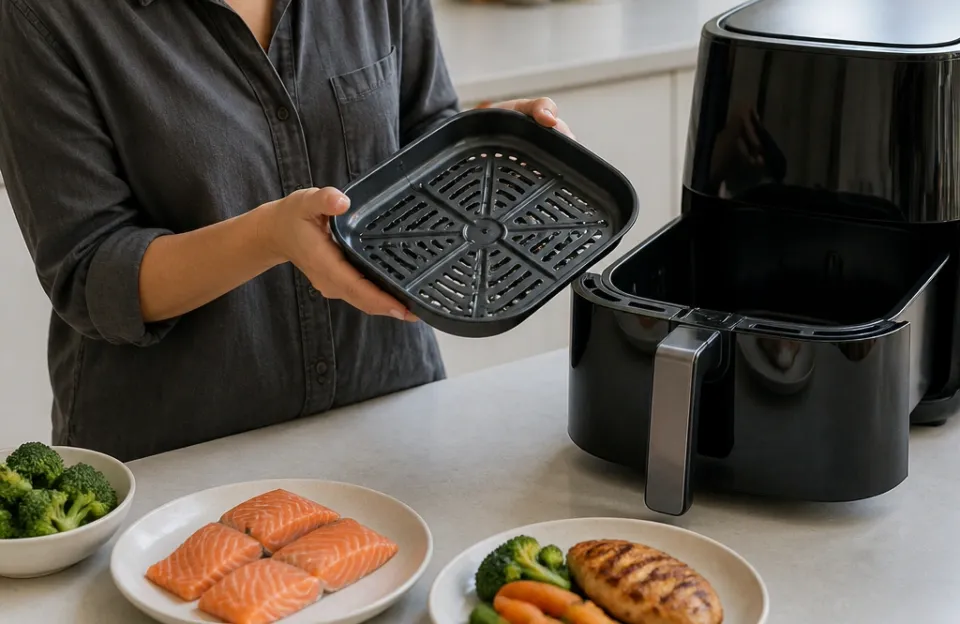
Yes, because the pan occupies floor space and you cannot stack food on it the way you can in a bare basket. Air fryers already have limited interior room, and overcrowding prevents proper circulation. Plan smaller batches when using a pan.
How Do I Prevent Smoke When Using a Grill Pan?
Trim excess fat, use a pan with drainage, and keep the pan and element clean per your manual. Philips treats white smoke as a troubleshooting topic rather than an emergency, but persistent smoke or any sign of fire means stopping the appliance and following the manufacturer’s safety instructions. Do not add water or bread inside the appliance unless the manual permits it.
Are Ceramic-Coated Grill Pans Better Than Traditional Nonstick?
Neither is universally better. Ceramic coatings need a high-heat rating and an intact surface, and chips or peeling shorten their useful life. PTFE nonstick has FDA-authorized food-contact uses with negligible migration from intact coatings. Choose based on your temperature habits and willingness to inspect and replace the pan.
Will a Grill Pan Work for Vegetables and Seafood?
Yes, with caveats. Firm vegetables and firm-fleshed fish benefit from ridges and drainage, while delicate items can fall through wide gaps or stick. Oil both the pan and the food, and use a thermometer for fish and poultry doneness rather than relying on appearance.
The Bottom Line
Choose the pan that matches your cooking, not the one with the longest feature list. Cast iron rewards patience with searing, stainless steel balances durability with heat tolerance, coated pans trade longevity for easy release, and silicone serves light-duty and storage-sensitive cooks.
Measure your basket, confirm the pan’s temperature rating against your air fryer’s maximum, and check the coating or surface before each use. Do that, and the pan you buy will earn its space in the basket.