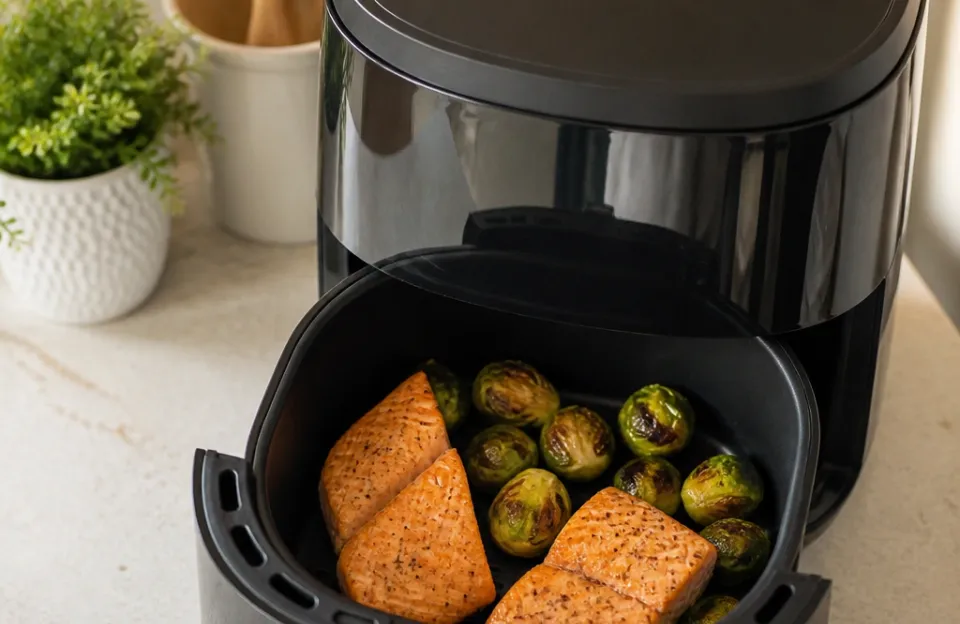
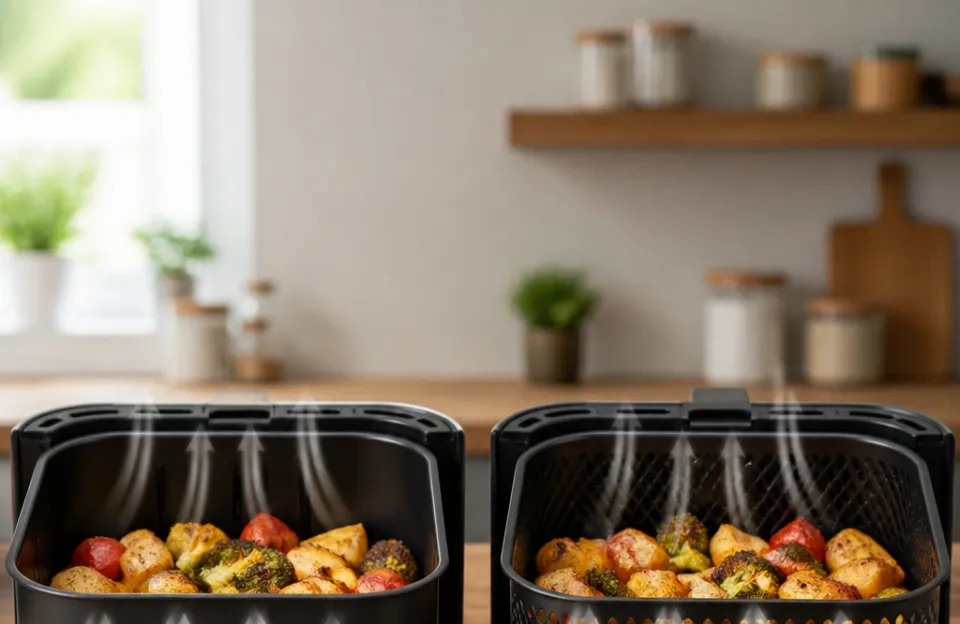
The honest answer is that neither design cooks better in every situation. A perforated basket, the kind with a mesh or slotted floor that lifts out of a pull-out tray, tends to produce crisper results with frozen foods and anything you want browned on all sides. A solid drawer, where food sits directly in a non-stick container with no removable mesh, handles wet batters, saucy dishes and larger flat items more gracefully. Your weekly menu decides which set of trade-offs matters more.
How Airflow Changes Between a Solid Drawer and a Mesh Basket
Every air fryer works the same basic way: a fan pushes hot air down through a heating element and across the food. The difference lies in what happens when that air reaches the bottom of the cooking container.
In a basket design, the perforated floor lets air pass underneath the food and escape upward around the sides. That means the underside of your food gets direct hot-air contact, which is why you rarely need to flip as carefully and why potatoes brown so evenly in this style. The trade-off is that small pieces can slip through the holes, and thin batters drip straight into the catch tray below.
A solid drawer has no holes in its base, so air can only flow over the top and around the sides of the food. Heat still circulates, but the bottom surface of whatever you’re cooking sits against metal rather than exposed to moving air. In practice, this means foods release moisture into a closed pool at the base, which can make the bottom of a breaded cutlet soggy unless you flip it partway through.
Why Batters Behave Differently in Each Style
Wet, loose coatings are the clearest dividing line between the two designs.
A basket’s perforated floor is a liability the moment your coating is thinner than the holes. Beer batter, tempura, and any dredge that hasn’t fully set will drip through the mesh, leaving you with a mess in the drip tray and a patchy crust on the food. If you’re working with coating wings in seasoned flour, a dry dredge is fine in either style, but a wet marinade that runs is not.
A solid drawer contains the batter. The coating pools slightly around the base of the food, where it sets into a thicker, more cohesive crust. This is why drawer-style air fryers are often favored for fritters, thick fish batters and Korean fried chicken glazes. You lose some of the air-contact crispness on the bottom, but you keep the coating intact.
If you mostly cook dry-rubbed or pre-breaded foods, this distinction barely matters. If wet batters are a regular feature of your cooking, it matters a lot.
Cooking Capacity and Batch Sizes
Capacity differences come down more to shape than to raw litre ratings. Most baskets are round or oval with sloped sides, which wastes corner space when you’re trying to fit rectangular items like a whole fish or a sheet of bacon. Most drawers are squarer with straighter walls, giving you more usable flat area for the same quoted volume.
For a full batch of meal prep wings or several salmon fillets for dinner, a wide, flat drawer lets you lay pieces side by side without stacking. A round basket forces you to pile food higher, which blocks airflow between pieces and slows cooking. The basket reaches temperature faster on the pieces that are exposed, but the buried ones steam rather than crisp.
One important caveat: usable capacity is lower than quoted capacity in both designs. Air fryers need space around the food for hot air to circulate. Filling a basket or drawer to the brim usually produces uneven results, so assume you’ll cook at roughly two-thirds of the printed volume.
Grease Management and Daily Cleanup
Basket air fryers typically use a two-part system: the perforated basket and a separate solid catch tray beneath it. Fat drips through the mesh into the tray, which keeps the food out of the grease pool. This is a real advantage for crisping up thick-cut bacon or rendering fat from duck breasts, because the food isn’t sitting in its own drippings.
That same system means you’re washing two pieces after every greasy cook, and the mesh floor is the harder of the two to clean. Baked-on residue loves to cling to the perforations.
Solid drawers keep everything in one container, which is faster to wash but less effective at separating food from fat. Grease pools at the bottom, and if you don’t drain it before the next batch, the food starts frying in it rather than air-frying. On the plus side, many drawer inserts are non-stick and dishwasher-safe, and there are fewer crevices for residue to hide in.
Heat Distribution and Cooking Speed
Basket designs expose the underside of the food to moving air because the perforated floor allows convection from below as well as above. That extra air contact helps moisture escape from the bottom surface, which is the same mechanism that produces browning on the top. Whether this translates into measurably faster cooking or more even browning than a solid drawer depends on the specific model, so treat it as a design tendency rather than a guaranteed result. It is most noticeable with small, irregular pieces such as drumettes, where more surface area is exposed to the airflow.
Solid drawers shield the underside of the food from direct airflow, so the bottom surface relies more on heat conducted through the metal floor. Flipping or shaking partway through helps even out the result. Any difference in total cooking time depends on the model’s wattage, fan strength and heating element placement, so check your unit’s own cooking chart rather than assuming a fixed gap.
That said, this comparison is only a tendency, not a rule. Wattage, fan strength, heating element placement and whether the unit has a single or dual heating zone all affect real-world speed far more than the shape of the container. A high-wattage solid drawer can easily outpace a low-wattage basket model. If exact cook times matter to you, look at the specific model’s rated wattage and any published cooking charts rather than assuming the design alone determines speed.
Which Design Fits Specific Ingredients Best
The clearest way to decide is to look at what you cook most often.
A basket design usually suits:
- Frozen fries, tater tots and nuggets, where airflow underneath prevents sogginess
- Chicken wings, drumettes and other small pieces you want browned all over
- Vegetables like Brussels sprouts, broccoli and cauliflower that benefit from a crisp exterior
- Foods you’d normally deep fry but want to cook with less oil
A solid drawer usually suits:
- Wet-battered fish, fritters and anything with a loose coating
- Fish fillets and delicate proteins that would fall apart on a mesh floor
- Casseroles, baked oatmeal, small cakes and other dishes with liquid
- Larger flat items like a whole side of salmon or a sheet of brownies
Some air fryers combine both approaches with a solid drawer and a removable perforated insert, letting you switch between the two styles. If you cook a genuinely mixed menu, that hybrid design is often the most practical compromise.
Mechanical Durability and Wear Over Time
Both designs wear out, but they wear out in different places.
Basket models have a release latch or clip that separates the inner mesh from the outer tray, and that mechanism is a moving part that can wear with heavy use. Overloading the basket or dropping it into the sink puts extra stress on the latch and handle. Follow the manufacturer’s care instructions for your specific model, including any guidance on weight limits and cleaning.
Solid drawer models rely on sliding tracks and a front-mounted handle. Repeated rough pulling or uneven loading can put strain on those parts over time. The non-stick coating on a drawer floor is a flat surface that comes into direct contact with utensils and sponges, so follow the manufacturer’s cleaning guidance to avoid damaging it.
In both cases, check the manufacturer’s care instructions for your specific model before choosing between hand washing and the dishwasher. Some non-stick coatings are labelled dishwasher-safe and some are not, and abrasive sponges or scouring pads can damage the surface regardless of design. If you need a replacement part, availability varies by brand and region, so check with the manufacturer or an authorised parts supplier for your model.
Picking the Right Container for Your Kitchen
Here’s a simple way to decide:
Choose a basket if your weekly menu leans toward frozen convenience foods, wings, roasted vegetables and anything you want crispy on all sides. You’re willing to wash two pieces after greasy cooks and won’t be cooking many wet batters.
Choose a solid drawer if you cook fish, casseroles, baked goods or wet-battered foods regularly. You’d rather have one container to wash and don’t mind flipping food partway through for even browning.
Choose a hybrid or drawer with a perforated insert if you cook a genuinely mixed menu and want the option to switch.
If none of these clearly fits, budget and brand matter more than container shape. A well-built air fryer of either style will outperform a cheap one, and wattage, fan quality and heating element design all have more influence on cooking results than the shape of the basket or drawer. Pick the design that matches your most common meals, then prioritise build quality and power within that category.
For most home cooks, the honest verdict is this: a basket is better for crispiness and grease separation, a drawer is better for versatility and cleanup convenience, and neither is universally superior. Match the container to your cooking, not the other way around.