The right air fryer cake pan is the one that fits your basket with room for air to move around it. Start by measuring the inside of your basket, not by trusting a pan’s advertised size. Then match the pan’s material, shape and coating to the cake you plan to bake and to your machine’s top temperature. Most standard 8-inch and 9-inch cake pans are too wide for a basket-style air fryer, so the buying decision usually centers on 6-inch and 7-inch pans, multi-cavity trays or flexible silicone molds.
Start with Your Basket, Not the Pan
Air fryers are essentially countertop convection ovens, and they cook food faster than a full-size oven because a fan moves hot air constantly around the food. That same design means space is tight. Air fryers generally do not have much room inside, and overcrowding the basket can prevent enough air circulation to cook food properly. A cake pan that fills the basket edge to edge leaves the fan nowhere to send heat, which is why the pan you buy should be smaller than the space you measured.
Write down three numbers before you shop: the basket’s interior width at its narrowest point, its depth (or corner-to-corner diagonal for a square basket), and the height from the basket floor to the heating element. Those three figures set the ceiling for any pan you consider. If you own a dual-basket model, measure each basket separately, because the two sides are not always identical.
Measuring Your Basket Before Shopping for Air Fryer Cake Pans
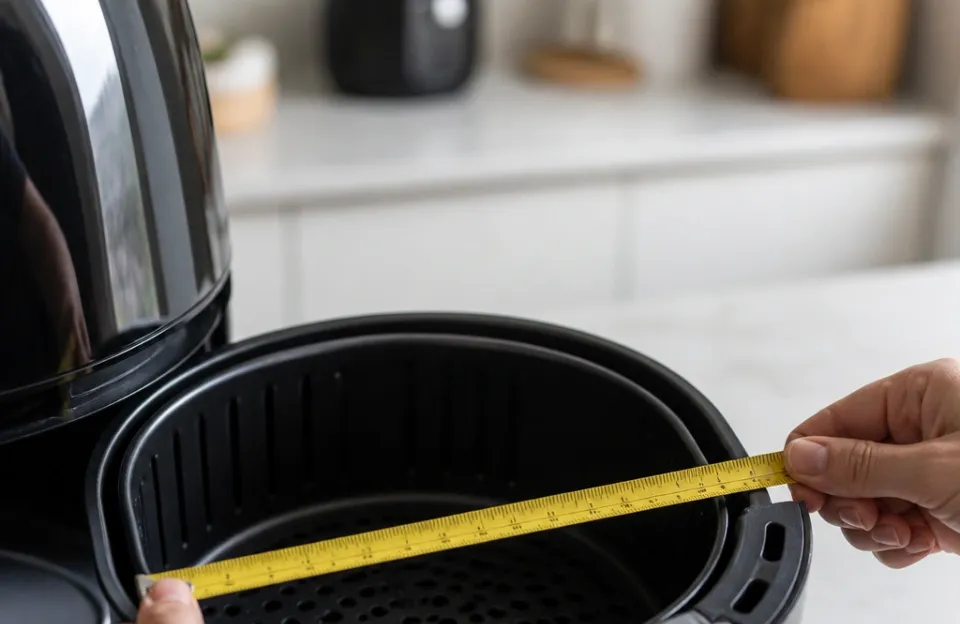
Width at the Narrowest Point
Run a tape measure across the inside of the basket at the bottom, then again a little higher up. Many baskets taper, so the opening can be wider than the floor. Use the smaller figure, since a pan has to sit on the floor. For a square or rectangular basket, measure corner to corner as well, because a round pan’s usable diameter is limited by the shorter side.
Height and Clearance Above the Pan
Measure from the basket floor straight up to the heating element or the top of the basket cavity. Subtract at least an inch for the pan’s own height plus the space a rising cake needs. A shallow pan that fits the floor but sits close to the element is a worse buy than a slightly smaller pan with headroom. Manufacturers publish different clearance guidance, so check your model’s manual if it gives any.
Depth and Rim Allowances
Advertised pan sizes usually describe the inside baking diameter, not the outer edge. Rims, handles, removable bases and locking clips all add width. When a listing gives only a nominal size, look for the outer dimensions in the specifications, or plan to measure the pan in person before you rely on it.
Materials That Handle Rapid Convection Heat
Material affects how evenly a small cake browns, how easily it releases and how much weight you lift in and out of a hot basket. There is no independent test data behind these categories in this guide, so treat the tradeoffs below as general material behavior rather than measured rankings.
Carbon Steel and Aluminized Steel
Metal pans conduct heat well and hold a firm shape, which suits small round and square cakes that need structure. Carbon steel is heavier than aluminum and often needs greasing or lining. Aluminized steel is lighter and common in bakeware. With either, check whether the pan has a coating and what maximum temperature that coating is rated for.
Silicone
Silicone molds are flexible, easy to unmold and simple to store in a cramped drawer. They are less rigid, so a full batter needs support on a rack or tray when you move it. Browning tends to be lighter than with metal. Maximum temperature ratings vary by product, and a mold rated below your air fryer’s top setting is not a safe match, so read the label rather than assuming.
Ceramic and Stoneware
Ceramic gives a rigid pan with a nonstick-style release on some glazed finishes. It is heavy and can be brittle, so handle it carefully and follow the maker’s guidance on preheating and temperature changes. Check that the piece is labeled oven-safe and rated for your machine’s maximum.
Foil and Parchment Liners
Disposable liners are cheap and convenient for occasional bakes, but they are not a substitute for a proper pan when you need structure. Loose foil or parchment can block airflow or contact the heating element if it is placed incorrectly, and appliance manuals differ on what is permitted. Follow your manufacturer’s instructions rather than a general rule.
Shapes and Styles That Fit Compact Baskets
Match the pan’s footprint to your basket’s geometry, then to the cake you want.
- Round pans suit layer cakes, small celebration cakes and single-batch brownies. A 6-inch round is the most common size that clears a compact basket.
- Square pans use the corners of a square basket more efficiently than a round pan and work well for bar cookies and snack cakes.
- Rectangular pans fit long, narrow baskets and are useful for loaf-style cakes and small sheet bakes.
- Bundt and tube pans need more height and a center column, so measure carefully; mini bundt molds are more likely to fit than full-size ones.
- Multi-cavity trays let you bake several small cakes or muffins at once, but each cavity adds width, and the tray’s outer dimensions are what must fit.
Bucket-style air fryers with a pull-out drawer and air fryer toaster ovens with a rack and door are different buying contexts. In a toaster oven, you slide the pan in on a rack and have more rectangular room. In a bucket, you lift the pan in and out of a deep basket, so handles and a removable base matter more for safe handling.
Coatings, Safety, and Temperature Ratings
Nonstick coatings are common on air fryer bakeware, and the type of coating determines how you care for the pan. Two broad families dominate:
- PTFE-based nonstick is durable and releases well but has a stated maximum temperature. Check the pan’s own rating against your air fryer’s top setting.
- Ceramic nonstick is often marketed as free of PFAS and BPA. Some air fryer cooking surfaces, such as those on the Cosori Iconic, are described this way, but that is a claim about the appliance, not a guarantee about a third-party pan you buy.
The practical step is the same for both: find the pan’s maximum temperature rating on its packaging or product page and compare it with your machine’s maximum. The Cosori Iconic operates from 90°F to 450°F, and the TurboBlaze lists a 450°F broil setting, so a pan rated below 450°F would not be suitable across those machines’ full ranges. If a pan’s rating is missing or unclear, treat that as a reason to keep looking. This guide does not make claims about coating degradation temperatures or food-contact safety beyond what the pan and appliance manufacturers state, so verify those details with the maker.
Airflow Clearance and Rack Compatibility
Air fryers rely on moving hot air, so the gap around and under the pan matters as much as the pan itself. Leave visible space on all sides so air can travel past the pan, and avoid a pan that sits flush against the basket walls. A low rack or trivet can lift the pan off the basket floor and let air pass underneath, but only use one your manufacturer permits and that keeps the pan stable.
A few model-specific points are worth checking before you buy:
- Confirm whether your manual allows a rack or trivet inside the basket at all.
- Check the maximum height with the rack in place, since it reduces headroom.
- Confirm whether foil or parchment is permitted and where it may be placed.
Cooking times vary between air fryers because of differences in appliance size and power, so a pan that works in one machine may bake differently in another. Use a food thermometer to check that egg-based batters reach a safe internal temperature of 160°F, and follow your recipe’s own doneness cues for the cake itself.
What to Look for in Accessory Sets vs. Individual Pans
Sets promise variety, but every piece has to fit. A bundle that includes a 7-inch pan may be fine for one basket and useless for another, and the pieces you cannot use still cost money.
Individual pans cost more per item in many cases, but you get exactly the size your basket accommodates and you avoid paying for pieces that do not fit. Buy a single pan when you have one machine and one regular bake size.
Buy a set only when the listed outer dimensions of every piece clear your measurements, including rims and handles. Verify each piece before you commit, keep the receipt, and check the return window. If a set’s dimensions are not published, that is a reason to skip it rather than guess.
For related buying decisions, this guide to air fryer baking pans covers solid-surface dishes for recipes that need a base, and the air fryer muffin pans guide covers multi-cavity trays in more detail.
Getting the Right Fit for Your Machine
Work through this checklist before you buy:
- Measure your basket’s interior width at the narrowest point, its depth or diagonal, and the height to the heating element.
- Subtract at least an inch of clearance on each side and below the element to get your maximum pan size.
- Look up the pan’s outer dimensions, including rim and handles, not just its nominal size.
- Check the pan’s maximum temperature rating against your air fryer’s top setting.
- Confirm your manual’s rules on racks, foil and parchment.
- Decide between one pan sized to your basket and a set whose every piece fits.
- Test the fit with an empty pan before your first bake, so you know it sits level and clears the element.
If you are choosing between a round and a square pan, let your basket decide. A square basket rewards a square pan; a round basket with tapered sides usually rewards a round pan one size below your measurement. Buying individual pans is the lower-risk path when you are unsure, because you can confirm the fit in one machine before adding more.
The best air fryer cake pan for you is the one that leaves clearance for air, clears your heating element, and carries a temperature rating that covers how you actually bake. Measure first, verify the outer dimensions and the coating rating, and buy the smallest number of pieces that covers the cakes you make.