Achieving perfectly cooked meat, whether a juicy steak, a tender roast, or safely cooked poultry, hinges on precise temperature control. Many home cooks and even seasoned grill masters grapple with the question: which thermometer is right for the job? The choice often boils down to two primary types: infrared (IR) thermometers and probe thermometers.
While both are valuable kitchen tools, they serve fundamentally different purposes, especially when it comes to measuring meat temperature. For the most accurate internal temperature readings of meat, ensuring both safety and optimal doneness, a probe thermometer is indispensable. An infrared thermometer, on the other hand, excels at measuring surface temperatures of cooking surfaces like grill grates or skillets, but it cannot accurately tell you if your meat is cooked through. Understanding their distinct functions is key to elevating your culinary skills and guaranteeing food safety. You can also read our guide on what is the most accurate thermometer method.
Understanding Meat Temperature: Why Accuracy Matters
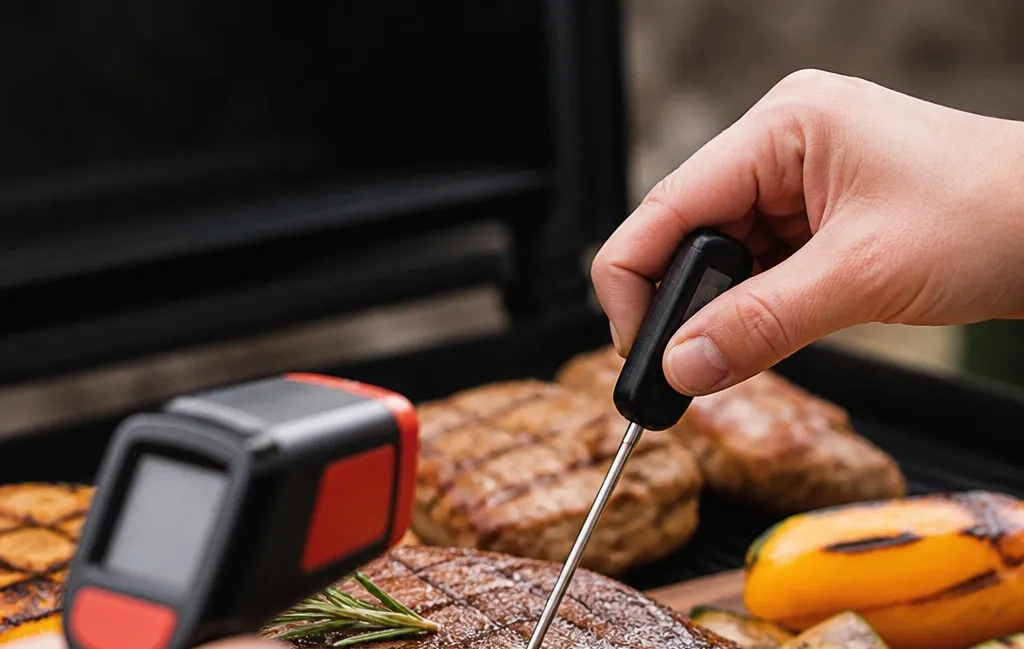
Cooking meat safely and to your desired doneness requires an understanding of how heat penetrates food. Heat transfers from the exterior inward, meaning the surface of a steak, roast, or chicken breast will reach high temperatures much faster than its core.
The Critical Role of Internal Temperature
Food safety guidelines, such as those from the U.S. Department of Agriculture (USDA), specify minimum internal temperatures for various meats to eliminate harmful bacteria like Salmonella and E. coli. For example, all poultry must reach 165°F (74°C) throughout, and ground meats like hamburgers need to hit 160°F (71°C). Relying on visual cues or external temperature alone is a dangerous gamble. Only by measuring the internal temperature can you confirm these critical safety thresholds have been met. You can also read our guide on how to use a meat thermometer to take your temperature.
The Danger of Surface-Only Readings
Imagine pulling a large roast out of the oven, its exterior beautifully browned and sizzling. An infrared thermometer pointed at its crust might read upwards of 300°F (149°C). However, the thermal center of that roast, the last point to reach the target temperature, could still be dangerously cold. This disparity between surface and internal temperature is precisely why an infrared thermometer is unsuitable for assessing meat doneness. You need to know what’s happening deep inside the food, not just on its skin.
Probe Thermometers: The Gold Standard for Meat
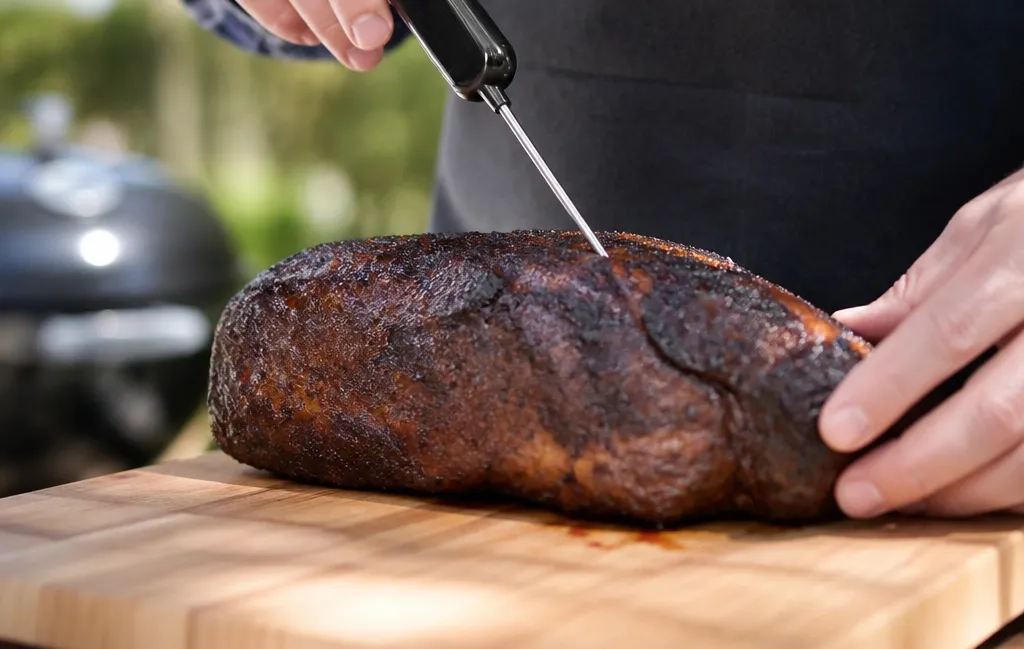
Probe thermometers are specifically designed for direct, accurate measurement of internal temperatures. They are the essential tool for any cook concerned with food safety and quality. You can also read our guide on chicken internal temperature chart safe cooking temps for every cut.
How Probe Thermometers Work
A probe thermometer uses a metal shaft with a temperature sensor (typically a thermistor or thermocouple) located at its tip. When this tip is inserted into the thickest part of the meat, it makes direct contact with the food’s fibers and juices. This physical contact allows the sensor to measure the kinetic energy transfer, providing a precise reading of the actual temperature inside the meat. The data is then transmitted to a digital display, offering a clear, reliable internal temperature.
Types of Probe Thermometers
Probe thermometers come in several forms, each suited for different cooking scenarios:
- Instant-Read Thermometers: These are handheld devices with a thin probe that provides a temperature reading in 1-5 seconds. They are ideal for quick spot checks of steaks, chops, burgers, and thin cuts of poultry. Their speed makes them perfect for checking multiple spots or confirming doneness just before serving.
- Leave-In / Wired Probe Thermometers: Designed for longer cooks in ovens, smokers, or grills, these thermometers feature a heat-resistant wire that connects the probe inserted into the meat to an external display. This allows you to monitor the internal temperature without opening the oven or smoker, preventing heat loss and maintaining a consistent cooking environment.
- Wireless Probe Thermometers: An advanced version of leave-in probes, these utilize Bluetooth or Wi-Fi to send temperature data directly to your smartphone or a separate receiver. This offers unparalleled freedom, allowing you to monitor your cook from a distance, making them a favorite for smoking briskets or roasting large turkeys. To understand the differences between models, consider articles like Thermapen One vs. DOT.
Best Use Cases for Probe Thermometers
- Thick Cuts and Roasts: For large items like prime rib, whole chickens, briskets, or turkeys, a leave-in probe is invaluable. It tracks the temperature steadily, helping you avoid undercooking the center or overcooking the exterior. Monitoring the internal temperature also helps understand phenomena like the “stall” in BBQ.
- Thin Meats and Ground Poultry: Even for thinner cuts like pork chops or chicken breasts, a thin-tipped instant-read probe ensures you hit the target temperature (e.g., 165°F for chicken) without drying out the meat. For ground meats like burgers, always check the thickest part of the patty to ensure it reaches at least 160°F (71°C) for safety.
- Carryover Cooking: After removing meat from the heat, its internal temperature continues to rise for several minutes. A probe thermometer allows you to monitor this “carryover cooking,” ensuring you pull the meat at the optimal temperature to hit your final desired doneness after resting.
- Liquid Temperatures: From tempering chocolate to deep-frying oil, a probe thermometer provides accurate readings for liquids.
Advantages of Probe Thermometers
- Unmatched Accuracy for Internal Temperature: Directly measures the temperature at the core of the food.
- Ensures Food Safety: The only reliable way to confirm meat has reached safe minimum internal temperatures.
- Guarantees Desired Doneness: Essential for achieving specific levels of doneness (e.g., medium-rare steak at 130-135°F).
- Versatility: Useful for a wide range of foods, including roasts, steaks, poultry, casseroles, and even bread.
Limitations of Probe Thermometers
- Physical Contact Required: Leaves a small puncture hole in the meat.
- Slower for Surface Checks: Not ideal for quickly scanning an entire grill grate for hot spots.
- Cleaning: The probe needs to be cleaned thoroughly after each use to prevent cross-contamination. You should also be aware of signs of a weak battery to ensure reliable readings.
Infrared Thermometers: A Powerful Tool (But Not for Meat Doneness)
While incapable of measuring internal meat temperatures, infrared thermometers are incredibly useful for managing the cooking environment and achieving optimal cooking results. You can also read our guide on why does my meat thermometer take so long to stabilize.
How Infrared Thermometers Work
Infrared thermometers are non-contact devices that measure thermal radiation (infrared energy) emitted from a surface. They use a lens to focus this energy onto a detector, which then converts it into an electrical signal displayed as a temperature. This process is nearly instantaneous.
The key scientific principle affecting IR accuracy is emissivity. Different surfaces emit infrared energy differently. Dark, matte surfaces (like cast iron or a pizza stone) have high emissivity, making them easy for IR sensors to read accurately. Shiny, reflective surfaces (like polished stainless steel) have low emissivity, reflecting ambient light and heat, which can lead to “false” low readings. While meat generally has good emissivity, the fundamental limitation for doneness is its inability to read below the surface. For further reading, see fluke.com.
Best Use Cases for Infrared Thermometers
- Preheating Pans and Grill Grates: Achieving a perfect sear on a steak requires your cast iron skillet or grill grates to be at a specific high temperature (eoften 400-500°F / 204-260°C). An IR thermometer allows you to quickly and safely verify these surface temperatures without touching them. You can scan an entire grill to identify hot and cold zones for better temperature management.
- Pizza Stones and Baking Steels: For crispy crusts, pizza stones need to be deeply saturated with heat, often reaching 600°F (315°C) or higher. An IR thermometer is the only practical way to check the surface temperature of these items to ensure they are ready for your dough.
- Frying Oil Temperatures: When deep-frying or shallow-frying, maintaining the correct oil temperature is crucial for crispy, non-greasy results. An IR thermometer can quickly check the oil’s surface temperature, though a probe is more accurate for the oil’s core if depth is a concern.
- Candy Making and Sugars: For very thin, non-steaming liquids, an IR thermometer can offer quick, approximate readings, though a probe often provides more precise control.
- Identifying Drafts or Appliance Hot/Cold Spots: Useful for diagnosing issues with ovens, refrigerators, or insulation.
Advantages of Infrared Thermometers
- Instantaneous Readings: Provides temperature in less than a second.
- Non-Contact: Safe for measuring extremely hot surfaces without physical contact.
- Wide Surface Scan: Can quickly check temperatures across a large area like a grill or oven.
- Durability: No probes to bend or break.
Limitations of Infrared Thermometers
- Surface-Only Measurement: Cannot measure internal temperatures, making it unsuitable for meat doneness.
- Affected by Emissivity: Readings can be inaccurate on shiny or reflective surfaces.
- Sensitive to Steam and Smoke: Water vapor can interfere with the IR sensor, leading to false readings.
- Distance-to-Spot Ratio: Consumer IR thermometers typically have a 12:1 ratio. This means at 12 inches away, they measure a 1-inch diameter spot. If you stand too far away, you’ll measure a larger area, including ambient or background temperatures, leading to inaccuracies.
- Doesn’t work through clear surfaces: Cannot read temperature through glass or clear plastic.
The Verdict: Which Should You Use for Meat?
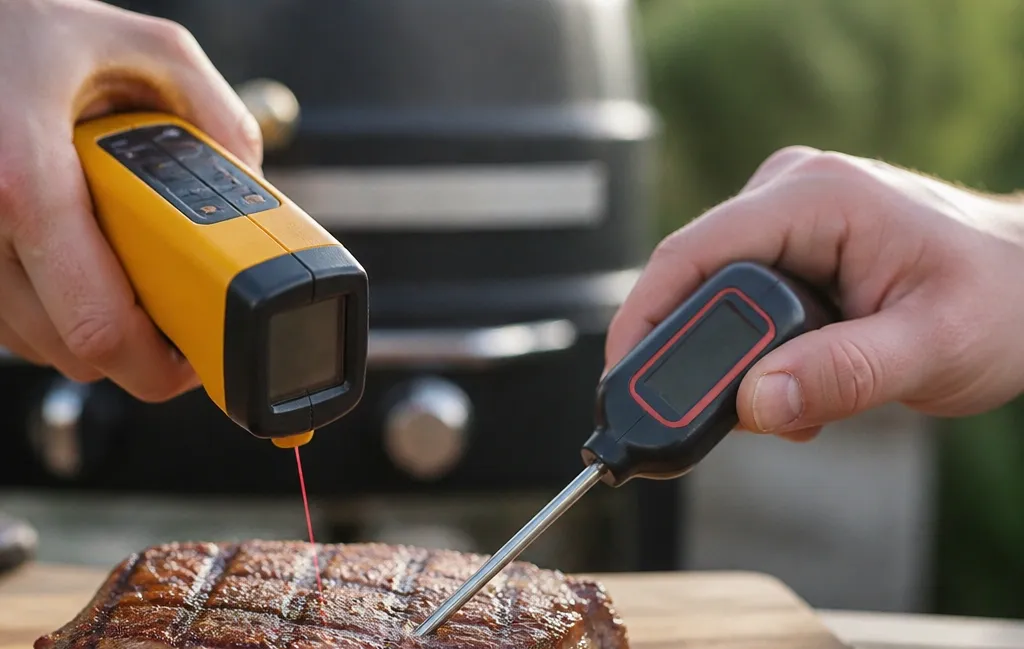
When it comes to measuring the temperature of meat to ensure safety and desired doneness, a probe thermometer is the only correct choice. Its ability to read the internal temperature directly is paramount. An infrared thermometer should never be used to determine if meat is cooked.
A Hybrid Approach: Using Both for Superior Cooking
The best chefs and home cooks understand that these are not “either/or” tools. They complement each other, offering comprehensive temperature control throughout the cooking process.
Practical Workflow
- Prep the Surface: Before placing meat on your cooking surface, use an infrared thermometer to quickly confirm your pan, grill grate, or pizza stone has reached the target temperature for optimal searing or baking. For example, aim for 400-450°F (204-232°C) for searing steaks.
- Monitor the Cook: For roasts, whole poultry, or larger cuts, insert a leave-in probe thermometer into the thickest part of the meat (avoiding bone) before it goes into the oven or smoker. This allows continuous monitoring of the internal temperature, providing real-time data on your progress.
- Spot Check for Doneness: As the meat approaches its target temperature, use an instant-read probe thermometer to quickly verify the temperature in multiple locations. This accounts for potential hot spots or uneven cooking within the meat. For highly rated options, explore top models for grilling.
- Manage Resting: After removing the meat from the heat, keep the probe inserted (if using a leave-in) or make a quick instant-read check. This allows you to observe the carryover cooking effect, ensuring the meat reaches its final desired temperature and rests properly for maximum juiciness.
Common Mistakes & Misconceptions
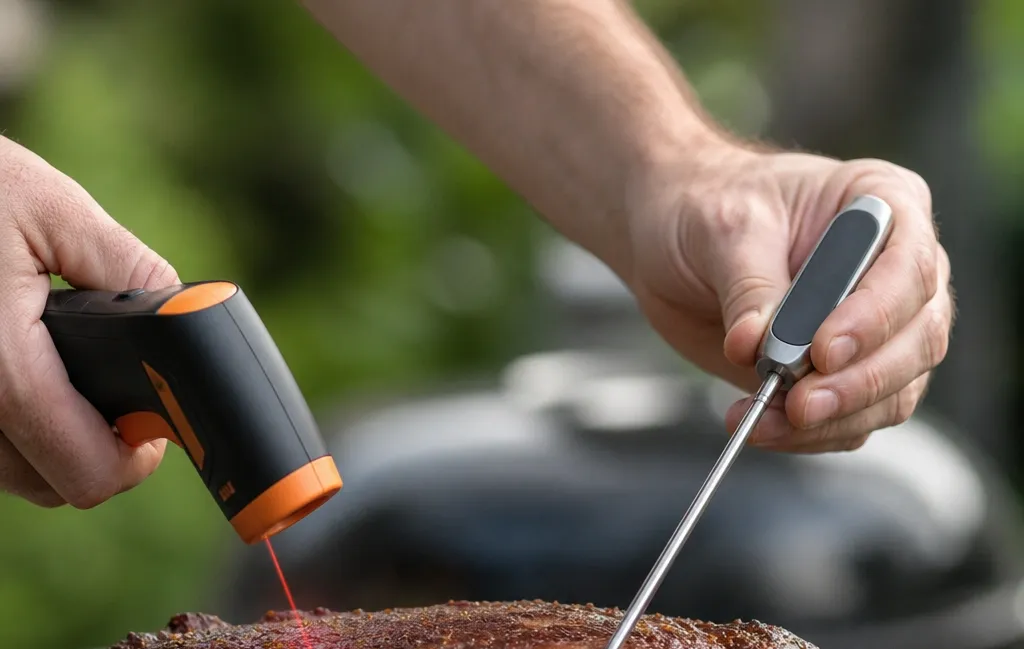
Understanding the limitations and proper usage of each tool can prevent common culinary pitfalls.
- Trusting the Infrared Laser for Doneness: A widespread mistake is assuming the “red dot” of an IR thermometer indicates the internal temperature. The laser is merely a pointer; the sensor reads the surface where the beam is directed.
- Checking Frozen Meat Surface with IR: An infrared gun might show a cold surface temperature on frozen meat, but gives no indication of how frozen or thawed the interior actually is.
- Ignoring Probe Depth: With probe thermometers, ensure the sensor tip (usually the last 0.5 to 1 inch of the probe) is fully inserted into the thickest part of the meat and away from bone. A shallow insertion can give a misleadingly low reading. If your device is not reading correctly, probe depth might be a factor.
- Probing Near the Bone: Bones conduct heat differently than muscle tissue and can give an artificially high or low reading. Always aim for the center of the thickest muscle mass, avoiding direct contact with bone.
- The “Finger Poke Test”: While some experienced chefs can estimate doneness by feel, this is an unreliable and unscientific method. Variables like meat thickness, fat content, and prior freezing significantly alter how meat feels. A thermometer is the only way to be 100% sure, confirming accuracy with real-world accuracy tests.
Comparison Table: Infrared vs. Probe Thermometer
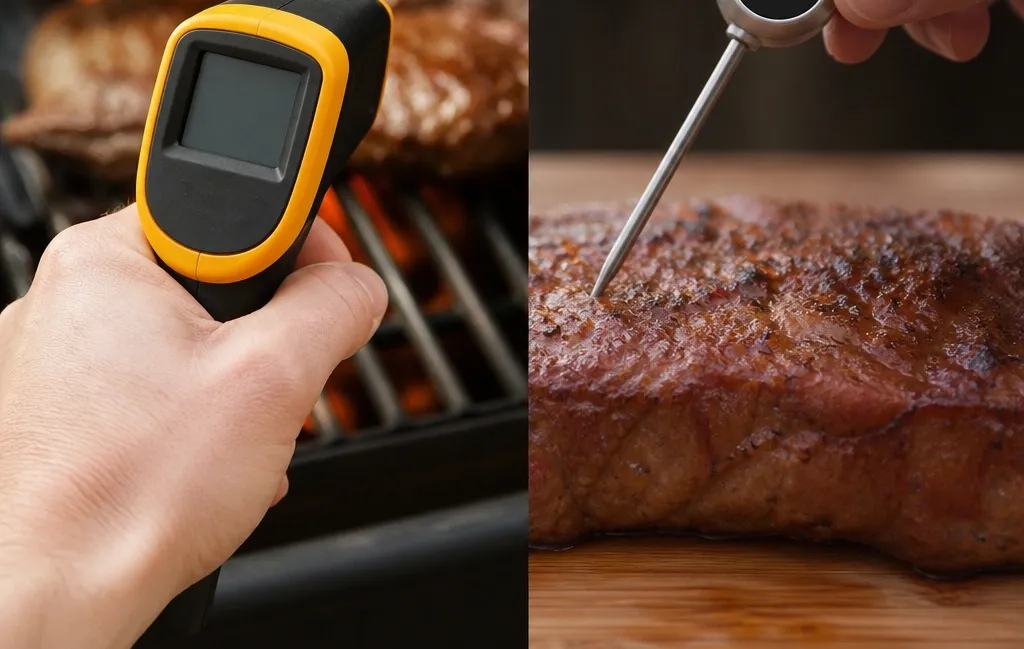
| Feature | Infrared Thermometer | Probe Thermometer |
|---|---|---|
| Primary Target | Surfaces (Grill Grates, Pans, Pizza Stones, Oil) | Internal Core (Meat, Liquids) |
| Contact Required? | No | Yes |
| Speed | Instant (under 1 second) | 1 to 5 seconds (instant-read) / Continuous (leave-in) |
| Food Safety | Poor (Surface only, cannot confirm doneness) | Excellent (Measures core, confirms safety) |
| Best Use Case | Preheating, finding hot spots, surface temp control | Final doneness, food safety, carryover cooking |
| Limitations | Affected by emissivity, steam, distance-to-spot ratio, surface-only | Leaves small hole, slower for surface checks |
| Technology | Thermal radiation sensor | Thermistor or thermocouple sensor in metal shaft |
Frequently Asked Questions
Can I use an infrared thermometer to see if chicken is cooked?
No, absolutely not. Chicken must reach an internal temperature of 165°F (74°C) to be safe to eat. An infrared thermometer only reads the surface temperature, which can be significantly hotter than the raw or undercooked interior. Always use a probe thermometer for poultry.
Why does my infrared thermometer give different readings on different pans?
This is due to “emissivity.” Dark, matte surfaces like seasoned cast iron have high emissivity and give accurate readings. Shiny, reflective surfaces like polished stainless steel have low emissivity and can reflect ambient temperatures, leading to inaccurate or low readings. A probe thermometer is more reliable for checking the temperature of liquids or food directly in reflective cookware.
Should I get an instant-read or a leave-in probe?
It depends on your cooking style. If you frequently cook large roasts, briskets, or whole poultry in an oven or smoker, a leave-in probe is invaluable for continuous monitoring. For quick stovetop cooking like steaks, burgers, or thin chicken breasts, a fast, accurate instant-read probe is more versatile and convenient. Many serious cooks own both.
Is the “finger poke test” better than a thermometer?
No. The “finger poke test” is an anecdotal method that lacks scientific accuracy. While some very experienced chefs can make educated guesses, it’s highly unreliable for the average home cook. Variations in meat type, thickness, and fat content make it inconsistent. A calibrated probe thermometer is the only truly reliable and safe method to ensure proper doneness.
Conclusion
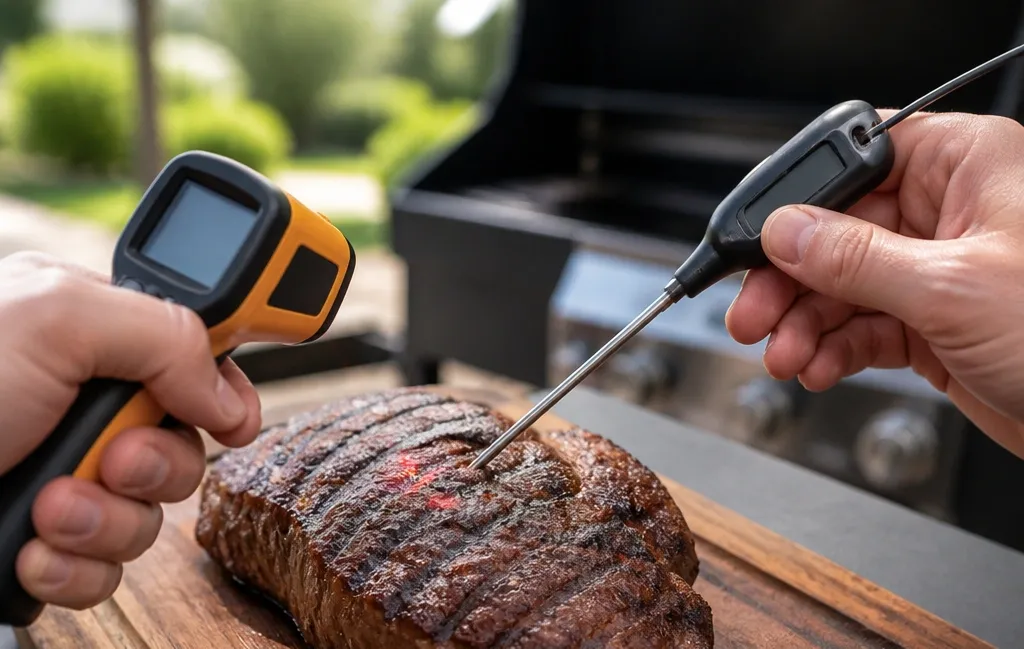
The debate between infrared and probe thermometers for meat isn’t about which one is “better,” but rather which tool is appropriate for the task at hand. For ensuring food safety and achieving perfect doneness in meat, the probe thermometer is your indispensable kitchen ally. It provides the crucial internal temperature readings that an infrared thermometer simply cannot.
An infrared thermometer, while excellent for monitoring surface temperatures of cooking equipment, should never be used to gauge the doneness of meat. For optimal results and culinary mastery, consider owning both. If you must choose just one, invest in a high-quality instant-read probe thermometer first. It offers the most critical data for safe and delicious meat cooking.