There is no single winner, because the two brewers succeed at different jobs. A drip coffee maker is the better choice when you want hands-off brewing for several cups and a clean cup with little sediment, and models such as the Moccamaster KBGV are certified to hold a consistent brewing temperature. A French press is the better choice when you want a heavier, oilier body, full control over steeping, and a low entry price. If you drink two or more mugs each morning and value convenience, buy the drip machine. If you brew one or two cups with attention and prefer a richer mouthfeel, buy the French press. If you already know you want something stronger than drip but are unsure where to start, learning about the different espresso styles can help you map out your kitchen setup.
Coffee Maker vs French Press: Quick Comparison
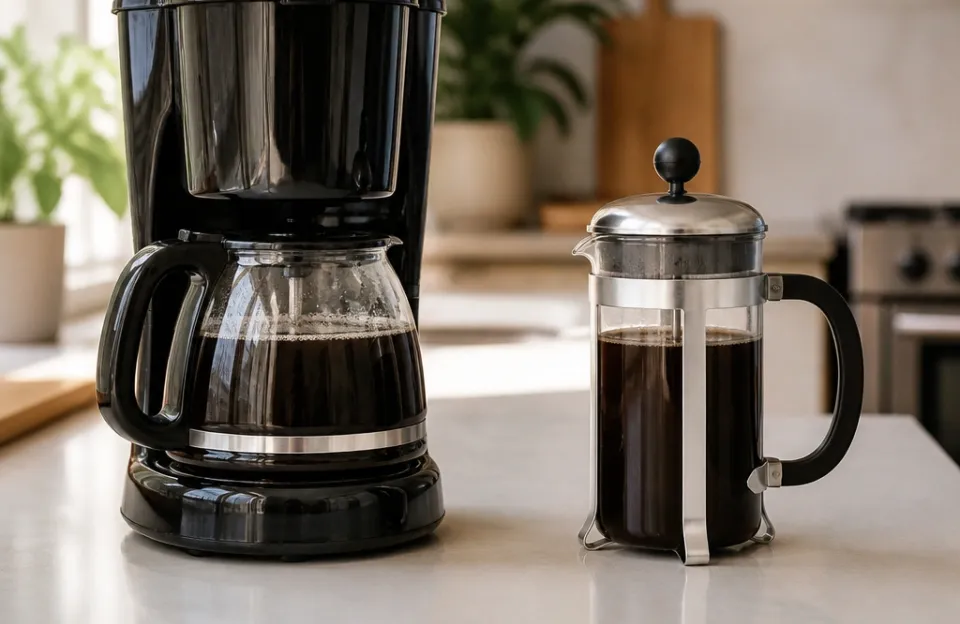
The table below compares the two categories in general terms, with model-specific figures labeled where they apply. Prices and specifications reflect the specific models named and can change.
| Factor | Drip Coffee Maker | French Press |
|---|---|---|
| Brewing method | Heated water is showered over a bed of grounds in a filter basket | Grounds steep fully in water, then a mesh plunger separates them |
| Grind | Medium is typical | Coarse is typical |
| Typical brew time | Varies by model and batch size; the Moccamaster KBGV brews a full pot in roughly 4 to 6 minutes | Commonly about 4 minutes of steeping, plus time to boil water |
| Filtration | Paper traps most oils and fine sediment | Mesh lets oils and suspended solids through |
| Body and clarity | Lighter body, cleaner cup | Heavier body, more sediment |
| Hands-on effort | Low once loaded; the Moccamaster KBGV has no programmable timer, so you start it by hand | Moderate; you control the pour and timing |
| Capacity | Varies by model; the Moccamaster KBGV holds up to 1.25 L (40 oz) and offers a half-carafe setting | Varies by model; Bodum Chambord sizes run from a 3-cup, 12-oz model to a 12-cup, 51-oz model |
| Cleanup | Discard filter and grounds, rinse carafe | Disassemble and rinse mesh and plunger |
| Upfront cost | Varies widely; the Moccamaster KBGV is listed at $369.00 | Varies widely; the Bodum Chambord 8-cup is listed at $50.00 |
| Ongoing consumables | Paper filters plus coffee | Coffee only |
| Heat retention | Depends on model; the Moccamaster KBGV uses a warming plate | No supplied source provides a comparative heat-retention measurement for insulated steel versus glass presses |
How Each Method Actually Brews Coffee
Drip brewers heat water, then release it through a shower head over a bed of medium-ground coffee sitting in a paper filter. Gravity pulls the water through the grounds and filter into a carafe below. The paper filter traps oils and fine particles, which is why the finished cup is cleaner and lighter than an unfiltered brew.
French presses work by full immersion. You add coarse grounds to the carafe, pour in hot water, wait roughly four minutes, then press the mesh plunger down to separate the grounds from the liquid. Because the steel mesh has larger openings than paper, more oils and fine particles remain in the finished coffee.
Both methods target the same brewing window. The Specialty Coffee Association publishes brewing standards covering water temperature, coffee-to-water ratio, brew strength and extraction, and water quality. Exact target figures vary by method and recipe, so check the current SCA standards directly rather than treating any single number as universal.
Taste and Texture Differences
The clearest difference between the two is filtration. Paper filters trap oils and sediment, so drip coffee arrives in the cup lighter, cleaner, and more transparent in flavor. Mesh filters do the opposite, retaining oils and suspended solids that add weight and a heavier mouthfeel. That extra body tends to mute perceived brightness, even when the acidity level is similar.
If you prefer a rounder, denser cup where texture is part of the appeal, the French press delivers that quality more directly. If you prefer a lighter, cleaner cup, drip brewing with a paper filter is the closer match. Neither result is objectively better coffee; they are two different expressions of the same beans.
Convenience and Morning Routines
Drip brewing wins on automation. On the Moccamaster KBGV, the machine includes an automatic drip-stop and shuts off on its own after 100 minutes. It does not, however, have a programmable timer, meaning you start each pot by hand.
French press brewing is manual from start to finish. You boil water, measure grounds, pour, wait about four minutes, and press. That is more steps, but the process is short and needs no electricity.
A practical pattern is to compare your weekday mornings. If you wake up rushed and want coffee waiting within a few minutes of pressing a button, automation matters more than anything else on this list.
Size, Capacity, and Counter Space
The Moccamaster KBGV brews up to 1.25 L, which is 40 oz or about 10 cups, and its selector switch lets you brew either a full or half carafe. It measures 14.00 inches high, 12.75 inches wide, and 6.50 inches deep, and weighs 6.00 lbs.
The 1 L Bodum Chambord holds 34 oz, an 8-cup nominal capacity that works out to roughly four standard mugs, which suits couples, small families, or entertaining. It is also available in sizes from a 3-cup, 12-oz model up to a 12-cup, 51-oz model. Because a French press does not need a power outlet, it frees counter space near the coffee station and stores easily in a cabinet.
For a single drinker who makes one mug at a time, a small French press takes less room and brews less waste. For a household pouring multiple cups before work, the drip machine’s larger batch saves repeated brewing cycles.
Cost Breakdown Over Time
Upfront, the gap is wide. The Moccamaster KBGV lists at $369.00 on the manufacturer’s US site, while the Bodum Chambord 8-cup is listed at $50.00 by Verve Coffee. The drip machine also requires paper filters every time you brew, while the French press needs only coffee.
A transparent example shows how the running costs compare. Assume one daily 8-oz cup, roughly 10 g of coffee per cup, and a $12 bag of beans that yields about 45 cups, which works out to about $97 of coffee per year for either method. Add paper filters for the drip machine, which cost a few dollars per hundred and add roughly $10 to $15 per year at one brew per day. On those assumptions, the French press stays cheaper in year one by the purchase-price gap plus the filter cost, and the gap narrows only if you already own a drip machine or brew many cups per day. These figures are illustrative, not a quote, and your actual costs depend on your coffee, filter prices and consumption. Choose a drip brewer when the convenience and certified brewing consistency justify the higher outlay. Choose a French press when you want the lowest entry cost and no recurring filter expense.
Cleanup and Maintenance
French press cleanup is simple but hands-on. On the Bodum Chambord, the glass, plunger, and filter are dishwasher safe, while the chrome frame and lid need hand washing with a non-abrasive sponge. Grounds go in the trash or compost, and there is no filter to buy or replace.
Drip brewers need more scheduled care. Moccamaster recommends descaling the KBGV every 100 cycles, or at least every three months, and warns that reverse osmosis or distilled water can damage the copper boiling element. Paper filters and wet grounds go in the bin after each brew, and the carafe and basket need a rinse.
One design detail to weigh: the Moccamaster’s glass carafe sits on a warming plate, and independent review notes that the plate degrades flavor after about 45 minutes. A glass French press also loses heat over time, and no supplied source provides a comparative heat-retention measurement against insulated steel models.
Health Considerations
Paper filtration removes most of the coffee oils, while a metal mesh lets them through. Coffee oils contain cafestol and kahweol, two diterpenes that the FDA notes can raise LDL cholesterol in some people, with the effect depending on how much unfiltered coffee is consumed. If you monitor your cholesterol, paper-filtered drip coffee is the lower-diterpene option, and it is worth discussing your intake with a clinician rather than treating this as medical advice. Caffeine content varies widely by recipe, grind, and serving size, and no single figure applies to every cup, so treat any published range as approximate.
Recommended Coffee Makers and French Presses
Moccamaster KBGV
Best for coffee drinkers who want certified drip brewing in a large batch. It carries SCA and ECBC certification, holds 1.25 L, includes automatic drip-stop and auto-off at 100 minutes, offers a full or half carafe selector, and is handmade in the Netherlands with a 5-year warranty and available replacement parts. Independent review data reports brew temperatures within the SCA range and TDS figures across measured brews. Limitations include no programmable timer, a warming plate that degrades flavor after about 45 minutes, a $369.00 price, and required descaling every 100 cycles. The manufacturer lists full specifications on the Moccamaster KBGV product page.
Bodum Chambord French Press
Best for drinkers who want a low-cost manual brewer with a heavier cup. The 1 L model holds 34 oz and its three-part stainless steel mesh plunger is designed to let aromatic oils through rather than trapping them. Construction uses borosilicate glass with a polished stainless steel frame, lid, and plunger, and the glass, plunger, and filter are dishwasher safe while the frame and lid need hand washing. Sizes run from a 3-cup 12-oz model to a 12-cup 51-oz model. It is listed at $50.00. Expect more sediment in the cup and a coarse grind requirement.
When Neither Option Fits Your Kitchen
Skip both if you drink only espresso-based drinks, if you want single-serve pods, or if you need programmable wake-up brewing that starts before you reach the kitchen, since the Moccamaster KBGV has no timer. If you want flavor clarity closer to a paper-filtered cup but prefer manual control, a pour-over setup is the closer alternative. If you want an insulated press for travel or outdoor use, the Stanley All In One French Press lists a 32 oz capacity, a roughly 5-minute brew, and a manufacturer claim of up to 4 hours of heat retention, though that claim has not been independently verified. If you are outfitting a whole kitchen, checking that your accessories actually fit your appliances before buying saves frustration across the board.
Pick Your Brewer: Decision Rules
Buy a drip coffee maker if you brew two or more mugs at a time, want the machine to handle timing and temperature, and prefer a cleaner cup with less sediment. The Moccamaster KBGV is the strongest fit among the options here because its SCA and ECBC certification, capacity, and half-carafe setting match that routine directly.
Buy a French press if you brew one or two cups, enjoy the ritual of steeping, want maximum control over strength, and prefer a heavier body in the cup. The Bodum Chambord delivers that experience for $50.00 with dishwasher-safe glass and mesh parts.
Buy neither if your routine depends on programmable start times, pod convenience, or espresso drinks. In that case the brewer choice stops being about drip versus press and starts being about matching the machine to how you actually drink coffee. If you are also thinking about kitchen safety and materials, checking whether your cooking gadgets avoid certain plastics is a reasonable step for your overall setup.