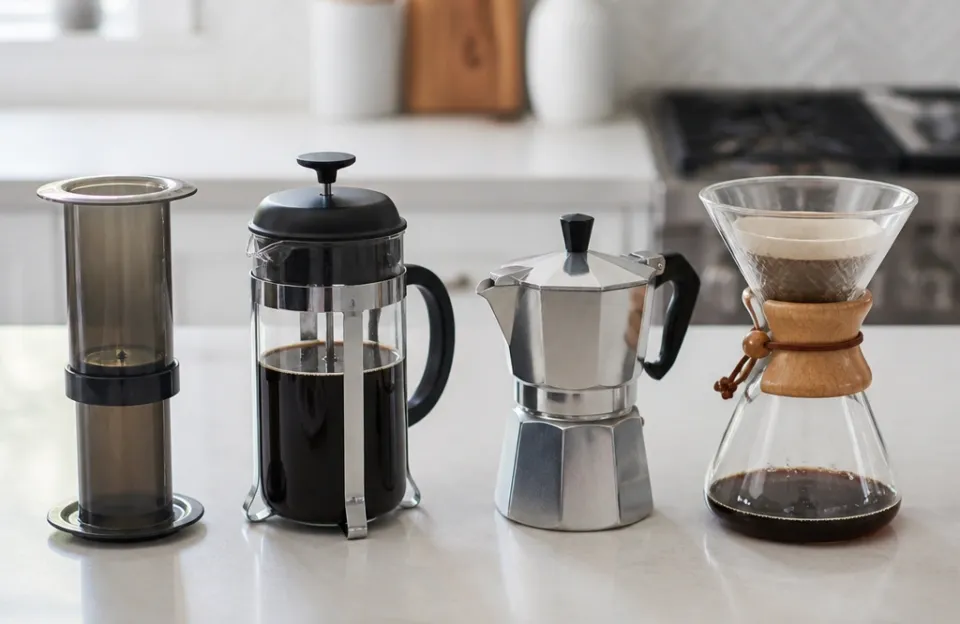
You do not need a full espresso machine to make strong, concentrated coffee at home. The AeroPress is the fastest and most forgiving place to start for most people, the Moka pot suits anyone who wants a classic stovetop brewer, and the Wacaco Nanopresso is the pick for travel and tiny kitchens because it builds pressure by hand. Manual lever makers such as the Flair target genuine espresso pressure without electricity, while a French press gives you full-bodied coffee with no pressure at all.
This comparison focuses on what each device can realistically produce, the grind it needs, and the situations where it makes sense. Manufacturer specifications are treated as specifications, not proof of real-world results.
Quick Comparison of Espresso Machine Alternatives
| Device | Pressure mechanism | Grind and contact time | Practical strengths | Main limits |
|---|---|---|---|---|
| AeroPress | Manual press, no espresso-level pressure specification in stored evidence | Medium, roughly 300 to 700 microns, 1 to 3 minutes | Fast, forgiving, low entry price | No guaranteed crema or true espresso texture |
| Moka pot | Steam-generated pressure from a stovetop heat source | Fine-medium, roughly 300 to 500 microns, 3 to 6 minutes | Concentrated, espresso-style cup | Needs a stove; model-specific induction compatibility not verified |
| Flair manual espresso maker | Manual lever, specifications not verified in stored evidence | Not verified in stored evidence | Genuine manual espresso concept without electricity | Pressure, dose, materials and price unverified |
| Wacaco Nanopresso | Up to 18 bar via a patented hydraulic hand pump | Finer than pour over, slightly coarser than espresso | 336 g, no electricity, portable | Needs practice; one reviewer found light roasts underextract |
| French press | None; full-immersion steeping | Coarse, roughly 800 to 1200 microns, about 4 minutes | Simple, no electricity, full body | No crema; sediment in the cup |
Grind ranges are working references from third-party charts, not a published micron standard. Treat them as starting points and adjust by taste.
AeroPress: the Fastest Espresso Machine Alternative
The AeroPress suits one or two people who want strong coffee quickly with a short learning curve. A medium grind and a brew time of roughly 1 to 3 minutes make it easy to repeat each morning.
Its biggest advantage is price. The AeroPress Original is listed at $39.95, the Go travel system at $49.95, and the XL at $89.95 at the time of checking, though storefront prices can change.
Skip the AeroPress if crema and a thick espresso texture are non-negotiable. Pressure matters for that result, and stored evidence does not give the AeroPress an espresso-level pressure rating. If you want a broader view of how machine types differ, see this breakdown of espresso machine types.
Moka Pot: the Classic Stovetop Brewer
The Moka pot fits anyone who likes the ritual of a stovetop brewer and wants a strong, concentrated cup close to espresso style. It uses a fine-medium grind, between table salt and sand, with roughly 3 to 4 minutes of contact time.
The result is concentrated but not true espresso, because the pressure comes from steam rather than a pump. Model-specific induction compatibility is not verified in the stored evidence, so check your own hob and pot before buying.
Skip the Moka pot if you have no stovetop heat source or want crema. Its brew is strong and syrupy in style, but it is a different drink from a pump-extracted shot.
Flair Manual Espresso Maker: Real Pressure Without Electricity
The Flair appeals to readers who want manual espresso pressure and full control over the shot, with no power cord and no counter-hungry machine. It is the option in this comparison closest to the idea of a lever espresso maker.
That said, the stored evidence does not verify the Flair’s pressure rating, dose, materials or price. Treat any specific bar figure you see elsewhere as unconfirmed until you check the manufacturer’s own documentation for your exact model.
Skip the Flair if you want a proven, fully documented specification sheet before you buy, or if you prefer a device with a short learning curve.
Wacaco Nanopresso: Portable Pump Power
The Nanopresso suits travellers, campers and anyone with a tiny kitchen. It generates up to 18 bar using a patented hydraulic system that amplifies the force you apply by hand, and it weighs 336 g with no electricity needed.
Its water tank holds 80 ml and the filter basket takes about 8 g of ground coffee, while the Barista Kit adds a 140 ml tank and baskets rated for up to 16 g for double shots. Use a grind finer than pour over but slightly coarser than espresso, and grind coarser if the pump is hard to push.
Expect a learning period. One independent reviewer found the Nanopresso needed practice, tended to underextract light roasts into sourness, and performed better with medium to medium-dark espresso roasts. That observation comes from a single reviewer, so treat it as a starting hypothesis rather than a rule.
Skip the Nanopresso if you mostly brew light-roast specialty coffee or want a device that works without any manual effort.
French Press: Strong Coffee, Zero Pressure
The French press fits readers who want a full-bodied, strong cup with minimal equipment and no interest in pressure. A coarse grind, like sea salt or breadcrumbs, steeped for about 4 minutes is the standard approach.
It is the simplest option here and needs no electricity, but it cannot produce crema or true espresso texture. If you want to understand why pressure changes the drink, see this explanation of how espresso machines work and why reservoir temperature matters on electric models.
Skip the French press if sediment bothers you or you specifically want an espresso-style shot rather than a strong mug of coffee.
Choosing the Right Alternative by Situation
- You want the cheapest fast start: choose the AeroPress, with the Original listed at $39.95 at the time of checking.
- You want espresso-style concentration from a stove: choose the Moka pot, ideally with a fine-medium grind.
- You travel or have almost no counter space: choose the Nanopresso, which weighs 336 g and runs on hand power.
- You want manual lever espresso and will verify specs yourself: consider the Flair, but confirm pressure, dose and price with the manufacturer first.
- You just want a stronger cup of coffee: choose the French press, which needs only a coarse grind and about 4 minutes.
If you are also weighing pod machines against traditional setups, this comparison of espresso machines versus Keurig covers the convenience trade-off.
Common Mistakes When Ditching Your Espresso Machine
Using the Wrong Grind
Grind size drives extraction. A finer grind exposes more surface area so water pulls out flavour faster, while a coarser grind extracts more slowly. Sour coffee usually points to under-extraction and suggests grinding finer, while bitterness usually points to over-extraction and suggests grinding coarser.
Start with the range for your device, then adjust one variable at a time. Remember that grinder dial numbers are not standardised, so setting 5 on one grinder is not setting 5 on another.
Expecting True Espresso from Every Device
Only devices that build real pressure can approach espresso texture. The Nanopresso reaches up to 18 bar by hand, but the AeroPress has no espresso-level pressure specification in stored evidence and the French press applies none at all. Judge each device by the drink it is designed to make.
Ignoring Grind Uniformity
Uniformity matters as much as size. Burr grinders produce more even grounds than blade grinders, which create mixed particle sizes and can cause uneven extraction. Fines and boulders also extract at different rates, which muddies the cup.
Forgetting That Roast Level Changes the Grind
Light roasts are denser and often need a finer grind than dark roasts. If your usual setting turns sour with a new bag, the roast, not the device, may be the reason.
The Bottom Line: One Decision Rule
Pick by your priority. If you want the fastest, cheapest path to strong coffee, buy the AeroPress. If you want espresso-style concentration from a stove, buy a Moka pot. If portability and hand-built pressure matter most, buy the Nanopresso. If you want manual lever espresso, verify the Flair’s specifications directly before committing. If you simply want a fuller, stronger cup, the French press delivers that with the least equipment.