Air fryer pork tenderloin cooks in about 20 minutes at 375°F and stays juicy when you pull it at an internal temperature of 145°F. This lean cut dries out fast in traditional ovens, but the air fryer’s concentrated heat creates a browned exterior while keeping the center moist. You need a reliable instant-read thermometer, a simple spice rub, and roughly half an hour from fridge to plate.
This guide covers the exact timing and temperature for tenderloins between one and two pounds. We also address carryover cooking, resting times, and how to adjust for different air fryer models. If you have cooked garlic parmesan wings before, you already understand the basic airflow principles that apply here.
Pork tenderloin just requires stricter temperature control because it has almost no fat to protect it.
Why Lean Pork Needs Strict Temperature Control
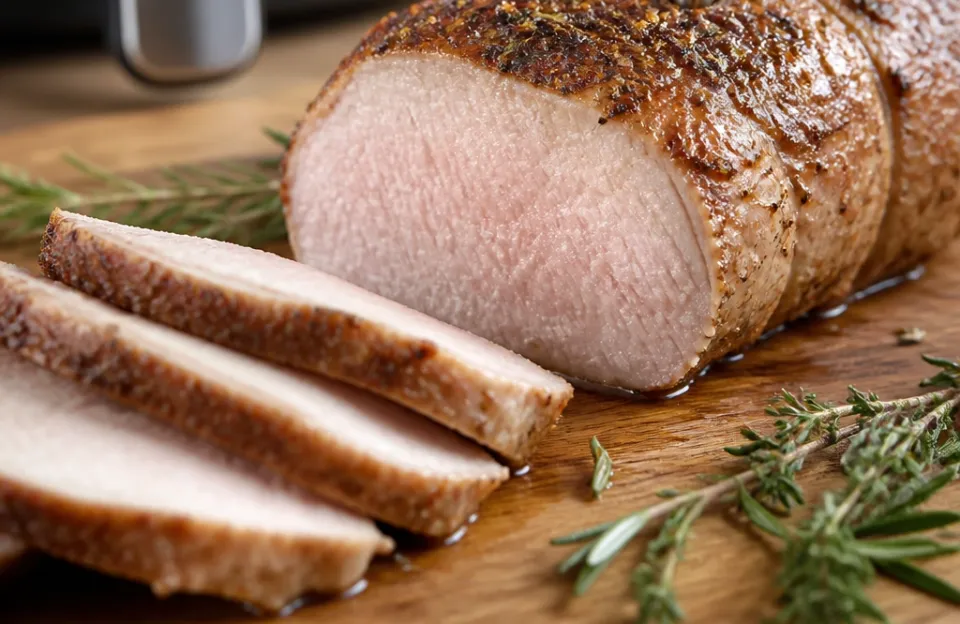
Pork tenderloin is the leanest muscle on the animal. It contains very little intramuscular fat or connective tissue. That makes it tender by nature, but it also means there is no buffer against overcooking.
Once the internal temperature passes 150°F, moisture loss accelerates rapidly. The USDA recommends cooking whole cuts of pork to 145°F followed by a three-minute rest. This standard produces meat that is safe to eat and slightly pink in the center.
Many older cookbooks still reference 160°F, which was revised downward in 2011 based on updated food safety data. Following the current USDA safe minimum internal temperature guidelines prevents both foodborne illness and dry, chalky texture.
The air fryer environment intensifies this risk. Hot air circulates at high speed directly against the meat surface. This creates excellent browning through the Maillard reaction, but it also strips surface moisture faster than a conventional oven.
A tenderloin can go from perfect to overdone in less than two minutes near the end of the cook. That narrow window is why time-based recipes fail consistently. Weight, shape, starting temperature, and individual air fryer wattage all shift the actual cook time.
Temperature is the only dependable indicator.
Carryover Cooking Matters More Than You Think
Carryover cooking is the rise in internal temperature that happens after you remove meat from the heat source. Residual thermal energy moves from the hotter exterior toward the cooler center. For a pork tenderloin pulled at 145°F, the temperature typically climbs another 3 to 5 degrees during resting.
If you wait until the thermometer reads 145°F inside the air fryer, your final serving temperature will likely hit 150°F or higher. Pulling at 140°F accounts for this rise and lands you exactly where you want to be.
Thicker tenderloins experience more carryover than thinner ones. A two-pound roast holds more residual heat than a one-pound piece. Resting time also affects the final number.
Three minutes is the USDA minimum, but five to seven minutes gives better juice redistribution without pushing the temperature too high. Tent loosely with foil if your kitchen is cold, but avoid wrapping tightly. Trapped steam softens the crust you worked to build.
Preparing the Tenderloin Before It Hits the Basket
Preparation determines whether seasoning sticks and whether the exterior browns evenly. Start by patting the entire surface dry with paper towels. Surface moisture creates steam instead of sear.
Remove any silver skin, which is the thin, silvery membrane running along one side. It does not render or soften during cooking. Slide a sharp knife under one edge and angle the blade slightly upward as you pull the membrane taut.
Leaving it on causes curling and creates chewy bites.
Apply oil before seasoning. A light coating of neutral oil helps spices adhere and promotes even browning. Use about one teaspoon per pound.
Rub it in thoroughly rather than drizzling. Then apply your salt and seasonings. Salt draws out moisture over time, so either season immediately before cooking or at least 45 minutes ahead to allow reabsorption.
Mid-range salting leaves the surface wet again. If you are planning ahead, consider how meal prep timing affects moisture management across different proteins.
Choosing a Rub That Complements Lean Meat
Bold, fatty rubs designed for pork shoulder or ribs overwhelm tenderloin. This cut benefits from balanced seasoning that enhances rather than masks its mild flavor. A basic mix of kosher salt, black pepper, garlic powder, paprika, and brown sugar works reliably.
The sugar aids caramelization without making the dish sweet. Dried herbs like thyme or rosemary add depth without adding moisture. Avoid fresh herbs in the rub itself.
They burn at air fryer temperatures and release water unpredictably. Add them after resting if you want their brightness.
Marinades are optional and require caution. Acidic marinades with vinegar, citrus, or wine begin breaking down muscle fibers within 30 minutes. For tenderloin, this quickly turns the texture mushy rather than tender.
Limit acidic marinades to two hours maximum. Oil-based herb pastes or brines are safer for longer marinating windows. Always pat marinated meat dry before air frying.
Wet surfaces steam instead of brown, regardless of how flavorful the liquid was.
Getting the Timing Right Across Different Sizes
Weight is the primary variable for cook time, but shape matters equally. A long, thin tenderloin cooks faster than a short, thick one of identical weight. Most grocery store tenderloins range from 1 to 1.5 pounds.
At 375°F, expect the following ranges as starting points only. Always verify with a thermometer.
| Tenderloin Weight | Estimated Cook Time | Target Pull Temp | Final Temp After Rest |
|---|---|---|---|
| 1 lb (thin) | 15–18 min | 140°F | 145°F |
| 1.25 lbs (average) | 18–22 min | 140°F | 145°F |
| 1.5 lbs (thick) | 22–26 min | 140°F | 145°F |
| 2 lbs (large) | 28–32 min | 138°F | 145°F |
Flip the tenderloin halfway through cooking. This ensures even exposure to the heating element, especially in basket-style air fryers where heat comes primarily from above. Tongs work better than forks, which pierce the meat and release juices.
Check temperature at the thickest point each time you flip. Insert the probe horizontally into the center, avoiding contact with the basket or rack beneath. Hitting metal gives a false high reading.
Adjusting for Your Specific Air Fryer Model
Not all air fryers behave identically. Wattage, basket size, and fan speed create meaningful differences. Higher-wattage units (1700W+) often run hotter and faster than lower-wattage models (1400W).
If your tenderloin consistently finishes below the estimated range, your unit likely runs hot. Reduce temperature by 10, 15°F next time rather than shortening the cook. Shorter cooks sacrifice crust development.
Lower temperatures preserve texture while extending browning time slightly.
Basket overcrowding causes uneven cooking. Air needs space to circulate around the entire surface. Cook one tenderloin at a time unless your basket is large enough to hold two without touching.
If you must cook multiple pieces, rotate their positions at the halfway mark. Outer edges receive more direct airflow than centers. Swapping positions compensates for this gradient.
For reference on how protein density affects results, compare this to achieving extra crispy skin on wings, where spacing is equally critical.
Using Thermometers Correctly to Avoid Guesswork
A digital instant-read thermometer is non-negotiable for pork tenderloin. Dial thermometers respond too slowly for the narrow window between done and overdone. Look for a model with a response time under three seconds and accuracy within ±1°F.
Calibrate periodically using ice water (32°F) or boiling water (212°F at sea level). Even good thermometers drift over time. When checking temperature, insert the probe into the geometric center of the thickest section.
Angle it so the tip sits away from bone, fat pockets, or the basket surface. Take readings in two or three spots to confirm consistency.
Leave-in probe thermometers offer continuous monitoring without opening the basket repeatedly. Each time you open the air fryer, internal temperature drops 20, 30°F and recovery takes several minutes. A wireless probe eliminates this disruption.
Models like the Typhur Sync Gold dual wireless thermometer transmit real-time data to your phone, letting you track progress without disturbing the cooking environment. Set an alarm for 135°F to give yourself time to prepare sides and check manually at 140°F. Redundancy protects against probe failure or misplacement.
Where Probe Placement Goes Wrong
Incorrect probe placement is the most common cause of inconsistent results. Inserting too shallow reads surface temperature, which runs hotter than the center. Inserting too deep risks hitting the basket, which reads far hotter than the meat.
Both errors lead to pulling the meat prematurely. Practice finding the true center by feel before relying solely on the display. The probe should enter horizontally through the side of the tenderloin, not vertically from the top.
Vertical insertion makes it harder to judge depth and increases the chance of bottoming out.
If you get a reading that seems off, trust your instincts. Reinsert in a slightly different spot. Compare against a second thermometer if available.
Digital sensors occasionally malfunction, especially if exposed to extreme heat cycles repeatedly. Keeping a backup digital meat thermometer in the drawer costs little and prevents ruined dinners. Never assume a single reading is correct if it contradicts visual cues or expected timing.
Resting and Slicing for Maximum Moisture Retention
Resting allows muscle fibers to relax and reabsorb expelled juices. Cutting immediately releases those juices onto the cutting board instead of keeping them in the meat. Place the cooked tenderloin on a warm plate or cutting board.
Tent loosely with foil. Wait five to seven minutes. During this time, the internal temperature stabilizes and moisture redistributes throughout the cross-section.
Skipping this step undoes careful temperature management.
Slice against the grain. Pork tenderloin has long, parallel muscle fibers running lengthwise. Cut perpendicular to these fibers in half-inch slices.
Cutting with the grain produces stringy, tough bites even when the meat is perfectly cooked. Use a sharp chef’s knife or slicing knife. Dull blades crush rather than cut, squeezing out moisture.
Serve promptly after slicing. Held slices continue losing heat and moisture. If holding is necessary, keep slices intact rather than pre-slicing.
Whole pieces retain warmth and juiciness longer.
Adapting Techniques for Stuffed or Wrapped Variations
Stuffing adds complexity to timing and food safety. Any filling containing dairy, eggs, or raw vegetables must reach 145°F alongside the pork. This often requires lowering the air fryer temperature to 350°F and extending cook time by 5, 10 minutes.
Higher heat browns the outside before the stuffing heats through. Secure stuffing with toothpicks or kitchen twine to prevent leakage. Remove picks before slicing.
Check temperature in both the meat and the center of the filling.
Bacon wrapping adds fat and flavor but changes heat transfer. Bacon insulates the surface, slowing browning and requiring longer cook times. Par-cook bacon partially before wrapping to ensure it crisps rather than staying rubbery.
Overlap slices slightly to create full coverage. Secure ends underneath the tenderloin. Monitor closely near the end, as rendered bacon fat can smoke at sustained high temperatures.
If smoking occurs, reduce temperature immediately and finish at lower heat. The principles mirror those used when balancing crispness and doneness in honey garlic wing preparations, where glaze or coating alters surface behavior.
Frequently Asked Questions
Can I cook frozen pork tenderloin in the air fryer?
Yes, but expect 50% longer cook time and less even browning. Cook at 350°F rather than 375°F to allow heat penetration without burning the exterior. Check temperature frequently after the 25-minute mark.
Thawing overnight in the refrigerator always produces superior texture and more predictable timing. Frozen cooking is a backup option, not a best practice.
Why did my pork tenderloin turn out dry despite hitting 145°F?
Your thermometer may read inaccurately, or carryover cooking pushed the final temperature higher than expected. Verify calibration in ice water. Also consider whether you rested the meat too long or sliced too early.
Even correctly cooked tenderloin loses moisture if handled poorly post-cook. Next time, pull at 138, 140°F and limit resting to five minutes.
Should I brine pork tenderloin before air frying?
Brining improves moisture retention and is worth doing if you have had dryness issues. Dissolve ¼ cup kosher salt in 4 cups water and submerge for 2, 4 hours. Longer brining makes the meat overly salty.
Pat completely dry before seasoning and cooking. Skip brining if your rub already contains significant salt. Wet-brined meat also takes longer to brown due to retained surface moisture.
How do I know when my air fryer is properly preheated?
Most air fryers signal completion with a beep or light. If yours lacks this feature, run empty at target temperature for 3, 5 minutes. Preheating matters for pork tenderloin because immediate searing locks in surface texture.
Adding meat to a cold basket extends total cook time and produces pale, steamed exteriors. Treat preheating as mandatory, not optional.
Can I use this method for pork loin roast?
No. Pork loin roast is thicker, wider, and often sold bone-in. It requires lower temperatures (325, 350°F) and significantly longer cook times.
Air fryer baskets rarely accommodate full roasts without crowding. Use tenderloin-specific guidance only for tenderloins. Confusing the two cuts is a common error that leads to undercooked centers or dried-out edges.
Worth Remembering
Air fryer pork tenderloin rewards attention to detail over rigid adherence to timers. Trust your thermometer, respect carryover cooking, and resist the urge to peek. The margin between juicy and dry is measured in degrees, not minutes.
Once you internalize the 140°F pull and proper resting protocol, this becomes one of the fastest reliable weeknight proteins available. Keep notes on your specific air fryer’s behavior. After two or three cooks, you will develop intuition that no generic chart can provide.