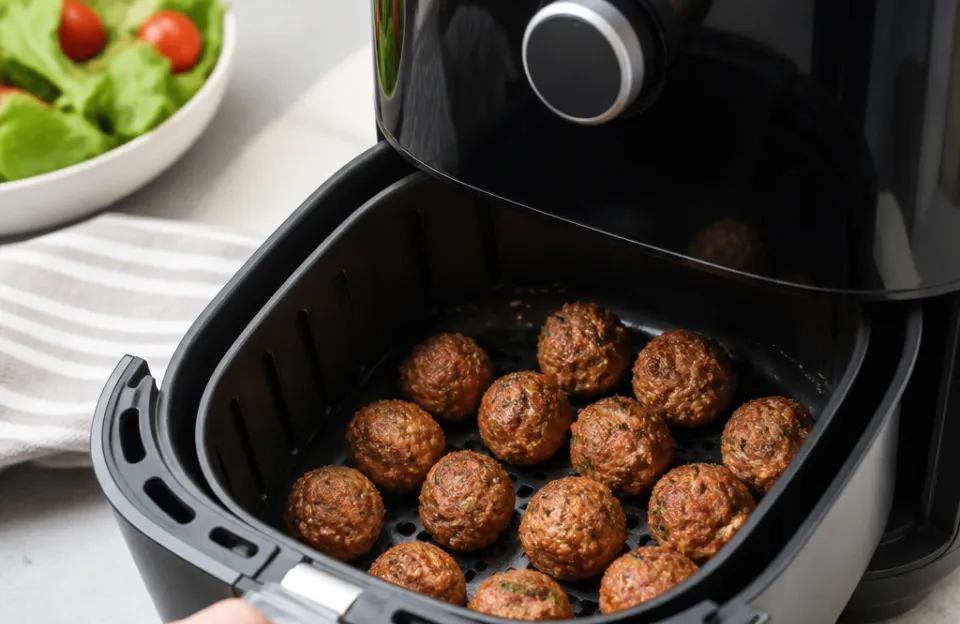
Air fryers with temperature probes cook thick meats by tracking the internal heat of the food in real time. The probe connects to a port on the machine and sends readings to the display, so you know exactly when a roast or chicken breast hits its safe target. This removes the guesswork from cooking dense proteins in a high-speed convection environment.
Standard air fryers rely entirely on set timers and fixed temperatures. That approach works fine for fries or reheating pizza. Thick cuts of meat need more attention because hot circulating air cooks the outside much faster than the inside.
A built-in probe bridges that gap by monitoring the center of the food directly. If you regularly cook whole chickens, pork loins, or thick steaks, air fryers with temperature probes save you from cutting into the meat to check for doneness.
How the Probe Reads Heat Inside the Basket
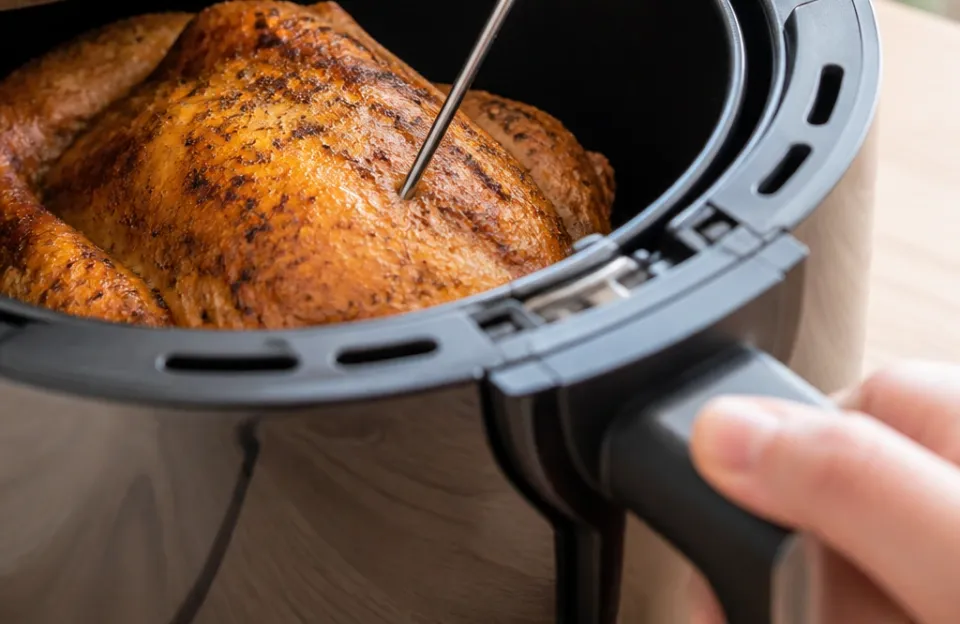
The system uses a metal rod connected to a wire that plugs into the base of the appliance. You insert the rod into the thickest part of the raw meat before starting the cycle. As the fan pushes hot air around the food, the sensor at the tip of the rod tracks the rising internal temperature.
That reading travels through the wire to a digital display on the front panel. Most models let you set a target temperature before you start cooking. When the meat reaches that number, the machine either beeps loudly or shuts off the heating element automatically.
This prevents overcooking, which happens fast in these appliances due to the intense airflow.
The technology is identical to standalone meat thermometers used in traditional ovens. The difference is the integration. Because the probe communicates directly with the heating element, the appliance can react immediately.
It stops applying heat the second your food is done.
You still need to place the probe correctly. Hitting a bone or resting the tip in a pocket of fat gives a false reading. Push it into the geometric center of the thickest muscle for accurate data.
I've found that angling the wire so it doesn't touch the heating element above the basket prevents the cord from melting or throwing off the sensor.
Why Timing Alone Fails With Dense Proteins
Cooking times printed in manuals assume a specific weight, thickness, and starting temperature. A two-pound piece of meat straight from the fridge takes longer to cook than one left on the counter for thirty minutes. Relying strictly on a timer means you are guessing.
This problem gets worse with irregular shapes. A whole chicken has thick thighs and thin wings. Setting a timer for forty minutes might leave the thighs undercooked while drying out the breast.
Air fryers with temperature probes solve this by ignoring time as the primary metric. The internal heat dictates when the cycle ends.
Food safety depends on hitting specific numbers. The FDA recommends cooking all poultry to an internal temperature of 165°F to destroy harmful bacteria. Ground meats require similar precision.
Guessing with a kitchen timer leaves room for error. A probe gives you a verified number on the screen.
If you plan your meals around large cuts, knowing how long a heavy loaf takes without a probe usually involves checking it multiple times. Opening the basket drops the ambient heat instantly. Every time you pull the drawer out to use a handheld thermometer, the machine loses momentum.
Leaving a wired probe inside keeps the drawer shut and the heat stable.
What to Look for in Probe-Equipped Models
Not every model with a jack for a thermometer performs the same way. Several hardware details separate a reliable machine from a frustrating one.
Cord Length and Routing
The wire needs to reach from the center of the basket to the exterior port without pulling tight. If the cord is too short, you can't close the drawer properly. A pinched cord damages the internal wiring over time.
Look for models where the port sits near the front hinge, giving the wire a natural path out of the cooking chamber.
Temperature Range Limits
Most probes read between 90°F and 400°F. Some budget models cap out lower. If you want to cook a thick steak to medium-rare, you need a sensor that responds accurately at lower targets like 130°F.
Cheap sensors often lag or jump erratically below 140°F. Check the spec sheet for the exact operating range.
Auto-Shutoff Behavior
The best machines turn off the heating element completely when the target is reached. Some cheaper versions only sound an alarm but keep blowing hot air. If you aren't standing right next to the counter, a beeping machine that keeps cooking will ruin your dinner.
Auto-shutoff is a necessary function for this setup to work safely.
Probe Storage
A loose metal rod rolling around in a drawer bends easily. Better models include a dedicated slot on the back or side of the housing to store the rod when you aren't using it. Losing the probe renders the entire function useless, since replacement cords are rarely sold separately by manufacturers.
When you look at different brands, comparing how they handle the physical connection matters just as much as the digital display. Some units route the wire through the top lid, while others use a side port. Side ports generally work better for basket-style machines.
Cooking Specific Cuts Using the Sensor
Different proteins require different placement strategies. The thickest part of the meat always dictates where the tip should rest.
For whole birds, push the rod into the deepest part of the thigh, avoiding the joint. Dark meat takes longer to cook than white meat. If the thigh hits 165°F, the breast is already past that point.
This guarantees the whole bird is safe to eat. Getting the skin perfectly browned still requires managing the external heat, so you might need to remove the probe and blast the heat for the last two minutes if the skin looks pale.
Thick steaks need the probe inserted horizontally through the side, aiming for the dead center. This gives you an accurate read on the gradient from rare to well-done. Pulling a steak at 130°F allows for carryover cooking while it rests on the cutting board.
Roasts and loins benefit most from this technology. A pork loin dries out incredibly fast in a convection current. Setting the target to 145°F and letting the machine stop itself yields a juicy result.
Trying to time a three-pound roast manually usually ends in tough, overcooked meat.
Even smaller items like individual drumsticks can be monitored, though fitting the probe into a small piece of meat takes practice. You have to angle the rod carefully so it stays buried in the flesh rather than poking out the other side.
Fish presents a unique challenge. Flaky fillets fall apart if you try to push a metal rod into them. The probe works best for thick salmon steaks or whole trout.
For thinner fish, standard timing remains the better method. Monitoring thicker cuts of seafood with a probe prevents the center from staying raw while the edges turn to leather.
Where Built-In Probes Fall Short
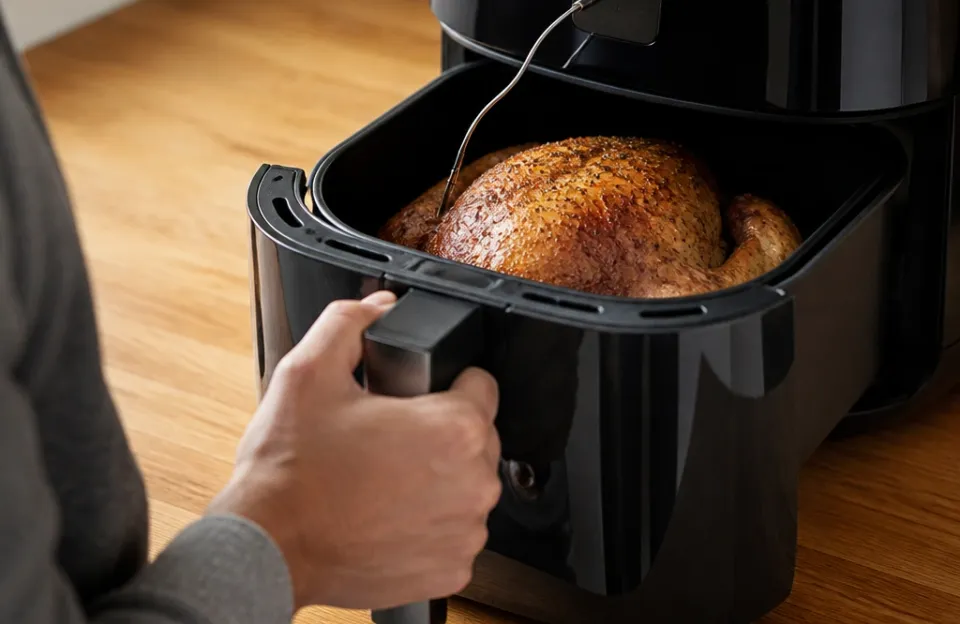
These machines excel at roasting, but they have clear limitations. Understanding what they cannot do prevents frustration.
You can't use the probe for frozen foods. Pushing a metal rod into a solid block of ice damages the sensor and gives meaningless readings. The food must be fully thawed before the probe can track the internal heat accurately.
Battered or breaded items don't work well either. Dragging a wet, coated piece of chicken out of the basket pulls the breading off on the wire. The probe is meant for bare proteins or dry rubs.
If you prefer a flour coating on your poultry, you are better off using a timer and a quick check with a handheld thermometer at the end.
Vegetables and baked goods ignore the probe entirely. Potatoes, broccoli, and muffins don't have a target internal temperature that dictates doneness in the same way meat does. The sensor is useless for these tasks.
Knowing roughly how long root vegetables take relies on visual cues and fork-tenderness, not digital readouts.
Cleaning the wire requires care. Submerging the connection end in water ruins the electronics. You have to wipe the rod down with a damp cloth and mild soap, keeping the plug completely dry.
Dishwashers destroy these cords quickly.
| Attribute | Standard Air Fryer | Model With Integrated Probe |
|---|---|---|
| Doneness Tracking | Manual timer estimation | Real-time internal reading |
| Best Used For | Fries, snacks, reheating, veggies | Whole chickens, roasts, thick steaks |
| Basket Interruptions | Frequent opening to check meat | Zero; drawer stays closed |
| Cleaning Effort | Basket and tray only | Basket, tray, plus careful hand-washing of the wire |
| Frozen Meat Capability | Yes (adjusting time) | No (must thaw first for probe accuracy) |
| Price Point | Lower baseline cost | Higher due to added sensor hardware |
Maintenance and Keeping the Hardware Working
The wire connecting the probe to the machine is the weakest link in the entire system. Bending it sharply near the base causes internal breaks that ruin the sensor. Always coil it loosely when storing it.
Grease buildup on the rod affects how fast it reads temperature changes. Wipe it down after every single use. Burnt-on fat acts as an insulator, making the sensor sluggish.
If the readings seem delayed compared to what you expect, scrub the metal tip gently with a non-abrasive sponge.
Check the port where the wire plugs into the machine. Splattering fat can get inside that socket. If grease hardens in the port, the connection becomes intermittent.
The display will flash errors or drop the reading entirely. Keep a cotton swab handy to clean out the socket when the unit is unplugged and cool.
Replacement parts are difficult to source. Manufacturers rarely sell the probe cord separately. If you break it, you lose the primary function you paid extra for.
Treat the cord gently. Don't yank it out of the meat; twist it slightly to release the grip of the cooked protein before pulling.
If you own a specific brand like a popular countertop model, check the manual for their specific cleaning warnings regarding the probe jack. Some units have sealed ports that tolerate moisture better than others.
Picking the Right Size for Your Kitchen
Adding a probe doesn't change the footprint of the machine, but it does change how you use the space. These models tend to come in larger capacities because probing a single chicken nugget makes no sense. You'll typically see them in five-quart to ten-quart sizes.
Make sure your counter has clearance for the wire. If the machine sits flush against a backsplash, routing the cord out of the basket becomes awkward. You need a few inches of breathing room around the unit so the wire doesn't kink against the wall.
Larger baskets also mean heavier loads. Moving a machine loaded with a four-pound roast requires a sturdy surface. The probe wire adds another thing to manage when pulling the drawer out, though you shouldn't be pulling the drawer out while cooking anyway.
Some oven-style units place the probe port on the interior back wall, while basket styles put it on the rim. Basket styles are easier to load because you can see the meat clearly from above. Oven styles sometimes hide the food behind racks, making probe insertion a blind task.
If you frequently rotate between different types of proteins, consider whether you want a machine dedicated to roasting or a multi-function unit. Some people keep a basic fryer for daily snacks and reserve the probe-equipped model for weekend meal prep. Balancing the nutritional outcome of your meals starts with cooking the meat properly without charring the outside to compensate for a raw center.
Frequently asked questions
Can I use my own handheld thermometer instead of the built-in probe?
You can, but you have to open the basket every time you want to check the meat. Opening the drawer releases the concentrated hot air immediately. The machine then has to work harder to recover that lost heat, which extends the total cooking time and dries out the surface of the food.
The integrated probe keeps the chamber sealed the entire time.
Does the probe wire melt if it touches the heating element?
Yes. The heating coils in these appliances reach extreme temperatures very quickly. If the wire drapes upward and touches the element, the insulation will melt and ruin the cord.
Always route the wire downward and out of the basket, ensuring it stays clear of the top heating zone.
Are air fryers with temperature probes safe to wash in the dishwasher?
The removable basket and crisper plate are usually dishwasher safe. The probe wire is never dishwasher safe. Submerging the electrical connection end destroys the sensor.
Wash the metal rod by hand with warm soapy water, keeping the plug end completely dry.
Do I need to calibrate the probe before cooking?
Most consumer models come pre-calibrated from the factory and don't offer user calibration settings. If you suspect the reading is inaccurate, test it by placing the probe in a glass of ice water. It should read 32°F.
If it's significantly off, contact the manufacturer, as the sensor may be defective.
Can I leave the probe in while preheating the machine?
No. Running the appliance empty with the probe inside exposes the metal rod to direct, unobstructed heat. This can damage the sensor or cause the wire to overheat since there is no food mass absorbing the thermal energy.
Insert the probe into the cold meat, place it in the basket, and then start the cooking cycle.
Worth remembering
Air fryers with temperature probes remove the anxiety from cooking thick cuts of meat in a rapid convection environment. They give you a precise, verifiable number instead of forcing you to guess based on a printed chart. The tradeoff is a delicate wire that requires careful handling, specific cleaning routines, and proper storage.
If your weekly rotation includes whole birds, pork loins, or thick steaks, the integrated sensor pays for itself by preventing ruined dinners. For daily batches of fries or reheated leftovers, the probe stays in the drawer, and the machine functions exactly like any standard countertop fryer.