Rechargeable food scales with USB or USB-C ports give you consistent power without hunting for replacement batteries. Battery-powered models run on standard cells you swap out when they die. The main difference comes down to how often you cook and where you keep the scale.
If you weigh ingredients daily, a rechargeable model saves money and hassle over time. If you bake once a week or need something portable for outdoor cooking, disposable batteries are simpler.
Choosing between rechargeable vs battery-powered food scales (USB & USB-C) depends on your kitchen habits. This comparison breaks down charging speeds, long-term costs, lifespan, and practical trade-offs so you can pick the right power source for your setup.
How Power Sources Change Your Kitchen Scale
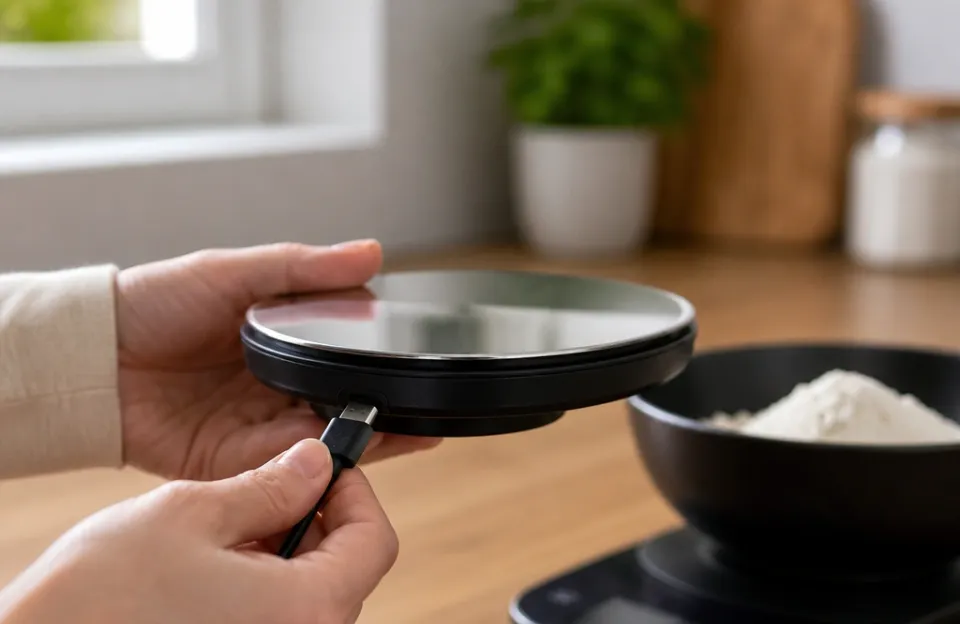
The core difference between these two types of food scales is how they store energy. Rechargeable scales contain a built-in lithium-ion or lithium-polymer cell. You plug them into a wall adapter, laptop, or power bank using a cable.
Battery-powered scales use a compartment that holds AA, AAA, or coin-cell batteries. When those drain, you pull them out and put new ones in.
This distinction changes how you interact with the scale every single day. A rechargeable scale sits on your counter near an outlet. You top it off like your phone.
A battery-powered scale lives anywhere because it has no cord dependency until the cells die. Both types use load cells to measure weight, so accuracy stays the same regardless of the power source. Precision relies on sensor quality, not whether electricity comes from a lithium pack or an alkaline cylinder.
Cable Types: USB-A vs USB-C Charging Speeds
Older rechargeable food scales use Micro-USB or USB-A connections. These cables deliver power at 5 volts and usually cap out around 1 to 2 amps. A full charge takes several hours.
Newer models ship with USB-C ports. USB-C supports higher wattage delivery and faster charging cycles. You can often top off a USB-C scale in under two hours.
USB-C also removes the frustration of plugging the cable in upside down. The connector is symmetrical. Since most modern kitchens already have USB-C cables lying around for phones and tablets, keeping your scale powered becomes much easier.
You share one cable across multiple devices. If you buy a rechargeable scale today, checking for a USB-C port is worth the few extra dollars it might cost over an older Micro-USB version.
Voltage Drops and Display Dimming
Battery-powered scales experience voltage drops as the cells deplete. Fresh alkaline batteries output 1.5 volts each. As you use them, that number falls.
Many scales compensate well, but some cheaper models show dimming LCD screens or sluggish button responses when the batteries get low. This doesn't mean the weight reading is wrong, but it makes the scale harder to read.
Rechargeable scales maintain a steadier voltage curve. The internal circuitry regulates power from the lithium cell until the battery is almost completely empty. The display stays bright.
The buttons stay responsive. Then the scale simply shuts off or shows a low-battery warning, giving you time to plug it in. This consistency matters if you rely on the screen while working quickly through a recipe.
Comparing Rechargeable vs Battery-Powered Food Scales (USB & USB-C)
Looking at specific categories makes the choice clearer. Cost, convenience, environmental impact, and longevity all behave differently depending on the power type. Here is how the two options stack up against each other.
| Comparison Factor | Rechargeable (USB / USB-C) | Battery-Powered (Disposable) |
|---|---|---|
| Upfront Price | Usually $25 to $60+ | Usually $10 to $30 |
| Ongoing Cost | Zero (uses existing chargers) | Replacement batteries ($4 to $10 per year) |
| Charge/Replace Time | 1 to 4 hours via cable | Seconds to swap cells |
| Environmental Impact | Lower waste, eventual e-waste | Continuous battery disposal |
| Portability | Tied to cable access eventually | Fully wireless indefinitely |
| Lifespan Limit | Battery degrades after 3 to 5 years | Lasts until electronic components fail |
| Low Battery Behavior | Steady performance, then shutoff | Gradual screen dimming or slow response |
Upfront Price vs Long-Term Spending
Battery-powered food scales are cheaper to buy. You can find basic digital models for ten to fifteen dollars. They include the first set of batteries in the box.
Rechargeable scales cost more initially because the manufacturer includes a lithium cell and a charging circuit. Prices typically start around twenty-five dollars and climb higher for models with premium materials or advanced functions.
Over a few years, the math shifts. If you cook daily, you might replace the batteries in a standard scale four to six times a year. Depending on the battery size, that adds up.
A rechargeable scale uses electricity that costs fractions of a penny per charge. Within two to three years, the higher purchase price of the rechargeable model pays for itself. If you only use the scale occasionally, the cheap battery model stays the better financial choice.
Counter Space and Cord Management
A rechargeable scale needs access to a cable when it dies. If your kitchen outlets are far from your prep area, dragging a cord across the counter gets annoying. Some people leave their scale plugged in constantly, which means dealing with a wire near water, flour, and food prep zones.
USB-C helps here because you can use shorter, more flexible cables, and many power banks work as temporary charging stations.
Battery-powered scales have zero cords during use. You place them anywhere. You store them in a drawer without worrying about tangling wires.
For small kitchens or cluttered counters, this freedom is a real advantage. Just keep spare batteries in the same drawer so you aren't stuck mid-recipe when the scale dies. Speaking of organizing your workspace, keeping appliances tidy goes hand in hand with other kitchen updates, like choosing the right cabinet finish to match your overall layout.
Environmental Waste and Disposal
Disposable batteries end up in landfills. Even alkaline cells, which are less toxic than older chemistries, represent continuous physical waste. If you go through multiple sets a year, that pile grows.
Rechargeable scales produce less frequent waste. One lithium cell lasts hundreds of charge cycles. However, when that internal battery finally degrades, disposing of a device with a built-in lithium battery requires following local e-waste rules.
You can't just throw it in the regular trash safely. According to EPA guidelines on electronics, lithium-ion batteries must be recycled properly to prevent fire hazards and chemical leaks. So while rechargeable scales generate less volume of waste, the disposal process at the end of their life demands slightly more attention.
Built-In Battery Degradation Over Time
Lithium-ion batteries lose capacity as they age. After three to five years of regular charging, a scale that originally lasted a month on a full charge might only last two weeks. Eventually, the battery won't hold enough power to turn the device on.
Because the cell is sealed inside the housing, replacing it requires opening the casing, desoldering connections, and finding a matching cell. Most people don't do this. The whole scale gets thrown away.
Battery-powered scales don't have this problem. The electronic components, like the load cell and the circuit board, often outlast the user's interest in the device. If a part fails, you haven't lost an expensive internal battery.
You just swap the outer cells and keep going. This makes battery-powered models surprisingly durable over very long timelines, assuming the physical buttons and sensors hold up.
If you prefer gadgets with built-in power packs, you'll notice similar technology in other tools. For example, a rechargeable probe thermometer uses the exact same lithium charging logic as a USB food scale. Understanding how one handles power helps you manage the other.
When a Dead Scale Ruins Dinner
Baking requires precision. If you're measuring flour by weight for bread or macarons, stopping to deal with a dead scale throws off your timing. With a battery-powered model, a sudden death means digging through drawers for spares.
If you don't have any, your baking session is over.
With a rechargeable scale, a dead battery means plugging in a cable. If you have a USB-C port nearby, you can actually use the scale while it charges. Many modern models support pass-through power.
You plug it in, turn it on, and keep weighing ingredients. This is impossible with a battery-powered scale unless you physically have new cells ready to drop in. Pass-through charging gives rechargeable scales a massive edge for heavy users who forget to top off the battery before starting a big project.
Accurate measurements matter across all cooking methods. Whether you are portioning dough or verifying that poultry hits the safe minimum internal temperature outlined by the USDA food safety standards, reliable equipment keeps your results consistent. A scale that loses power mid-task compromises that reliability.
Water Resistance and Cleaning Around Ports
Food scales get messy. Flour dust, spilled milk, sticky syrups, and grease cover the surface regularly. Wiping down a battery-powered scale is simple.
You remove the batteries if you want to be safe, or just avoid the bottom compartment while cleaning the top. The battery door usually has a basic seal.
Rechargeable scales introduce a vulnerability: the charging port. A USB or USB-C hole is an open path into the electronics. If water or liquid sugar seeps into that port, it can short the circuit board or corrode the contacts.
Manufacturers try to mitigate this with rubber flaps or recessed port designs, but it remains a weak point. You have to be careful when washing the scale. Never submerge a rechargeable model.
Wipe it with a damp cloth and keep moisture away from the socket.
This concern extends to all your digital kitchen gear. Keeping moisture out of sensitive ports applies equally when you scrub the interior of a toaster oven air fryer or wipe down any countertop appliance with exposed connections.
Travel, Camping, and Off-Grid Weighing

If you take your food scale camping, to a farmer's market, or use it in an RV, power availability dictates your choice. A rechargeable scale works great on a trip as long as it starts fully charged. But once it dies, you need a power bank, a car charger, or a solar panel to revive it.
In deep off-grid situations, that dependency becomes a liability.
A battery-powered scale thrives off-grid. You toss a couple of spare AA batteries in your bag. They weigh almost nothing.
If the scale dies in the woods, you swap them in ten seconds and keep cooking. For backpackers tracking food weight or vendors selling bulk goods outdoors, disposable batteries offer peace of mind that a USB cable can't match.
Even high-tech wireless gear faces similar constraints. If you've ever dealt with a dropped signal on a Bluetooth thermometer while grilling outside, you know how frustrating connectivity issues get away from home. Power and connection stability always matter more when you leave the kitchen.
Which Type Fits Your Cooking Routine
Picking between rechargeable vs battery-powered food scales (USB & USB-C) comes down to frequency and location. Match the power source to how you actually cook.
Choose a rechargeable USB-C scale if you weigh food daily, meal prep in batches, or bake frequently. The steady voltage keeps the display bright, pass-through charging prevents interruptions, and you stop buying disposable batteries. It fits best in a stationary kitchen where an outlet is within reach of your prep zone.
Pick a battery-powered scale if you cook casually, need maximum portability, or work in environments without easy access to electricity. It's cheaper upfront, completely waterproof-friendly since there are no exposed ports, and swapping cells takes seconds. It fits best for occasional bakers, campers, or anyone who hates managing another charging cable.
Some people own both. They keep a heavy-duty rechargeable scale on the main counter for daily tasks and a cheap battery model in a drawer for travel or backup. That approach covers every scenario without compromise.
Misconceptions About Scale Power Sources
People repeat a few claims about food scale power that don't hold up in practice.
- Rechargeable scales are less accurate. Accuracy comes from the load cell sensor, not the power supply. A twenty-dollar battery scale and a sixty-dollar USB-C scale can have identical gram-level precision.
- Leaving batteries in ruins the scale. Modern alkaline batteries rarely leak if used periodically. Problems arise when scales sit untouched in humid storage for years. Remove batteries if you plan to store the scale for months.
- Any USB cable works the same. Cheap, thin cables cause voltage drops that make charging painfully slow or trigger false "low battery" warnings. Use a quality cable rated for data and power transfer.
- Built-in batteries cannot be replaced. Technically, they can, but it requires soldering skills. Manufacturers design them as sealed units, meaning replacement is impractical for most users.
- Solar panels easily recharge USB scales. While possible, the tiny solar panels on novelty kitchen gadgets rarely provide enough amperage to charge a lithium cell efficiently indoors.
Frequently Asked Questions
Can I use a rechargeable food scale while it is plugged in?
Many modern USB-C food scales support pass-through charging. This means you can weigh ingredients while the device draws power from the wall. Check the manufacturer specifications before trying it, as older Micro-USB models sometimes disable the sensors while charging to protect the circuit.
Which is better for baking, rechargeable or battery-powered food scales?
Rechargeable scales are generally better for serious baking. Baking requires precise, uninterrupted measurements. A rechargeable model provides consistent voltage to the display and allows you to plug it in immediately if the battery drops low mid-recipe.
How long does a USB-C food scale battery last per charge?
Most rechargeable food scales last between two weeks and two months on a single charge, depending on how often you use the backlight and tare functions. Heavy daily use drains it faster, while occasional weekend baking stretches the cycle significantly.
Do battery-powered scales lose accuracy as the batteries die?
The load cell measures weight mechanically, so the actual accuracy rarely changes. However, low voltage can cause the digital display to flicker, freeze, or round numbers incorrectly. This makes the scale appear inaccurate even if the underlying sensor is still functioning properly.
Are replacement batteries expensive for food scales?
Standard AA or AAA batteries cost very little, especially in bulk. Coin-cell batteries like CR2032 are slightly more expensive per unit but last longer due to the low power draw of simple scales. Overall, battery costs remain low unless you weigh items multiple times every single day.
Is USB-C really necessary for a kitchen scale?
It isn't strictly necessary, but it is highly convenient. USB-C charges faster than older ports, uses a reversible connector, and matches the cables you already own for phones and tablets. It removes the need to keep a dedicated, outdated cable in your kitchen drawer.
Picking the Right Power Source for Your Counter
Your cooking habits dictate the right choice. Daily meal preppers benefit from the steady power and modern convenience of a USB-C rechargeable scale. Occasional cooks save money and avoid cord clutter with a simple battery-powered model.
Think about where you stand while you prep, how often you turn the scale on, and whether you want to manage another charging cable. Once you align the power source with your actual routine, you won't think about it again until it's time to weigh your next ingredient.