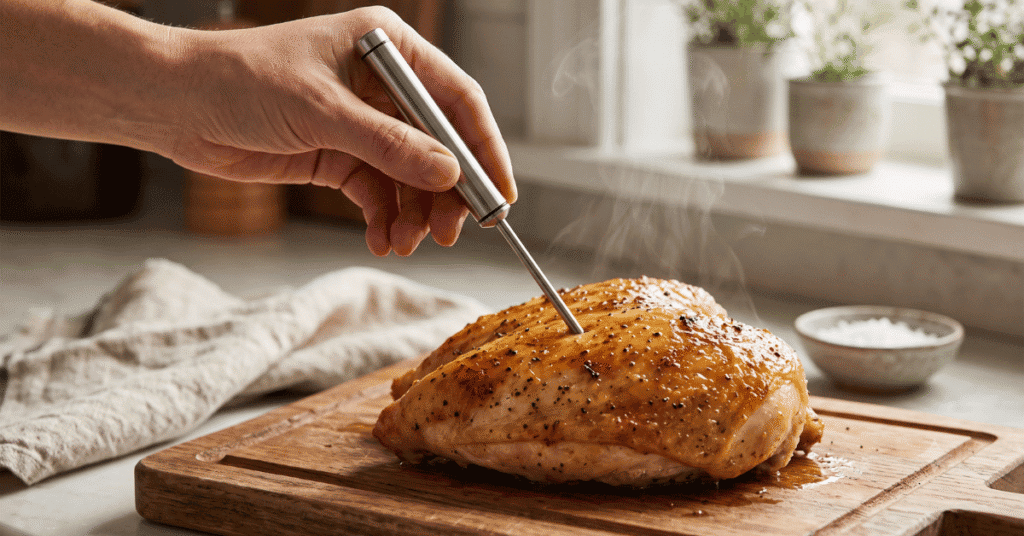
You’ve spent an hour hovering over the grill, watching the crust on your ribeye turn a perfect mahogany brown. You stick the probe in, see the number you’ve been waiting for, and kill the heat. But ten minutes later, you cut into a grey, leathery mess that looks nothing like the medium-rare steak you promised.
What happened? You fell victim to the most common mistake in the kitchen: ignoring the momentum of heat.
Quick Answer: You should pull your meat thermometer out, and remove the meat from the heat, when the internal temperature is 5°F to 10°F (3°C to 6°C) below your final target temperature. This account for “carryover cooking,” where the heat on the surface of the meat continues to travel toward the center even after it is off the flame. For large roasts, pull the meat 10°F early; for smaller steaks or chops, 5°F is usually enough.
Why Carryover Cooking Changes Everything
When you cook a piece of meat, you aren’t just heating the center; you are creating a massive temperature gradient. The outside of a steak might be 400°F from the pan, while the very center is still struggling to hit 130°F. When you remove that steak from the burner, that intense energy on the surface doesn’t just disappear.
It has nowhere to go but inward.
Think of it like a speeding car. If you want to stop at a red light, you don’t wait until your bumper is touching the white line to hit the brakes. You let off the gas early and coast.
Carryover cooking is the “coasting” phase of your meal. If you wait until the thermometer hits 145°F for a medium-rare roast, carryover cooking will likely push it to 155°F or higher while it rests, leaving you with a dry, overcooked dinner.
The USDA provides safety guidelines for minimum internal temperatures, such as 145°F for beef and pork with a three-minute rest. You can find these official standards at Food Safety and Inspection Service (FSIS). These guidelines emphasize the importance of the “rest” period, which is exactly when carryover cooking does its best work.
The Physics of Heat Transfer in Meat
Meat is mostly water and protein. When you apply heat, the muscle fibers contract and squeeze out moisture. Heat moves from the hot exterior to the cool interior via conduction.
Even after the external heat source is gone, the outer layers of the meat are much hotter than the core.
During the rest, the temperatures across the cut of meat attempt to equalize. The center gets hotter, and the exterior cools down slightly. This internal rise is what we call the “carryover.” If you don’t account for this, you are effectively overcooking your food every single time you use a thermometer.
Why You Can’t Skip the Rest
Pulling the meat early is only half the battle; you must also leave the thermometer probe in (or check it frequently) during the rest. Resting isn’t just about temperature; it’s about juice retention. As the fibers relax during the temperature equalization, they reabsorb some of the moisture they squeezed out during the high-heat phase.
If you cut the meat the second you pull it off the grill, those juices will end up on your cutting board instead of in your mouth.
When Should You Pull Your Meat Thermometer Out?
The timing depends entirely on the size of the meat and the temperature at which you are cooking. A thin skirt steak won’t have much carryover because it has very little mass to hold onto heat. A 20-pound Thanksgiving turkey or a prime rib roast, however, has a massive amount of “thermal mass.”
Large Roasts and Whole Poultry
For big items like briskets, whole chickens, or pork shoulders, the carryover is significant. These dense cuts act like heat batteries. You should pull these items when they are 10°F below your target.
If you want a finished temp of 165°F for a turkey, take it out of the oven at 155°F. By the time it has rested for 20 to 30 minutes, the residual heat will have marched all the way to the bone, hitting that safe target perfectly.
Steaks, Chops, and Smaller Cuts
For individual portions like a New York strip or a thick pork chop, the heat gradient isn’t as extreme. These should be pulled 5°F below the target. If you are aiming for a 135°F medium-rare steak, pull it at 130°F.
Because these cuts are smaller, they lose heat to the air faster than a roast does, so the internal temperature won’t climb as high.
Factors That Increase Carryover Rise
Several variables can cause the temperature to jump more than expected:
- High Cooking Temperatures: If you are searing at 500°F, the exterior is much hotter than if you are slow-smoking at 225°F. More external heat means more carryover.
- Tenting with Foil: If you wrap your meat tightly in foil while it rests, you trap the heat. This can increase the carryover rise by an extra 2-3 degrees.
- Mass and Shape: Round, thick cuts (like a tenderloin) hold heat better than flat, thin cuts (like flank steak).
Practical Steps to Master the Pull Temperature
To get consistent results, you need a process that accounts for these variables. It isn’t enough to just guess; you need to use your thermometer as a predictive tool, not just a reactive one.
- Identify Your Target: Know your final desired temp (e.g., 145°F for medium pork).
- Calculate the Gap: Subtract 5°F for small cuts or 10°F for large roasts. This is your “Pull Temp.”
- Monitor the Rise: Once the meat is on the counter, keep the thermometer probe in the thickest part. Watch as the numbers continue to climb despite being away from the stove.
- Wait for the Peak: Do not slice the meat until the temperature has stopped rising and has started to drop by one or two degrees. This signals that the heat has equalized and the resting period is doing its job.
Edge Cases and Exceptions
While the 5-10 degree rule works for 90% of cooking, there are a few scenarios where carryover cooking behaves differently.
Sous Vide Cooking: If you cook a steak in a water bath at exactly 131°F, there is zero temperature gradient. The outside is 131°F and the inside is 131°F. In this case, there is no carryover cooking.
You pull it at exactly the temp you want to eat it.
Low and Slow Smoking: If you are smoking a brisket at a very low temperature (around 225°F), the difference between the surface temp and the internal temp is minimal. You might only see a 2-3 degree rise during the rest. In these cases, pulling too early can leave the fat unrendered and the connective tissue tough.
Very Thin Meats: Items like bacon, thin-sliced jerky, or pounded chicken scaloppine have so little mass that they cool almost instantly when removed from the heat. There is no need to pull these early; cook them until they are done.
Common Mistakes with Meat Thermometers
Even with the best tools, it is easy to get a false reading that ruins the calculation.
- Hitting Bone or Fat: Bones conduct heat differently than muscle, and fat pockets can insulate the probe. Always aim for the center of the thickest muscle.
- Pulling the Probe Too Fast: If you are using a leave-in probe, don’t yank it out the moment the alarm goes off. The hole left behind can allow juices to escape, and you lose the ability to track the carryover rise.
- Ignoring the Ambient Temp: If you are resting meat in a cold kitchen versus a hot patio in July, the carryover will vary. In a cold room, the meat loses heat to the air faster, potentially shortening the carryover window.
- Misjudging “Done” vs “Safe”: Remember that “doneness” (texture/color) and “safety” (bacteria kill-off) are two different things. Carryover cooking helps you reach the safety threshold while maintaining the doneness you prefer.
Temperature Reference Guide
| Meat Type | Desired Final Temp | Pull Temp (Early) |
|---|---|---|
| Beef Steak (Medium-Rare) | 135°F (57°C) | 130°F (54°C) |
| Beef Roast (Medium) | 145°F (63°C) | 135°F (57°C) |
| Pork Chops | 145°F (63°C) | 140°F (60°C) |
| Whole Chicken/Turkey | 165°F (74°C) | 155°F (68°C) |
| Fresh Ham | 145°F (63°C) | 138°F (59°C) |
Frequently Asked Questions
Does carryover cooking happen if I cut the meat immediately?
Yes, the heat still moves inward, but you ruin the meal by letting the juices escape. When you cut into “unrested” meat, the internal pressure forces the liquid out. The center might still rise in temperature, but the texture will be dry and stringy because the moisture is gone.
Should I pull the meat earlier if I’m using a high-heat method like broiling?
Yes. The more aggressive the heat source, the larger the temperature gradient between the crust and the core. For broiling or high-heat searing, lean toward pulling the meat at least 7-8°F early for steaks, as the surface is incredibly hot and will drive heat inward rapidly.
Why does my chicken sometimes stay pink even if I hit the safe temp?
Chicken near the bone can remain slightly pink due to cytochrome (a protein) even after it reaches a safe 165°F. This is why using a thermometer is so important, color is an unreliable indicator of safety. If you pulled at 155°F and it rose to 165°F during the rest, it is safe to eat regardless of the tint.
Can I leave the thermometer in the meat while it rests?
It is actually better to leave a probe thermometer in. It allows you to see exactly when the carryover cooking has peaked. Once the temperature stops rising and begins to tick downward, you know the heat has equalized and the meat is ready to serve.
Worth Remembering
Managing carryover cooking is the difference between an amateur cook and someone who knows their way around a kitchen. It requires patience and a bit of faith in physics. It can feel scary to pull a chicken out of the oven when the thermometer says it’s technically “underdone,” but that 10-minute rest is where the magic happens.
Always look at your thermometer as a guide for when to stop adding heat, not as a sign that the cooking process is finished. If you give the meat time to finish itself on the counter, you’ll be rewarded with a much juicier, more evenly cooked meal. For those looking to upgrade their gear, checking out an instant-read thermometer is a good move to ensure these readings are fast and accurate.
5 thoughts on “When Should You Pull Your Meat Thermometer Out? (Carryover Cooking Explained)”