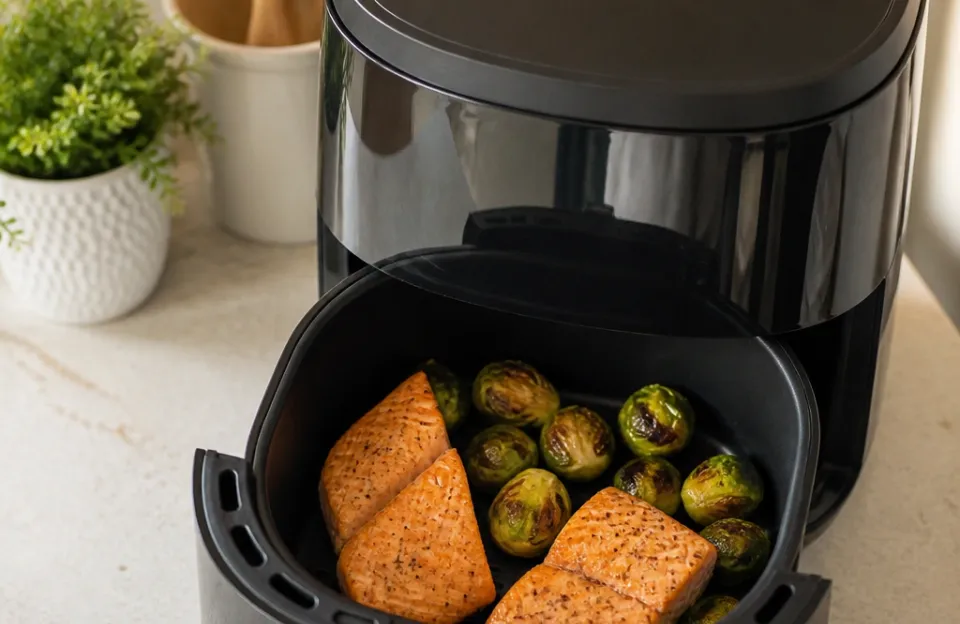
A stainless steel air fryer is a countertop convection oven wrapped in metal housing instead of plastic. If you're shopping for one, the main reasons to pick stainless steel over plastic are better heat retention, no risk of melting exterior panels at high temperatures, and a longer overall lifespan. This buying guide covers what to look for when comparing models, how capacity changes your cooking results, and which brands build reliable machines.
When people search for a stainless steel air fryers buying guide, they usually want two things. They need to know which specs matter most. They also want to avoid paying extra for a machine that just has a thin metal sticker over a plastic shell.
We'll cover both angles so you can spot the difference between genuine metal construction and cheap marketing tricks.
What makes the outer shell material matter
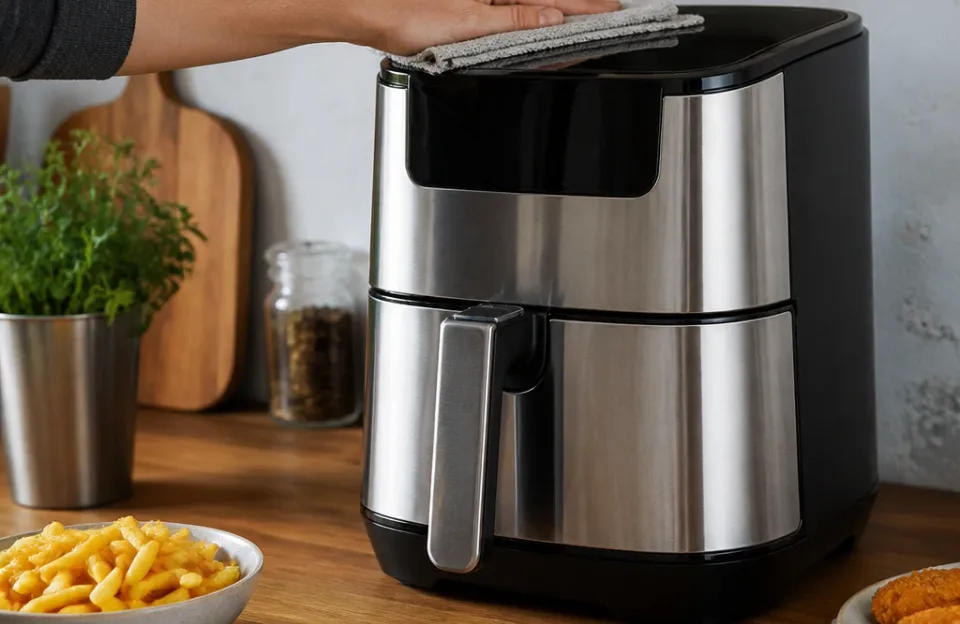
The outside material of an air fryer dictates how much heat stays inside the cooking chamber and how safe the appliance is on your counter. Plastic exteriors get hot. Some cheaper models reach surface temperatures that can warp nearby items or burn your fingers if you brush against them mid-cycle.
Stainless steel handles thermal stress much better. It doesn't degrade, discolor, or release chemical odors when exposed to 400 degrees Fahrenheit repeatedly.
There is a catch. A heavier metal body means the appliance weighs more. If you plan to store your air fryer in a cabinet and pull it out daily, a full stainless steel unit might be too heavy for comfortable lifting.
You also need to check the grade of the steel. Most reputable kitchen appliance makers use 304 grade stainless steel for food contact areas and outer shells because it resists rust and corrosion from steam and grease.
You should also verify what "stainless steel" actually covers on the model you're eyeing. Some manufacturers label a unit as stainless steel when only the front door panel is metal while the sides and top remain plastic. If you want the durability benefits, look for units where the primary housing is fully metal.
Checking appliance safety standards through organizations like UL helps confirm whether a specific model's materials meet baseline electrical and thermal requirements.
Basket style versus oven style layouts
Air fryers generally come in two shapes: a pull-out basket design or a front-door oven design. Your choice here affects how much food you can cook and how easily you can clean the machine.
Basket models work well for single-layer foods. You toss in fries, shake the drawer halfway through, and pull it out when done. The heating element sits directly above the food.
This creates intense, fast browning. However, basket models with full stainless steel bodies are somewhat rare. Many brands use plastic for the outer drawer shell even if the inner basket is metal.
Oven-style air fryers look like miniature toaster ovens. They have racks, a drip tray, and a glass or metal door. These are almost always built with stainless steel housings because the larger footprint generates more ambient heat.
Oven styles let you cook on multiple levels at once. You can roast vegetables on the bottom rack while crisping chicken wings on the top rack. The tradeoff is that air circulation isn't quite as aggressive as a basket model, so you might need to rotate pans for even browning.
Knowing how long to get chicken wings crispy in an oven-style unit often requires adding a few minutes compared to a basket model.
| Layout Type | Best For | Cleaning Effort | Typical Capacity |
|---|---|---|---|
| Pull-out Basket | Fast crisping, shaking foods | Low (one nonstick basket) | 2 to 6 quarts |
| Oven Style | Multi-level meals, roasting | Medium (racks, crumb tray) | 10 to 30 liters |
Sizing the interior for your actual meals
Capacity numbers on the box can be misleading. Manufacturers measure volume in quarts or liters, but usable cooking space depends entirely on the shape of the interior. A tall, narrow 6-quart basket holds fewer chicken breasts than a wide, flat 5-quart basket.
Always look at the internal dimensions rather than just the total volume.
For a single person or a couple, a 3 to 5-quart basket model is plenty. You can fit two large chicken breasts or a generous portion of fries. Families of four or more usually need a 6 to 10-quart unit, or they should jump straight to an oven-style model.
If you regularly cook whole chickens or large batches of meal prep ingredients, anything under 8 quarts will frustrate you.
Keep in mind that larger stainless steel air fryers require more counter space and draw more wattage. A compact 3-quart unit might run on 1200 watts. A 10-quart oven style often pulls 1700 to 1800 watts.
Make sure your kitchen outlets can handle the load, especially if you run other high-draw appliances on the same circuit. Getting the timing right for cooking root vegetables evenly becomes much easier when the basket isn't overcrowded, so size up if you frequently cook dense starches.
Heating elements and fan speed mechanics
The core of any air fryer is its heating coil and fan. In stainless steel models, the heating element is typically exposed metal or encased in a metal sheath. Exposed quartz or metal coils heat up faster.
Encased elements take slightly longer to reach temperature but are much easier to wipe down since grease doesn't bake directly onto the wire.
Fan speed determines how quickly hot air moves around the food. Higher wattage usually pairs with a stronger fan. A weak fan leaves cold spots, meaning half your food burns while the other half stays soggy.
When reading product specs, look for mentions of "rapid air technology" or specific RPM ratings if the manufacturer provides them. Most good units circulate air fast enough to drop cooking times by 20 percent compared to a standard conventional oven.
Some premium stainless steel models include dual heating elements. One sits on top and one sits on the bottom. This eliminates the need to flip food halfway through a cycle.
Dual-element units cost more, but they produce noticeably more even browning on thick cuts of meat. Understanding proper salmon cooking durations is simpler in a dual-element machine because the heat surrounds the fish uniformly without drying out the top layer.
Control panels: digital touchscreens versus manual dials
You will find two types of interfaces on these machines. Manual dials use physical knobs for time and temperature. Digital screens use touch buttons and preset programs.
Neither is objectively superior; they just serve different preferences.
Manual dials are mechanical. They rarely fail electronically. If you prefer turning a knob to setting a timer, this is your route.
The downside is precision. A dial marked in five-minute increments makes it hard to stop exactly at seven minutes. Temperature dials can also drift slightly over years of use.
Digital touchscreens give you exact control. You can set 375 degrees and 12 minutes without guessing. Many digital stainless steel air fryers include presets for common foods.
While presets are convenient, they are just pre-programmed time and temperature combinations. You can always enter custom settings. One warning about digital screens: if the control board fails, the entire machine stops working.
Replacement parts for proprietary circuit boards are often unavailable, meaning a dead screen equals a dead appliance.
If you buy a digital model, check whether the display is angled toward you. Flat displays mounted on the top of a heavy stainless steel unit force you to lean over the hot machine to read the screen. Front-facing or tilted panels are much safer and easier to read.
Cleaning routines for metal interiors
Stainless steel interiors resist staining better than painted or coated metals, but they still require regular cleaning. Grease aerosolizes during cooking and settles on every interior surface. If left alone, it polymerizes into a sticky, brown residue that is incredibly difficult to remove.
Avoid abrasive scouring pads on polished stainless steel. They leave permanent scratches. Use a soft sponge with warm water and dish soap immediately after the unit cools down.
For baked-on grease, a paste of baking soda and water left to sit for fifteen minutes breaks down the oils without scratching the metal. Never submerge the main housing in water. Wipe it down with a damp cloth instead.
Oven-style models with removable racks make cleaning simpler. You can soak the wire racks in the sink while wiping out the main chamber. Basket models with nonstick coatings require gentler care.
Once a nonstick coating starts flaking, the basket needs replacing. Pure uncoated stainless steel baskets don't have this problem, though food sticks to them more readily unless you use a light spray of oil. Keeping the interior spotless also prevents smoke during future cooks, which is especially important when preparing fatty meats like sausage that render significant grease.
Brands building reliable stainless steel models
Several established kitchen appliance companies manufacture stainless steel air fryers. Knowing who makes what helps you filter out generic white-label products that offer zero customer support.
Cuisinart produces several highly rated oven-style air fryers with full stainless steel housings. Their models typically range from 15 to 20 liters. They use analog dials on some units and digital interfaces on others.
Build quality is consistent, and replacement parts like wire racks are easy to source. Exploring a reliable Cuisinart model shows how traditional kitchen brands approach metal construction differently than budget importers.
Ninja offers multi-cookers that combine pressure cooking and air frying. Some of their higher-end units incorporate stainless steel elements, though many Ninja air fryers rely heavily on heat-resistant plastics for the outer shell to keep weight down. Their fan motors are exceptionally strong, making them great for rapid crisping even if the exterior isn't pure metal.
Breville builds premium countertop ovens with air frying capabilities. Their Smart Oven line uses heavy-gauge stainless steel and advanced PID temperature control algorithms. These are expensive.
They target users who want to replace their toaster oven, slow cooker, and air fryer with one heavy-duty metal box.
Instant Pot expanded beyond pressure cookers into air fryers. Their Instant Vortex line includes some stainless steel options, mostly in the oven-style category. They strike a middle ground between Breville's premium pricing and budget brands' questionable longevity.
When evaluating lesser-known brands on major retail sites, look closely at the warranty terms. A one-year warranty is standard. Anything shorter suggests the manufacturer doesn't expect the heating element or fan motor to last.
Also check the weight listed in the specifications. Genuine stainless steel housing adds significant mass. If a supposedly all-metal unit weighs under eight pounds, it likely uses very thin gauge steel or hides plastic underneath.
Matching the appliance to your kitchen workflow
Before finalizing a purchase, think about where the machine will live. Stainless steel air fryers vent hot air from the back or top. They need at least five inches of clearance from walls and cabinets to prevent heat damage.
Placing one directly under low-hanging wooden cabinets is a fire hazard regardless of the outer shell material.
Consider noise levels. High-speed fans generate sound. Larger oven-style units with bigger fans tend to hum louder than small basket models.
If you have an open-concept kitchen near a living area, check user reviews specifically mentioning noise.
Finally, assess your actual cooking habits. If you only air fry frozen snacks twice a month, spending hundreds on a heavy-duty stainless steel oven is unnecessary. If you cook fresh proteins and vegetables daily, the investment pays off in durability and performance.
Pairing your new appliance with a solid meatloaf recipe proves how much faster convection cooking works compared to waiting for a traditional oven to preheat.
Frequently asked questions
Do stainless steel air fryers cook faster than plastic ones?
The exterior material does not change cooking speed. Heat retention comes from the insulation thickness and the power of the heating element. However, stainless steel housings are often paired with higher-end components and better insulation, which can result in slightly faster preheat times and more stable temperatures during the cooking cycle.
Is a stainless steel interior safer than nonstick coating?
Uncoated stainless steel avoids the risk of PTFE or PFAS chemicals degrading at extremely high temperatures. Nonstick coatings are generally safe below 500 degrees Fahrenheit, but they eventually scratch and peel. Stainless steel won't peel.
It does require more attention to prevent food from sticking, usually solved by lightly oiling the surface before cooking.
How do I choose between a basket and an oven style?
Pick a basket model if you primarily cook single-layer items like fries, nuggets, or roasted vegetables that benefit from shaking. Pick an oven style if you need to cook multiple items at once, want to use baking pans, or plan to roast whole chickens. Oven styles take up more counter space but offer significantly more versatility.
Can I put stainless steel air fryer parts in the dishwasher?
Removable stainless steel racks and uncoated baskets are usually dishwasher safe. Check the specific manual for your model. Dishwasher detergents are highly alkaline and can sometimes dull the finish of polished stainless steel over time.
Hand washing with mild soap preserves the shine longer.
Why does my stainless steel air fryer smell during the first use?
Manufacturing residues, protective oils, and dust burn off during the initial heating cycle. Run the empty air fryer at its maximum temperature for fifteen to twenty minutes in a well-ventilated area before cooking food. This burn-off period is normal for almost all new metal kitchen appliances.
Making the final call on your purchase
Choosing the right stainless steel air fryer comes down to balancing your available counter space, your typical batch sizes, and your preference for digital versus manual controls. Verify the metal grade, check the warranty length, and confirm the interior dimensions match the foods you actually cook. A heavier, well-built metal unit costs more upfront, but it survives daily high-heat cycles far longer than thin plastic alternatives.
Measure your space, read the spec sheet carefully, and pick the layout that fits your weekly meal rotation.