Using a meat thermometer in an air fryer takes about five seconds if you pull the basket out for a quick check, or it runs completely hands-free if you use a leave-in probe. The main thing to know is that you should never leave a standard instant-read thermometer inside the appliance while it cooks. Air fryers move hot air at high speeds, and exposed plastic heads or thin wires will melt.
If you want to track internal temperatures safely, you either pause the cook and test with an instant-read tool, or you route a heat-safe probe cable outside the closed basket. Both methods work well. The right choice depends on what you are cooking and how often you need to check it.
This guide covers exactly how to use a meat thermometer in an air fryer without damaging your gear or ruining dinner.
Tools That Survive High-Speed Convection Heat
Air fryers reach 400°F easily. Some models hit 450°F. The heating element sits just inches above the food, and a powerful fan blasts air across the entire chamber.
Standard kitchen tools aren't always built for that environment.
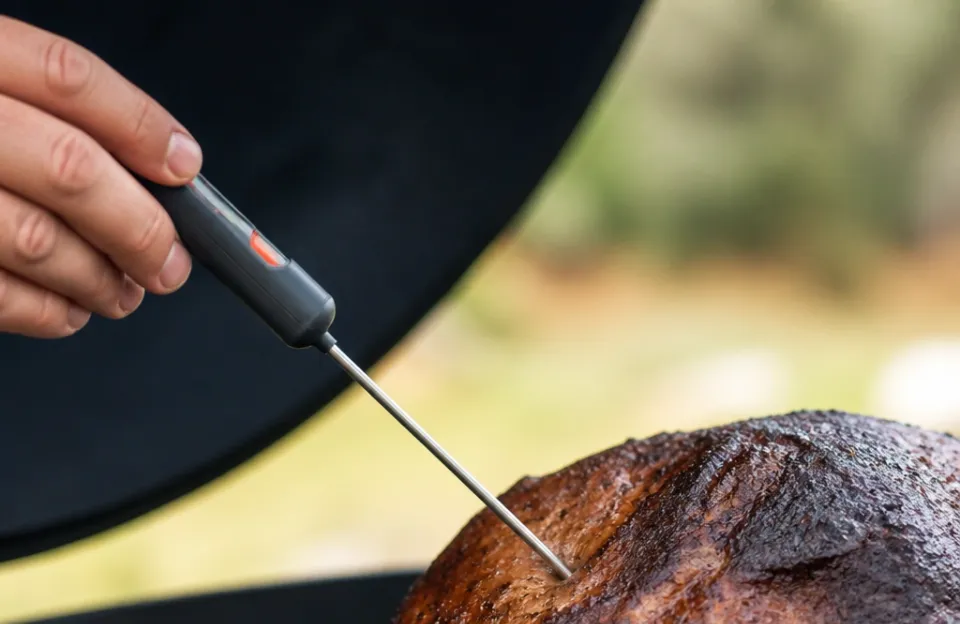
Instant-read thermometers are the safest option because they only enter the hot zone for a few seconds. You open the basket, insert the probe, read the number, and pull it out. The body of the thermometer stays in your hand, far from the heating coil.
A fast digital model works best here since the basket loses heat rapidly when opened. Picking up a quick-reading digital tool cuts down the time the drawer stays open.
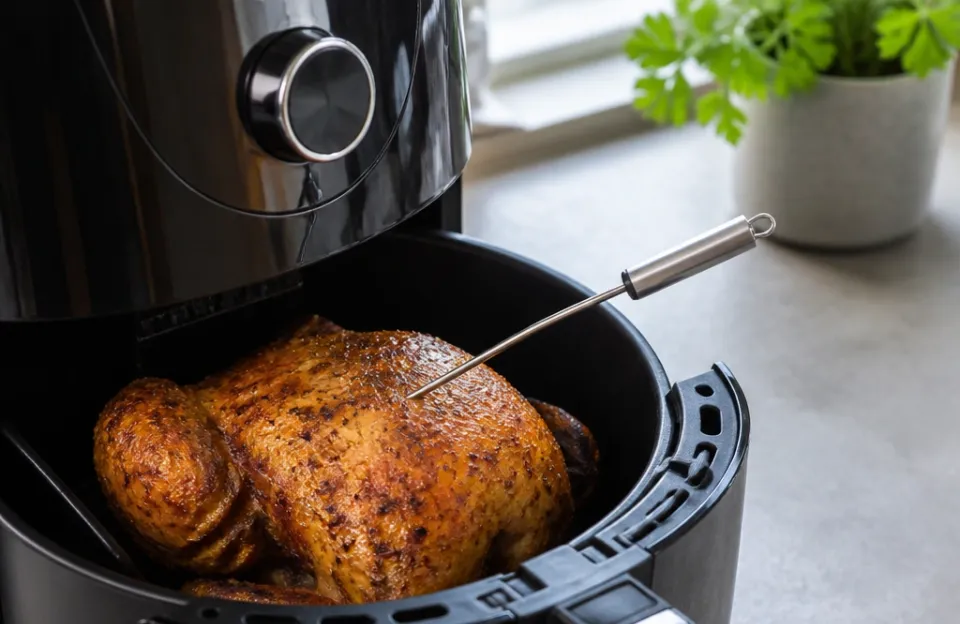
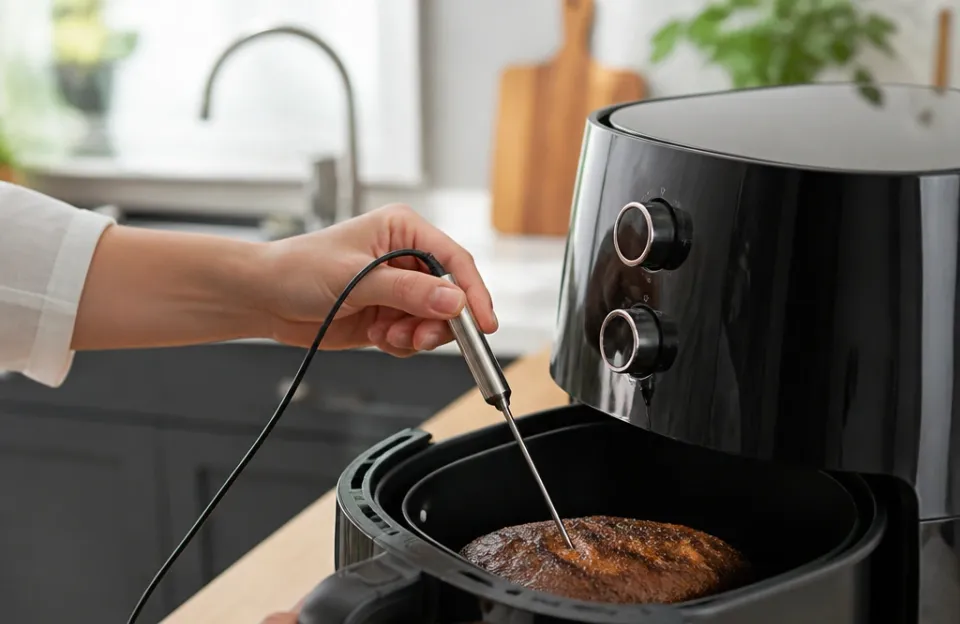
Leave-in probe thermometers require more planning. The metal probe goes into the meat, but the wire must drape over the edge of the basket so the transmitter or display unit rests on the counter outside. If any part of the wire touches the top heating element, the insulation will burn.
You also need a model rated for oven or grill use. Checking which thermometers hold up over time prevents buying one that fails after a few uses.
Wireless smart thermometers have changed how people cook in these appliances. The base station sits on the counter, and the probe transmits via Bluetooth or Wi-Fi. You still have to route the probe or its signal through the basket gap, but you don't have to stand next to the machine.
Setting up a wireless temperature tracker means you can monitor the cook from another room.
Infrared laser guns measure surface temperature only. They cannot tell you if the center of a chicken breast is done. They are useful for checking how hot the air fryer basket gets before adding oil, but they won't replace a physical probe for testing meat.
| Thermometer Type | Stays Inside During Cooking | Speed of Reading | Best Used For |
|---|---|---|---|
| Instant-Read Digital | No | 1 to 5 seconds | Quick checks on any meat |
| Leave-In Probe (Wired) | Yes, wire routed outside | Continuous monitoring | Whole chickens, thick roasts |
| Wireless Smart Probe | Yes, base stays outside | Continuous via app | Long cooks, remote tracking |
| Infrared Laser Gun | No | Instant | Surface temps only, not meat |
How to Use a Meat Thermometer in an Air Fryer Safely
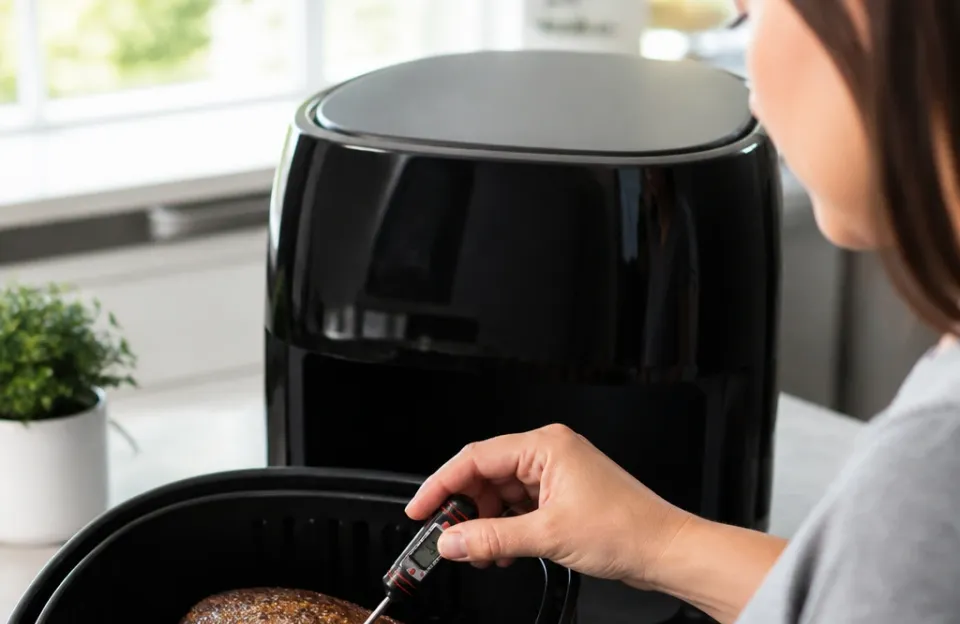
Getting an accurate reading requires placing the probe correctly and managing the airflow around your equipment. Follow these steps every time you cook.
1. Prep the meat and position the basket
Season your meat and place it in the air fryer basket in a single layer. Overcrowding blocks the hot air circulation that makes these appliances work. If you are using a leave-in probe, insert it into the thickest part of the meat now.
Keep the tip away from bone, fat pockets, or the bottom of the basket. Route the wire carefully over the rim so the basket can slide fully into the housing.
2. Set the temperature and start the timer
Program your air fryer according to your recipe. If you are using a leave-in probe, close the basket gently. Don't pinch the wire against the metal frame too hard, as this can fray the shielding over time.
Most air fryer baskets have a slight gap near the handle where a thin wire fits without keeping the drawer fully open.
3. Pause the cycle for instant-read checks
If you are using an instant-read thermometer, wait until the meat is roughly three-quarters done before your first check. Pull the basket out. Most air fryers automatically pause the fan and heater when the drawer opens.
Insert the probe into the thickest section of the meat. Wait for the numbers to stabilize. Remove the probe, push the basket back in, and let the cycle resume.
4. Target the correct internal temperature
Knowing when to pull the meat out relies on official safety standards. The USDA safe minimum internal temperatures dictate that all poultry must reach 165°F. Ground meats like beef or pork need 160°F.
Whole cuts of beef, pork, lamb, and veal require 145°F followed by a three-minute rest period. Fish also finishes at 145°F.
5. Rest the meat outside the basket
Once the meat hits the target temperature, remove it from the air fryer immediately. Leaving it in the hot basket causes carryover cooking, which pushes the internal temperature higher and dries out the protein. Place the meat on a cutting board or plate.
Let it rest for the recommended time before slicing.
Routing a Probe Wire Without Pinching or Melting It
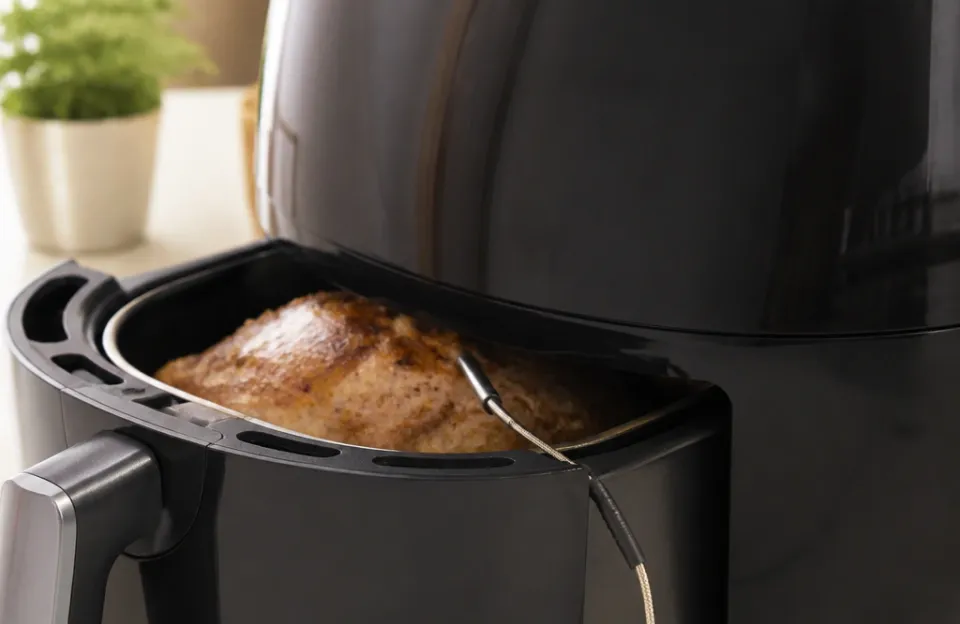
The hardest part of leaving a thermometer inside an air fryer is managing the cable. The heating element sits at the top of the unit. If the wire curls upward during the cook, the intense radiant heat will melt the outer jacket.
Always drape the wire downward and outward. Push it toward the front handle of the basket. When you slide the drawer shut, the wire should exit through the small seam between the basket lip and the outer shell.
Do not force the drawer completely flush if the wire is thick. A tiny gap is fine; the fan pressure inside is strong enough to circulate air even with a minor leak.
Check the wire's rating. Probes designed for deep frying or heavy grilling have silicone or braided steel jackets that withstand 500°F or more. Thin cables meant for light indoor use might degrade at sustained air fryer temperatures.
A heavy-duty stainless probe handles extreme heat much better than basic kitchen wiring.
If you notice the wire getting stiff or discolored after a few cooks, replace the probe. Melted wire insulation can release fumes into the cooking chamber and ruin the food.
Testing Different Cuts in a Convection Basket
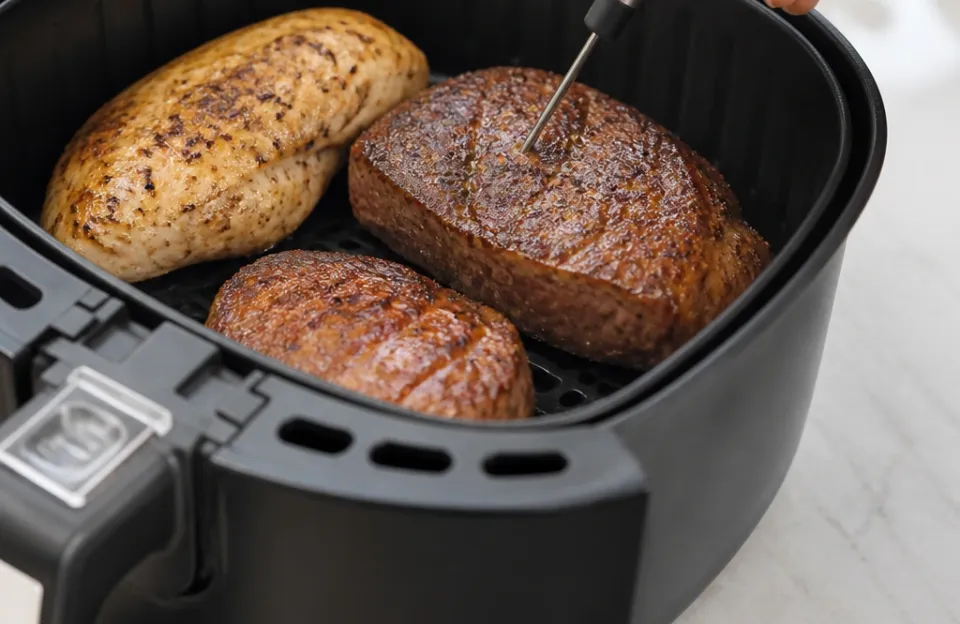
Different shapes of meat require different probing techniques. The rapid air movement in an air fryer cooks the outside faster than a standard oven, making precise placement even more important.
Whole chickens and bone-in pieces
Insert the probe into the thickest part of the thigh, aiming toward the center without touching the femur. Bone conducts heat differently than muscle tissue. If the probe tip rests against bone, the reading will be artificially high, and you'll pull the bird out before the surrounding meat is actually safe.
For whole birds, check both the thigh and the deepest part of the breast.
Thick steaks and pork chops
Aim for the exact geometric center of the steak. Push the probe in from the side rather than the top if the cut is less than an inch thick. Going in from the top risks pushing the sensor past the center and hitting the hot basket grate below.
A fast-response digital reader gives you the number before the meat cools down from the open drawer.
Burgers and meatballs
Smaller items cook very fast in an air fryer. A burger patty might go from raw to overdone in two minutes. Insert the probe horizontally through the side edge into the dead center.
Because ground meat carries higher bacterial risk throughout the mix, verifying that the core reaches 160°F matters more than with solid muscle cuts.
Roasts and tenderloins
Large, dense cuts take longer, making them ideal candidates for leave-in probes. Insert the sensor into the thickest end of the roast. If the tenderloin tapers significantly, fold the thin tail under itself before cooking so the entire piece has a uniform thickness.
This prevents the thin end from drying out while the thick center catches up.
Why You Should Never Leave an Instant-Read Inside the Drawer
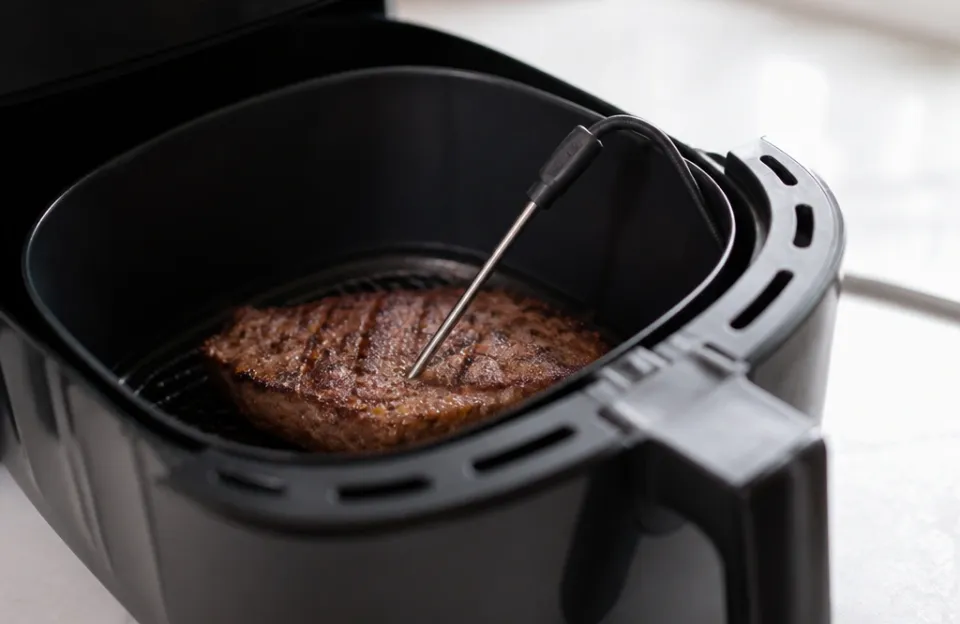
People sometimes prop an instant-read thermometer in the meat and shut the air fryer, hoping to watch the dial through the window or just guessing it will be fine. This destroys the tool.
Instant-read thermometers have plastic heads containing batteries, circuit boards, and LCD screens. These components are rated for brief exposure to steam and heat during a manual check. They are not built to sit in a 400°F convection current.
The plastic will warp within minutes. The battery can leak or rupture. The screen will black out permanently.
Even if the head hangs over the edge of the basket, the reflected heat bouncing off the interior walls is enough to damage it. Only use tools specifically engineered for continuous ambient heat exposure if you plan to close the drawer. A reliable standard digital thermometer belongs in your hand during the check, resting on the counter the rest of the time.
Dealing With Rapid Temperature Swings When Opening the Drawer
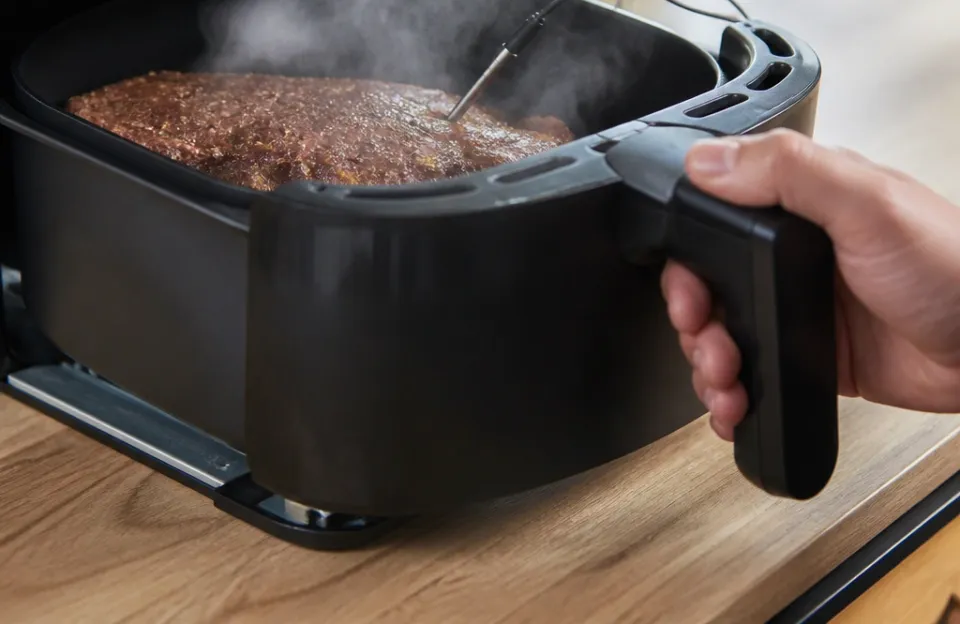
Every time you pull the basket out to check the meat, the internal temperature drops drastically. The fan stops. The heating element shuts off.
Cold room air floods the chamber.
This means you lose cooking momentum. If you check the meat six times during a twenty-minute cook, you are extending the total time significantly. The outside might dry out while waiting for the inside to catch up.
Limit your checks. Calculate the estimated cook time based on your recipe, and do your first temperature check at the 75% mark. If a chicken breast usually takes 16 minutes, check it at minute 12.
If it needs more time, close the drawer and wait another two or three minutes.
Using a leave-in probe eliminates this problem entirely. You watch the temperature climb on an external display without ever opening the basket. If you prefer dual monitoring to track both the meat and the ambient air inside the fryer, a two-sensor setup provides constant data without breaking the heat seal.
Troubleshooting Bad Readings and Signal Drops
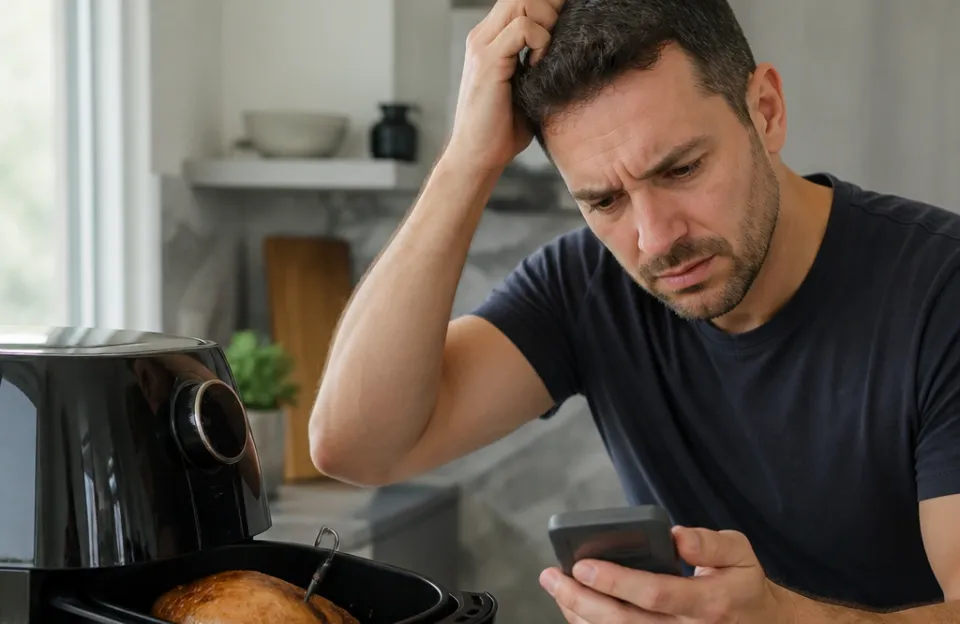
Sometimes the numbers jump around or the wireless connection dies mid-cook. A few common issues cause this.
Fluctuating instant-read numbers. If the digits won't settle, the probe tip is likely sitting in a pocket of fat or resting against the metal basket grate. Pull the probe out slightly, reposition it deeper into the solid muscle, and wait again. Fat insulates the sensor, giving slow, inaccurate readings.
Wireless probe losing connection. The thick metal walls of an air fryer block Bluetooth and Wi-Fi signals. If your smart thermometer keeps dropping out, move the base station closer to the appliance. Sometimes placing the receiver directly on top of the air fryer housing (if the top doesn't get too hot) bridges the gap.
If signal loss happens frequently, look into ways to fix dropped wireless connections before assuming the hardware is broken.
Reading stays too low despite long cook times. The sensor might be damaged, or the battery is dying. Test the thermometer in a glass of ice water. It should read 32°F.
Then test it in boiling water. It should read 212°F at sea level. If it misses these marks by more than two degrees, calibrate it if the model allows, or replace it.
Smoke coming from the probe wire. Stop the cook immediately. Unplug the air fryer. The wire insulation is melting, either because it touched the heating element or exceeded its maximum temperature rating.
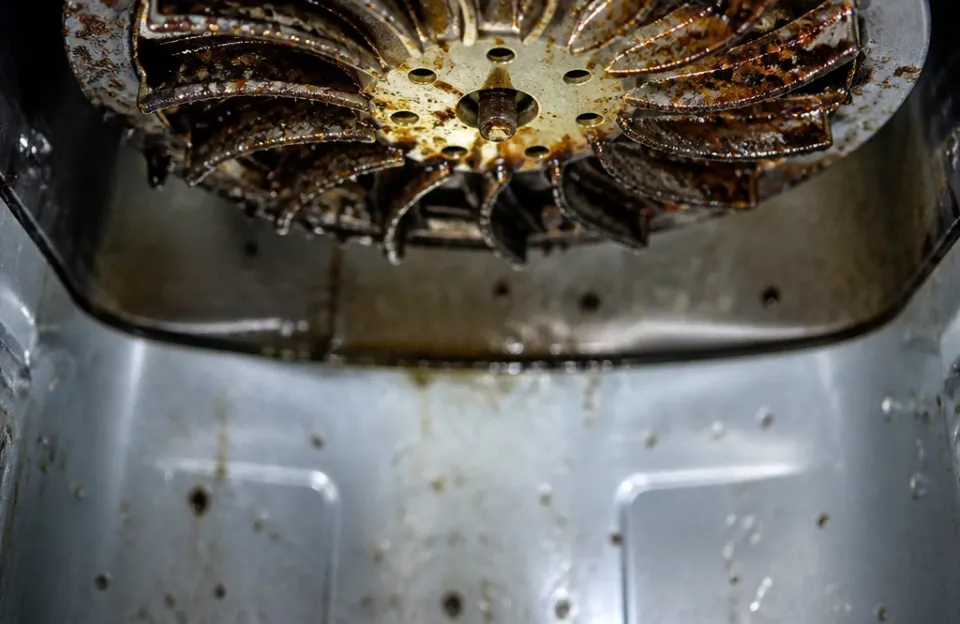
Discard the probe. Clean the interior thoroughly before cooking again to remove toxic residue.
Frequently asked questions
Can I use a glass dial thermometer inside my air fryer?
No. Traditional glass tube thermometers can shatter under the intense, direct convection heat of an air fryer. The rapid temperature changes and high-speed fan create stress points that break the glass.
Stick to metal-probed digital or analog dial thermometers rated for high-heat oven use.
Does the air fryer fan affect how fast the meat cooks compared to an oven?
Yes. The forced air strips away the boundary layer of moisture on the meat's surface much faster than a standard oven. This accelerates browning and shortens total cook times.
Because the exterior cooks faster, relying solely on visual cues leads to overcooked outsides and raw centers. A thermometer is the only way to verify the core is done.
Where exactly should the probe tip sit in a thick chicken breast?
Push the probe into the thickest end of the breast, aiming for the geometric center. Avoid sliding it all the way through to the other side, as the tip will read the temperature of the basket or the air instead of the meat. If the breast is uneven, pound it flat first so it cooks evenly and the probe placement is predictable.
Is it safe to leave a wired probe inside while the air fryer runs?
It is safe only if the wire is rated for the temperature and routed away from the top heating element. The metal probe itself can stay in the meat indefinitely. The danger lies entirely with the cable insulation and the transmitter unit.
If the cable touches the heating coil, it will melt and potentially start a fire.
Do I need to adjust the target temperature because air fryers cook hotter?
No. Food safety temperatures are absolute. Chicken must reach 165°F internally regardless of whether you bake, grill, fry, or air-fry it.
The cooking method changes how fast the meat reaches that number, but it does not change the required final temperature set by the USDA.
Can I check multiple pieces of meat at once with a single probe?
You have to check each piece individually. An air fryer basket often has hot and cool spots depending on the fan design. One chicken thigh might finish three minutes before another.
Insert the probe into the largest, thickest piece first. Once that one hits the safe temperature, quickly spot-check the smaller pieces.
Before You Start Your Next Batch
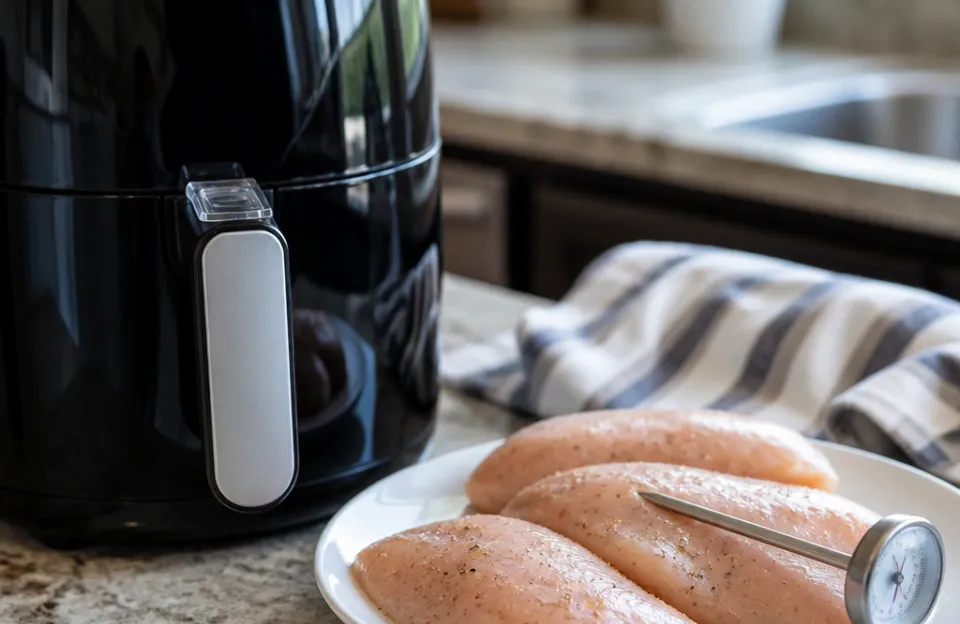
Knowing how to use a meat thermometer in an air fryer removes the guesswork from fast, high-heat cooking. Pick an instant-read model for quick meals like burgers and fish fillets. Switch to a leave-in probe with a heat-safe cable for whole birds or thick roasts.
Always route wires away from the heating element, limit how often you open the drawer, and trust the internal temperature over the clock. Once you build the habit of checking the core temp, you'll stop pulling out dry, overcooked proteins for good.