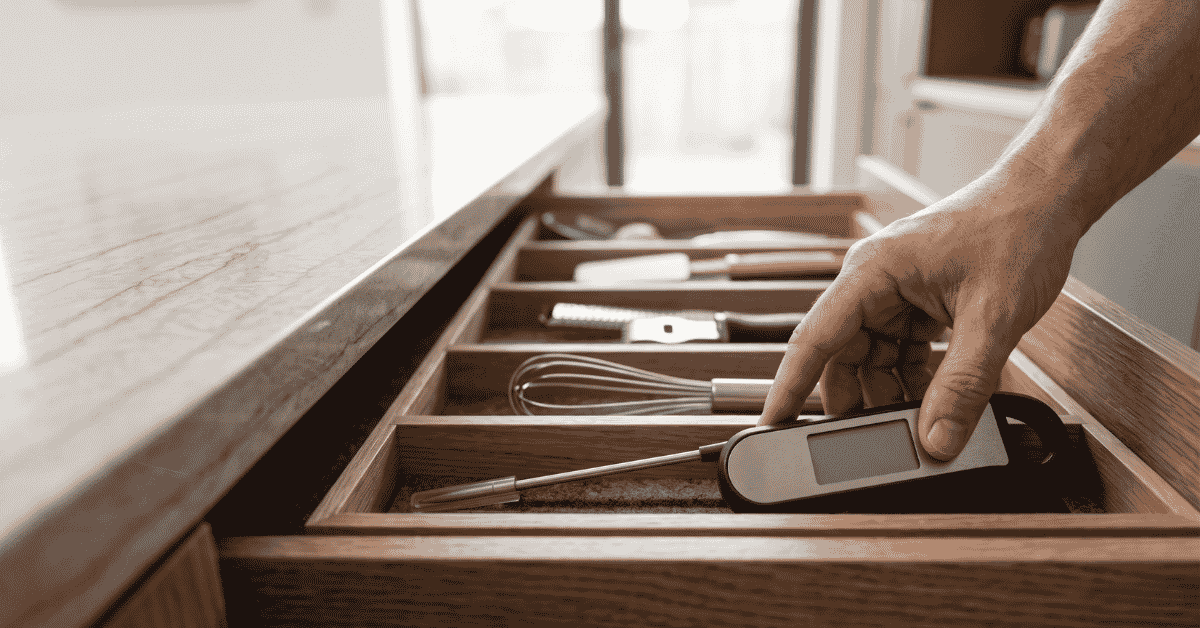
You reach into the kitchen drawer, fingers brushing against whisks and spatulas, only to grab the sharp end of your digital probe. Or worse, you pull out your favorite instant-read device only to find the screen cracked or the battery dead from a button being held down by a heavy ladle. We’ve all been there, tossing a precision tool into a “junk drawer” and hoping for the best.
Quick Answer: Storing a meat thermometer properly requires a dry, temperature-stable environment where the probe is shielded from physical impact. Use the original protective sheath, a dedicated storage case, or a magnetic mount away from direct heat sources to prevent calibration drift or screen damage. Always clean and dry the device thoroughly before putting it away to stop bacterial growth and battery contact corrosion.
Why proper storage is a necessity for accuracy
A meat thermometer is a precision instrument, not just another piece of silverware. Inside that thin metal probe are delicate sensors, usually thermistors or thermocouples, that rely on specific electrical resistance or voltage to tell you if your steak is medium-rare. When you knock these sensors around, you risk shifting their calibration.
A thermometer that’s off by just five degrees can be the difference between a juicy pork loin and a dry, tough one.
Beyond accuracy, there is the issue of hygiene. Most meat thermometers have small crevices where the probe meets the plastic housing. If you store a thermometer that hasn’t been dried properly, moisture gets trapped in those gaps.
This can lead to mold or, in digital models, moisture leaking into the internal circuitry. Over time, damp storage conditions will ruin the liquid crystal display (LCD) or cause the battery terminals to rust.
Heat is another silent killer. Many people keep their thermometers in a drawer right next to the oven or even hanging on a hook above the stovetop. Constant exposure to ambient heat can warp the plastic casing and degrade the battery life.
Keeping it in a cool, neutral spot helps the electronics last years longer than they would in a high-heat zone.
The risks of “drawer clutter”
The most common way people break their tools is through mechanical stress. When a thermometer is loose in a drawer, every time you open and shut that drawer, the device slides. It hits heavy metal cans, tongs, and knives.
For a digital instant-read thermometer, the screen is the most vulnerable point. A single impact from a heavy meat mallet can shatter the glass or bleed the ink on the display.
Moisture and electronic failure
Digital thermometers are rarely 100% waterproof unless specifically rated as IP67 or higher. Even then, “water-resistant” doesn’t mean “steam-proof.” Storing your device in a humid area, like a cupboard directly above a boiling kettle, allows microscopic water droplets to enter the housing. This leads to a screen not working where numbers fade in and out, or the device may simply refuse to turn on.
Practical steps for storing your thermometer
Practical steps for storing your thermometer Storing your tool correctly doesn’t have to be complicated. It generally follows a three-step rule: clean, protect, and place. If you follow these steps every time you cook, you won’t have to recalibrate your device nearly as often.
-
Sanitize and Dry: Wash the probe with hot, soapy water. Avoid submerging the entire unit unless the manufacturer says it’s fully waterproof. Dry it immediately with a clean towel. Never put a wet thermometer back into a plastic sheath, as this creates a petri dish for bacteria.
-
Use the Sheath or Case: Most high-quality thermometers come with a plastic sleeve or a padded case. Use it. This protects the sharp tip of the probe and prevents the body of the device from getting scratched. If you lost yours, you can use a small piece of food-grade silicone tubing to cover the tip.
-
Choose a Neutral Environment: Find a spot far from the dishwasher and the stove. A dedicated “tool crock” or a shallow drawer with a divider is ideal. You want to prevent the thermometer from being buried under heavier items.
Magnetic mounting vs. drawer storage
Many modern digital thermometers, such as those made by Thermoworks or Maverick, have built-in magnets. This allows you to stick the device directly to the refrigerator or a magnetic knife strip. This is often the best storage method because it keeps the device visible and away from the crushing weight of other tools.
However, be careful with magnetic storage near the stove. While the fridge is cool and safe, sticking a thermometer to the side of a hot oven can melt the plastic or damage the internal battery. Always check that the surface is cool to the touch before mounting.
Handling long-probe “leave-in” models
If you use a smoke-house or oven-going thermometer with a long wire lead, storage gets trickier. The wires are the weakest link. If you kink the wire or wrap it too tightly, the internal copper filaments will snap.
To store these properly:
-
Loosely coil the wire: Follow the natural curve of the cord. Never fold it sharply.
-
Use a Velcro tie: A small strip of Velcro can keep the wire from tangling without putting pressure on the insulation.
-
Store probes separately: If your unit allows you to unplug the probes from the base, do so. Store the base in a padded box and the probes in a flat organizer.
Specific storage for different thermometer types
Specific storage for different thermometer types Not all thermometers are built the same, so their storage needs vary based on their mechanical design. A thick-dial analog thermometer is sturdier than a folding digital one, but it still has vulnerabilities.
Analog (Bimetallic Coil) Thermometers
These are the old-school round dials. They work via a metal coil that expands and contracts. They are generally tough, but dropping them can knock the needle out of alignment.
-
Tip: Store these upright if possible. If they must go in a drawer, ensure they are at the very top of the pile so the glass face isn’t under pressure.
-
Note: These often have a “calibration nut” under the dial. Ensure this nut isn’t being twisted or pressured by other tools in the drawer.
Folding Digital Thermometers
These are the most popular for home cooks because the probe folds into the handle.
-
The Pivot Point: The most common failure point is the hinge. Ensure no crumbs or grease are inside the hinge before folding it for storage.
-
Battery Safety: Some folding models turn on automatically when opened. If stored in a tight drawer, another tool might nudge the probe open just enough to turn the device on, draining your battery overnight.
Infrared (Non-Contact) Thermometers
These look like small “guns” and measure surface temperature.
-
Lens Care: The most important part of storing an infrared thermometer is keeping the sensor lens clean. Dust or grease on the lens will give you false readings.
-
Protection: These should always be stored in a padded bag or the original box. A single scratch on the lens can ruin the device.
Temperature and battery considerations
The chemistry inside batteries is sensitive to the environment. If you store your thermometer in an unheated garage (perhaps near your outdoor smoker) during a cold winter, the battery capacity will drop significantly. Conversely, high heat can cause alkaline batteries to leak acid, which will dissolve the circuit board of your thermometer.
If you don’t plan on using your meat thermometer for more than three or four months, perhaps you only use it for the Thanksgiving turkey, it is a smart move to remove the batteries entirely. This prevents any chance of “battery rot” destroying an expensive tool while it sits in the cupboard.
Summary of Storage Locations
Location Pros Cons
Magnetic Fridge Surface Easy access, low physical risk Possible grease buildup from cooking
Divided Kitchen Drawer Protected from light and dust Risk of crushing if drawer is overfilled
Original Padded Box Best protection for high-end tools Takes up more space
Wall Hook Keeps probe straight Exposed to kitchen humidity/steam
Common mistakes to avoid
-
Leaving it in the meat: Never store a thermometer inside the meat in the refrigerator. The moisture and cold can damage the display, and it’s a major cross-contamination risk.
-
The “Dishwasher Trap”: Even if a thermometer says ” dishwasher safe ,” it’s better for the lifespan of the tool to hand wash and store it manually. The high-heat drying cycle in a dishwasher can ruin the seals over time.
-
Tangled Wires: Forgetting to undock wired probes leads to “wire memory,” where the cord becomes permanently tangled and difficult to use without protect your meat thermometer wires .
-
Ignoring the Sheath: Throwing the thermometer in a drawer without its sleeve of sheath. This dulls the probe, making it harder to insert into meat, which causes juice to leak out of your food.
Frequently asked questions
Can I store my meat thermometer in the freezer?
No. While some probes are rated for cold, the digital displays (LCDs) are not. Extreme cold can cause the liquid in the display to freeze and crack, or lead to massive condensation when you bring it back to room temperature, shorting out the electronics.
Is it okay to leave the thermometer in the oven?
Only if it is specifically labeled as “oven-safe” or “leave-in.” Instant-read thermometers will melt instantly if left in a hot oven. Even if it is oven-safe, you should remove it once the cooking is done; do not store it there permanently as the constant heat cycles will wear out the materials.
How do I know if storage damaged my thermometer?
Check the “ice bath” test. Fill a glass with crushed ice and a little water. If your stored thermometer doesn’t read 32°F (0°C) within a degree or two, the storage conditions may have caused a calibration drift or the sensor is failing.
Should I store my thermometer with the probe open or closed?
For folding models, always store them closed. This protects the probe from snapping and prevents the battery from draining. For fixed-probe models, always use a sheath to protect the tip and the user’s fingers.
Worth remembering
Thinking of your meat thermometer as a scientific instrument rather than a spoon will change how you treat it. By keeping it clean, dry, and shielded from the chaos of a busy utensil drawer, you’re not just saving money on replacements, you’re ensuring that the next time you drop a prime rib or a Thanksgiving bird into the oven, you can actually trust the numbers on the screen accurately. A little bit of care in how you put it away ensures that it’s ready to perform when the heat is on.