You’re standing over a sizzling grill with a spatula in one hand and a plate of raw patties in the other. Your friends are hungry, the sun is setting, and you’re trying to guess if that middle burger is done just by poking it with a finger. We’ve all been there, hoping the red juice turns clear before anyone takes a bite, but guessing is how people get sick.
Quick Answer: For total safety, ground beef burgers must reach an internal temperature of 160°F (71°C) as measured by a digital food thermometer. Unlike whole steaks, ground meat moves surface bacteria into the center during the grinding process, requiring a higher heat to kill pathogens like E. coli.
Why 160°F is the magic number for safety
When you cook a steak, the bacteria usually stay on the outside surface. Searing that steak at high heat kills those germs quickly, even if the inside remains rare. Ground beef is a different story because the grinding process takes those surface bacteria and mixes them throughout the entire batch of meat.
Every tiny piece of a hamburger patty was once on the outside of a larger cut of beef.
The USDA sets the 160°F standard because it is the point where harmful bacteria, specifically Escherichia coli (E. coli) and Salmonella , are destroyed instantly. While some pathogens start to die off at lower temperatures if held there for a long time, 160°F provides a safety cushion that accounts for cold spots in the meat or slight inaccuracies in your thermometer. Eating a burger at this temperature significantly lowers the risk of foodborne illness, which can cause severe stomach cramps, fever, and dehydration.
It’s also about how the meat is processed. Commercial ground beef often comes from multiple animals and is processed in large facilities. This increases the chance of cross-contamination compared to a single roast you might buy from a local burger.
Because you can’t see, smell, or taste these bacteria, the thermometer is your only reliable defense.
The color myth: Why pink doesn’t mean “raw”
Many people think they can tell a burger is safe just by looking at the color of the meat. This is actually a dangerous habit. According to research by the USDA Food Safety and Inspection Service, one out of every four burgers turns brown before it ever reaches a safe internal temperature.
This “premature browning” can happen due to the age of the meat, how it was packaged, or even the pH level of the beef.
On the flip side, some burgers can stay pink inside even after they’ve reached 160°F. If the meat has high levels of certain pigments or if you cooked it with certain vegetables like onions, that pink hue might stick around. If you rely on your eyes alone, you might eat an undercooked burger that looks brown or overcook a safe burger until it’s like a hockey puck just because it’s still pink.
The danger zone for ground meat
The “Danger Zone” is a temperature range between 40°F and 140°F where bacteria multiply the fastest. When you’re preparing hamburgers, you want the meat to spend as little time in this range as possible. This means keeping patties in the refrigerator until the very moment they go on the heat.
Leaving raw burgers out on a counter next to a hot grill allows bacteria to double every twenty minutes. Even if you cook the burger to 160°F later, some bacteria produce toxins that are heat-resistant. Starting with cold meat and moving it quickly to a hot surface ensures the center stays safe while the outside develops a good crust.
How to check hamburger temperature correctly
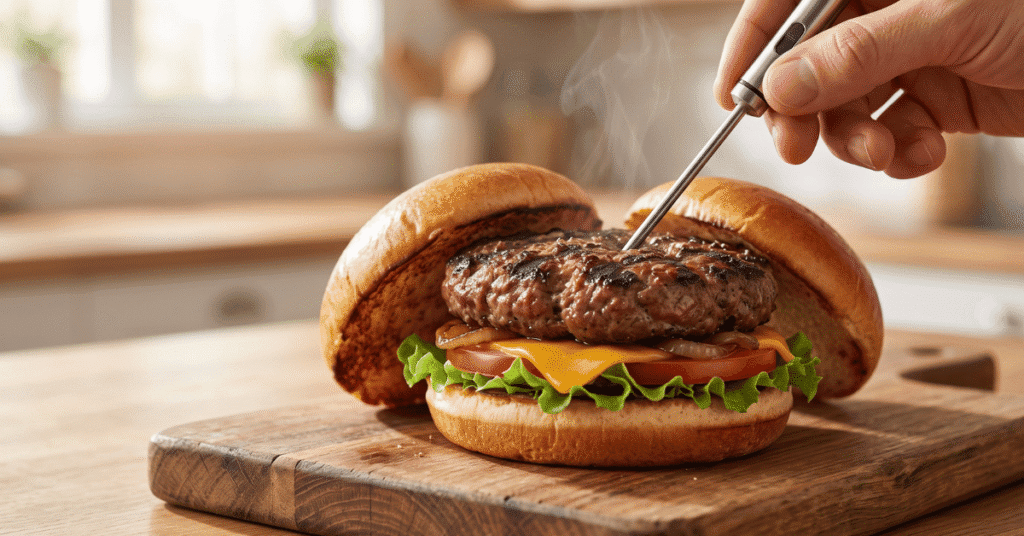
You can’t get an accurate reading by touching the top of the burger or looking at the juices. You need to use a digital instant-read thermometer. These tools have a sensor in the very tip, allowing you to find the exact temperature of the coldest part of the meat in seconds.
To do this right, follow these steps:
-
Remove from heat: Lift the burger slightly or move it to a cooler part of the grill so the rising flames don’t mess with the probe’s accuracy.
-
Insert from the side: Especially with thin patties, don’t poke the thermometer through the top. Try to insert it through the side of the burger so the tip reaches the very center of the patty.
-
Wait for the steady number: Instant-read thermometers usually take two to five seconds to lock in. Don’t pull it out the moment the numbers start moving.
-
Clean between checks : If you check a burger and it reads 130°F, wipe the probe with a sanitizing wipe or hot soapy water before you touch the next burger. You don’t want to move raw juice from a cool burger to one that is almost finished.
Rare vs. Well-done: The risks of undercooking
Food safety experts and chefs often disagree on the “best” way to eat a burger. A chef might tell you that a medium-rare burger tastes better, but a food safety expert will tell you it’s a gamble. A medium-rare burger usually sits around 130°F to 135°F.
At this temperature, E. coli can survive.
E. coli is particularly nasty because it doesn’t take much to make you sick. Just a few cells are enough to cause a “food poisoning” event. For kids, the elderly, or anyone with a weakened immune system, this risk is much higher.
If you choose to eat a burger cooked below 160°F, you are essentially trusting that the meat was handled perfectly from the slaughterhouse to your kitchen.
If you really love a pink center, some people choose “sous vide” cooking. This involves sealing the meat in plastic and holding it at a lower temperature, like 140°F, for a very long period (at least an hour). This process can pasteurize the meat without turning it grey and dry.
However, for a standard backyard grill setup, 160°F remains the only standard that guarantees safety.
Handling variations: Turkey, Chicken, and Plant-based burgers
Not every “hamburger” is made of beef, and the safety rules change depending on the protein. If you are grilling ground turkey or chicken patties, the target temperature is actually higher. Poultry must reach 165°F (74°C) to be considered safe.
Ground poultry carries a higher risk of Salmonella, which is more heat-resistant than some strains of E. coli found in beef.
Plant-based burgers, like those from Beyond Meat or Impossible Foods, have different requirements. Since they don’t contain animal fats or proteins, they don’t carry the same bacterial risks as raw cow carcasses. However, these companies often recommend cooking to an internal temperature of 160°F anyway.
This isn’t necessarily to kill “meat” bacteria, but to ensure the starches and plant proteins bind correctly so the texture feels right.
For “wagyu” or high-fat beef blends, the fat can actually act as an insulator. This means it might take longer for the heat to penetrate the center of the patty. Always check the thickest burger in the batch, as smaller or thinner ones will naturally finish faster.
Ground meat vs. Whole muscle steaks
It is helpful to compare a burger to a ribeye steak to see why we treat them differently. A steak is a solid “whole muscle” cut. Bacteria cannot easily penetrate the dense fibers of the meat.
This is why you can safely eat a blue-rare steak that is basically raw in the middle; the heat of the pan kills everything on the surface.
When that ribeye is tossed into a grinder, the surface is pulverized and folded into the center. What was “outside” is now “inside.” This is why “steak tartare” (raw ground beef) is considered a high-risk food. Professional kitchens that serve tartare often sear the outside of the roast first, then trim it, then grind it in a sterile environment to lower the risk.
Most home cooks and grocery stores don’t follow these extreme protocols, making the 160°F rule vital.
Common mistakes in burger safety
Many people unintentionally make their burgers less safe by trying to speed up the process or save space. Here are the most common errors to avoid:
-
Using the same plate: Never put cooked burgers back on the same plate that held the raw patties unless you’ve washed it with hot, soapy water. The raw juices will contaminate the safe, cooked meat instantly.
-
Pressing the patties: You might see people smash burgers with a spatula to hear that “sizzle.” This actually pushes out the juices and can create uneven temperature spots. It also makes the burger dry before it ever hits the safe 160°F mark.
-
Thawing on the counter: Never let frozen patties thaw at room temperature. The outside will enter the “Danger Zone” while the inside is still a block of ice. Always thaw in the fridge or cook them straight from frozen (adjusting your time accordingly).
-
Crowding the pan: If the burgers are touching each other, the steam is trapped between them. This lowers the surface temperature and prevents that quick sear that helps move the cooking process along.
Internal Temperature Reference Table
Doneness Level Internal Temperature Safety Level Texture/Color
Well Done 160°F+ (71°C) Safe Brown throughout, no pink.
Medium Well 150°F to 155°F At Risk Slight hint of pink, firm.
Medium 140°F to 145°F High Risk Pink center, very juicy.
Medium Rare 130°F to 135°F Danger Red/very pink, soft.
Poultry Burger 165°F (74°C) Safe Opaque and firm.
Frequently asked questions
Can I eat a medium burger if I grind the meat myself?
Grinding at home is generally safer than buying pre-ground beef because you control the cleanliness of the equipment and the quality of the cut. However, bacteria can still exist on the surface of the roast you buy. Even with home grinding, the 160°F rule is the only way to be 100% sure the meat is pathogen-free.
Why do some restaurants ask how I want my burger cooked?
In many regions, restaurants are allowed to serve undercooked ground beef if they provide a “consumer advisory” on the menu. This is the fine print at the bottom of the page warning you that eating undercooked meat increases your risk of illness. They are shifting the legal risk to you, the consumer.
Is a “bloody” burger actually bleeding?
No. That red liquid is not blood; it’s a mixture of water and a protein called myoglobin. This protein is what carries oxygen to the cow’s muscles.
When you see red juice, it just means the protein hasn’t reached the temperature where it turns brown or grey. It is not an indicator of safety on its own.
How long can a cooked burger sit out?
Once the burger hits 160°F, the clock starts. It should not sit at room temperature for more than two hours. If it’s a hot day (over 90°F), that time drops to just one hour.
After that, bacteria from the air can land on the meat and start growing again.
Worth remembering
Getting the temperature right isn’t just about avoiding a stomach ache; it’s about being a confident cook. When you know for a fact that your burgers have hit 160°F, you can serve them to your family and friends without a second thought. You don’t have to cut them in half to peer inside or guess based on the smoke coming off the grill.
Invest in a decent digital thermometer and use it every single time. It takes the guesswork out of grilling and ensures that the only thing your guests remember is how good the food tasted, not a trip to the doctor later that week. Safety doesn’t have to mean dry meat; it just means cooking with precision.