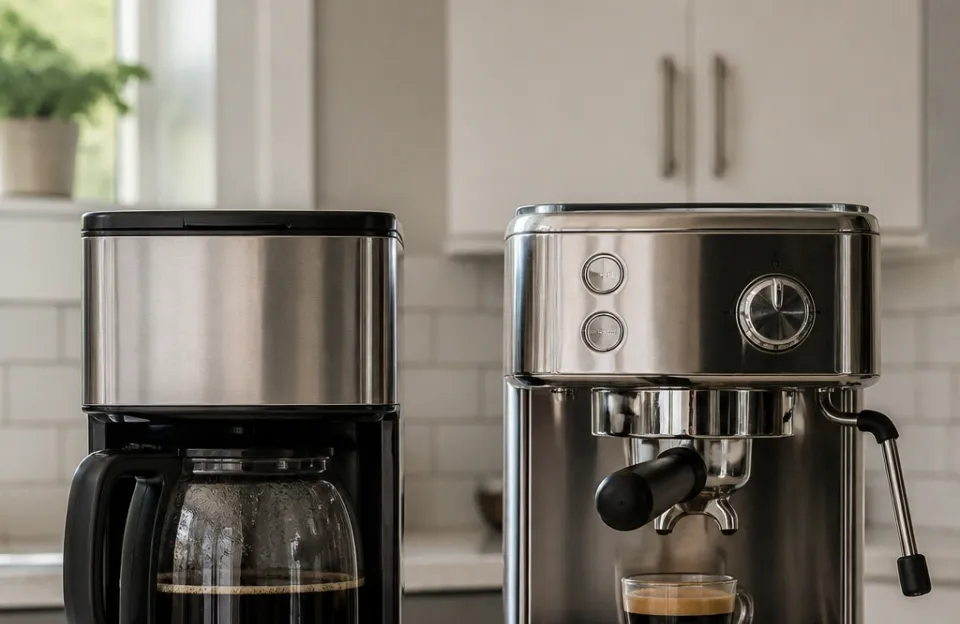
The right choice depends on how you actually drink coffee. If you fill a mug (or three) from a pot each morning and want minimal fuss, a drip coffee maker fits better. If you want espresso, lattes, or cappuccinos and will accept a grinder purchase plus a cleaning routine, an espresso machine earns its counter space. Household size, budget, and how much technique you enjoy learning decide the rest.
Coffee Maker vs Espresso Machine: Quick Comparison
| Factor | Drip Coffee Maker | Espresso Machine |
|---|---|---|
| Brewing method | Gravity pulls hot water through loose grounds | Pump forces water through packed grounds at about 9 bars |
| Typical serving | 8 to 12 oz cup | 1 to 2 oz shot |
| Grind required | Medium-coarse, roughly 600–900 microns | Fine, roughly 200–400 microns |
| Brew time | About 3–5 minutes per batch | Under 30 seconds per shot |
| Grinder needed | Standard drip burr grinder is adequate | Dedicated espresso-capable grinder required |
| Indicative machine price | Commonly $40–$200 for entry-level | High-end setups with grinders can exceed $1,000 |
| Daily cleanup | Toss filter, rinse carafe | Knock out puck, purge steam wand, wipe group head |
| Best for | Batch drinkers, households, low-effort routines | Espresso and milk-drink fans who will learn technique |
How Each Machine Brews Your Coffee
A drip coffee maker drips hot water over ground coffee beans, letting gravity pull it through the bed of grounds over roughly three to five minutes. The result is a mild, batch-brewed cup you can pour for several people at once.
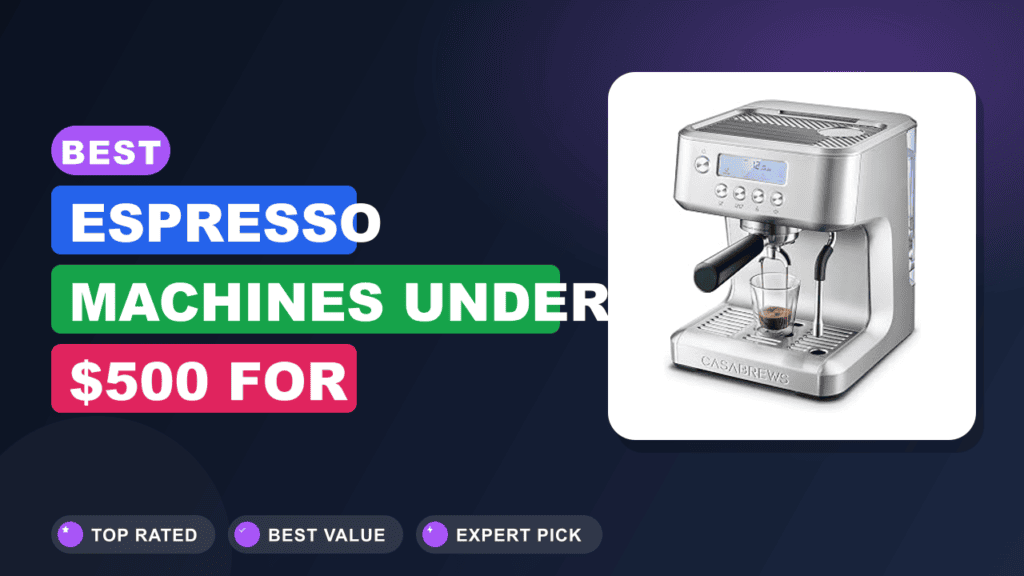
An espresso machine does something different: it uses pressure to force hot water through finely ground coffee. Most machines target about 9 bars of pressure and finish a shot in under 30 seconds.
Temperature matters for both. The Specialty Coffee Association certifies brewers that hold water between 195°F and 205°F through the brew cycle. Standard drip machines often run cooler, frequently hovering around 180°F to 185°F, which can leave coffee tasting sour or under-extracted. If temperature control matters to you, look for that certification on the box.
What You Actually Pay For
Entry-level drip coffee makers commonly cost $40 to $200, while high-end espresso setups with grinders can exceed $1,000 and climb into the thousands.
The hidden cost is the grinder. Drip coffee is forgiving: a standard burr grinder does the job. Espresso is not. A blade grinder or an entry-level drip burr grinder generally cannot produce the grind size and consistency espresso needs. Cited espresso grinders span roughly $170 to $550 depending on burr type and range. Budget for that before you fall in love with a machine.
Counter Space and Kitchen Setup
Drip machines tend to be wide and tall: a full pot needs a footprint plus vertical clearance to lift the lid and pour. Espresso machines are often more compact but heavier, and you need extra room for a grinder, tamper, knock box, and cups.
Before buying an espresso machine, check its water tank access. Some machines sit under cabinets, and a rear-loading tank becomes a daily annoyance if you cannot slide the machine forward. Also confirm the voltage and plug type match your kitchen, and consider whether your water needs filtration. Hard water drives scale buildup, which shortens the interval between descaling sessions.
Daily Routine and Convenience
A drip machine is close to hands-off: add water, add grounds, press start. Cleanup means tossing the filter and rinsing the carafe. A glass carafe on a hot plate can turn brewed coffee bitter within about 30 minutes, so if you sip slowly, a thermal carafe holds drinking temperature for more than two hours.
Espresso demands more of you. You weigh beans, grind fine, distribute and tamp, pull the shot, and steam milk if you want a latte. The learning curve is real: grind size, dose, and tamp pressure all affect the result. In exchange, you get a concentrated shot in under 30 seconds and the ability to make milk drinks at home.
Taste, Strength, and Milk Drinks
These machines produce different drinks, not better and worse versions of the same one. Drip gives you a larger, milder cup. Espresso gives you a small, intense shot with a concentrated flavor and, on many machines, a layer of crema.
Caffeine is where people get confused. An 8 oz cup of drip coffee has about 95 mg of caffeine, compared with about 63 mg in a single 1 oz espresso shot. Espresso is more concentrated per ounce, but a single shot delivers less total caffeine than a mug of drip. These are typical values; bean, dose, and brew strength shift the numbers.
If your ideal morning is a latte, cappuccino, or flat white, an espresso machine is the base you need. A drip maker cannot produce true espresso or the steamed milk that goes with it.
Maintenance and Cleaning Requirements
Neither machine is maintenance-free, but the routines differ.
Drip coffee makers need periodic descaling. Frequency depends on water hardness rather than machine type. Municipal water at about 150 mg/L CaCO3 hardness may require descaling roughly every two to three months at one shot per day. Water formulated to the SCA standard of 40–75 mg/L CaCO3 hardness can stretch that to six to twelve months. Follow your manual’s descaling instructions.
Espresso machines add backflushing and steam wand care. Water-only backflushing should be done daily after the last shot, and detergent backflushing weekly at one shot per day. Not every machine supports backflushing: models without a three-way solenoid valve cannot be backflushed at all. Check before you buy if a full cleaning routine matters to you.
Gaskets wear out. Rubber group gaskets typically need replacement every 6 to 12 months, while silicone gaskets last 12 to 18 months. When descaling, avoid solutions containing sulfamic acid on machines with aluminum thermoblocks, because they can etch aluminum. Always check your manufacturer’s approved descaler.
Picking the Right Grinder
Grind size splits the two machines cleanly. Drip coffee brews best at roughly 600–900 microns, about the texture of coarse kosher salt. Espresso needs roughly 200–400 microns, closer to powdered sugar.
That difference determines what grinder you can get away with. A blade grinder or entry-level drip burr grinder generally cannot hit the fine, consistent range espresso requires. If a grinder has fewer than 20 adjustment increments total, or its published range starts above 350 microns, it is a drip grinder wearing an espresso label. Espresso-focused grinders also tend to run at lower RPM, around 300–700 RPM, to reduce heat buildup at fine settings.
For drip, a standard burr grinder is enough. For espresso, plan on a dedicated grinder, with cited models spanning roughly $170 to $550.
Pick a Coffee Maker If
- You brew for more than one person and want a pot ready at once.
- You drink 8 to 12 oz mugs rather than shots.
- You want a low-effort morning routine and simple cleanup.
- Your budget is tight, and you would rather not add a grinder purchase.
- You do not need lattes or cappuccinos at home.
Pick an Espresso Machine If
- You want espresso, lattes, cappuccinos, or flat whites at home.
- You drink small, concentrated servings rather than large mugs.
- You are willing to buy a dedicated espresso grinder.
- You will keep up with descaling, backflushing where supported, and gasket replacement.
- You enjoy learning technique and dialing in a shot.
When Neither Machine Fits
If you want one cup with almost no effort, a pod system may suit you better than either machine. Pods cost more per cup than whole-bean brewing and create more waste, so weigh that against the convenience. If you want espresso-style coffee without a pump machine, a moka pot is a low-cost stovetop option, though it does not produce true espresso and gives you less control over pressure and temperature.
If you drink only an occasional cup, a pour-over setup or French press may be cheaper and simpler than either machine. The best choice is the one that matches how you actually drink coffee, not the one with the longest feature list.
Related Reading
- Coffee Maker vs Pour Over: Which Brews Better Coffee?
- Coffee Maker vs French Press: Which Brews Better Coffee?
- How Often Should You Clean Your Coffee Maker?
The Bottom Line
Choose a drip coffee maker if you want volume, simplicity, and a lower total cost. Choose an espresso machine if you want espresso and milk drinks and will invest in a proper grinder plus a regular cleaning routine. If neither matches your habits, a pod system, moka pot, or pour-over may be the smarter buy.