The right choice depends less on which machine is “better” and more on how many people you feed and how often you cook. Choose a basket air fryer if you mostly cook for one or two people, want the crispiest results with the least cleanup, and have limited counter space. Choose an air fryer oven if you cook for a family of four or more, want to bake, toast, and roast in the same appliance, and can spare the room for a wider unit. Neither design wins universally: each is genuinely better at different jobs.
How Basket Models and Oven Styles Actually Differ
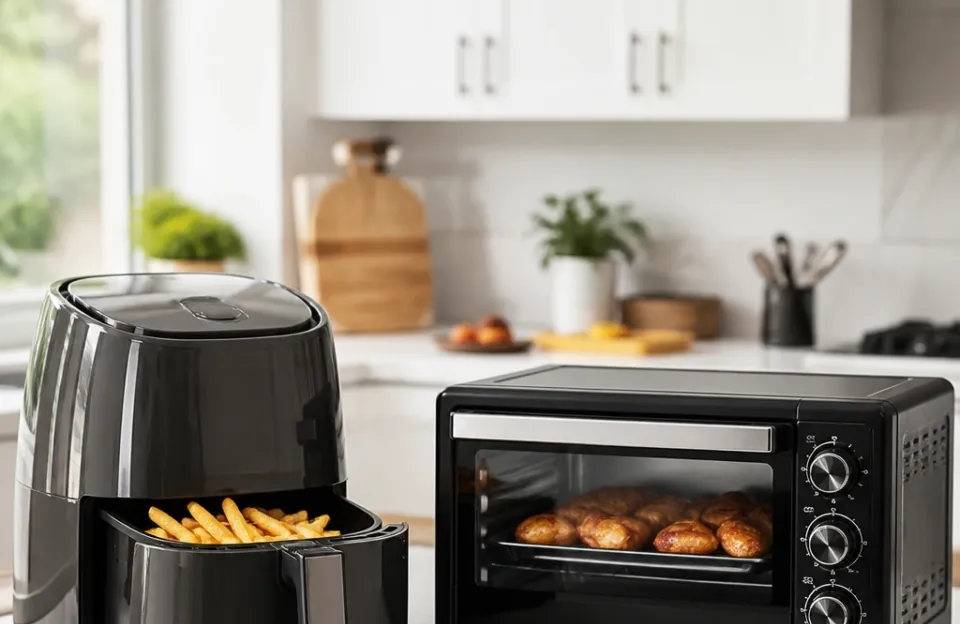
Both formats cook the same way at heart. A fan circulates heated air around the food, but basket and oven-style machines arrange the heating element and fan differently. A basket model keeps food in a pull-out drawer or deep basket, while an oven-style model uses shelves or trays like a small countertop oven.
That structural difference drives almost every trade-off that follows: how much food fits, how fast it cooks, how much counter it needs, and how long you spend scrubbing afterward.
Capacity and Batch Cooking: Comparing Usable Space
Basket air fryers generally run from about 2 to 8 quarts. Compact 2 to 3 litre units suit one or two people, while larger 5 to 7 litre designs can handle a small whole chicken or generous portions. Oven-style models typically offer more room, with cited ranges from 6 to 25+ quarts. The units in buying guides are inconsistent (quarts vs litres), so convert before comparing: 1 quart is roughly 0.95 litres.
Advertised capacity is total volume, not usable cooking space. Usable area is often only about 60 to 70 percent of the number on the box because food needs room for air to move. Two fryers rated at the same capacity can also cook differently if one basket is wide and square while the other is deep and narrow.
Single-layer cooking matters just as much. Basket models typically cook food in a single layer, and stacking food reduces the airflow that makes air frying work. Oven-style units spread batches across rack positions instead. If you regularly cook for a crowd or prep meals ahead, this is where an oven style earns its place.
Speed, Preheat, and Heat Distribution
Basket models are generally described as preheating in about 2 to 3 minutes, while oven-style units take roughly 3 to 5 minutes. Faster preheating and a tighter chamber help basket fryers cook 15 to 25 percent faster in some comparisons, although these figures come from general buying guides rather than lab tests, so treat them as tendencies rather than guarantees.
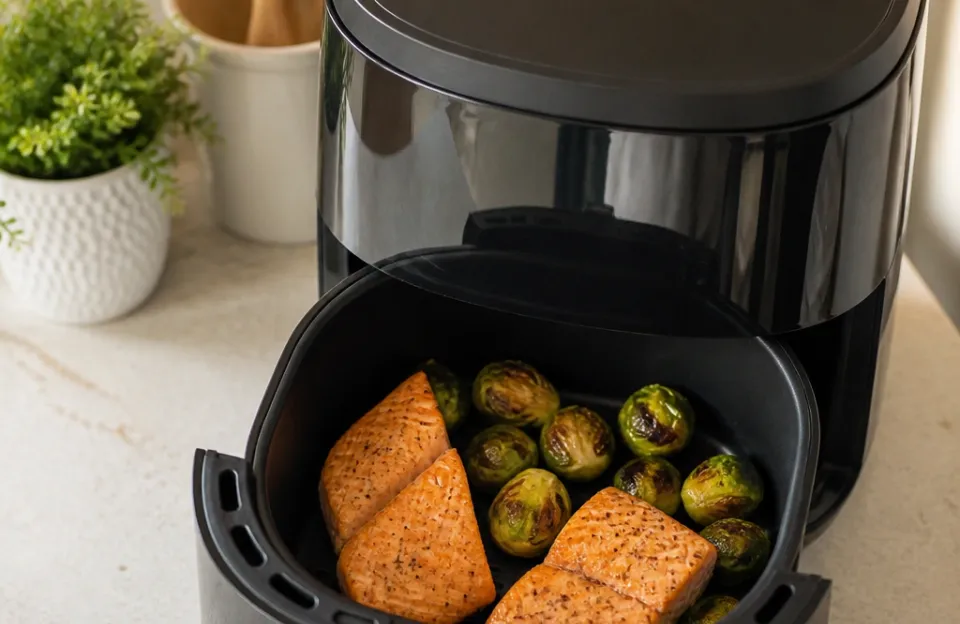
The practical upshot for weeknight cooking: if you often reheat leftovers or cook a quick side of crispy chicken wings, a basket unit usually gets you there sooner. If you are timing several dishes to finish together, the oven’s extra rack space often outweighs its slower start. Delicate items also benefit from predictable timing, which is why knowing how long salmon needs helps regardless of style.
Counter Space, Clearance, and Kitchen Layout
Basket air fryers usually take up a relatively small countertop footprint, though they tend to be taller and narrower. Oven-style units generally need a larger, wider footprint.
When measuring your counter, account for four things: the appliance body itself, space to pull the basket or open the door fully, airflow clearance at the back and sides, and enough overhead room to use the controls comfortably. Exact clearance distances vary by model, so check your specific unit’s manual before committing; no single number applies across brands.
Cleaning Up After Dinner
Basket cleaning is usually straightforward: the basket and drawer are typically non-stick and removable, and many are dishwasher-safe, with splatter largely contained inside the basket. Buyers commonly favor basket models for exactly this reason.
Oven-style air fryers generally involve more work because there are multiple racks, trays, and interior surfaces to clean. If you know you will skip using an appliance that takes fifteen minutes to scrub, cleanup effort deserves real weight in your decision, not just a footnote.
Cooking Beyond Basic Frying: Versatility and Toaster-Oven Overlap
Basket air fryers are built primarily for air frying and offer fewer cooking modes. Oven-style models often add toast, bake, broil, roast, and dehydrate functions.
That extra range makes oven-style units more practical for toast, baking, open-faced foods, sheet-pan style cooking, and anything that does not fit neatly into a deep basket. A glass door on many oven models also lets you watch progress without opening the unit, while basket visibility is limited.
If you already own a toaster oven, an air fryer oven overlaps with it heavily. Ask yourself whether the new appliance replaces the toaster oven or merely duplicates it. Basket fryers occupy a different niche and complement an existing toaster oven better than they compete with it.
For crisp-skin techniques that work in either format, see this guide to extra crispy skin.
Edge Cases Where the Standard Rules Break Down
Dual-zone baskets. Some basket fryers now offer two independent cooking areas, useful for cooking a main and a side together at different temperatures. A standard single-basket model struggles to cook multiple different foods separately at once because everything shares one space and one temperature.
Compact ovens. Smaller oven-style units can fit tighter kitchens while keeping rack-based cooking, making them a middle ground for couples who want versatility without a huge footprint.
Wet batters. Coating consistency changes airflow and browning significantly. For guidance on flour-based coatings, see flour on chicken wings.
Noise. Air fryer fans are loud, comparable to a loud kitchen hood. If you cook in a studio apartment or open-plan space, plan around the noise rather than expecting a quiet appliance, and note that noise varies by model rather than by category alone.
When neither fits. If your kitchen has no usable counter space or your household regularly cooks for six or more in one sitting, a full-size oven or a different appliance may serve you better than either air fryer format.
Common Mistakes People Make with Both Types
- Overcrowding the basket or tray. Stacking food blocks airflow; cook in batches instead.
- Skipping the shake or flip. Even airflow cannot compensate for food that never moves.
- Using aerosol cooking sprays on non-stick surfaces. These can degrade coatings over time; check your manual for approved methods.
- Blocking vents with foil. Never cover the entire bottom or block air vents; this stops circulation.
- Assuming recipe times transfer unchanged. Conversion depends on your specific model and recipe; check the manual and start checking early.
- Ignoring wattage and circuit load. Drawer fryers typically draw around 1,500 to 1,800 watts for short bursts, so avoid running one on the same circuit as other high-draw appliances.
For general appliance safety guidance, the consumer product safety guidelines from the CPSC are a reasonable starting point, though they do not set air-fryer-specific standards.
Picking the Right Machine for Your Counter
Use this decision rule:
| Your situation | Better fit | Why |
|---|---|---|
| One or two people, quick snacks, reheating | Basket air fryer | Compact, fast preheat, easy cleanup |
| Family of four or more, batch cooking, meal prep | Air fryer oven | Larger capacity, multiple racks |
| Want to bake, toast, and roast in one appliance | Air fryer oven | Extra modes and open-faced cooking |
| Limited counter space, small kitchen | Basket air fryer | Smaller footprint, narrower body |
| Cook two different foods at different temperatures | Dual-zone basket or oven | Independent zones or rack positions |
| Hate cleanup | Basket air fryer | Removable, often dishwasher-safe basket |
A few final checks before you buy: confirm interior dimensions rather than trusting capacity alone, verify wattage against your kitchen circuits, read the manual’s clearance and ventilation requirements, and confirm warranty terms. Price ranges in buying guides are indicative; current prices and availability need a live retailer check.
If you are still weighing broader appliance trade-offs, this comparison of an air fryer toaster oven vs air fryer and this guide to air fryer vs conventional oven cover the adjacent questions.
For most households, the honest answer is simple: buy the basket fryer for speed and simplicity, or the oven for capacity and range. Match it to the size of your table and the space on your counter, and you will use it far more often than a machine that wins on paper but does not fit your life.