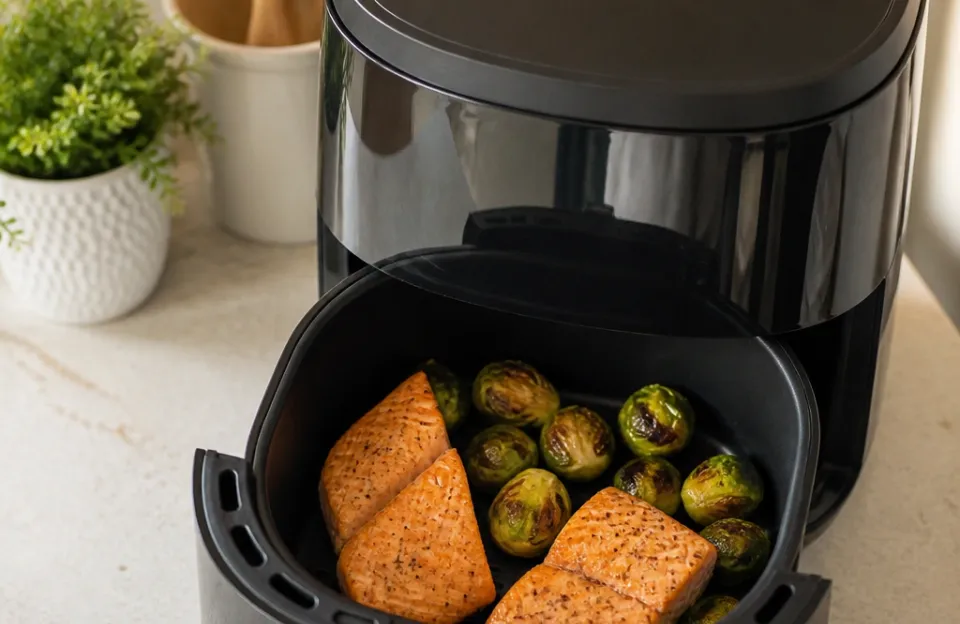
A Teflon-free air fryer replaces the conventional PTFE nonstick coating on the basket with ceramic, uncoated stainless steel, glass, or anodized aluminum. If your main goal is a cooking surface with no fluoropolymer coating at all, uncoated stainless steel and uncoated glass are the clearest fits. If you want nonstick convenience without PTFE, a ceramic-coated basket is usually the closest match, with the trade-off that the coating can lose its release properties over time. This guide explains what PTFE-free actually means, compares the four surface types on the trade-offs that affect daily use, and gives you a decision framework and label checks so you can pick the basket that matches how you cook and clean.
PTFE, PFAS, and PFOA: What the Terms Actually Mean
PFAS are a group of manufactured chemicals used in industry and consumer products since the 1940s, and there are thousands of different compounds in the group. Two of the most widely used and studied are PFOA and PFOS. In recent years, PFOA and PFOS have been replaced in the United States with other PFAS. Many PFAS break down very slowly and can accumulate in people, animals, and the environment over time.
The reason PFAS show up in a cookware discussion is that nonstick coatings fall under the food-contact uses the FDA has authorized for certain PFAS-containing substances since the 1960s. Authorized food-contact PFAS generally fall into four categories: nonstick coating applications, sealing gaskets for food processing equipment, manufacturing aids, and grease-proof agents for paper food packaging.
Two regulatory details matter for how you read a “PTFE-free” label. First, for nonstick applications on pots and pans, the PFAS molecules are polymerized and applied at very high temperatures, which tightly binds the coating to the cookware and vaporizes off virtually all the smaller, migratable PFAS molecules. Studies show negligible amounts of PFAS in this coating can migrate to food. Second, the FDA has identified paper and paperboard grease-proofing agents as the food-contact PFAS use most likely to result in dietary exposure that could raise a safety concern, and in February 2024 the agency announced those substances are no longer being sold by manufacturers into the U.S. market. In January 2025, the FDA determined that 35 related food contact notifications are no longer effective.
In practice, that means a “PFAS-free” claim on an air fryer is usually about the coating chemistry, not about the entire supply chain of the appliance. The FDA requires manufacturers to submit data demonstrating a reasonable certainty of no harm from an intended food-contact use, and it reviews new scientific information afterward to confirm authorized uses remain safe. You can read more from the FDA on authorized uses of PFAS in food contact applications.
Why Some Cooks Avoid PTFE Coatings in Their Kitchen
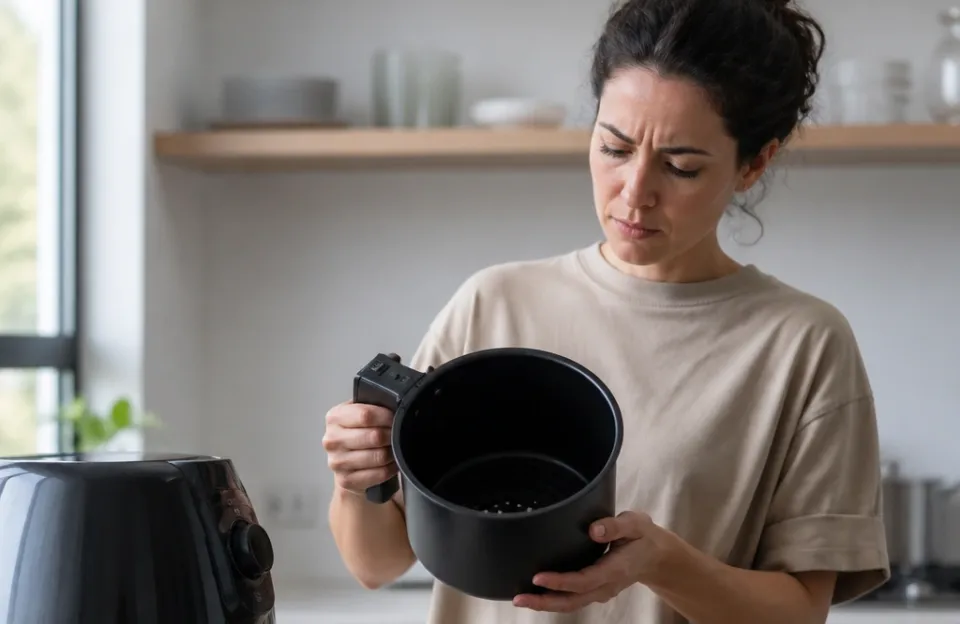
!Why Some Cooks Avoid PTFE Coatings in Their Kitchen
The concern is less about the coating in normal use and more about what happens when it is pushed past its limits. PTFE coatings degrade with sustained high heat, generally cited as above approximately 260°C (500°F). Air fryer baskets are coated through a high-temperature manufacturing process specifically so the polymer binds tightly and migratable fractions are driven off, which is why migration studies show negligible transfer to food.
That leaves three honest points for a buyer:
- Regulatory exposure from the coating is not the same as the broader PFAS issue. The FDA has flagged paper and paperboard grease-proofers, not nonstick cookware coatings, as the food-contact use with a potential safety concern.
- Very high heat is the scenario the coating is not designed around, and degradation above roughly 500°F is the reason that limit is cited.
- Stainless steel and glass sidestep the question entirely because there is no coating to degrade in the first place.
If you use your air fryer within its normal temperature range and avoid preheating an empty coated basket at maximum heat, the coating’s design intent is intact. If you would rather not think about it at all, the uncoated options below remove the category from the decision.
The Four PTFE-Free Surface Types Compared
The comparison below reflects the material trade-offs documented in the available evidence. Anodized aluminum air fryer baskets are not covered by that evidence, so no values are given for that row.
| Surface | Nonstick performance | Durability | Heat behavior | Weight | Relative cost |
|---|---|---|---|---|---|
| Ceramic-coated | Good release when new; can lose nonstick properties over time with high heat | Coating-dependent; wears with scratches and abrasion | Silica-based chemistry rather than PTFE; still heat-sensitive over time | Light to moderate | Mid-range |
| Uncoated stainless steel | No nonstick surface; food can stick and may need oil or parchment | No coating to wear off; durable long term | Handles high heat | Not specified in the available evidence | Not specified in the available evidence |
| Uncoated glass | No nonstick treatment; needs a light coat of oil for best results | No coating to wear off; borosilicate is chosen for thermal-shock resistance | Borosilicate glass selected for resistance to thermal shock | Generally the heaviest option, with variation by design | Higher than conventional nonstick |
| Anodized aluminum | Not covered by the available evidence | Not covered by the available evidence | Not covered by the available evidence | Not covered by the available evidence | Not covered by the available evidence |
Two details are worth pulling out of that table. First, ceramic’s weakness is time, not chemistry: the coating starts out as the easiest surface to release food from, and heat exposure is one of the things that erodes that advantage. Second, glass air fryers make the food visible through the bowl itself, which is a real workflow difference if you like to watch browning without pulling the basket.
Cooking Performance Differences You Will Notice
On a fresh ceramic basket, food release feels close to a traditional nonstick surface, and cleanup is often quick. As the coating ages, expect to reach for oil or parchment more often, particularly for starchy foods like how long root vegetables take in the basket.
Uncoated stainless steel is the biggest behavior change. Because there is no release layer, proteins and starch-heavy foods will grip the surface unless you oil them first. The upside is that you can preheat aggressively and run high temperatures without worrying about a coating. For crispy skin on chicken pieces, a light oil rub and a stainless or glass basket will still give you browning; you just lose the automatic release.
Glass behaves like stainless in terms of release: no nonstick treatment means a light coat of oil is recommended for best results. Its distinct advantage is visibility. Its distinct cost is weight, since glass is generally the heaviest surface type, though that varies by product design.
Anodized aluminum is common in the broader cookware world, but the evidence available here does not document how anodized aluminum air fryer baskets perform on nonstick quality, heat tolerance, durability, or weight, so treat any specific claim about it as something to verify on the product page rather than assume from other cookware categories.
Which Material Fits Your Cooking: A Decision Framework
There is no single best PTFE-free air fryer surface, because the trade-offs point in different directions. Use your own priorities to pick the row that fits:
Choose ceramic-coated if you want the closest experience to a conventional nonstick basket, you cook a lot of foods that would otherwise stick, and you accept that the coating has a finite nonstick life. Plan to use silicone or wooden utensils and to avoid abrasive scouring.
Choose uncoated stainless steel if durability and a coating-free surface matter more to you than effortless release. You are comfortable oiling food and soaking the basket after sticky cooks. It handles high heat well.
Choose glass if you want to watch food cook and you want a coating-free surface. Accept the weight penalty when lifting and pouring hot contents, and know that borosilicate is chosen for thermal-shock resistance rather than indestructibility. A light oil coat helps release.
Do not treat anodized aluminum as an automatic answer to the PTFE question until you can confirm the specific model’s cooking-surface construction and any coating applied over the aluminum. The available evidence does not document this category for air fryers.
If you are weighing a coated basket against a conventional one, our comparison of ceramic and nonstick air fryers goes deeper on the coating chemistry behind both.
How to Verify a PTFE-Free or PFAS-Free Claim
Marketing language and regulatory vocabulary do not always line up, so it helps to know what you are actually checking.
- “PTFE-free” is a coating-chemistry claim. Confirm it by finding the manufacturer’s statement about the basket material, not just a badge on the box.
- “PFAS-free” is broader. Because the FDA authorizes PFAS for several food-contact applications, not only nonstick coatings, a PFAS-free claim should specify that it applies to the cooking surface and any food-contact parts.
- “PFOA-free” is not the same as PTFE-free. PFOA and PFOS have been replaced in the U.S. with other PFAS in recent years, so a product can be legitimately PFOA-free while still using a fluoropolymer coating.
- “Ceramic” should be paired with a manufacturer statement about the coating chemistry. Ceramic coatings typically use a silica-based chemistry rather than PTFE, but this varies by manufacturer, so general claims about “ceramic” are weaker than a named, verified surface specification.
- Uncoated is self-evidencing. The clearest PTFE-free position is a basket with no coating at all, which is what uncoated stainless steel and uncoated glass provide.
For broader food-contact regulatory context, the FDA maintains general food safety guidance at food safety guidelines that covers how authorized substances are reviewed.
Shopping Checklist for a PTFE-Free Air Fryer
Once you have picked a surface type, a few specification decisions do the rest of the work:
- Surface construction. Confirm the basket’s cooking surface, any coating applied to it, and whether the manufacturer states the chemistry. This is the single most important check for a PTFE-free purchase.
- Size. Match capacity to how many people you usually cook for. Overfilling any basket type hurts air circulation and browning, and glass and stainless baskets are heavier to handle when full.
- Weight and handling. If you will lift the basket one-handed or pour off hot oil, weigh the heavy-glass trade-off against the convenience of visibility.
- Warranty. Warranty terms differ by surface type, and coated surfaces generate more warranty claims than uncoated metal or glass in general cookware experience. Check what the warranty says about coating wear specifically, since coating degradation over time is the known weak point of ceramic.
- Heat range. Verify the appliance’s maximum temperature against the surface type you are choosing. Ceramic can lose nonstick performance with high heat over time, while uncoated stainless steel and borosilicate glass are not coating-limited in the same way.
Wattage is often listed as a headline spec, but the available evidence does not include verified wattage recommendations by capacity or model, so treat wattage as a specification to compare on the specific product page rather than a universal number to target.
Cleaning and Upkeep for Each Surface Type
Ceramic-coated. Clean gently. The coating’s weak points are scratching and abrasion, so soft sponges and non-abrasive cleaners protect the release layer. Hand-washing is the safer default for a coated basket, since coating wear, not food residue, is the limiting factor on its life.
Uncoated stainless steel. Stainless resists buildup better than coated surfaces over the long term, but sticky foods can leave residue that needs soaking rather than scrubbing. Avoid steel wool on the cooking surface if you want to keep it looking uniform.
Uncoated glass. Glass also resists buildup well long term. Because there is no nonstick treatment, a light oil coat before cooking reduces the amount of stuck-on residue you have to remove afterward. Handle borosilicate with normal care around sudden temperature changes, since thermal-shock resistance is a design property, not a guarantee against every abrupt shift.
General habit. A fresh nonstick or ceramic coating is easiest to clean when new, while glass and stainless steel hold up better as the years pass. That is the core cleaning trade-off: coated surfaces front-load convenience; uncoated surfaces reward patience.
For cooks whose sticky, greasy foods cause the most cleanup, breakfast strips on the weekend illustrate why a light oil coat and a short soak make uncoated baskets manageable.
Adjusting Recipes for Uncoated Baskets
Switching to stainless steel or glass does not change cook times so much as it changes handling:
- Oil the food, not just the basket. A light coat of oil on the food itself does more for release and browning than oiling the basket alone, and glass in particular recommends a light oil coat for best results.
- Use parchment or a perforated liner for delicate items that would tear or stick on stainless.
- Preheat when the recipe calls for it. Uncoated stainless handles high heat well, so you can preheat confidently.
- Give proteins a moment before moving them. A brief rest lets the surface set, which reduces tearing on uncoated steel and glass.
- Expect to adjust browning, not doneness. The appliance’s heating behavior is unchanged; what changes is how easily food releases and how evenly the exterior browns without a nonstick layer.
For a fast-cooking protein that benefits from a light oil rub on an uncoated surface, preparing seafood quickly is a useful test case.
Planning Your Switch
If you are new to air frying entirely, the appliance category itself is not new; the background of countertop convection cooking explains how these machines evolved into what you see on shelves now.
A practical sequence for making the switch:
- Decide how much you value nonstick release. If a lot, ceramic-coated is the closest PTFE-free substitute, with coating wear as an accepted cost.
- Decide how much you value a coating-free surface. If that outweighs convenience, choose uncoated stainless steel or glass.
- Weigh handling. If weight and pouring matter, factor in that glass is generally the heaviest option.
- Verify the label claim in writing. Look for a manufacturer statement about the cooking-surface chemistry rather than a badge.
- Adjust your technique once. Oil the food, use liners when needed, and give proteins a moment before moving them.
Closing Decision
Match the surface to your priorities rather than chasing a single “best” label. If you want the easiest everyday release without PTFE, choose ceramic-coated and plan to replace the basket before you would replace an uncoated one. If you want a cooking surface with no coating to degrade, scratch, or discuss at all, choose uncoated stainless steel for durability and heat tolerance or uncoated glass for visibility, accepting the extra weight. Any PFAS, PFOA, or ceramic claim on a product page should be checked against the manufacturer’s own description of the cooking-surface chemistry. That check, plus the fit between the basket and the way you actually cook, is the whole decision.