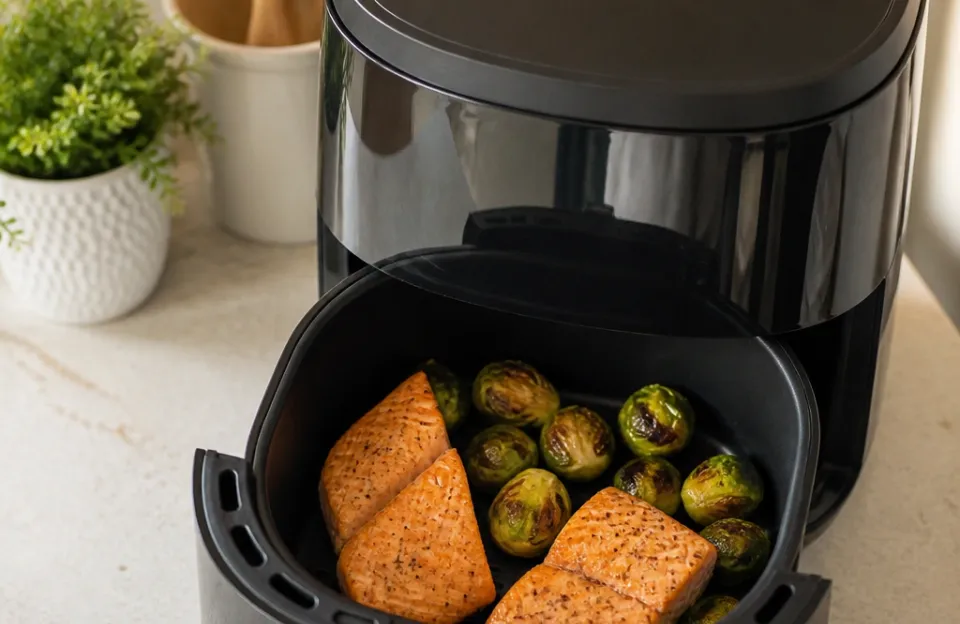
If you regularly cook whole chickens or large roasts and have the counter space for an oven-style unit, a rotisserie air fryer is the design built for that job. If your air fryer mostly handles fries, vegetables, breaded foods and reheating, a standard basket or drawer model is the simpler, more space-efficient choice. The rotisserie is a specialist feature, not an all-purpose upgrade, and it only earns its place if whole-bird cooking is a routine part of your week.
The Short Answer
The decision comes down to one question: what goes in the basket most often?
- Choose rotisserie if you roast whole birds or large joints regularly and can spare the counter depth for an oven-style chamber.
- Choose standard if you want quick sides, crispy frozen foods, reheated leftovers and small-batch cooking without extra accessories or a larger footprint.
- Consider both only if you have the room and the budget; a rotisserie oven with flat racks can cover some everyday cooking, though the spit and other accessories take up part of the cavity.
Neither design is universally better. Claims that one cooks faster or more evenly than the other require side-by-side testing evidence, and that evidence is not available here. The honest answer is that each design suits a different pattern of cooking.
How Air Fryer with Rotisserie vs Standard Models Actually Differ
Both designs circulate hot air around food to create a browned, crisp exterior. The difference is the cooking chamber and what sits inside it.
A standard air fryer uses a pull-out basket or a flat tray in a compact oven-style body. Food sits in a single layer, and hot air moves across the exposed surface. A rotisserie model is built around a larger oven-style cavity with a rotating spit and, usually, a set of wire racks. The spit turns the food so all sides pass through the hot air stream.
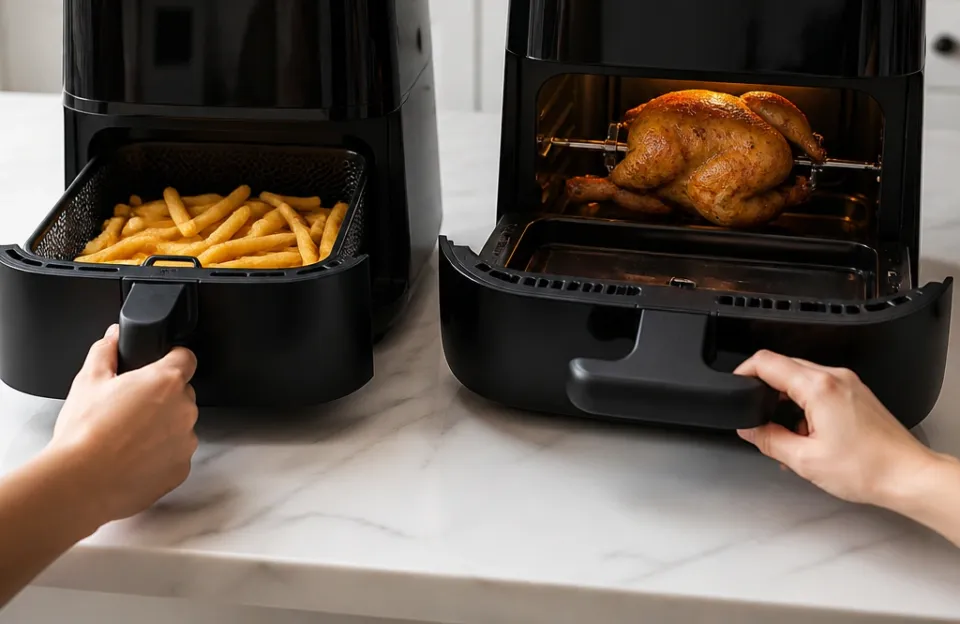
Both designs circulate hot air, so the practical difference is the chamber and what sits inside it rather than the heating principle itself.
That structural difference drives almost every trade-off in this comparison: capacity, footprint, cleanup, accessories and the learning curve. It also means nominal volume figures are not directly comparable. On a multi-function rotisserie oven, the spit, skewers or tumbler sit inside the quoted cavity, so the flat area left for everyday cooking can be smaller than the headline number suggests. Check the usable flat area, not just the quoted volume.
Cooking Whole Birds and Large Roasts
This is the rotisserie’s core advantage. A flat basket cannot turn a whole chicken, and a bird that sits still will brown unevenly on the side facing away from the airflow. A spit rotates the bird through the heat, which is why rotisserie chicken is associated with evenly rendered skin.
Fit is the first thing to check. Rotisserie capacity depends on weight, balance and clearance inside the chamber. Before buying, find the manufacturer’s stated spit weight limit and cavity dimensions, then compare them with the size of bird you actually cook. A bird beyond the motor’s stated limit, or too tall for the cavity, may not rotate as intended, and an unbalanced load can put extra strain on the mechanism.
Food safety matters more here than with any other use of the appliance. Cook all poultry, including whole birds, to a safe minimum internal temperature of 165°F (74°C), measured with a food thermometer. For a whole bird, check the innermost part of the thigh and wing and the thickest part of the breast. If the bird is stuffed, the center of the stuffing must also reach 165°F. Insert the thermometer into the thickest part of the food, away from bone, fat or gristle, and check several places. Color and texture are not reliable indicators of doneness; the thermometer is the reliable check. You can cook poultry to higher temperatures for personal preference, but not lower. The USDA’s safe temperature chart and FoodSafety.gov’s minimum internal temperature chart cover these basics for home cooks the FDA.
For red meat roasts, the targets differ. Beef, pork, veal and lamb steaks, chops and roasts should reach 145°F (62.8°C) with a rest of at least three minutes. Ground meats need 160°F (71.1°C).
One practical limitation: while a bird is on the spit, the chamber is largely occupied. You are cooking one thing, not a protein and a side together.
Fries, Vegetables, Breaded Foods and Reheating
This is the standard air fryer’s home ground. A flat basket or tray gives you direct access to the food, easy shaking mid-cook and predictable results for anything that needs to be spread in a single layer.
Frozen fries, roasted vegetables, breaded cutlets and chicken tenders all work well in a basket because they benefit from lying flat with air moving over them. If you want guidance on specific foods, our notes on cooking potatoes until tender and getting bacon perfectly crisp cover timing for two common basket staples.
Reheating is another standard-model strength. Leftovers should be reheated to 165°F (73.9°C), and a basket makes it easy to check and stir food as it heats.
A rotisserie oven can handle these jobs too, using its flat racks, but the experience is different. Racks are fiddlier to load and clean than a single basket, and small portions in a large cavity can cook less predictably because there is more empty air to heat. If most of your cooking looks like this, the rotisserie mechanism is cost and complexity you will rarely use.
Capacity, Footprint and Kitchen Clearance
Nominal capacity figures mislead in both directions. A standard basket’s quoted volume assumes a certain fill level, and usable capacity is really about the flat area of the basket floor. A rotisserie oven’s quoted volume includes the cavity around the spit, so part of that space is not usable for flat cooking.
Measure before you buy, and measure three things:
- Counter depth. Oven-style rotisserie units are deeper than most basket models. Check that the unit sits fully on the counter with the door open.
- Door swing and overhead clearance. A drop-down door needs room in front; a top-loading lid needs clearance above.
- Storage position. If the appliance lives under a cabinet, confirm it can vent and that the door or lid opens without hitting anything.
If space is the binding constraint, a low-profile basket design is usually the safer fit than a full oven-style chamber. Our look at a slim countertop appliance shows how much footprint varies within the standard category alone.
Dual-basket standard models add a different kind of capacity: two independent cooking zones. The Ninja Foodi DualZone XL, for example, has two 5-quart baskets that can be programmed to heat independently or for the same time and temperature. That flexibility for cooking two different foods at once is a practical advantage over a single-cavity rotisserie oven, which cooks everything at one ambient temperature.
Cleanup, Grease and Noise
Expect more grease handling with rotisserie cooking than with basket cooking. A whole bird renders fat that drips onto a tray or into the cavity, and the spit, forks and drip tray all need washing. Some of that cleanup is unavoidable given what the appliance is doing, but it is a real difference in effort.
Basket models concentrate mess in one removable piece, which usually goes in the dishwasher. That is a simpler routine, though greasy breaded foods can still leave residue on the basket mesh.
Measured noise levels for either design are not available here, and manufacturer decibel ratings are not a substitute for real-world comparison. A rotating spit adds a motor to the appliance, so a rotisserie unit has one more moving part that may produce sound or need servicing. Treat any specific noise claim as something to verify in person or in independent reviews rather than assume.
Accessories are the other cleanup factor. Spit rods, forks, skewers and tumblers all need storage and washing, and lost or broken parts are a real risk over the appliance’s life.
Power Draw and Heat Output
Air fryers draw significant power because they heat a chamber quickly with a fan running. Exact wattage varies by model, so check the rating plate or manual for the specific unit you are considering rather than relying on a category average.
Two practical points follow. First, a high-wattage appliance on a shared kitchen circuit may trip a breaker if other appliances are running, so confirm your circuit’s capacity and the plug type required in your region before you buy. Second, a larger oven-style rotisserie chamber has more volume to heat, which may mean a longer preheat, though the size of that difference depends on the individual model and is not established here.
Manufacturer guidance on accessories matters for safe operation. If you plan to use foil, baking pans or liners, follow the manual for that model rather than improvising. A workaround that seems harmless in one appliance can block airflow or contact a heating element in another.
Before You Buy: Verify These Specifications
This is the step most buying guides skip. The specifications that determine whether a rotisserie air fryer actually works for you are model-specific, and they need checking before purchase, not after.
| What to verify | Why it matters | Where to find it |
|---|---|---|
| Spit weight limit | A bird heavier than the motor’s rating may not rotate reliably | Manufacturer manual or product page |
| Cavity dimensions | A bird too tall or wide for the chamber may not fit on the spit | Product specifications |
| Usable flat area | Nominal volume can overstate flat cooking space | Product specifications and reviews |
| Wattage and plug type | Circuit compatibility varies by region and home | Rating plate or manual |
| Warranty terms | Rotisserie motors and spit assemblies are the parts most likely to need service | Manufacturer warranty page |
| Replacement parts availability | Spit forks, trays and motors should be purchasable separately | Manufacturer parts store |
| Return policy | Lets you confirm fit and performance in your own kitchen | Retailer terms |
If a manufacturer does not publish a spit weight limit or cavity size, that is a signal to look at a different model or to contact the brand directly. Buying blind on this specification is a common way rotisserie owners end up disappointed.
Deciding What Belongs on Your Counter
Work through the decision in this order:
- List what you cooked in the last month. If whole birds or large roasts appear repeatedly, rotisserie is worth considering. If the list is fries, vegetables, nuggets and leftovers, standard wins.
- Measure your counter. Depth, door swing and overhead clearance decide whether an oven-style rotisserie unit fits at all.
- Check the specifications. Spit weight limit, cavity size, wattage, warranty and parts availability, per the table above.
- Consider batch cooking. If you prep multiple portions at once, a dual-zone standard model or a large basket may serve you better than a single-cavity rotisserie oven. Our guide to prepping batches of wings covers that workflow.
- Accept the edge cases. A small rotisserie attachment may not fit the bird you buy; small portions in a large oven need accessories to cook well; and if you already own a full-size oven that roasts well, the rotisserie feature may duplicate it.
The history of these appliances explains why so many configurations exist, but it should not drive the purchase. Your cooking habits and your counter should.
The bottom line: buy the rotisserie model if roasting whole birds is a habit you will keep and the specifications fit your bird size. Otherwise, buy a standard air fryer, put the savings toward a larger basket or a dual-zone model, and use your main oven for the occasional whole chicken. The best air fryer is the one that matches the food you actually cook, in the space you actually have.