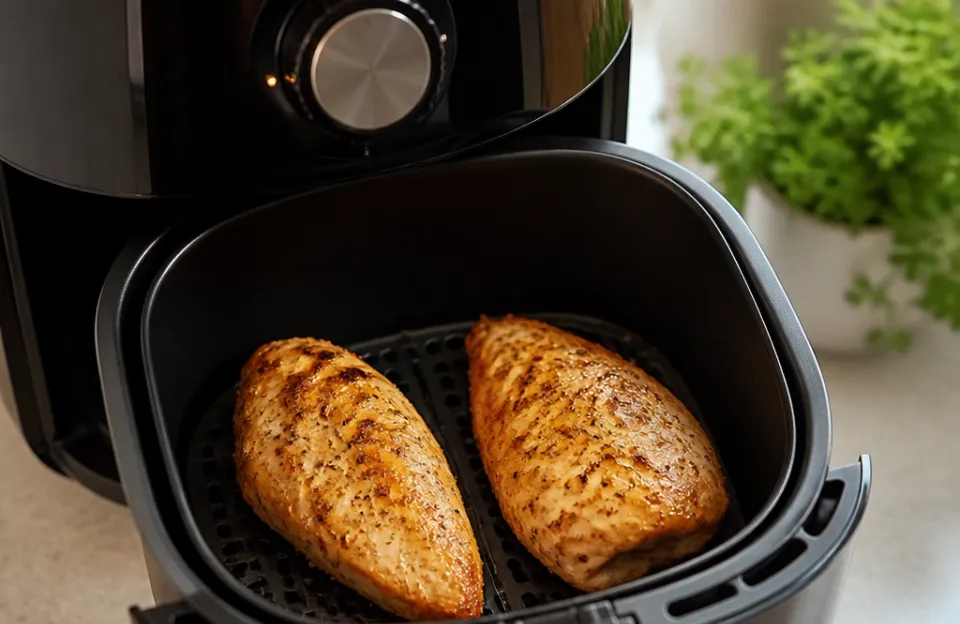
The short answer: buy an air fryer if you want fast, crisp food and don’t mind cooking in batches. Buy a slow cooker if you want tender, hands-off meals that are ready when you get home. If your routine includes both quick weeknight dinners and long, unattended cooking, owning both makes sense, though a multi-cooker can combine some of those functions if counter space is tight.
The rest of this comparison explains the trade-offs behind that recommendation so you can match the appliance to how you actually cook.
How Heat Moves Inside Each Appliance
An air fryer is essentially a small countertop convection oven. A powerful fan circulates hot air rapidly around the food, which browns and crisps the surface.
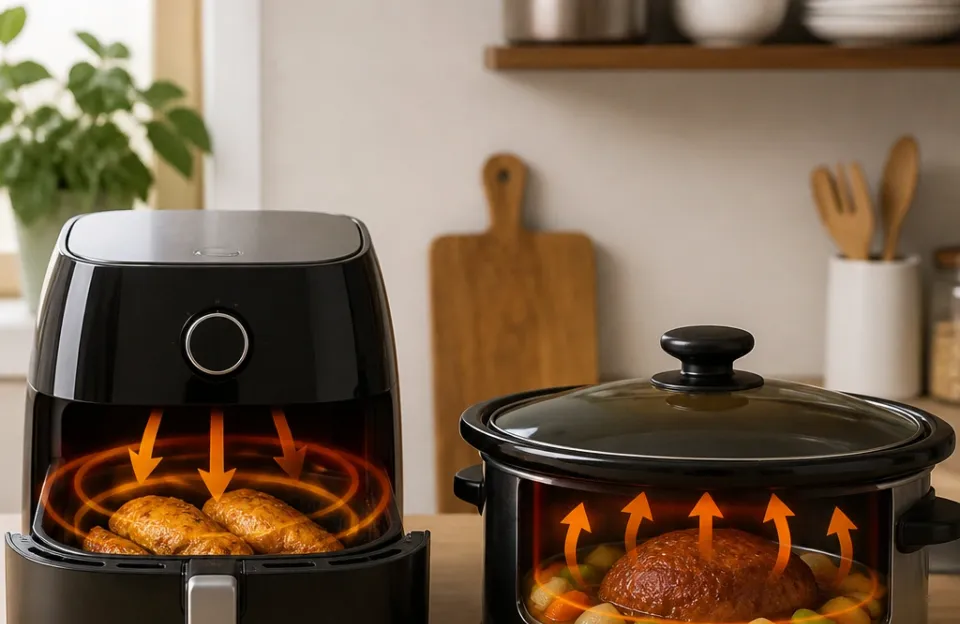
That dry, high-heat environment is why an air fryer produces results closer to roasting or frying than to steaming. It also explains the main limitation: liquid-heavy mixtures don’t work well, because there’s no gentle, sustained moist heat to simmer them. If you’re working out timings for specific foods, guides on how long potatoes need show how much the basket format affects cooking time.
A slow cooker works in almost the opposite way. It surrounds food with low, moist heat for hours, which breaks down connective tissue and keeps sauces from reducing too far. That makes it well suited to stews, braises and sauce-heavy dishes that an air fryer handles poorly.
Cooking Times Compared
The two appliances sit at opposite ends of the time spectrum. An air fryer cooks in minutes and often needs no preheat, while a slow cooker typically runs for several hours on low or high. For small items like poultry pieces, cooking chicken pieces quickly is a fair illustration of how fast the basket method can be.
| Factor | Air Fryer | Slow Cooker |
|---|---|---|
| Heating method | Rapid circulating hot air (dry convection) | Low, moist, sustained heat |
| Typical cook time | Minutes | Several hours |
| Texture outcome | Crisp, browned exterior | Tender, saucy, soft |
| Best for | Small batches, crisp foods | Stews, braises, sauce-heavy meals |
| Poor at | Liquid-based mixtures | Crisp browning |
| Supervision | Generally needs attention during cooking | Designed for long, largely hands-off cooking |
Which Foods Belong in Which Machine
An air fryer handles far more than chips and nuggets. It can bake items such as banana bread, cook soft-boiled eggs, reheat pizza and roast nuts and chickpeas. It also works well for proteins and vegetables that benefit from browning. You can prepare seafood quickly, and techniques for getting extra crunch on wings show where the appliance genuinely outperforms a slow cooker. Some newer models even add a steaming function for vegetables, chicken, fish and dumplings.
A slow cooker is the better tool for anything wet. Stews, curries, chilis, pulled meat and sauce-based dishes all suit its moist, low-heat approach. What it cannot do is produce a crisp crust, so anything you want browned at the end usually needs a separate step.
Energy Draw and Kitchen Temperature
Air fryer wattage varies widely. Reported ranges run from roughly 1,000 to 1,500 watts for compact models up to 2,400 watts or more for large dual-basket units, though these figures come from secondary sources and should be treated as indicative rather than exact. Importantly, higher wattage does not automatically mean an appliance is less efficient or more expensive to run, because a higher draw often comes with a shorter cooking time.
For many everyday meals, an air fryer is generally reported to be cheaper to run than a conventional electric oven, with the savings depending on the food, cooking time and household size. The comparison that matters most is against a full-size oven, not against a slow cooker. Verified wattage and running-cost figures for slow cookers were not available for this comparison, so any direct energy comparison between the two appliances should be treated with caution.
On kitchen heat, an air fryer concentrates its output in a small chamber and vents it locally, while a slow cooker releases gentle warmth over hours. Neither is a major source of ambient heat compared with an oven, but the air fryer’s shorter run time limits how long any heat is added to the room.
Food Safety and Unattended Use
Both appliances must bring food to safe internal temperatures. The USDA publishes minimum internal temperatures measured with a food thermometer, and FoodSafety.gov advises using a thermometer to confirm meat has reached a safe minimum, noting that some meats also need a rest time after cooking. Key targets include 165°F (73.9°C) for all poultry, 145°F (62.8°C) with a 3-minute rest for beef, pork, veal and lamb steaks, chops and roasts, 160°F (71.1°C) for ground meats, 145°F (62.8°C) for fish and shellfish, and 165°F (73.9°C) for reheating leftovers and for casseroles.
For dense cuts cooked in a slow cooker, the practical risk is that the outside can dry out before the center reaches a safe temperature. Checking with a thermometer rather than relying on time alone resolves that, and it’s the reason the temperature targets above matter for both appliances.
An air fryer runs at high temperatures with a powerful fan, so it’s best treated as an appliance that needs attention while it’s on rather than one to leave running while you’re out. A slow cooker is built for long, low cooking, but the same thermometer check applies before you serve.
Health Considerations and Oil Usage
The health case for an air fryer is usually about oil. Because it circulates hot air rather than submerging food in oil, you can use little or none, which is why people often choose it over deep frying.
The other consideration is acrylamide, a chemical that can form in some foods during high-temperature cooking such as frying, roasting and baking. The FDA states that boiling and steaming do not typically form acrylamide, and that acrylamide is found mainly in plant-based foods such as potato products, grain products and coffee, forming at lower levels or not at all in dairy, meat and fish. Formation is generally more likely with longer cooking at higher temperatures.
On risk, the FDA notes that high levels of acrylamide caused cancer in laboratory animals, but at levels much greater than those found in human food, and that the human risk is not clearly established; while there is no consistent epidemiological evidence on the effect of food acrylamide on cancer in humans, both the U.S. National Toxicology Program and JECFA consider acrylamide a human health concern. The FDA’s practical advice is not to stop eating fried, roasted or baked foods, but to follow a healthy eating plan emphasizing fruits, vegetables, whole grains and other nutrient-dense foods. If you’re comparing broader dietary guidance, the FDA guidelines on nutrition are a useful starting point.
Slow cooking, because it uses moist low heat, is not typically associated with acrylamide formation in the way high-heat roasting is. No verified source establishes that either appliance produces better overall nutritional outcomes.
Cleanup, Counter Space and Storage
Cleanup differs by design. An air fryer usually has a removable basket or tray, and some parts are dishwasher-safe, though baked-on grease on the element or basket can take effort. A slow cooker’s ceramic insert is generally easy to wash, but sauce-heavy recipes can leave residue around the rim and lid.
On footprint, an air fryer is compact but needs clearance around its vents for airflow, and larger dual-basket models take up meaningful counter depth. A slow cooker is wider and heavier but low-profile in use. If storage matters, measure both the appliance and your cupboard before buying, and think about how often you’ll actually move it versus leaving it out.
Sizing is worth planning rather than guessing. Capacity in quarts should match how many people you usually cook for and whether you want leftovers; a small air fryer fills quickly and forces batch cooking, while an oversized slow cooker can be awkward for small portions.
Where Each Appliance Falls Short
An air fryer’s main drawbacks are batch limits and liquids. You can’t reliably cook stews or sauce-heavy recipes in it, and filling the basket too densely prevents the air from circulating, so crispness suffers. It also demands more attention during cooking than a slow cooker does.
A slow cooker cannot brown or crisp food on its own, and its long cook times make it a poor fit for spontaneous or last-minute meals. Its results are also less forgiving if you’re watching texture closely, since hours of moist heat will soften anything that should stay firm.
For buyers weighing how established each appliance is, a background piece on how long these countertop appliances have been around can add useful context.
If you want to combine functions, a multi-cooker is one route: these can replace appliances such as a slow cooker, pressure cooker, rice cooker, steamer and sometimes an air fryer, and some can also grill, sear and stand in for a cooktop. The catch is that not all multi-cookers can air fry, and models that can often need an additional lid. Functions vary between models, so choose one whose modes suit your cooking style.
Picking the Right Fit for Your Routine
Match the appliance to the meals you actually make, not to the one with more features on the box.
Choose an air fryer if you cook for one or two people most nights, want dinner on the table quickly, and care about crisp texture. It’s the better fit for roasted vegetables, chicken pieces, fish, reheated leftovers and small baked items. If you’re comparing air fryer styles, a guide to tossing vegetables in the basket shows how the basket format shapes results. Accept that you’ll cook in batches for larger households and that stews and curries aren’t its strength.
Choose a slow cooker if your priority is walking in the door to a finished meal. It suits households that eat stews, braises, chilis and pulled meats regularly, and anyone whose schedule makes long, low cooking practical. Accept that you’ll need another method for browning and crisping.
Choose both, or a multi-cooker, if your cooking mixes quick crisp meals with hands-off batch cooking, and counter space allows it. A multi-cooker can cover slow cooking plus several other functions, but verify that the specific model you’re considering can air fry and whether it needs an extra lid.
Whichever you pick, buy a food thermometer alongside it. It’s the one accessory that makes the safety guidance above practical for either appliance.