An air fryer is a compact countertop convection oven. That's the short answer when comparing an air fryer vs convection oven. Both appliances use a fan to circulate hot air around food, which speeds up cooking and creates browning.
The real difference comes down to size, fan speed, and how close that moving air sits to your food.
If you want fast, crispy results for small batches, the air fryer wins. If you need to cook larger meals or bake evenly across multiple racks, a convection oven handles it better. We'll break down exactly how each one works, where they overlap, and which situations call for one over the other.
How the heating mechanics differ between these two appliances
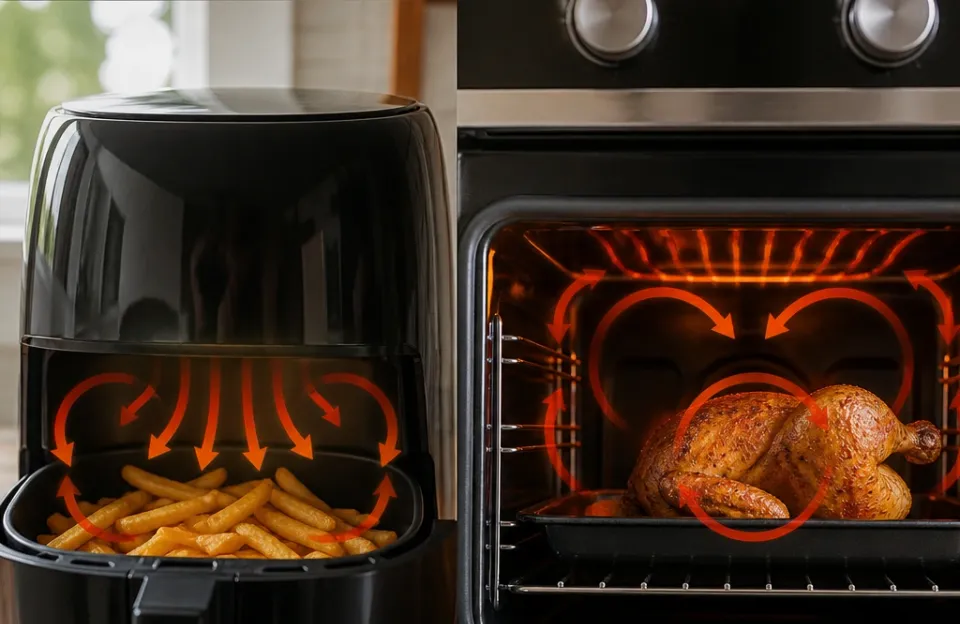
Both machines rely on convection. A heating element warms the air, and a fan pushes it around the cooking chamber. This moving air transfers heat faster than the still air inside a standard oven.
That shared principle is why people get confused about whether they need both.
The main mechanical difference is scale and intensity. An air fryer has a very small cooking chamber, usually between 2 and 10 quarts. Because the space is tight, the fan can be smaller and spin much faster relative to the volume.
The heating element sits directly above the food, often just an inch or two away. This setup blasts the food surface with intense, rapid airflow. That high-speed circulation is what strips moisture from the outside of french fries or chicken skin so quickly, mimicking the crunch of deep frying.
A full-size convection oven has a much larger cavity, typically 3 to 5 cubic feet. The fan is larger in diameter but moves air at a lower velocity relative to the total space. The heating elements are usually located at the back wall or top and bottom, further from the food.
This gentler airflow distributes heat evenly across multiple racks. It browns a whole sheet pan of vegetables or roasts a large cut of meat uniformly, without drying out the exterior as aggressively as an air fryer would.
Fan speed and proximity to the heating element
The fan in an air fryer operates at a higher RPM than a typical oven fan. When you look into how long these appliances have been used in home kitchens, the engineering focus was always on shrinking commercial convection technology into a high-speed countertop format. The close proximity of the element to the basket means radiant heat combines with the forced air immediately.
In a convection oven, the distance between the element and the food acts as a buffer. The air has time to mix and stabilize before hitting the food. This prevents delicate items like cakes or custards from forming a hard crust too early, which is a common problem if you try baking them in an air fryer.
Basket design versus flat sheet pans
Air fryers use perforated baskets or wire racks. These holes allow the high-speed air to flow underneath the food, cooking all sides simultaneously. You rarely need to flip items halfway through, though doing so helps.
Convection ovens rely on solid metal sheet pans or roasting racks. Air only hits the top and sides directly unless you elevate the food on a wire rack placed inside the pan.
This physical difference changes what you can cook easily. Tossing wings in a basket lets fat drip away while air surrounds every piece. Spreading those same wings on a flat baking sheet in a convection oven means the bottoms sit in rendered grease unless you set up a wire rack first.
For getting that specific texture on crispy chicken pieces, the basket design does the heavy lifting.
Capacity limits and kitchen footprint
Size dictates what you can realistically cook. Most air fryers hold between 2 and 6 quarts. Larger models reach 8 or 10 quarts, sometimes split into dual zones.
Even at 10 quarts, you are limited to a few pounds of food arranged in a relatively shallow layer. Overcrowding the basket blocks the airflow, defeating the purpose of the appliance.
Convection ovens come in two forms. Built-in wall ovens or ranges offer 3 to 5 cubic feet of space. You can slide in three racks holding full sheet pans simultaneously.
Countertop convection toaster ovens bridge the gap, offering roughly 0.5 to 1 cubic foot. They take up more counter space than a round air fryer but handle a 12-inch pizza or a small whole chicken.
| Attribute | Air Fryer | Full-Size Convection Oven | Countertop Convection Oven |
|---|---|---|---|
| Typical Capacity | 2 to 10 quarts | 3 to 5 cubic feet | 0.5 to 1 cubic foot |
| Batch Size | 1 to 4 servings | Family-sized or meal prep | 2 to 6 servings |
| Counter Space | Small to medium | None (built-in) | Large |
| Preheat Time | 0 to 3 minutes | 10 to 15 minutes | 3 to 7 minutes |
| Best For | Snacks, sides, small proteins | Roasts, baking, large batches | Toasting, small roasts, baking |
If you live alone or cook for two, a 4-quart air fryer handles most daily tasks. Families cooking dinner for four or more will find themselves running multiple batches in an air fryer, which eliminates the time advantage. A convection oven cooks everything at once.
Cooking speed and energy consumption
Air fryers preheat almost instantly. Some models don't require preheating at all because the small chamber reaches target temperature within two minutes. A full-size convection oven needs 10 to 15 minutes just to heat the air and the metal walls.
Once cooking starts, the air fryer finishes faster. The intense, concentrated heat reduces cooking times by 20% to 30% compared to a standard oven, and slightly faster than a full-size convection oven. For example, figuring out the right timing for root vegetables takes less overall time in the basket because the heat transfer is so aggressive.
Energy use favors the air fryer for small jobs. Heating a massive steel oven cavity to 400°F to cook six chicken tenders wastes electricity. The air fryer heats a tiny plastic and metal box using a smaller wattage element, typically 1,400 to 1,800 watts.
A full electric oven draws 2,000 to 5,000 watts. However, if you are cooking three sheet pans of food for meal prep, running the large oven once uses less power than running a small air fryer five separate times.
Temperature accuracy and heat retention
Convection ovens hold their temperature steadily because of the thermal mass of the heavy walls and racks. Opening the door drops the temperature, but the large elements recover it. Air fryers lose heat rapidly when you pull the basket out to shake the food.
The lightweight walls don't retain thermal energy well. This means the actual cooking temperature fluctuates more in an air fryer during active use.
For recipes requiring precise, steady heat, like baking bread or tempering chocolate, the convection oven provides a stable environment. The USDA notes that proper internal temperatures are required for safe poultry handling, and a stable oven environment makes hitting those targets predictably easier across large cuts of meat.
Texture outcomes: crispiness versus even browning
The word "fry" in air fryer sets expectations. The machine excels at creating a dry, crunchy exterior. It pulls surface moisture away rapidly.
Frozen foods like tater tots, mozzarella sticks, or pre-breaded fillets come out significantly crisper in an air fryer than in a convection oven. The perforated basket allows steam to escape downward instead of pooling under the food.
A convection oven produces excellent browning, but it is a different type of browning. It yields the golden, roasted exterior of a Thanksgiving turkey or the caramelized edges of roasted carrots. It doesn't achieve the shatteringly crisp texture of fried food because the airflow isn't fast enough to dehydrate the surface instantly, and solid pans trap moisture underneath.
When preparing things like salmon fillets, the choice depends on the desired result. An air fryer gives you a slightly firmer, drier exterior while keeping the center moist due to the short cook time. A convection oven roasts the fish more gently, resulting in a softer, flakier texture throughout.
Neither is wrong; they just produce different eating experiences.
Baking highlights this divide clearly. Cookies baked in a convection oven spread normally and develop chewy centers with crisp edges. Cookies baked in an air fryer often puff up too fast, brown heavily on top before the bottom sets, and dry out because the fan speed is too high for delicate doughs.
Cleaning routines and daily maintenance
Air fryer baskets usually have a nonstick coating. After cooking greasy food, you pull the basket out and wash it in the sink. Many are dishwasher safe.
The main unit requires wiping down the interior occasionally to remove splattered oil. If grease builds up on the heating element above the basket, it can smoke during the next use.
Convection ovens demand more effort. Sheet pans need soaking and scrubbing. The oven interior collects splatters over time, requiring a self-cleaning cycle or manual scrubbing with oven cleaner.
Countertop convection ovens are easier to manage than built-in ones, but they still have glass doors, crumb trays, and interior walls that collect baked-on grease.
The tradeoff is frequency. You might clean an air fryer basket after every single use because the small space gets dirty fast. You might wipe down a convection oven once a week if you use sheet pans lined with parchment paper.
Lining your pans makes oven cleanup trivial, whereas you cannot line an air fryer basket completely without blocking the crucial airflow holes.
Deciding which appliance fits your kitchen routine
Choosing between an air fryer vs convection oven comes down to what you cook most often and how many people you feed.
Pick the air fryer if you primarily cook for one or two people. It is the right tool if you frequently reheat leftovers, cook frozen snacks, or want fast side dishes without turning on a large appliance. It suits renters or dorm rooms where a full oven isn't available.
The speed and crispiness are its main selling points.
Choose the convection oven if you cook for a family, entertain guests, or do weekly meal prep. It is necessary for baking cakes, roasting whole chickens, or cooking multiple dishes simultaneously. If you already own a modern oven with a convection setting, buying a separate air fryer is only useful if you specifically crave that extra-crispy texture for small items or want to avoid heating the house in summer.
Countertop convection ovens act as a middle ground. They toast bread, roast a small chicken, and bake cookies better than an air fryer, while taking up less space than a full range. Some newer countertop models include a dedicated "air fry" setting that increases the fan speed, effectively combining both tools into one larger footprint.
Adjusting recipes between the two machines
You can adapt almost any convection oven recipe for an air fryer, provided the food fits in the basket. The general rule is to reduce the temperature by 25°F and check the food 20% earlier than the recipe states. Because the air fryer is hotter and faster, things burn quickly if you follow standard oven times blindly.
Going the other direction requires patience. If an air fryer recipe calls for 400°F for 12 minutes, a convection oven will likely need 400°F for 15 to 18 minutes, and you may need to use the broiler at the end to match the crispiness. Always use a wire rack inside your baking sheet when adapting air fryer recipes for a convection oven to mimic the airflow underneath the food.
Knowing proper timing for thicker cuts in either machine prevents raw centers. Dense items like meatloaf or thick pork chops cook more evenly in a convection oven because the gentler heat penetrates to the center before the outside chars. In an air fryer, dense foods often require lower temperatures and longer times than you'd expect, or they need to be sliced thinner.
Edge cases where the usual rules change
Not every air fryer behaves identically. Dual-basket models split the capacity, meaning each side holds even less food. Halogen convection ovens, sometimes marketed as air fryers, use a glass bowl and a light bulb for heat.
They cook slower than coil-element air fryers and behave more like traditional countertop ovens.
Moisture-heavy foods expose limitations in both machines. Steaming broccoli or cooking rice requires trapped moisture. An air fryer actively removes moisture, making it terrible for steaming.
A convection oven dries out uncovered wet dishes faster than a conventional oven. If you need to braise or steam, neither tool is ideal unless you tightly cover the food with foil, which negates the benefits of the convection fan.
Altitude affects both appliances, though the impact is more noticeable in baking. At higher elevations, water boils at lower temperatures, and evaporation happens faster. The aggressive fan of an air fryer accelerates this drying effect, potentially turning baked goods into rocks if recipes aren't adjusted for altitude.
Frequently asked questions
Is an air fryer just a small convection oven?
Mechanically, yes. An air fryer uses a heating element and a fan to circulate hot air, which is the exact definition of convection cooking. The distinction lies in the engineering.
Air fryers have smaller chambers, faster fans, and heating elements positioned closer to the food, which creates a more intense crisping effect than a standard convection oven.
Which appliance is better for cooking chicken wings?
An air fryer produces crispier skin on chicken wings because the high-speed fan renders fat quickly and dries the surface. A convection oven handles larger batches easily, but the wings may not get quite as crunchy unless you use a wire rack and the broiler. For maximum texture on small batches, the air fryer wins.
If you are feeding a crowd, the oven is the practical choice.
Can I bake a cake in an air fryer?
You can, but the results are often inferior to a convection oven. The intense, direct airflow tends to set the top crust before the batter rises fully, leading to domed, cracked, or unevenly baked cakes. Small items like muffins or lava cakes work reasonably well, but standard layer cakes belong in a traditional or convection oven where the heat is gentler.
Does a convection oven use more electricity than an air fryer?
For small tasks, yes. Heating a large oven cavity to cook a single serving of food consumes more energy than running a compact 1,500-watt air fryer. However, if you are cooking a full meal with multiple dishes, running the large oven once is more efficient than cooking each component separately in a small air fryer over an hour.
Do I need an air fryer if my oven has a convection setting?
You don't strictly need one. A convection oven setting covers 90% of what an air fryer does. People buy standalone air fryers for convenience, faster preheating, avoiding summer kitchen heat, and achieving slightly crispier textures on small snacks.
If counter space is limited and your convection oven performs well, a separate air fryer might gather dust.
Why does my food dry out in the air fryer but not the oven?
The fan speed and chamber size cause rapid moisture evaporation. Food that lacks natural fat or a protective coating (like breading) will dehydrate quickly under the intense airflow. Lowering the temperature slightly or tossing vegetables in oil before cooking creates a barrier that slows down this moisture loss.
Picking the right tool for tonight's dinner
The debate over an air fryer vs convection oven resolves itself once you look at your plate. Heavy, wet, or large-scale cooking belongs in the oven. Fast, dry, crispy, single-serving cooking belongs in the basket.
Owning both gives you flexibility, but understanding the physics of how they move heat ensures you stop guessing which button to press. Match the machine to the moisture level and volume of your food, and the timing takes care of itself.