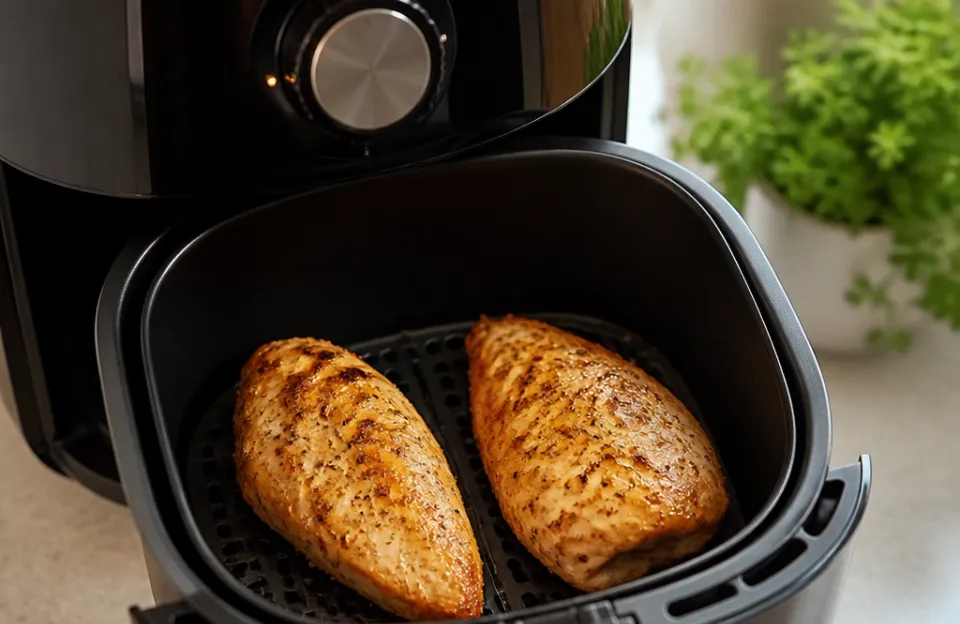
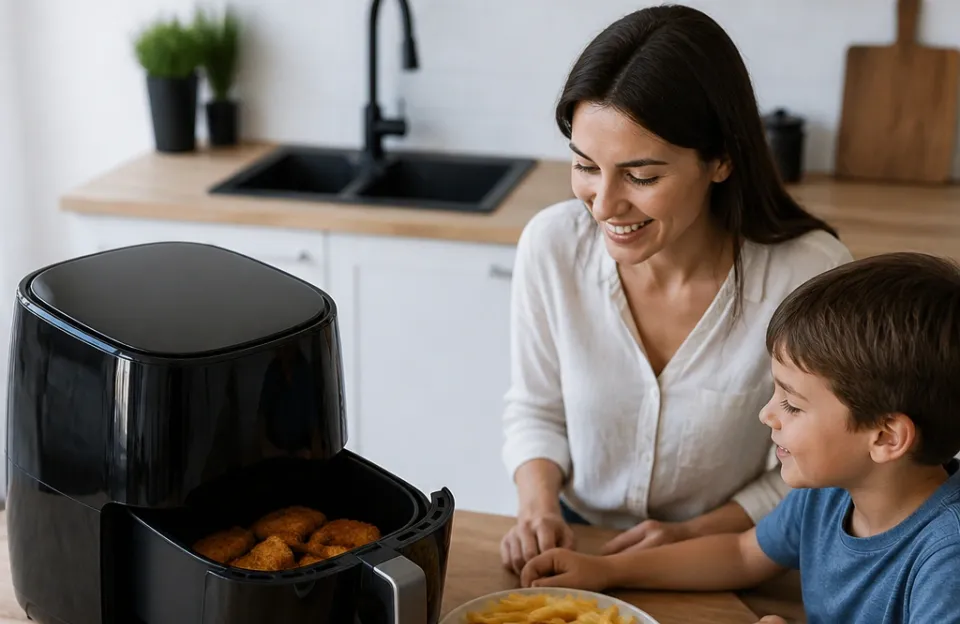
For a household of four, an air fryer between 5 and 6 quarts is the standard recommendation. A 4-quart model works if you cook in batches or mostly prepare side dishes. An 8-quart unit fits families that want to roast whole chickens or cook entire meals at once without stacking food.
Picking the right air fryer size for four people comes down to what you plan to cook most often. Capacity dictates whether your chicken wings crisp up evenly or steam into a soggy mess. This guide breaks down how quart sizes translate to actual food volume, why basket shape matters just as much as total capacity, and how different cooking habits change the math.
How Quart Capacity Translates to Real Meals
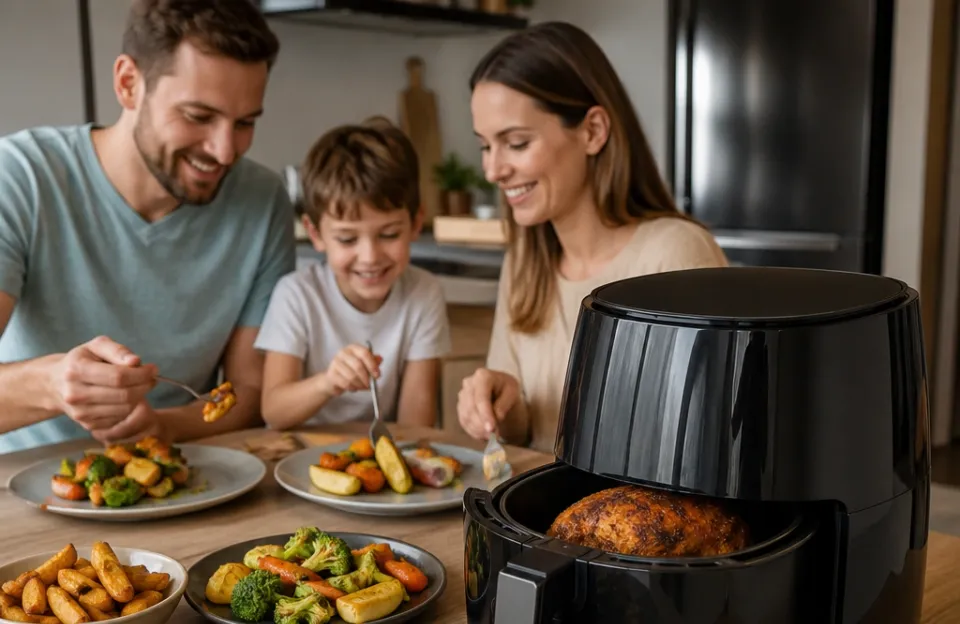
Manufacturers measure air fryer capacity by the total internal volume of the cooking chamber or basket. That number includes the space taken up by the heating element, the fan clearance, and the empty air above the food. You can't fill a 6-quart basket with 6 quarts of potatoes.
The usable cooking area is always smaller than the advertised number.
As a general rule, you need about 1 to 1.5 quarts of capacity per person for a main dish. For four people, that puts you squarely in the 4 to 6-quart range. If you're only making sides or snacks, you can get away with less.
A 4-quart basket holds roughly two large chicken breasts, three cups of french fries, or about 12 standard chicken wings. That's enough for two adults eating a full meal, or four people sharing a side dish. To feed four hungry adults a main course from a 4-quart machine, you'll run two batches.
A 5.8-quart basket, which is one of the most common sizes on the market, fits about 3 pounds of chicken wings or a small whole chicken weighing up to 4 pounds. It handles four portions of salmon fillets laid out flat. This is where most families of four land because it cooks a full dinner in one go without taking over the entire counter.
An 8-quart or larger dual-basket unit gives you room to separate foods. You might cook protein in one drawer and vegetables in the other. Dual-zone models often advertise 8 quarts total, meaning each basket is 4 quarts.
Keep that split in mind when reading the box.
| Air Fryer Size | Best Fit for Four People | Typical Food Capacity |
|---|---|---|
| 3 to 4 Quarts | Side dishes, snacks, batch cooking | 12 wings, 2 chicken breasts, 3 cups fries |
| 5 to 6 Quarts | Full dinners, single-basket convenience | 20 wings, 4 salmon fillets, 4 lb chicken |
| 7 to 8+ Quarts | Large roasts, dual-drawer meals | Whole 5 lb chicken, two separate dishes |
Why Basket Shape Matters Just As Much As Volume
Two air fryers can both say "6 quarts" on the label and perform completely differently. The reason is the footprint of the basket. A tall, narrow basket forces you to stack food.
Stacking blocks airflow. When hot air can't circulate around every surface of the food, the items in the middle steam instead of crisping.
If you frequently cook things like crispy chicken pieces or frozen fries, a wide, shallow basket beats a deep, round one every time. Laying food out in a single layer lets the convection fan do its job. You'll get better browning and faster cook times even if the total quart rating is slightly lower.
Square baskets also use counter space more efficiently than round ones. A 5-quart square basket often has a wider flat bottom than a 6-quart round bucket style. Check the interior dimensions in inches if the manufacturer lists them.
A cooking surface that measures 9 by 9 inches gives you plenty of room for four pork chops. A 7-inch round base will have you overlapping them.
Dual-basket models solve the stacking problem by giving you two separate zones. They are popular for families because you don't have to compromise on flavor profiles. You can keep the spicy dry rub away from the plain breaded pieces.
Just remember that each individual drawer in an 8-quart dual model is usually 4 quarts. That means each drawer fits about two servings. You still cook for four, but you divide the food between the two bins.
Matching Your Cooking Habits to the Right Capacity
The ideal air fryer size for four people shifts depending on what you actually eat. Someone who uses their machine exclusively for reheating leftovers needs a different appliance than someone roasting entire dinners.
If you mostly cook proteins like chicken thighs, pork chops, or fish fillets, a 5 to 6-quart single basket is the sweet spot. You can lay four average-sized portions flat. Getting the timing right for thicker cuts takes practice, so knowing how long to cook salmon prevents you from drying it out while trying to fit everything in.
If your family eats a lot of vegetables alongside the main dish, you either need a massive single basket (8 quarts or more) or a dual-basket model. Trying to cram broccoli florets around the edges of four chicken breasts in a 4-quart basket results in uneven cooking. The chicken shields the vegetables from the heating element.
Separating them guarantees everything finishes at the same time.
Batch cooking for meal prep changes the equation entirely. If you plan to cook a week's worth of lunches on Sunday, buy the largest unit your counter can hold. Running six consecutive batches in a 3-quart machine takes hours and wears out the heating element faster.
A larger basket lets you process bulk ingredients quickly.
For households that treat the appliance as a secondary oven used only for appetizers or snacks, a 3.5 to 4-quart model is fine. It takes up less cabinet space and preheats faster. But if you expect it to replace your oven for Tuesday night dinners, going too small will frustrate you within the first week.
Counter Space and Storage Reality Checks
Bigger isn't always better if it doesn't fit under your cabinets. Standard kitchen upper cabinets sit 18 inches above the countertop. Many 8-quart air fryers stand 15 to 16 inches tall, leaving almost no clearance.
You also need at least 5 inches of space behind the exhaust vent to prevent heat damage to your backsplash or wall.
Before buying, measure your available counter depth. A 6-quart unit typically requires a footprint of about 14 by 14 inches. If you have a small kitchen, look for models designed with a vertical orientation or a slimmer profile.
Some brands specifically design units with a reduced footprint for tight spaces, like this slim 6-quart model, which trades a bit of width for height while keeping the capacity intact.
Weight is another factor. A 5.8-quart air fryer usually weighs between 12 and 15 pounds. Larger 10-quart oven-style models can push 25 pounds.
If you plan to store it in a cabinet and pull it out only on weekends, lifting a heavy unit repeatedly gets old fast. Consider how often you'll move it before committing to the largest size available.
Oven-style air fryers with front-opening doors and multiple racks offer high capacity in a different shape. They take up more horizontal space but can hold sheet pans. These are great for families of four who want to bake or dehydrate, though they sometimes struggle to get foods as crispy as a traditional basket model because the fan placement differs.
Safety Clearances and Proper Ventilation
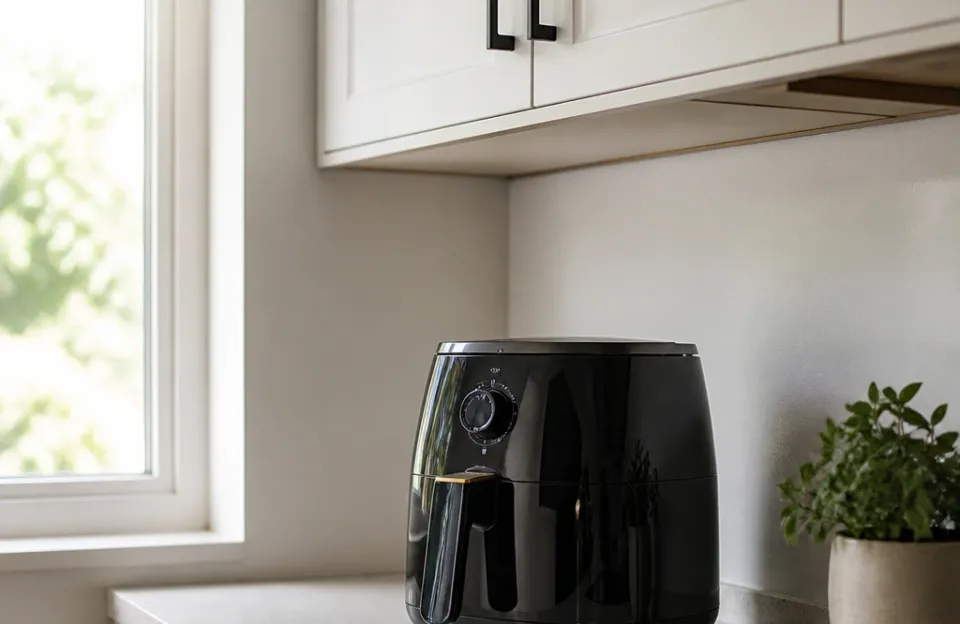
Air fryers generate significant heat. The exhaust vent pushes out air that can reach temperatures well over 300 degrees Fahrenheit during operation. Placing the unit flush against a wall or underneath a low-hanging shelf creates a fire hazard and can melt nearby plastics or warp wood.
The National Fire Protection Association provides guidelines on safe appliance usage and electrical load management in residential kitchens. Always plug a high-wattage appliance directly into a wall outlet. Avoid using extension cords or power strips, as the sudden current draw when the heating element cycles on can overload them.
Larger air fryers (8 quarts and up) often pull 1700 to 1800 watts. Smaller 4-quart models might use 1400 to 1500 watts. Check your kitchen circuit breaker.
If you share a 15-amp circuit with a microwave or coffee maker, running a high-wattage air fryer simultaneously might trip the breaker. Knowing your electrical limits is part of choosing the right size.
Proper ventilation also affects performance. If the machine can't pull in cool air and exhaust hot air freely, the internal thermostat struggles to maintain the set temperature. This leads to longer cook times and uneven browning.
Give the machine room to breathe, especially if you opt for a larger capacity model that generates more exhaust.
Adjusting Cook Times When Scaling Up Portions
Buying the right size is only half the equation. You also need to know how to use it when cooking for four. Recipes written for a 2-quart personal air fryer don't translate perfectly to a 6-quart family model, and vice versa.
When you increase the amount of food in the basket, the overall thermal mass increases. The heating element has to work harder to bring all that food up to temperature. Expect to add a few minutes to the cook time when loading a basket to maximum capacity compared to cooking a single serving.
Shaking the basket becomes mandatory when cooking for four. If you're making a large batch of roasted potatoes, pull the basket out halfway through and toss them. This redistributes the food so the pieces that were trapped in the center get exposed to the direct airflow.
If you skip this step, the outer layer burns while the middle stays raw. Mastering the right timing for root vegetables ensures everything finishes together.
Don't overcrowd the basket just because it fits. There is a difference between "it physically fits inside" and "it will cook properly." Leave a little space between items like chicken drumsticks or sausage links. If you find yourself forcing the lid closed or stacking meat three layers deep, you've exceeded the functional capacity of your machine, regardless of what the box says.
Cooking in two relaxed batches yields significantly better texture than one cramped batch.
Preheating matters more for larger units. A 3-quart basket heats up in about two minutes. A 7-quart oven-style unit might need five minutes to stabilize the air temperature.
Dropping cold food into a cold large basket drops the ambient temperature drastically, leading to soggy exteriors. Always let the machine run empty at your target temperature for a few minutes before adding the food.
Common Sizing Mistakes Families Make
People tend to make the same errors when shopping for a family-sized machine. Recognizing these ahead of time saves you from returning a unit two weeks later.
- Buying based on price rather than capacity. The cheapest model on the shelf is often 2 or 3 quarts. It looks like a bargain until you realize you have to cook dinner in four separate shifts. Price per quart is a better metric than sticker price alone.
- Ignoring the difference between total volume and cooking area. An 8-quart oven-style air fryer sounds huge, but if the racks are narrow, you still can't fit four large steaks side-by-side. Look at the square inches of the primary cooking rack, not just the total cubic volume.
- Assuming a bigger machine cooks faster. Larger baskets require more energy to heat the air volume. A massive 10-quart unit might take longer to preheat and cook a small handful of fries than a compact 4-quart model. Only buy big if you regularly cook big.
- Forgetting about cleanup. A 6-quart non-stick basket is heavy and bulky to wash in a standard sink. If you don't have a deep basin or prefer dishwasher-safe parts, check the dimensions of the removable components before buying. Some large baskets simply don't fit in standard dishwasher racks.
- Overlooking wattage limitations. Renters or those with older homes might have 15-amp circuits shared across multiple outlets. Plugging a 1800-watt air fryer into the same circuit as a running refrigerator can cause nuisance tripping. Verify your kitchen's electrical capacity supports the size you want.
Frequently Asked Questions
Is a 4-quart air fryer big enough for a family of four?
A 4-quart air fryer is large enough for four people if you are cooking side dishes, snacks, or small portions of protein. For a full main course where everyone eats from the same batch, you will likely need to cook in two rounds. It works best for families with younger children or those who use the appliance as a supplement to their stove rather than a replacement.
Should I get a single basket or a dual basket for four people?
A dual-basket model is highly recommended if your family prefers complete meals cooked simultaneously, like protein in one drawer and vegetables in the other. However, ensure the total capacity is at least 8 quarts, meaning 4 quarts per side. If you mostly cook large quantities of a single item, like a big batch of wings, a single 6-quart basket provides more uninterrupted surface area.
Will a larger air fryer use significantly more electricity?
Larger air fryers generally have higher wattage elements, ranging from 1700 to 1800 watts compared to 1400 watts for smaller units. Because they cook food faster and require fewer batches, the total energy used per meal is often comparable. The spike in power draw happens during preheating, but the overall runtime decreases when you aren't repeating cycles.
Can I fit a whole chicken in a 5-quart air fryer?
You can fit a small whole chicken, typically up to 4 pounds, in a 5-quart basket. Anything larger will sit too close to the top heating element, causing the skin to burn before the interior reaches a safe temperature. For birds larger than 4 pounds, you need at least a 6.5 to 8-quart capacity to allow proper air circulation over the top of the meat.
Does the shape of the air fryer change how much food it holds?
Yes, significantly. Square or rectangular baskets provide more usable flat surface area than round buckets of the same quart rating. Since air frying relies on laying food in a single layer for maximum crispness, a wide square 5-quart basket will often hold more practical food for four people than a deep, narrow 6-quart round basket.
Getting the Right Fit for Your Kitchen
Choosing the correct air fryer size for four people comes down to measuring your actual habits, not just guessing based on headcount. A 5 to 6-quart single basket handles most standard family dinners comfortably. Dual-drawer setups offer flexibility if you want to separate flavors or cook sides and mains at the same time.
Measure your counter space, check your electrical outlets, and resist the urge to buy the biggest model available unless you genuinely plan to fill it. The right size makes weeknight cooking faster and keeps food textures exactly where they should be.