You pull the salmon out of the oven, and it looks beautiful. But as soon as you flake it with a fork, it’s either unpleasantly translucent in the middle or, worse, bone-dry and covered in white gunk. We’ve all been there, wondering if thirty more seconds will make it perfect or ruin the meal.
Quick Answer: The USDA recommends an internal temperature of 145°F (63°C) for safety, measured at the thickest part of the fillet. However, many chefs and home cooks find 145°F overcooked and prefer 125°F to 135°F for a moist, flaky texture. For wild-caught species like Sockeye, pulling the fish at 120°F often yields the best results.
Why temperature determines the texture of your fish
When you cook salmon, the proteins in the muscle fibers begin to shrink and firm up as they heat. If the temperature climbs too high, those fibers squeeze out all the internal moisture, leaving the fish tough and chalky. This is also when you see “albumin”, that white, protein-rich liquid, leaking out of the gaps in the meat.
While albumin is safe to eat, it’s a visual sign that the muscle fibers are tightening too much.
Getting the temperature right isn’t just about safety; it’s about preserving the fats and oils that give salmon its flavor. Farm-raised salmon usually has a higher fat content than wild-caught varieties. This means it can handle a slightly higher temperature without drying out.
Wild salmon, like King or Sockeye, is leaner and more prone to becoming dry if it spends even a minute too long over the heat.
The heat also affects the collagen between the layers of the fish. As the temperature rises, this connective tissue breaks down, allowing the fish to “flake.” If you undercook it, the layers stay stuck together and feel rubbery. If you overcook it, the flakes become brittle.
The sweet spot is that moment when the collagen melts but the muscle fibers still hold their moisture.
The USDA standard vs. culinary preference
The official USDA guidelines state that all finfish should be cooked to 145°F. This is a “fail-safe” temperature designed to kill any potential parasites or bacteria. At this level, the salmon will be completely opaque and very firm.
Most professional kitchens find this too high for high-quality fish, as the texture loses its silkiness.
Many food safety experts and chefs note that if you know your fish is high-quality or was previously frozen (which kills most parasites), you can safely aim for a lower temperature. For a medium-rare to medium finish, most people aim for 125°F to 135°F. This range keeps the center a bit more orange and succulent while the outside remains crisp.
Carryover cooking and the “pull” temperature
One thing people often forget is that the temperature continues to rise after the fish leaves the pan or oven. This is called carryover cooking. If you want your final plate to be 130°F, you should take the salmon off the heat when it hits 125°F.
The residual heat trapped in the thickest part of the meat will finish the job while the fish rests on your counter.
Resting is just as vital for fish as it is for steak. Giving the fillet three to five minutes of rest allows the juices to redistribute. If you cut into it immediately, those juices spill out onto the plate, and the fish feels drier than it actually is.
How to measure salmon internal temperature
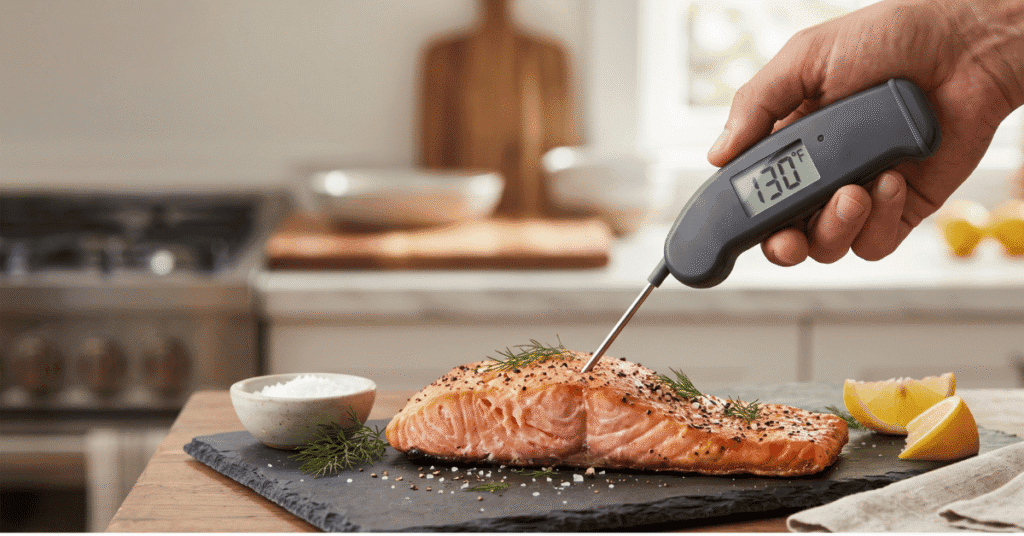
To get an accurate reading, you need an instant-read digital thermometer. Analog dial thermometers are often too slow and bulky for a delicate piece of fish. You want something with a thin probe that can give you a reading in two or three seconds.
- Identify the thickest part: This is usually the center of the fillet, furthest from the tail and the belly flaps.
- Insert the probe sideways: Instead of poking straight down through the top, try inserting the thermometer into the side of the fillet. This puts more of the sensor in contact with the coldest part of the fish.
- Find the lowest number: Push the probe into the center, then slowly pull it back out. Watch the numbers on the screen. The lowest number you see is the true internal temperature of the fish.
- Check multiple spots: If you are cooking a large side of salmon, check two or three different areas. Heat isn’t always even across a baking sheet or grill.
If you don’t have a thermometer, you can use the cake tester method. Insert a thin metal skewer or cake tester into the thickest part for five seconds. Remove it and touch it to your bottom lip or the skin on your wrist.
If it feels cold, the fish is raw; if it’s warm but not hot, you’re in the medium-rare zone. If it feels hot, the fish is likely well-done.
Factors that change your target temperature
Not all salmon is the same. The species, the fat content, and whether it was farmed or wild will change how you should approach the stove.
Wild-caught salmon (Sockeye, Coho, Pink)
Wild fish are the “athletes” of the salmon world. They swim thousands of miles and have much less body fat than their farm-raised cousins. Because they are leaner, they cook much faster.
If you cook a Sockeye fillet to 145°F, it will likely be dry and unappealing. I think it’s best to pull wild salmon at 120°F and let it rest up to 125°F. This keeps it tender.
Farm-raised salmon (Atlantic)
Atlantic salmon is generally what you find at the typical grocery store. It’s bred to be fatty and marbled. Those extra white lines of fat act as a buffer.
If you accidentally overcook Atlantic salmon by five degrees, it will still taste okay because the fat keeps it moist. You can safely aim for a “pull” temperature of 130°F or 135°F for these fillets.
Frozen vs. Fresh
If you are using fish that was “flash-frozen” at sea, it is often safer to cook to lower temperatures than fresh-caught fish that hasn’t been frozen. Freezing is an effective way to kill parasites. If you’re confident in the source and the handling, a medium-rare center (120°F-125°F) is a much better culinary experience.
Common cooking methods and their heat profiles
How you apply heat changes how quickly the internal temperature rises.
- Pan-Searing: This uses high, direct heat. The temperature will rise very quickly at the end. It’s best to sear the skin side for 90% of the time, then flip it just to “kiss” the top with heat. Check the temp immediately after flipping.
- Baking: This is more gentle. However, the air in the oven can dry out the surface before the middle is done. Using a lower oven temperature (like 275°F or 300°F) gives you a much wider window of success to hit your target temperature without overshooting.
- Grilling: This is the riskiest method because flare-ups are common. Always keep a cool zone on your grill. Once the skin is crisp and the temp hits about 115°F, move the fish to the cool side to finish rising to your goal temperature.
- Sous Vide: This is the only way to perfectly “lock in” a temperature. You can set your water bath to exactly 125°F and leave the fish for 45 minutes. It will never go a degree higher, ensuring edge-to-edge perfection.
Common mistakes when checking temperature
A common error is checking the temperature too late. Because fish fillets are thin, they can jump from 110°F to 140°F in less than a minute. Start checking when you think the fish has about three minutes left to cook.
It’s better to check three times and find it’s undercooked than to check once and find it’s ruined.
Another mistake is ignoring the tail. The tail end of a salmon fillet is much thinner than the head end. If you wait for the thick part to reach 135°F, the tail will be closer to 160°F.
If you’re cooking a whole side of salmon, you might want to tuck the tail under itself to create a more uniform thickness.
Finally, avoid “poking the bear.” Don’t stab the fish twenty times with the thermometer. Every hole you make allows juices to escape. Be deliberate and try to use the same hole if you need to re-check the temp a minute later.
Temperature Reference Table
| Desired Doneness | Pull Temp (Off Heat) | Final Temp (Spent Rest) | Texture Description |
|---|---|---|---|
| Rare | 110°F | 115°F | Translucent, soft, similar to sashimi |
| Medium-Rare | 120°F | 125°F | Silky, slightly translucent center |
| Medium | 130°F | 135°F | Flaky, opaque, very moist |
| Well-Done | 140°F | 145°F | Firm, completely opaque, can be dry |
Frequently asked questions
Is it safe to eat salmon at 125°F?
Most healthy adults find 125°F safe and much more delicious. While the USDA suggests 145°F, high-quality fish that has been handled properly or previously frozen carries a very low risk at medium-rare temperatures. However, people with compromised immune systems, pregnant women, or the elderly should stick to the 145°F guideline.
What happens if I cook salmon to 160°F?
At 160°F, the salmon is severely overcooked. The proteins will have contracted so much that the fish will feel like sawdust in your mouth. You will likely see a large amount of white albumin on the surface.
If this happens, your best bet is to flake the fish and mix it with a binder like mayo or Greek yogurt to make salmon salad or fish cakes.
Why is my thermometer giving different readings in the same fillet?
Fillets aren’t uniform in shape. The “belly” part is thinner and fattier, while the “loin” is thicker and meatier. Heat moves through different densities at different speeds.
Always rely on the reading from the thickest point, as that will be the last part to finish cooking.
Can I just look at the color to tell if it’s done?
Looking at color is a decent hint, but it’s unreliable. Some wild salmon is so deep red that it looks “rare” even when it’s fully cooked. Other farm-raised varieties can look opaque on the outside while still being icy in the middle.
A thermometer is the only way to be 100% sure.
Worth remembering
Hitting the right internal temperature is the single most important part of cooking salmon. Everything else, the marinade, the spice rub, the side dishes, matters less than the texture of the fish itself. If you focus on pulling the fish off the heat about five degrees before your target, you’ll avoid the dry, chalky results that turn people off from cooking fish at home.
Get a good digital thermometer, keep an eye on the fat content of your specific fillet, and don’t be afraid of a little pink in the middle.