Gravity water filters are worth it for some households, but they are not automatically cheaper or safer than tap water. The real value depends on your water quality, replacement filter cost, daily usage, flow speed, and whether the specific system removes the contaminant you care about.
A gravity filter can make sense if you dislike the taste of tap water, rent your home, lose power often, or want a countertop backup. It may be a poor buy if your municipal water is already safe and you mainly want an inexpensive way to improve flavor.
Are Gravity Water Filters Worth It for Everyday Use?
A gravity filter is usually worth considering when convenience matters more than speed and you want treated water without plumbing or electricity.
The system has an upper chamber and a lower chamber. You pour water into the top, and gravity moves it through one or more filter elements into the bottom. The clean water stays ready in a storage tank with a spigot.
Typical countertop gravity filters produce roughly 1 to 4 liters per hour depending on how many elements are fitted. That simple design gives you several practical benefits:
- It works during power outages.
- Installation usually means unpacking, assembling, and placing it on a stable counter.
- It can reduce some unwanted tastes, odors, sediment, and specific contaminants.
- It uses little or no electricity.
- It can serve a rental kitchen without changing the faucet or plumbing.
The trade-off is speed. Gravity units operate at only about 0.1 to 1 psi, far below the 40 to 80 psi of a plumbed reverse osmosis system, which is why output is slow. The storage tank also takes counter space and needs regular cleaning.
My short verdict is this: gravity water filters are worth it when you need portable, non-electric filtration and will maintain the system. They are less convincing when you only want cold drinking water at the lowest possible cost.
The True Cost Goes Beyond the Purchase Price
The first price you see is only the entry cost. A fair comparison includes replacement filters, cleaning supplies, replacement parts, storage space, and the water used for flushing or cleaning.
| Cost category | What to count | Why it matters |
|---|---|---|
| Initial system | Chambers, spigot, lid, stands, and filter elements | A low entry price may include basic filters with limited claims |
| Replacement filters | Carbon, ceramic, membrane, or mixed media elements | Filter life depends heavily on water quality and usage |
| Cleaning | Mild dish soap, soft brushes, and occasional replacement gaskets | Neglected parts can cause odor, leaks, or slow flow |
| Replacement parts | Spigots, washers, lids, stands, and seals | A worn seal can make a usable system frustrating |
| Counter space | The footprint and height of the filled unit | A large unit may take over the area near your sink |
| Water waste | Discarded water from flushing or cleaning the filter | Some filter types need more preparation than others |
Replacement cost is the number most buyers miss. A system that looks inexpensive may become costly if its filters need frequent replacement. A premium unit can also lose its value if replacement elements are expensive or difficult to find.
Check the manufacturer’s stated capacity in gallons, but treat it as a starting point. Filter life changes with sediment, chlorine levels, hardness, and the amount of water you pour through each day.
Write down the replacement price before buying. Then estimate your annual cost:
Annual filter cost = replacement price multiplied by the number of replacements per year.
Here is a hypothetical example using clearly assumed inputs, not a quote for any specific product. Suppose a replacement element costs $70 and is rated for 1,000 gallons. If your household uses two gallons daily, that is about 730 gallons per year before accounting for flushing, cooking, pets, spills, or guests. At that rate, one element covers more than a year, so the element cost is roughly $70 annually. If your actual use is three gallons a day, you would approach the rated capacity within a year and buy replacements more often. If performance falls with cloudy or hard water, practical service life may be shorter still.
Reported element life varies widely by model. A secondary review lists rated life of 1,200 gallons per filter for the ProOne 9-inch G-Series, 1,000 gallons for the 7-inch G-Series, 800 gallons for the Berkefeld BB9-2 candle, and 50 gallons for the Culligan MaxClear 7-inch. Those are vendor and reviewer figures, so confirm capacity for the exact element you plan to buy.
What Does a Gravity Filter Actually Remove?
A gravity filter removes only the contaminants its filter media and certification cover. The word “filtered” does not describe one uniform level of protection.
Many gravity systems use activated carbon. Carbon adsorbs free chlorine effectively, while chloramine is harder to remove, and many standard gravity filters reduce but do not fully remove it. Some systems add ceramic media, ion exchange, or other layers.
Ceramic elements typically have a pore size of 0.2 to 0.5 micron, which traps bacteria and protozoan cysts by size exclusion rather than killing them. That also means trapped organisms can colonize a wet, warm element between uses, so drying and cleaning matter.
Those materials can change what the system removes, but the exact claim depends on the model. A carbon-only element lacks the mechanical pathogen barrier that a ceramic element provides.
NSF/ANSI standards can help you interpret claims. NSF/ANSI 42 covers aesthetic effects such as chlorine and taste, NSF/ANSI 53 covers health effects such as lead reduction, NSF/ANSI 401 covers emerging compounds and incidental contaminants, and NSF P231 is the microbiological purifier standard. NSF International publishes these certification programs and their scope.
A filter marked for chlorine reduction is not automatically certified to remove lead. A system that reduces sediment may not remove bacteria, viruses, nitrate, arsenic, or PFAS. A filter that makes water taste better may leave a serious contaminant unchanged.
For a specific health contaminant such as lead, a point-of-use filter certified to NSF/ANSI 53 for lead reduction can be used at drinking and cooking taps. The meaningful question is whether the unit you are considering carries that exact claim.
Look for a performance data sheet that names:
- The contaminant
- The reduction percentage or stated claim
- The test method
- The filter capacity
- The conditions used for testing
- The certification or independent verification
To verify a certification, search the certifier’s own public database for the exact model number and read which standard and which reduction claims the listing names. The Environmental Protection Agency is a useful starting point for drinking water information, household treatment, and contaminant guidance.
If you have a specific concern, start with your water report or an accredited water test. Public water customers can request a Consumer Confidence Report from their utility. EPA recommends testing a private well annually for total coliform bacteria, nitrates, total dissolved solids, and pH. More frequent testing may be warranted if small children, elderly adults, or someone pregnant or nursing lives in the house. Use only laboratories certified for drinking water testing.
Gravity Filtration Is Not the Same as Purification
A gravity filter should not be treated as a universal answer for unsafe water.
Some products use the word “purifier” in marketing, but the meaningful question is whether the unit has a verified claim for the hazard in your water. A carbon filter may improve taste while leaving disease-causing organisms untouched. Standard carbon pitchers and under-sink filters do not make advisory-affected water safe on their own, because they are built for chlorine taste and sediment rather than bacteria or viruses.
NSF/ANSI 244 rates point-of-entry and point-of-use filters for reducing bacteria, viruses, and cysts during intermittent contamination events. NSF Protocol P231 is the standard used to rate purifiers intended for active use during a boil water advisory or with water of unknown microbiological quality. A gravity unit without one of these credentials should not be pressed into that role.
During a boil water advisory, follow your local health department’s instructions. EPA guidance states that the principal customer action is to boil water from the public water system for three minutes before use, because boiling can prevent or reduce health risks from pathogens. Local advisories control, and some sources cite different boiling times, so read the notice you receive. Don’t assume a countertop gravity unit makes questionable water safe.
This matters for well water, emergency storage, camping, international travel, and homes with known plumbing problems. A filter chosen for flavor is not a substitute for testing and proper treatment. Private well water quality is not regulated by the federal government under the Safe Drinking Water Act, nor by most state governments, and EPA estimates that more than 23 million U.S. households rely on private wells. If a contaminant exceeds health standards in a well sample, EPA advises contacting your public health department for specific steps and re-testing to confirm.
The Biggest Daily Limitation Is Slow Flow
Gravity filtration is slow by design. Water must pass through the filter without a pump, so the system depends on filter condition, water temperature, and the height of the water column.
A new filter may flow at a reasonable pace. A secondary review reports the Doulton Super Sterasyl two-candle setup flowing at roughly 0.27 to 0.44 gallons per hour, slower than several competing gravity elements. Flow often drops when:
- The filter pores collect sediment.
- The element needs priming.
- Air is trapped inside the filter.
- The upper chamber is nearly empty.
- The water is cold.
- A ceramic surface needs cleaning.
- The filter has reached the end of its useful life.
Sediment load clogs ceramic elements over time and reduces flow rate.
This creates a common kitchen problem. Someone pours a full batch at night, uses most of it for coffee and cooking, then forgets to refill the upper chamber. The lower chamber may still contain water, but there is no ready supply for breakfast.
A gravity system works best when you refill it at a regular time. If your household needs several gallons quickly, an under-sink system or plumbed filter may suit you better.
Capacity also needs a practical reading. A large upper chamber does not always mean a large supply of finished water. The lower chamber may hold less, and the filter still needs time to process the batch.
A compact unit may fit a small apartment but require repeated refills for a family.
Counter Space and Handling Affect the Value
A full gravity filter can be heavy, awkward, and difficult to move safely. Water weighs about 8.3 pounds per gallon, before adding the weight of the container, so a unit holding several gallons may stay in one place because lifting it to the sink is inconvenient.
Measure the space before buying:
- Counter width and depth
- Clearance under cabinets
- Room to remove the lid
- Space beneath the spigot for a glass or pitcher
- Distance from the sink for cleaning
- Clearance around the base
A system that barely fits under a cabinet may become annoying every day. You need enough room to lift the upper chamber, inspect the filter, and wipe the lower reservoir.
Glass, stainless steel, and plastic each change the experience. Glass resists odor but can break. Stainless steel blocks light and can feel sturdy, but it may hide the water level. Plastic is lighter and often less expensive, though some plastics can scratch or retain smells if cleaned poorly.
A covered design matters if the system sits near a stove, toaster, or open window. Dust, grease, and food particles can settle around an uncovered opening. Keep the unit away from heat and direct sunlight.
Cleaning Determines Whether the Savings Last
A gravity filter saves little if the storage chambers become slimy or the spigot starts to smell.
Wash the reservoirs and lid with warm water and mild dish soap according to the manufacturer’s instructions. Rinse thoroughly. Avoid abrasive pads that scratch plastic or metal. Scratches give residue more places to collect.
The spigot deserves extra attention. Water can sit inside its passage, and small particles can gather around the washer. Disassemble it only as far as the instructions allow. Check for drips after reassembly.
Filter elements need different care:
- Ceramic surfaces may be cleaned gently when flow slows.
- Carbon blocks usually should not be scrubbed unless the manufacturer allows it.
- Hollow-fiber membranes can be damaged by rough handling.
- Mixed-media cartridges may need replacement rather than cleaning.
Never use household disinfectants on a filter element unless the manufacturer specifically permits that method. Chemical residue can remain in the media, and some materials can be damaged.
Some ceramic elements are made with silver-impregnated shells intended to prevent bacterial colonization within the filter during extended contact time, though this is reported by a secondary reviewer and should be confirmed for the exact product. Cleaning and drying a wet element between uses still matters.
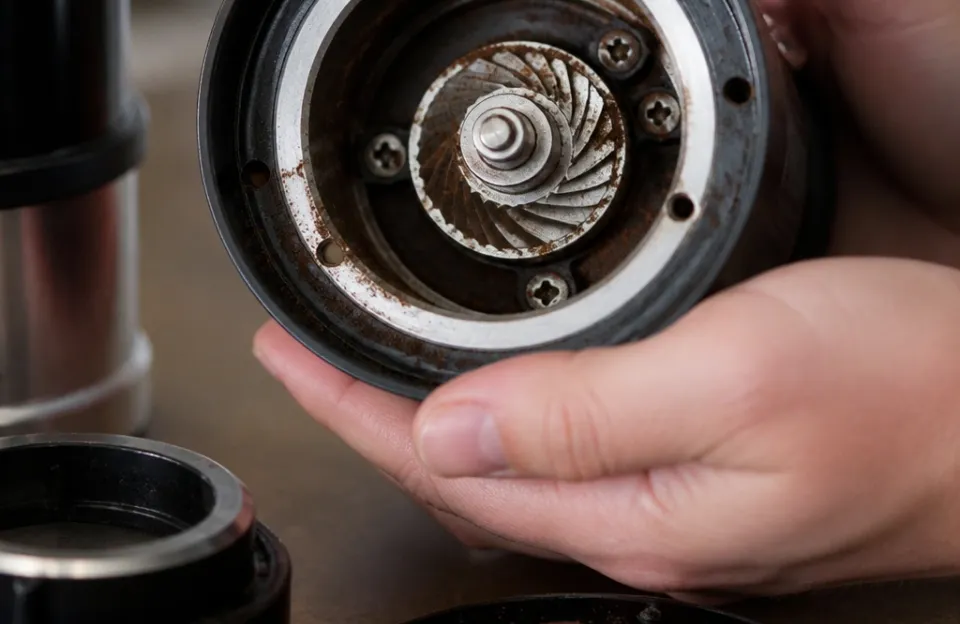
If you already care for a countertop brewing setup, the same habit applies to the storage vessel. Regular cleaning routines for coffee equipment can remind you to include the filter reservoir, spigot, and drip area in your kitchen maintenance schedule.
Is Filtered Water Cheaper Than Bottled Water?
Often, yes, but the answer depends on filter life and how much bottled water you replace.
A gravity system can cost less than single-use bottles over time, especially for a household that already buys drinking water every week. It also reduces packaging waste and avoids carrying cases home.
For a rough benchmark, a secondary source reports filtered-pitcher water costing roughly $0.20 to $0.30 per gallon in replacement cartridges, compared with about $1.20 per gallon for single-use bottled water. Those figures are brand-specific and secondary, so they cannot be transferred directly to gravity filters, which typically have different element prices and capacities.
The comparison changes if you buy inexpensive refill water, use a long-lasting municipal supply, or replace filters early. You should also count the water used for flushing new elements and cleaning the system.
A simple comparison looks like this:
- Add the system price and the first filter.
- Estimate one year of replacement elements.
- Add any replacement spigot, gasket, or stand you expect to need.
- Compare that total with your normal annual bottled water spending.
- Compare taste, convenience, and storage, not only dollars.
Gravity filters can be a good value for coffee, tea, and cooking because the same treated water can serve several uses. But don’t expect filtration to fix every flavor problem. Old coffee grounds, mineral buildup in the brewer, and poor water temperature can still affect the cup.
Water quality is only one part of brewing, alongside keeping the reservoir fresh and maintaining the machine.
When Another Filtration Method Makes More Sense
Gravity filtration is only one option. The table below compares what the stored evidence supports; where no evidence was available, the cell says so rather than guessing.
| Option | Upfront and replacement cost | Speed | Installation | Contaminant coverage notes |
|---|---|---|---|---|
| Gravity filter (ceramic plus carbon) | Replacement elements reported from roughly $58 to $84 per ProOne G3.0 filter | Roughly 1 to 4 liters per hour typical | No plumbing or electricity | Ceramic blocks bacteria and protozoan cysts; carbon adsorbs free chlorine, partially reduces chloramine |
| Pitcher filter | Secondary source: roughly $0.20 to $0.30 per gallon in cartridges | No comparable figure available | None | Only NSF/ANSI 53 certified models are verified for lead; a Brita Elite filter is rated about 120 gallons and certified for lead |
| Faucet-mounted filter | No stored evidence | No comparable figure available | Needs a compatible faucet | Certification varies by model |
| Under-sink filter | No stored evidence | No comparable figure available | Plumbing work required | NSF/ANSI 244 certifies units rated for bacteria, viruses and cysts during intermittent events |
| Reverse osmosis | No stored evidence | No comparable figure available | Plumbing and drain connection | Operates around 40 to 80 psi; a secondary source describes PFAS reduction by membrane separation rather than adsorption alone |
| Whole-house filter | No stored evidence | No comparable figure available | Point-of-entry installation | NSF/ANSI 244 point-of-entry certification is the relevant marker for microbiological reduction |
A few qualifications sit behind that table. Reported element prices come from vendor and affiliate pages and change over time, so treat them as directional. Some reported certifications are element-level rather than full-system: ProOne G3.0 elements are described as NSF/ANSI 42 component certified, and a secondary review reports the Doulton ATC Super Sterasyl ceramic filter as carrying NSF/ANSI 42, 53, 372 and 401 certification with a 0.9 micron absolute rating and 400-gallon life. Confirm any claim in the certifier’s database before relying on it.
Faucet-mounted filters take less counter space and can fill a pot faster than gravity. An under-sink carbon system keeps the counter clear and delivers treated water from a separate faucet, though installation takes more work. A pitcher is compact and can live in the refrigerator, but capacity is limited. Reverse osmosis can address a wider range of dissolved substances, yet it generally costs more, uses plumbing, and may send some water down the drain.
For coffee drinkers, the best choice depends on the machine and the water. Some espresso machines need a reservoir filled daily, while others connect to plumbing. A gravity unit can supply reservoir water, but you still need to monitor mineral buildup and follow the machine maker’s water guidance. Different brewing designs have different water needs, as explained in this guide to choosing a coffee machine style.
Who Should Buy a Gravity Water Filter?
A gravity filter makes sense for people who:
- Rent and cannot install a faucet or under-sink system.
- Want drinking water available during power outages.
- Prefer to avoid routine bottled water purchases.
- Need better taste and odor from otherwise acceptable tap water, and have confirmed the element’s claims.
- Have enough counter space for a filled reservoir.
- Will track filter changes and clean the unit.
- Understand the difference between taste improvement and contaminant removal.
It is a weaker choice for people who:
- Need water immediately for a large household.
- Have a confirmed contaminant that the unit does not specifically address.
- Cannot lift or clean a full reservoir comfortably.
- Have very hard or sediment-heavy water without a suitable prefilter.
- Want a fully hidden installation.
- Tend to ignore replacement schedules.
The best buying decision starts with your water problem, not the number of filter stages. More stages do not prove better performance.
The Practical Verdict
Gravity water filters are worth the cost when they match a clear need: portable filtration, backup water, better taste, or less bottled water. Buy based on verified contaminant claims, realistic replacement costs, cleaning effort, and the space the filled unit will occupy.
If your tap water is already safe and your main goal is flavor, a smaller and cheaper filter may do enough. If you have a known water quality problem, test first and choose treatment based on that result. And during a boil water advisory, boil or use a method your health department approves rather than assuming a countertop filter will cover the gap.