No, air fryer accessories do not fit all models. Basket shape, interior dimensions and heating element placement vary too much between brands for a single rigid accessory to work everywhere. A round silicone liner made for a 5.8-quart Cosori may sit loosely in a square Ninja Foodi basket, while a rack sized for one machine can jam partway into another.
If you are shopping for extra pans, racks or liners, match the accessory to your specific machine. The sections below explain why sizing differs across brands, which add-ons have the best chance of working across models, and how to measure your basket so you buy the right part the first time. Safety limits matter too: anything you place near a heating coil needs a heat rating above your cooking temperature and enough clearance for air to circulate.
Why Basket Dimensions and Shape Change Between Brands
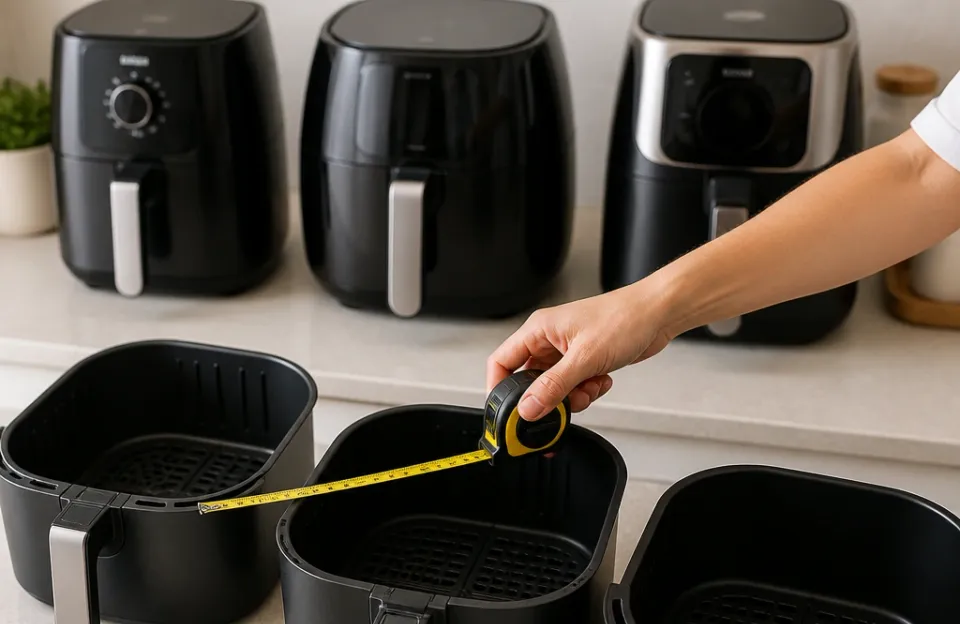
Air fryer designs vary widely, and that includes basket-style and oven-style configurations. Manufacturers build each basket around a specific heating element and fan layout, which dictates interior width, depth and height. Two machines with the same stated capacity, say 4 quarts, can have completely different footprints: one tall and narrow, another wide and shallow.
Basket shape is the biggest dividing line. Many early air fryers used round baskets, a design Philips popularized. Later, brands such as Ninja and Cosori moved toward square or rectangular baskets because they hold more food in a single layer. A round accessory in a square basket leaves dead corners where air cannot circulate, while a square accessory forced into a round basket will not reach the bottom.
Heating element placement adds another constraint. In most drawer-style units the coil sits directly above the basket, and some models leave very little clearance between the top of the food and the element. A thick rack or tall silicone mold can push food too close to the heat source. Oven-style air fryers place elements differently and use flat wire racks, so they need accessories that sit on shelves rather than drop into a deep bucket.
What “Universal” Really Means on Accessory Listings
Products labeled “universal air fryer accessories” usually fit a range of sizes, not every machine on the market. Makers achieve that range through flexible materials or adjustable designs, and a product listing is not the same as an operating manual for your model.
Silicone liners are the most common example. Because silicone bends, a liner rated for a spread of sizes can stretch or fold to fit several baskets. It may sit loosely in a larger unit or need folding in a smaller one. Flexible silicone muffin cups work the same way.
Rigid metal accessories rarely earn the universal label honestly. A stainless steel trivet has fixed dimensions: if your basket is narrower than the trivet, it will not go in. Foldable legs or adjustable widths help, but the adjustment range is usually limited.
Paper liners are another tricky category. A round sheet in a square basket leaves the corners exposed, so grease pools there. A square sheet in a round basket bunches against the walls, where loose edges can lift toward the heating element.
| Accessory Type | Material Flexibility | Chance of Cross-Brand Fit | Main Sizing Risk |
|---|---|---|---|
| Silicone liners | High | Good across similar shapes | Too loose in oversized baskets |
| Metal racks | None | Low unless adjustable | Will not fit if even slightly too wide |
| Paper liners | Medium | Depends entirely on shape match | Edges lifting toward the heating coil |
| Skewer sets | Low | Moderate | Length exceeds basket depth |
| Baking pans | None | Very low | Blocks airflow around the sides |
How to Measure Your Air Fryer Before Buying Accessories
Guessing from quart capacity alone causes most sizing mistakes, because volume does not equal footprint. A 6-quart basket from one brand can measure differently from another brand’s 6-quart version. Take physical measurements with a tape measure or ruler, and match them to the exact model and market rather than assuming a brand-wide fit.
Interior width: Measure straight across the widest point of the basket floor. On a square basket, measure both sides; they are usually identical, but manufacturing variance happens.
Interior depth: Measure from the basket floor to the top rim. This tells you how tall an accessory can be before it stops the drawer closing or crowds the heating element.
Lid or door clearance: For oven-style and lid-based models, measure the depth from the base to the lowest point of the lid, plus the clearance needed for the door to close fully.
Shape and corners: Note whether the corners are sharp right angles or rounded, and whether the walls taper inward toward the bottom. A rigid pan can match your overall width measurement and still catch on curved edges or wedge itself lower down.
When you shop, compare your numbers against the accessory’s listed dimensions and ignore vague packaging claims. If you cook wings often, knowing your exact interior space also helps when prepping chicken wings so they lie flat without stacking too high.
Which Add-Ons Travel Well Across Brands and Which Do Not
Some accessories sidestep the shape problem entirely. Skewer racks often rest on the basket rim rather than the floor, so they can work whether the base is round or square, as long as the rim falls within the rack’s adjustable range. Magnetic vent covers attach to the ceiling of the cooking chamber to stop lightweight food flying into the fan, so basket shape does not matter; you only need to confirm the interior ceiling is magnetic.
Small oven-safe glass or ceramic dishes can work across models if they are small enough, since a modest ramekin fits inside almost any air fryer above 3 quarts. The tradeoff is that thick glass blocks radiant heat from below and slows cooking, so you lose some of the speed that makes these appliances useful.
If you track internal temperatures while using inserts, a reliable probe prevents undercooked food. Checking the final temperature with a quick digital reader takes guesswork out of the timing adjustments that thicker dishes cause.
Rigid, model-specific parts are the opposite case. Replacement baskets, fitted drip trays and custom racks depend on locking mechanisms and chassis details that change between sub-models, and Philips HD92xx baskets are a documented example of that lack of cross-compatibility. Always compare the full model number, not just the first few digits.
Materials, Heat Limits and Airflow Clearance to Check First
Fitting inside the basket is only half the requirement. The material must also survive your machine’s operating temperature, so check the maximum heat rating on the accessory against the top temperature in your manual. A product page is not an operating manual, and a source for one model does not establish settings for another.
Silicone-coated baking paper generally has a higher heat tolerance than standard parchment. Plain parchment has a slightly lower heat ceiling than silicone-coated stock and darkens and turns brittle faster past its rated limit. Whatever paper you use, keep it below the coil: preheat first, weigh the liner down with food immediately, and never run the appliance empty with paper inside.
Metal accessories should be bare stainless steel, carbon steel or uncoated aluminum. Avoid plastic feet or rubber grips unless they are explicitly rated for oven temperatures, and treat unknown painted or coated finishes with suspicion.
Clearance is the other half. Because air fryers work by circulating hot air through a compact cooking area, an accessory that seals against the basket walls stops that circulation. Leave a visible gap around the edges of any insert, and keep the top of the food well below the heating element when the drawer is closed. Manufacturer manuals contain model-specific guidance on minimum fill lines, clearance and safe accessory use; follow those figures for your machine rather than a generic rule.
Wet marinades add a practical wrinkle: heavy liquids can make parchment soggy and more likely to tear or shift mid-cycle. A solid base helps when cooking marinated chicken pieces that release juices quickly under high heat.
Drawer Units, Oven-Style Machines and Dual-Zone Baskets
Drawer-style and oven-style air fryers form two largely separate accessory ecosystems. Drawer units use deep buckets that slide out horizontally, and accessories built for them assume deep vertical walls. Tall egg-bite molds or hanging skewer racks rely on that depth; inside an oven-style machine they either block the door or eat up so much shelf space that you cook one item at a time.
Oven-style machines accept bakeware sized for their flat racks, much like a toaster oven. Those pans will not fit inside a deep drawer basket. Some multi-function models also switch between cooking modes with a lid attachment, and for those the manual is necessary to confirm the correct lid or accessory for the function you have selected.
Dual-zone machines add another layer. Models with two side-by-side drawers usually have smaller individual baskets than a single-drawer machine of the same total capacity, so measure each zone independently rather than dividing the total in half.
The design spread is wide: some brands build countertop-oven shapes, some favor basket designs, and some use a transparent glass vessel. Fan control differs too, and some DC-powered Cosori air fryers let you adjust convective flow speed as well as temperature. Those differences change how air moves around an insert, which is another reason to test fit and airflow on your own machine.
Check the Manual and Manufacturer Accessories Before You Buy
Before buying third-party parts, open your manual and look for the accessory and clearance section. Manuals are written for your exact model and market, and they should be your first reference for approved accessories and safe use. If you no longer have the printed copy, look up the model number on the manufacturer’s site; indexes that separate official manufacturer documents from third-party PDFs can help you find the right file.
Manufacturer accessory lines are the safest starting point when they exist. They are designed and tested for specific models, which removes most of the fit and heat-rating guesswork.
Warranty terms vary by brand and model, with typical coverage running from about one to five years. Many warranties cover only defects in original materials and workmanship, not normal wear and tear or improper use. Some warranty summaries also list unapproved third-party replacement parts as an exclusion, though exact wording differs by manufacturer, region and purchase date, so read your own terms before assuming.
You can review how consumer appliances are evaluated for household safety through organizations such as UL Research Institutes, but a general safety framework is not a compatibility approval for a specific accessory in a specific machine.
Common Sizing Mistakes and a Simple Buying Checklist
Buying by quart capacity is the most common error. A 4-quart round basket and a 4-quart square basket share volume but have entirely different geometry. Ignoring basket taper is the second: an accessory that slides past the rim can wedge tight lower down, and once hot, expanding metal makes a jammed rack even harder to remove.
Other frequent mistakes:
- Using lightweight parchment without weighing it down, so the fan lifts it toward the coil.
- Stacking a rack on a liner on the basket floor, creating layers that block vertical airflow.
- Assuming every accessory is dishwasher-safe; harsh detergents can strip coatings and degrade some silicones, so hand washing is gentler.
- Forgetting that added mass changes cooking time. A heavy pan absorbs heat before it reaches the food.
One more sizing error is easy to miss: even small differences in drawer opening width or depth can cause air leaks and reduce cooking efficiency. That is why “close enough” is not a good standard for rigid parts.
Before you pay, run through this checklist:
- Measure interior width, depth and corner shape, and note any taper.
- Compare those numbers with the accessory’s listed dimensions, not its capacity claim.
- Confirm the heat rating sits above your machine’s maximum temperature.
- Check that air can move around the edges and above the food.
- Read your manual’s accessory and clearance guidance, and check your warranty terms.
Before You Buy Replacement Parts
Matching accessories to your machine comes down to measuring the interior, respecting airflow boundaries and checking heat ratings. “Universal” on packaging usually signals flexibility, not guaranteed compatibility. Stick to heat-rated silicone or bare stainless steel, leave space around the edges, and keep everything clear of the heating coil.
Five minutes with a tape measure prevents buying parts that rock, jam or block the fan. Replacement basket assemblies and other rigid parts deserve extra caution: check the full model number against the listing before ordering. If you swap liners and racks often, note how each setup affects browning so you can adjust times instead of guessing, and favor lighter inserts to keep the speed these appliances were built for.