Disposable air fryer liners are single-use parchment sheets, often perforated, that sit inside the basket to catch grease, crumbs, and sticky marinades so cleanup takes less scrubbing. They are genuinely useful for messy foods and basket protection, but they come with trade-offs: they can reduce bottom browning, they add recurring cost and waste, and loose paper near the heating element is a real fire risk. The practical answer is to use them selectively, size them correctly, and follow the package temperature rating.
An air fryer is essentially a countertop convection oven that cooks by rapid circulation of hot air. That circulation is exactly what a liner interferes with, which is why the decision is rarely “always use” or “never use.”
What Disposable Air Fryer Liners Are and the Core Tradeoff
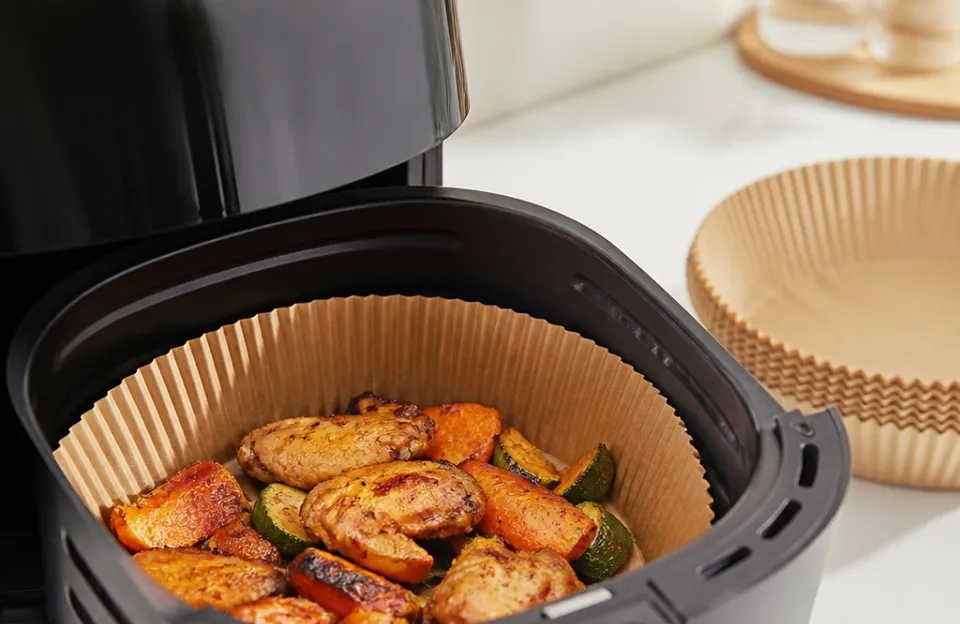
Disposable liners are pre-cut paper sheets, usually silicone-coated parchment, shaped as rounds or squares to fit common basket sizes. Some are solid; many are punched with holes to let air and grease pass through.
The tradeoff is simple. A liner catches drips before they hit the basket, but it also sits between your food and the perforated base that hot air rises through. Solid liners block more of that flow than perforated ones, and any liner that lifts or flops around risks contacting the heating element. Reynolds states that parchment paper can be used in an air fryer if it is used correctly, and it sells pre-cut liners with ¼-inch holes designed to let hot air circulate for crisp, even cooking.
Pros: Basket Protection and Easier Cleanup
The strongest case for liners is cleanup, especially with foods that leave baked-on residue.
- Catching grease and crumbs. A liner intercepts drips from marinated meats, cheesy dishes, and anything breaded, so the basket’s perforations stay clearer.
- Protecting the nonstick coating. Scrubbing is the usual way basket coatings wear down. Less scrubbing means less abrasion over time, though no manufacturer in this evidence claims a specific lifespan extension.
- Easy food release. Reynolds describes its liners as having a nonstick surface for easy food release.
- Handling sticky or wet mixtures. Small batches of vegetables, battered items, or sticky glazes lift out cleanly rather than welding to the basket floor.
These benefits are real but modest. They matter most if you air fry messy foods often; they matter little if you mostly reheat dry items.
Cons: Texture, Grease Pooling, Cost, and Waste
Liners change how food cooks, and not always for the better.
Reduced bottom browning. Because a liner sits between food and the basket, the underside receives less direct hot-air contact and radiates less heat from the metal. Solid sheets are the worst offenders. Perforated liners reduce the effect, and silicone mats can also soften browning on items like fries.
Grease pooling. With a solid liner, fat drips onto the paper and pools around the food. That can leave the underside of the food sitting in grease instead of crisping. Perforated liners let fat drain through to the outer pan, where it still needs disposing of safely after the basket cools.
Recurring cost and waste. Every use consumes a sheet. That is a small per-cook expense but an ongoing one, and it generates paper waste that a reusable silicone liner does not. Exact per-use cost figures vary too widely by brand and pack size to quote reliably.
Airflow interference. A liner that covers most of the basket floor, or that rides up the sides, reduces circulation and can leave food unevenly cooked. Overcrowding compounds this, and food safety guidance advises not overfilling the basket because crowding can prevent enough air circulation to cook food properly.
Fire risk with loose paper. This is the serious con. Lightweight paper that is not weighed down by food can lift toward the upper heating element. Manufacturer guidance converges on the same fix: never let the liner contact the heating element, and never preheat with an empty liner in the basket.
Material Safety and Temperature Limits
Not all kitchen paper behaves the same in an air fryer, and the differences matter.
Parchment Paper: the Intended Material
Parchment is paper coated with a food-safe silicone release layer, which is what makes it nonstick and heat resistant. It is the material disposable air fryer liners are made from, and manufacturers publish a maximum temperature for their specific products. Reynolds rates its air fryer liners to 400°F on the air fryer setting only. Ratings differ between brands and products, so the number on the package, not a general figure, is the one that applies to your liner.
Wax Paper: Not a Substitute
Wax paper has a wax coating rather than a silicone one. It is designed for cold and room-temperature uses, not for oven or air fryer heat. The wax can melt, smoke, or transfer onto food and appliance surfaces. Do not use it as a liner.
Greaseproof Paper: Not the Same as Parchment
Greaseproof paper resists fat but is not silicone-coated and generally lacks a published high-heat rating. If a package does not state an air fryer temperature limit, treat it as unsuitable.
Food-Contact Basics
In the US, the regulatory status of a food-contact material depends on each individual substance that makes up the article, and manufacturers can provide a letter of guaranty certifying that a product is acceptable for its intended food-contact use. In practice: buy liners labeled for food contact and for air fryer use, and check that the package states both. The FDA also evaluates food-contact substances by estimating how much of the substance and its components can migrate into food, and that migration potential depends on the intended use, the substance’s molecular structure, and how the product is manufactured.
On PFAS, the FDA announced in February 2024 that substances containing PFAS used as grease-proofing agents on paper and paperboard for food contact are no longer being sold by manufacturers into the US market. That does not certify every liner on every shelf, but it does mean older concerns about grease-proofing chemistry are not a reason to avoid paper liners categorically.
How to Place and Size a Liner Safely
Placement errors cause most liner problems. A short routine prevents nearly all of them.
- Check the package rating first. Confirm the liner is labeled for air fryer use and note its maximum temperature. Reynolds liners, for example, are rated to 400°F and are not intended for rectangular or toaster-oven-style air fryers.
- Preheat without the liner. Reynolds advises preheating the air fryer according to the manufacturer’s instructions before placing the liner and food inside. An empty liner in a preheating basket is the classic failure mode, because nothing holds it down.
- Size it to the basket floor. The liner should sit flat inside the basket with its edges clear of the walls and well below the heating element. Trim oversized sheets so they cannot curl up. A liner that is too large is more dangerous than one that is slightly small.
- Add food immediately. Put the food on the liner the moment it goes in so the weight holds the paper down.
- Keep it below the element. Never let any part of the liner, including a lifted corner, touch the heating element.
- Do not reuse paper liners. Grease-soaked paper that has already been heated is weakened and loaded with fat. Use a fresh sheet or switch to silicone.
- Discard cooled grease safely. Let the basket and liner cool completely, then lift the liner out and dispose of it. Do not tilt a hot basket to pour off fat.
If your air fryer is a toaster-oven or rectangular style with exposed elements, follow that appliance’s manual. Some paper liner products are explicitly not intended for those designs.
Solid vs Perforated vs Silicone: Which Suits Which Job
| Feature | Solid Parchment Liners | Perforated Parchment Liners | Reusable Silicone Liners |
|---|---|---|---|
| Best for | Wet batters, saucy foods, small bakes | Fatty meats, frozen foods, foods needing bottom crispness | Frequent users who want less waste |
| Airflow impact | Highest blockage | Lower blockage; holes admit air | Blocks the floor but will not lift |
| Grease handling | Pools on the sheet | Drains through the holes | Collects in the liner, poured off after cooling |
| Heat rating | Check the package | Check the package; Reynolds states 400°F for its liners | Check the package; ratings vary by product |
| Bottom browning | Noticeably reduced | Closer to bare basket | Reduced on flat mats |
| Reusability | Single use | Single use | Reusable and washable |
Two honest caveats sit outside this table. First, silicone liners will not blow into the heating element, which removes the paper-specific fire risk, but silicone is not chemically inert, and any migration question depends on the specific product and its documented food-contact status. Second, quantified airflow comparisons between solid and perforated liners are not established to a reliable public standard, so treat any precise percentage you see elsewhere with suspicion.
When Liners Hurt Results and When to Cook Bare
The best uses are conditional, and they follow the food.
Use a liner when:
- The food is saucy, cheesy, breaded, or likely to drip (marinated chicken, glazed vegetables, frozen breaded items).
- You are cooking a small quantity and want the basket to stay clean.
- You are working with a perforated liner and want most of the airflow benefit retained.
Cook bare when:
- You want maximum crispness, especially on fries, wings, and anything where the underside matters. Manufacturers’ whole design premise is rapid hot-air circulation, and any liner reduces that.
- The food is dry and lean, with little grease to catch.
- You are cooking at or near the top of your liner’s temperature rating, or above it.
Use a reusable silicone liner instead when you use the air fryer frequently and want to cut waste, accepting slightly softer browning on flat-bottomed foods.
On food safety, liners do not change the target internal temperatures, which are the same regardless of appliance size or power: fish at 145°F; whole cuts of beef, pork, veal, and lamb at 145°F with a three-minute rest; ground meat at 160°F; and poultry at 165°F. Use a food thermometer rather than relying on time alone, and refrigerate leftovers within two hours to stay out of the 40°F to 140°F danger zone.
Deciding Whether a Liner Fits Your Cooking
Ask one question: does cleanup or mess prevention matter more to you than the crispest possible underside?
If the answer is cleanup, choose perforated parchment liners sized to your basket, check the package rating, preheat first, and add food immediately. If you cook messy food several times a week, a reusable air fryer liner is worth comparing on waste and durability grounds. If the answer is crispness, cook bare and accept the scrubbing.
Whatever you choose, treat the liner’s stated temperature limit as a ceiling, not a target, and keep all paper well clear of the heating element. If you want to compare specific liner formats before buying, this air fryer liners buying guide covers the trade-offs between paper, perforated, and reusable options. For the regulatory background on food-contact materials, the FDA’s guidance on determining the regulatory status of food contact components explains why the specific product matters more than the category.