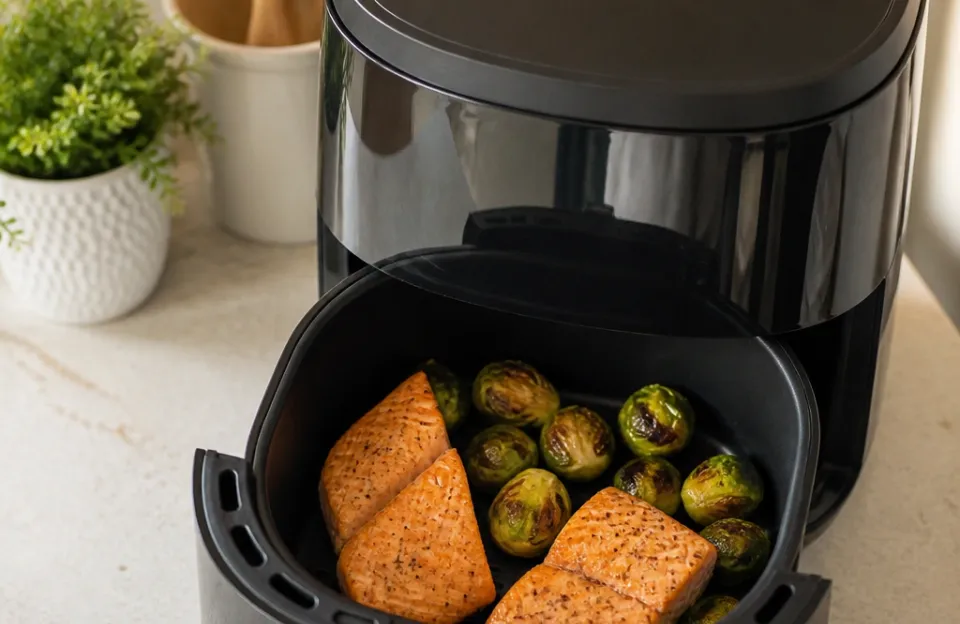
The direct answer depends on what you cook most. A basket-style air fryer, with its perforated pull-out drawer, suits small batches of frozen snacks, breaded bites and vegetables that need to crisp on all sides. A tray-style or oven-style air fryer, with flat or mesh racks inside a door-front cabinet, suits larger flat items, baking and cooking for a family. If you want one appliance and cook mostly quick single or two-person meals, buy a basket. If you want oven-like flexibility and batch capacity, buy a tray-style oven.
Both designs are essentially countertop convection ovens that crisp food through quick circulation of hot air inside an enclosed appliance. That shared mechanism matters because it keeps the comparison honest: shape changes where the air goes, not whether hot air is doing the cooking.
How Airflow Changes Between Basket and Tray Designs
A basket’s perforated bottom and sides let hot air reach food from underneath as well as from above, so fries and nuggets brown on all surfaces. Put the same food on a solid sheet and the touching side steams instead of crisping instead. This is why even oven-style air fryers usually ship with mesh trays that mimic the basket’s open structure, with a solid tray underneath to catch drips rather than hold food.
The practical consequence is about contact area. Anything sitting flush on a solid surface loses bottom browning. If your tray-style unit includes a mesh rack, you get much of the basket’s airflow advantage with more usable width.
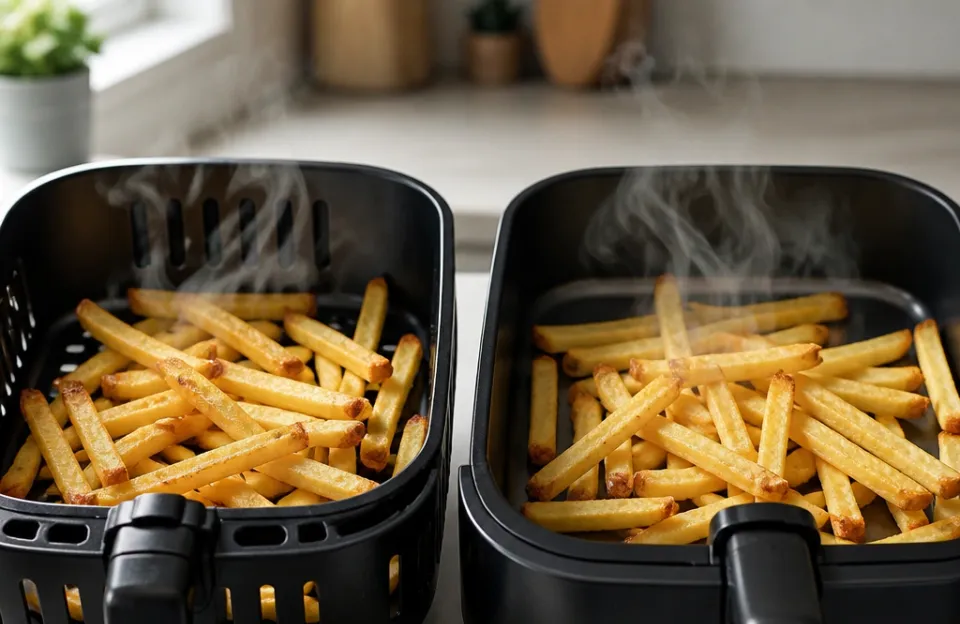
Cooking Performance for Different Types of Food
Basket models are commonly associated with quick, crispy results for one or two people, while oven-style units are associated with family portions, baking and toaster-oven replacement. A single first-hand comparison reported hash browns taking longer and turning out less crispy in a toaster-oven-style air fryer than in a basket model, though this is one anecdotal account and not a generalizable test.
Treat those findings as directional rather than definitive. Manufacturer power, fan design and preheat behavior vary more between models than the basket-versus-tray label alone predicts. Cooking times differ by appliance size and power, so recipes need adjustment per machine rather than per category.
Foods most likely to favor a basket:
- Frozen fries, tots and breaded bites, which need underside airflow
- Small vegetable pieces that benefit from shaking mid-cook
- Single or two-person portions of chicken pieces or fish fillets
Foods most likely to favor a tray:
- Large flat items such as whole fish, longer cuts and full trays of vegetables
- Baked goods and anything needing a level surface
- Mixed meals cooked side by side or on stacked racks
For timing anchors on common basket foods, see how long frozen potatoes need or the right duration for fish. Breaded items aiming for crunchy exterior on poultry also benefit from perforated surfaces.
Capacity and Kitchen Counter Footprint
Capacity is where the two designs diverge most clearly for buyers. One review source reports that basket models typically offer roughly 4 to 8 quarts while oven-style units commonly span 10 to 26 quarts or more, though these ranges are indicative rather than verified specifications. Larger interiors reduce the number of batches, which matters because air fryers generally have limited room and overcrowding prevents enough air circulation to cook food properly.
In those cases, USDA advises cooking large amounts in batches rather than all at once. A basket’s smaller capacity makes this guideline a near-daily reality for families; a tray design’s multiple racks give it more room to satisfy the same rule.
Footprint follows the opposite pattern. Basket units are typically compact and tall, while oven-style units are wider and deeper. A pull-out drawer needs vertical clearance but opens upward or forward only slightly; an oven-style door swings out, so it needs clear counter in front plus cabinet clearance above. Measure both before buying, especially in a narrow kitchen.
If batch-cooking is your priority, meal-prepped wings illustrate how volume planning works in practice.
Cleanup After High-Fat Meals
A removable basket drawer is easy to soak and wash, which helps after greasy foods. Oven-style units spread the mess: the mesh tray, drip tray, interior walls and door glass all collect spatter, so cleanup involves more surfaces even if each is simple to wipe.
This section’s comparison table summarizes the main differences:
| Attribute | Basket Style | Tray Style |
|---|---|---|
| Airflow path | Around food through perforated bottom and sides | Mostly top-down; mesh racks restore underside airflow |
| Best for | Fries, small vegetables, breaded bites, quick portions | Large proteins, baking, full meals, multiple racks |
| Shaking or turning | Lift and shake the drawer | Requires opening the door and using a spatula or tongs |
| Counter footprint | Compact and tall | Wider and deeper, with door swing clearance needed |
| Batch cooking | Usually one layer; batches needed for volume | Multiple racks possible in larger models |
| Cleaning | Soak and wash the removable drawer | Wipe interior and wash flat trays and racks |
For fatty foods specifically, reheating guidance for bacon cook times shows how quickly grease accumulates and why the removable drawer has an edge.
Picking the Right Shape for Your Cooking Habits
Use these conditional scenarios rather than a single winner, because no comparable tested metric across both designs was available.
Buy a basket model if:
- You cook for one or two people and want fast, crispy sides and snacks
- Your kitchen is short on horizontal counter space
- You reheat and crisp more than you bake
- You value a simple one-piece drawer to wash
Buy a tray or oven-style model if:
- You regularly cook for three or more people
- You bake, roast large cuts, or want to replace a toaster oven
- You want multiple racks running at once
- You need level surfaces for batters, small cakes or casseroles
A thick meatloaf illustrates a dense, oven-style cook that sits more naturally on a flat pan than in a basket. If a particular brand’s fan and heating layout matters to your choice, checking how a particular brand circulates heat helps you confirm the design before purchase.
Edge Cases Where the Usual Rules Break Down
Hybrids blur the categories. Some units combine a basket with tray accessories, or pair oven-style doors with rotating baskets. Judge them by the specific accessory included, not the label.
Liners change airflow. Foil should never cover the entire basket floor because it blocks airflow, and it should be weighted down. Parchment paper needs trimming to fit without overhang and carries temperature limits, so check your manual for the exact figure rather than assuming one applies to every brand. FDA-authorized nonstick coatings used on cookware have shown negligible migration of PFAS to food in studies, which addresses coating concerns generally but does not certify any individual product.
Baking and dehydrating. Air fryers can bake, roast and reheat food without making it soggy. Dehydrating works in tray-style units with low, steady temperatures and multiple racks; most basket models handle only small quantities.
Raw stuffed breaded chicken should not be cooked in an air fryer at all, according to USDA guidance.
Aftermarket trays and racks. Some basket models accept third-party racks, but compatibility is model-specific. Verify against the manufacturer’s accessory list before buying add-ons.
Is One Healthier Than the Other?
Neither shape is inherently healthier. Both cook by circulating hot air, and the USDA notes air fryers are used for “frying” foods without cooking them in oils. Food safety depends on internal temperature, not basket versus tray. Safe minimum internal temperatures are 145°F for fish, 145°F with a three-minute rest for whole cuts of beef, pork, veal and lamb, 160°F for ground meat, and 165°F for poultry. Use a food thermometer regardless of design. USDA’s air fryer food safety guidance puts these temperatures in cooking context.
How to Verify a Model Before You Buy
Because current pricing, rankings and spec sheets were not available for this comparison, confirm these yourself before checkout:
- Read the product page specs for capacity in quarts or liters, wattage, and the exact accessories included. A “tray-style” unit without a mesh rack behaves very differently from one with two.
- Check the manual online for liner restrictions, dishwasher-safe parts and maximum parchment temperature.
- Confirm the warranty and return window, especially if you are unsure between designs.
- Measure your counter against height, width, depth and door swing.
- Check the coating care instructions, since scraping and metal utensils shorten any nonstick surface’s life.
Deciding Before You Buy
For most shoppers, the decision reduces to a single question: do you need speed for small crispy batches, or space for larger, oven-style cooking? Choose the basket for the first, the tray or oven-style unit for the second. If you cook both ways often, a compact basket model plus a larger tray unit is a reasonable two-appliance setup, though it costs more counter space. When in doubt, pick the design that matches your most frequent meals, and verify the specific model’s accessories, capacity and warranty before ordering.