Stainless steel air fryers last longer and avoid coating wear, while nonstick models clean faster and cost less upfront. The right choice depends on whether you prioritize long-term durability or everyday convenience. Stainless steel vs nonstick air fryers is a debate that comes down to how often you cook, what you cook, and how much effort you want to spend scrubbing the basket afterward.
This comparison covers heat performance, cleaning routines, health considerations, and lifespan differences between the two interior types. You'll also find specific situations where one material clearly outperforms the other.
How Stainless Steel and Nonstick Interiors Actually Differ
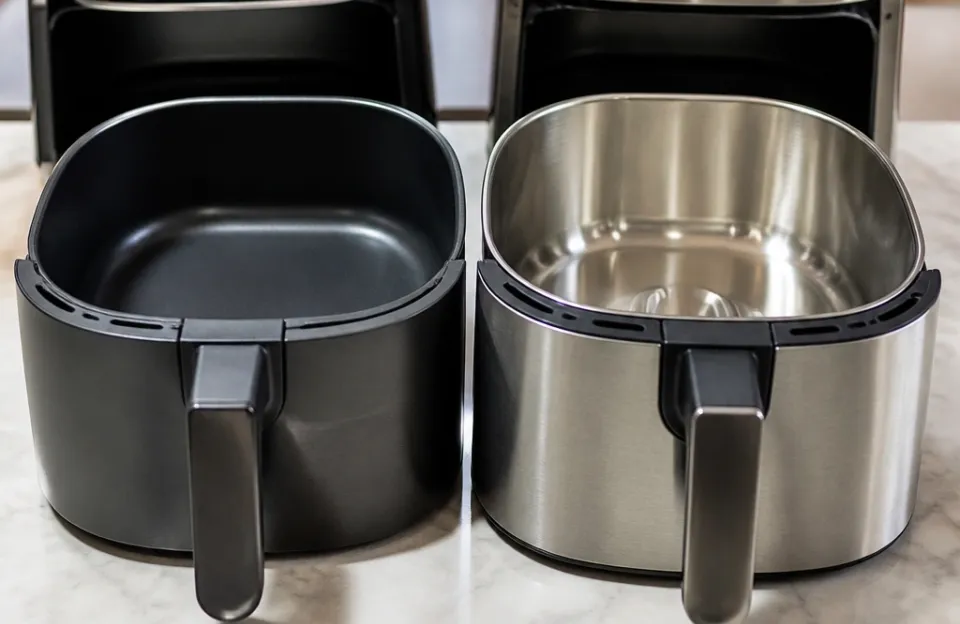
The core difference between these two types of air fryers is the cooking surface inside the basket or tray. A stainless steel interior uses bare metal, typically 304-grade food-safe steel, with no chemical coating applied over it. A nonstick interior uses a base metal covered in a synthetic layer, usually polytetrafluoroethylene (PTFE) or a ceramic-based alternative.
That single difference changes how heat transfers to your food, how oil behaves during cooking, and how the appliance ages over hundreds of cycles. Stainless steel heats evenly and holds temperature well, though it requires preheating for best results. Nonstick coatings heat up slightly faster because the thin layer doesn't absorb as much thermal energy before passing it to the food.
Food interaction is where the gap widens. Bare steel bonds with proteins when they hit high heat. That's why chicken skin sticks to uncoated metal if you don't use oil or parchment.
Nonstick surfaces prevent that bond entirely, letting delicate items slide out without tearing. If you regularly prep wings for meal prep, that release matters for keeping batches uniform.
Heat Distribution and Cooking Speed
Stainless steel takes slightly longer to reach peak temperature because the metal itself absorbs more heat before radiating it into the cooking chamber. Once hot, it maintains steady temperatures through the fan cycle. This makes it reliable for foods that need consistent heat over longer periods.
Getting the timing right on crispy potato batches is easier when the heat stays level throughout the run.
Nonstick interiors transfer heat to food marginally faster since the coating is extremely thin. The trade-off is that extreme temperatures can degrade that coating. Most manufacturers cap safe operating temperatures for PTFE-coated baskets around 500°F, though standard air frying rarely exceeds 400°F.
Ceramic coatings handle slightly higher heat before breaking down.
Oil Requirements During Daily Use
Bare stainless steel needs fat to prevent sticking. A light spray or brushed layer of oil creates a temporary barrier between the food and the metal. Without it, starchy foods and lean proteins will fuse to the surface.
This means you're adding at least a small amount of oil to most recipes.
Nonstick baskets let you cook with zero added fat. The coating itself provides the slip. For people tracking fat intake closely, this matters.
You can still get a good sear on chicken pieces cooked properly without brushing them first. Some users add oil purely for flavor or browning, but the coating doesn't demand it for food release.
Cleaning Routines and Long-Term Upkeep
Washing an air fryer after every use is unavoidable. The material inside the basket dictates how much work that involves.
Nonstick surfaces wipe clean with minimal effort. Grease and caramelized sugars don't bond to the coating, so warm water and a soft sponge remove most residue in under a minute. Stubborn spots soak loose quickly.
The catch is that you must protect the coating during this process. Metal utensils, abrasive scrubbers, and harsh chemical cleaners scratch or strip the surface. Once scratched, the nonstick property degrades rapidly around the damaged area.
Stainless steel demands more physical effort. Baked-on grease and protein residue stick firmly to bare metal. You'll need hotter water, stronger dish soap, and sometimes a nylon brush or non-scratch pad to remove buildup.
The advantage is that stainless steel tolerates aggressive cleaning. You can use tougher scrubbers without worrying about ruining a coating. If you frequently cook fatty cuts like bacon, that heavy-duty cleanup becomes routine.
Some stainless steel baskets are dishwasher safe, which reduces manual labor. Nonstick baskets are often labeled dishwasher safe too, but the high heat and harsh detergents in dishwashers accelerate coating breakdown. Hand washing extends a nonstick basket's life significantly.
| Attribute | Stainless Steel Interior | Nonstick Interior |
|---|---|---|
| Cleaning effort | Higher; baked-on food needs soaking and scrubbing | Low; wipes clean easily with soft sponge |
| Safe tools | Nylon brushes, scrub pads, some steel wool | Soft sponges, microfiber cloths only |
| Dishwasher safety | Generally safe and durable over time | Technically safe, but accelerates wear |
| Oil needed for release | Yes, light coating required | No, food slides off bare surface |
| Heat tolerance | Very high, no degradation at air fry temps | Moderate, degrades above 500°F |
| Typical lifespan | 5+ years with normal use | 1 to 3 years depending on frequency |
Health and Safety Considerations for Both Coatings
Concerns about nonstick chemicals drive many buyers toward stainless steel. Understanding the actual science helps separate real risks from outdated fears.
Traditional nonstick coatings use PTFE. Older manufacturing processes used perfluorooctanoic acid (PFOA) as a processing aid. PFOA was linked to health issues and has been phased out of consumer cookware production in the United States since 2013.
Modern PTFE coatings are PFOA-free. The FDA regulates food-contact surfaces, including food contact materials, to confirm they meet safety standards under normal use conditions.
PTFE remains stable at standard cooking temperatures. Problems arise only if the pan is heated empty to extreme temperatures above 500°F, which causes the coating to break down and release fumes. Air fryers have built-in thermostats and fans that prevent localized overheating, making this scenario rare in practice.
Still, if a heating element malfunctions, a nonstick basket carries a risk that bare steel does not.
Ceramic nonstick coatings offer a mineral-based alternative. They contain no PTFE or PFOA. They appeal to buyers who want easy cleanup without synthetic polymers.
The limitation is that ceramic coatings lose their nonstick properties faster than PTFE, often within a year of heavy daily use.
Stainless steel introduces no chemical concerns. It's an inert alloy. Nothing leaches into food at cooking temperatures, and there is no coating to degrade.
People with severe nickel allergies should note that stainless steel contains nickel, though transfer to food during dry air frying is negligible compared to boiling acidic liquids in steel pots.
For those focused on minimizing added fats while avoiding synthetic coatings, the choice gets tricky. Nonstick lets you skip oil but uses polymers. Stainless steel avoids polymers but needs a light oil spray to prevent sticking.
Many health-focused cooks accept the small amount of oil required by steel as a reasonable trade-off, especially when testing if certain foods fit their diet.
Durability and How Fast Each Material Wears Out
Lifespan is where stainless steel vs nonstick air fryers diverge most sharply.
A stainless steel basket doesn't wear out from cooking. It might discolor over time due to heat exposure, developing a rainbow tint or dull patina. This is cosmetic.
The structural integrity and cooking performance remain identical on day 1,000 as they were on day one. Dents or warping only happen from dropping the basket or exposing it to sudden extreme temperature shocks, like running a scorching hot basket under freezing water.
Nonstick coatings have a finite lifespan. Every heating cycle, every scrape from tongs, and every wash slowly thins the coating. Even with perfect care, PTFE loses its slickness over time.
Heavy users report noticeable sticking after 12 to 18 months. Casual users might stretch a basket to three years. Once the coating fails, food sticks aggressively, and the basket becomes frustrating to use.
Replacing just the basket is possible with some brands, but replacement parts cost money and aren't always available for older models. Often, a failed nonstick basket means replacing the entire unit. With stainless steel, the appliance itself (the motor, heating element, and electronics) will likely fail long before the basket does.
If you buy a larger multi-function model, like a high-capacity countertop unit, protecting that investment matters. A steel interior guards against premature basket failure in machines designed for heavy rotation.
Price Differences Between Steel and Coated Models
Manufacturing costs dictate retail prices. Applying a uniform, food-safe nonstick coating to a stamped metal basket is cheaper than forming, polishing, and finishing a stainless steel basket to food-grade smoothness.
Entry-level air fryers almost exclusively use nonstick interiors. You'll find them starting at very low price points. Mid-range models also lean heavily on nonstick, sometimes upgrading to ceramic coatings or thicker PTFE layers.
Stainless steel interiors appear mostly in premium models. Brands position them as professional-grade or health-conscious options. Expect to pay noticeably more for a steel-basket machine compared to a similarly sized nonstick version.
The higher initial cost spreads out over the appliance's longer functional life, but the upfront hit is real.
Some mid-tier brands offer hybrid approaches: a stainless steel outer basket with a removable nonstick inner crisper plate. This gives you the durability of steel where it counts structurally, with the convenience of nonstick where food touches the surface. The crisper plate still wears out eventually, but replacing a flat plate is cheaper than replacing a whole drawer.
When Stainless Steel Is the Clear Choice
Pick stainless steel if you cook daily or multiple times a day. High-frequency use destroys nonstick coatings quickly. Commercial kitchens, large families, and meal preppers burn through coated baskets fast enough to make steel the only practical option.
Choose steel if you use metal utensils habitually. Tongs, forks, and spatulas scratch nonstick instantly. If you can't commit to silicone or wooden tools every single time you cook, bare metal saves you frustration.
Stainless steel fits better if you plan to keep the appliance for five years or more. The basket won't degrade, meaning the machine stays usable until the electronics or fan motor finally give out.
It's also the right pick if you want to avoid all synthetic polymers in your cooking environment. Whether driven by allergy concerns, environmental preferences, or general caution, bare metal removes the variable entirely.
When Nonstick Makes More Sense
Go with nonstick if you cook infrequently. A few meals a week won't stress the coating, and the convenience outweighs longevity concerns for casual users.
Nonstick is better for delicate foods. Fish fillets, battered items, and soft vegetables tear apart on bare steel unless heavily oiled. The coating handles fragile textures gracefully.
If you prefer getting zucchini perfectly tender without it bonding to the grate, nonstick prevents that mess.
Budget constraints favor nonstick. If you need an air fryer now and can't stretch to premium pricing, a coated model performs identically in terms of airflow and heating. You just replace it sooner.
Easy cleanup matters most to some households. If spending extra minutes scrubbing baked-on grease sounds miserable, nonstick eliminates that chore. A quick wipe under warm water is all it takes.
Edge Cases Where the Standard Rules Break Down
Not every air fryer fits neatly into these two categories. Basket shape affects performance regardless of material. Deep, narrow baskets restrict airflow compared to wide, shallow trays.
A poorly designed stainless steel basket will cook worse than a well-designed nonstick one. Always check the geometry alongside the material.
Some "stainless steel" air fryers only use steel for the exterior housing. The cooking basket inside is still coated aluminum. Read the specifications carefully.
Look for phrases like "uncoated interior," "bare stainless steel basket," or "304-grade steel cooking chamber." Marketing copy often highlights a steel exterior while hiding a nonstick interior.
Ceramic-coated baskets sit between the two extremes. They lack PTFE, satisfying buyers worried about synthetic chemicals. They provide excellent initial food release, matching traditional nonstick.
However, their lifespan is shorter than PTFE, often losing slickness within six to twelve months of regular use. Treat ceramic as a short-term convenience option rather than a permanent solution.
Preheating behavior differs too. Stainless steel benefits greatly from a three-to-five-minute preheat. The metal needs time to absorb and radiate heat evenly.
Dropping cold food into a cold steel basket guarantees sticking. Nonstick baskets are more forgiving if you skip preheating, though preheating still improves crispiness.
Frequently asked questions
Which is better for cooking fish without tearing the skin?
Nonstick air fryers handle delicate proteins far better than bare stainless steel. Fish skin bonds aggressively to uncoated metal, even with oil. A nonstick surface allows fillets to release cleanly when flipped or removed.
If you must use stainless steel for fish, place a perforated parchment liner underneath to create a physical barrier.
Do stainless steel air fryers take longer to cook food?
They require slightly longer preheating, usually three to five extra minutes, because bare metal absorbs more thermal energy before radiating it into the chamber. Once fully heated, actual cooking times are nearly identical to nonstick models. The fan speed and wattage of the heating element matter much more for total cook time than the basket material.
Are modern nonstick coatings safe at high temperatures?
Yes, under normal operating conditions. Current PTFE coatings manufactured without PFOA are stable up to roughly 500°F. Since most air fryer recipes max out at 400°F, the coating remains inert during standard use.
Avoid running an empty nonstick air fryer at maximum temperature for extended periods, as localized overheating can cause breakdown.
Can I put stainless steel air fryer baskets in the dishwasher?
Most uncoated stainless steel baskets are fully dishwasher safe. The high heat and detergent won't damage bare metal. Check your specific model's manual, as some manufacturers include plastic components attached to the steel basket that aren't rated for dishwasher heat.
Nonstick baskets survive dishwashers technically, but the harsh environment strips the coating much faster than hand washing.
Why do some stainless steel baskets still have food sticking?
Bare steel requires fat or moisture to prevent protein bonding. If you place dry, lean food directly onto unheated stainless steel, it will stick. Preheat the basket first, then apply a light coat of oil via spray or brush before adding food.
Sticking also happens if the steel surface has deep scratches trapping old carbonized residue. Thorough cleaning restores the smooth surface.
Is ceramic coating better than traditional nonstick for air fryers?
Ceramic avoids PTFE and PFOA entirely, which appeals to buyers wanting polymer-free cooking. It offers excellent food release initially. The downside is durability.
Ceramic coatings lose their nonstick properties significantly faster than high-quality PTFE, often degrading within a year of daily use. Choose ceramic for chemical avoidance, but expect to replace the basket sooner.
Deciding What Goes in Your Kitchen
Stainless steel vs nonstick air fryers isn't a question with one universal answer. It's a trade-off between longevity and daily convenience. Bare steel survives years of heavy abuse, tolerates any cleaning method, and introduces no synthetic materials near your food.
It asks for more effort during cleanup and requires a bit of oil to behave.
Nonstick delivers immediate ease. Food slides out, wiping the basket takes seconds, and you can skip added fats entirely. You pay for that convenience with a shorter lifespan and the constant need to protect the coating from scratches and high heat.
Look at your weekly cooking habits. If the machine runs twice a day, steel pays for itself quickly. If it comes out for weekend snacks, a coated model keeps things simple without wearing out prematurely.
Match the material to your actual routine rather than chasing a theoretical ideal.