The short answer: buy a basket air fryer if you want fast, crispy results in small portions and have limited counter space. Buy an air fryer toaster oven if you want one appliance that toasts, bakes, roasts and air fries, and you regularly cook for a family. The rest of this guide explains the trade-offs behind that split so you can match the appliance to your kitchen and cooking habits.
The Core Difference Between a Basket and an Oven Cavity
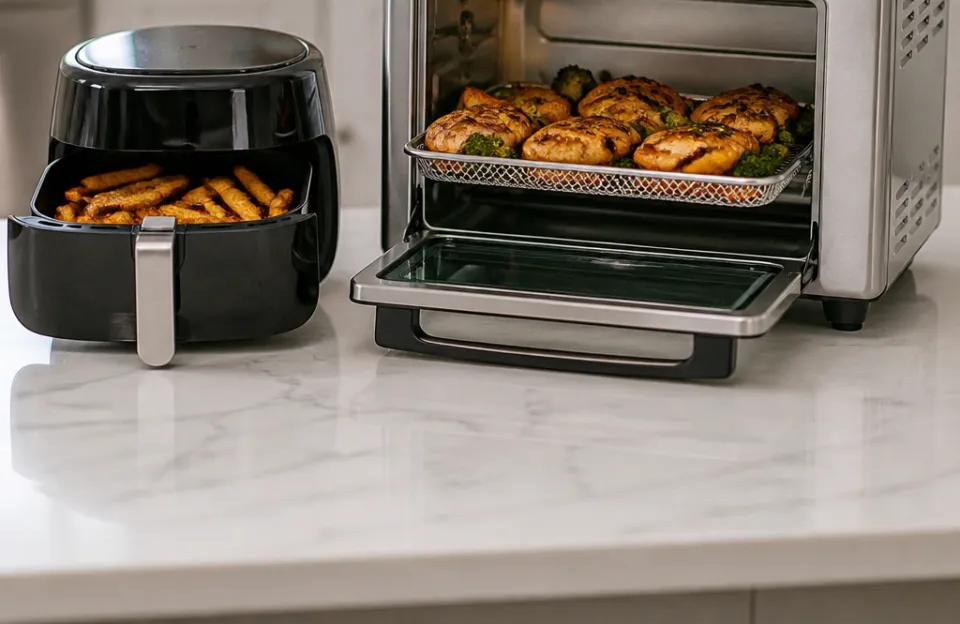
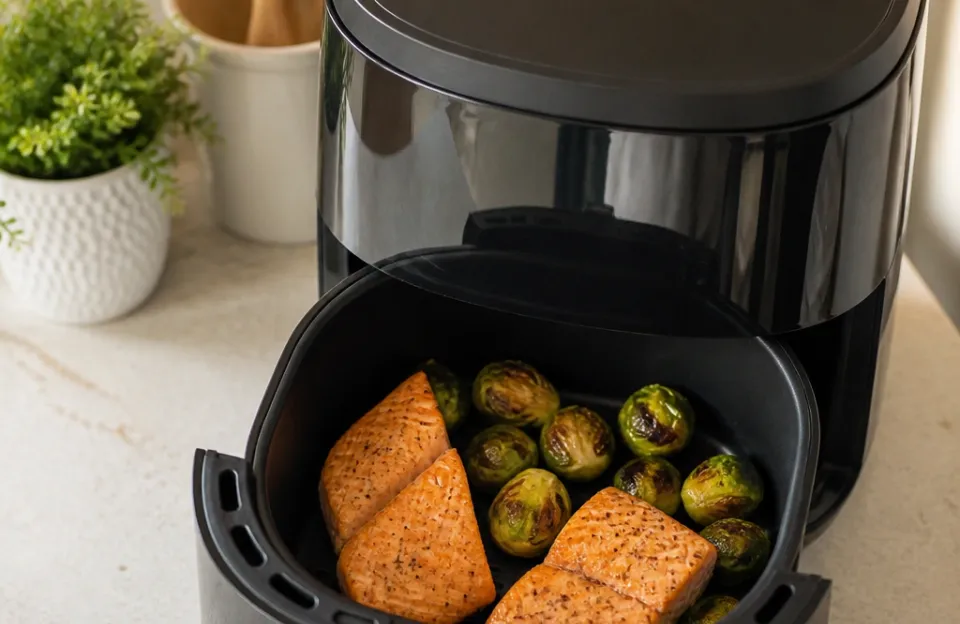
A basket air fryer is built around a pull-out drawer with a perforated basket. Food sits close to a heating element and a fan, and hot air circulates tightly around it.
An air fryer toaster oven works like a compact convection oven, with a front door, trays or racks, a viewing window and heating elements around a larger cavity. That airflow pattern explains most of the practical differences below.
Measure Before You Buy: Space, Clearance, Vents and Power
Air fryer toaster ovens are bulkier than they look in photos, so measure first. Check counter depth, width, and the height of any cabinet above the unit. Also confirm where the vents sit, because some models need open space above and around them.
Model-specific clearances vary widely and should come from your manual, not a general guide. The same applies to electrical requirements: the COSORI CTO-R251S, for example, is rated 1800W with a 26 qt / 25 L capacity. Do not assume that specification carries over to other models.
A quick check before checkout:
- Counter depth: the body, the open door and the tray clearance.
- Overhead clearance: cabinet height above the unit.
- Vent placement: front, sides or top. Blocking a vent traps heat.
- Electrical: confirm the model’s voltage and wattage against your outlet and circuit.
- Placement warnings: check the manual for restrictions on use on a stove or inside another heated oven.
Basket air fryers usually save space, especially slim models designed for a tight kitchen, such as those covered in guides for compact countertop cooking. If counter space is your binding constraint, that decision often settles the question on its own.
Capacity and Batch Sizes: Area Matters More Than Quarts
Nominal capacity numbers are hard to compare across types. A toaster oven’s 26 quarts are spread across racks and trays, while a basket’s number refers to a single confined container. Usable surface area and rack configuration tell you more about how much food you can actually cook. For wings, where a single layer matters, check timing guidelines for poultry so you do not overcrowd the basket.
A tray gives you flat, wide space for multiple items in one layer. A deep basket gives you a smaller footprint but stronger airflow around every piece. Overloading either one defeats the purpose: crowded food steams instead of crisping.
As a rough working guide, an individual or couple usually does fine with a basket. A family cooking four or more portions at once will likely be frustrated by repeated batches. A toaster oven style lets you spread food across one or more racks, which can shorten total cooking time because you avoid running several batches.
Speed, Preheat and Temperature Control
Basket air fryers heat a small volume of air, so many models reach cooking temperature quickly. Preheat guidance varies by model, and the instruction manual should be your guide. That quick start is a big part of why they feel fast for weeknight dinners.
Air fryer toaster ovens have larger cavities to heat, so preheating can take longer. Cooking times vary by model, batch size, and food. Compare the cooking guidance for the specific appliances rather than assuming a fixed time difference.
Temperature control also differs. Some oven styles offer lower temperature settings suited to dehydrating, proofing or warming, while many basket fryers focus on high-heat crisping. Both work for delicate proteins, but timing and basket or rack placement matter. For fish, see getting salmon perfectly flaky.
Cleaning and Grease Management
Cleaning is where buying preferences and daily reality meet.
Basket air fryers: many baskets and crisper plates have a nonstick coating and clean with warm soapy water. Avoid abrasive scrubbers, which can damage the coating. Grease from fatty foods collects in the bottom of the drawer and is usually easy to empty. For greasy foods, see cooking duration for fatty cuts.
Air fryer toaster ovens: there is more surface area to manage. Racks, trays, the door glass and the crumb tray all collect grease and bits. The manufacturer of one toaster oven model warns that accumulated grease and crumbs can overheat and catch fire, so the crumb tray needs cleaning after each use. A deeper cleaning routine is covered in a dedicated guide if you want the full process.
Metal scouring pads are a bad idea on many ovens: fragments can contact electrical parts and create a shock risk. Always unplug and let the appliance cool before removing parts for cleaning.
What Else Each One Can Actually Cook
This is where the two appliances diverge most sharply.
A basket air fryer does a few things very well: fries, wings, vegetables, reheated leftovers and anything that benefits from direct, high-velocity air. A light coating or a light baking soda coating can improve crunch on wings.
An air fryer toaster oven does more, and often for larger volumes: toast, bake, roast, broil, reheat and air fry in one box. In one publication’s evaluation, toaster-oven styles were described as generally more versatile than traditional basket fryers. Flat items such as pizza, sheet-pan vegetables and open-face sandwiches are awkward in a basket and natural on a tray. If you use a flour-based coating for crunch, place a solid baking sheet on the lower rack to catch drips.
Drag your finger down these practical comparisons:
- Toast and bagels: oven style wins clearly.
- Crispy wings and fries: basket style tends to outperform.
- Whole chicken or larger roast: oven style, if the cavity fits.
- Wet batters or loose coatings: both can drip; a tray with a lined bottom catches the mess more effectively in an oven style.
- Dense items such as meatloaf: an oven style surrounds the food with steady heat, so check the right duration for thick loaves.
A drip tray under a wire rack is useful for greasy or coated foods in an oven style, provided the tray does not block airflow to the heating elements. Paper and foil rules below apply.
Energy Consumption and Daily Electricity Use
Energy comparisons are genuinely difficult to generalize. Consumption depends on wattage, batch size, how often you preheat, how full the cavity is and how long the appliance runs. A larger cavity takes more energy to heat but may finish more food per cycle.
No verified general figures are available to state a single winner here, so treat efficiency as a per-use calculation rather than a category fact. If energy cost matters to you, compare the specific models’ wattage and typical run times for the foods you cook most. Also consider which appliance replaces what: a toaster oven that replaces a full-size oven for small meals may use less energy overall because it heats a smaller space.
Noise Levels in a Shared Living Space
Noise is one of the most model-dependent factors in this comparison, and there is no verified general decibel comparison between the two categories. Fan and motor design vary widely, so a basket unit may sound louder or quieter than an oven style depending on the specific model.
If the appliance will run while others sleep or work nearby, shortlist models with noise mentioned in trusted reviews and listen to in-store demos where possible. Do not treat a product page’s “quiet operation” claim as a measurement.
Safety Considerations for Households with Kids
Both appliance types produce hot surfaces and hot food, so placement and supervision matter more than the category.
Oven-style safety warnings are extensive because the front door and exposed heating elements create extra hazard points. The manufacturer of one model states that the outside of the oven, including the door, is hot during and after use. It also warns that close supervision is necessary when the oven is used by or near children and to keep foil as secure as possible so it never contacts the heating elements.
Key fire-safety rules for toaster-oven styles:
- Never place foil or parchment so it can touch the heating elements.
- Never put parchment in without food on top; air circulation can lift the paper into the elements.
- Do not store items on top of the oven while it is operating.
- Do not place paper, cardboard or non-heat-resistant plastic inside.
- Do not place the unit on a stove, near burners or inside another heated oven.
For basket air fryers, follow the same basic precautions: hot exterior, hot drawer, and a surface that stays warm for a while after cooking. Where you place either appliance matters as much as the appliance itself. Keep children away from the cooking zone and check that hot surfaces are out of reach.
Which One Fits Your Actual Routine?
The decision comes down to how you cook most days.
Buy a basket air fryer if:
- You cook for one or two people.
- You want fast, crispy food with less oil.
- Counter space is limited.
- Cleanup needs to be quick and contained.
Buy an air fryer toaster oven if:
- You cook for a family and want larger batches.
- You want one appliance that toasts, bakes, roasts and air fries.
- You cook flat items such as pizza and sheet-pan meals.
- You can spare more counter space and a more involved cleaning routine.
Both fit your kitchen if you cook a mix of small, crispy foods daily and larger, versatile meals regularly. Many households end up with a basket fryer for quick jobs and a toaster oven for everything else.
If you are still unsure, start with the routine test. Take your three most common weeknight meals. If each one fits in a drawer, choose a basket air fryer. If at least one needs a tray, a rack or a whole bird, choose the oven style.
Deciding What Stays on Your Counter
Before buying, run this final checklist:
- Measure the counter and overhead clearance for the model you want, then verify the vent requirements in its manual.
- Read the safety section of the manual, especially foil, parchment and placement warnings.
- Confirm the wattage and voltage match your home’s outlets.
- Check the warranty and return policy for the specific model.
- Match capacity and rack or basket configuration to the number of people you usually feed.
The right answer is the appliance that fits your cooking habits, your space, and your willingness to clean it. Match the type to your weeknight reality first, and the details second.