Most air fryers need between 15 and 20 inches of counter width, about 14 to 16 inches of depth, and at least 5 inches of open space above the unit. The exact footprint depends heavily on the basket capacity and whether you buy a round or square model. A compact 2-quart machine might only take up 10 by 10 inches, while a dual-basket 8-quart version can easily stretch past 16 inches wide.
Figuring out how much counter space does an air fryer need involves more than just measuring the box it comes in. You have to account for heat exhaust, cord reach, drawer clearance, and daily workflow. This guide breaks down the physical dimensions across different sizes, explains the required safety clearances, and covers practical ways to fit one into a small kitchen without moving everything else around.
Why the Box Dimensions Don't Tell the Whole Story
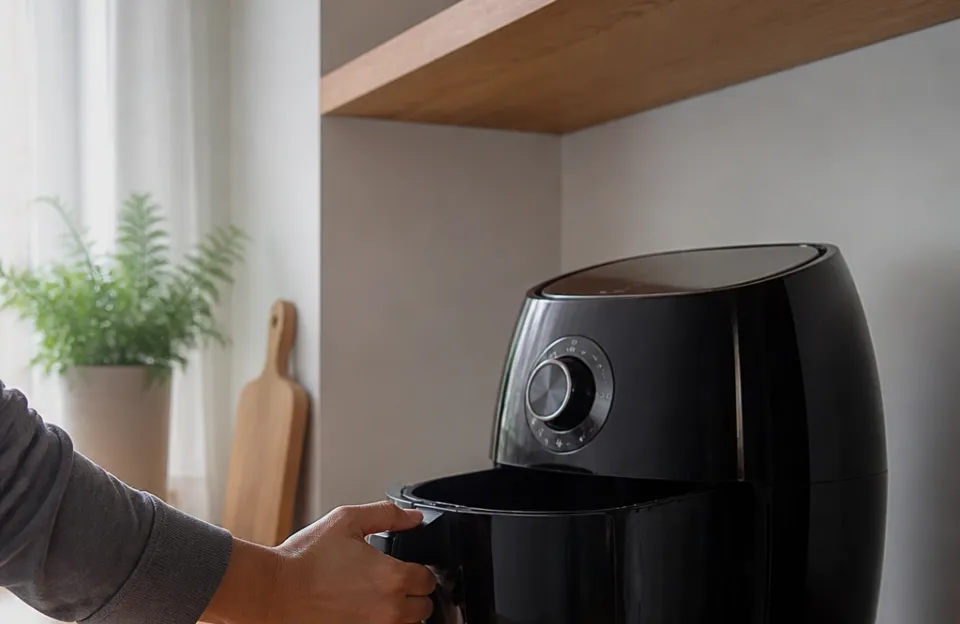
Manufacturers list the exterior measurements of their appliances on the packaging. Those numbers tell you the size of the plastic shell. They don't tell you how much room the appliance actually requires to operate safely.
An air fryer pulls in cool air from the bottom or sides and pushes very hot air out of the back vent. Blocking that airflow causes the heating element to overwork and shortens the lifespan of the machine.
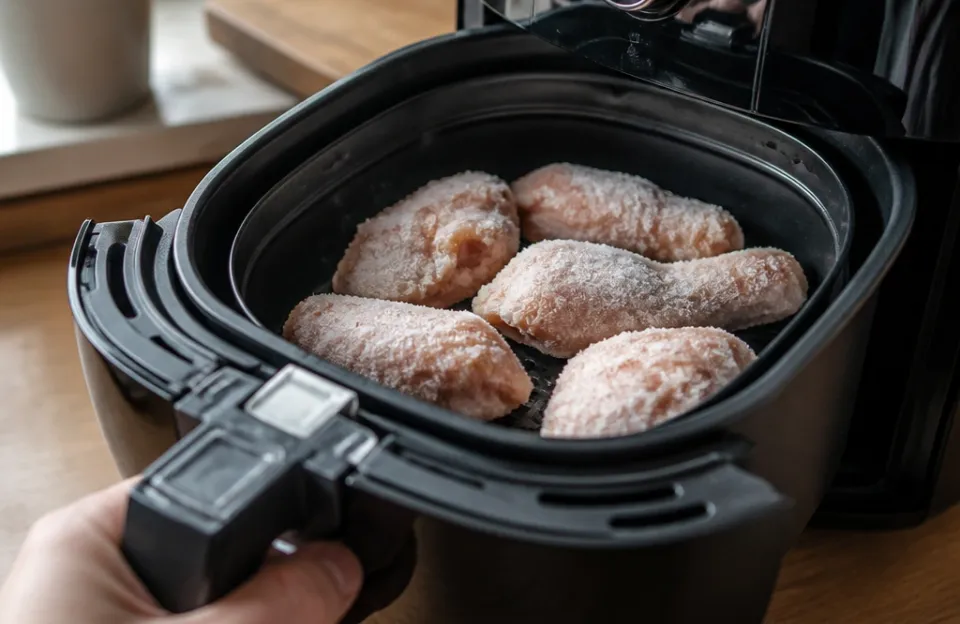
You also have to think about your own hands. When you pull the basket out to shake some fries halfway through cooking, the handle extends outward. If your air fryer sits flush against a wall, you won't have room to grip the handle comfortably.
Dropping a hot basket full of food is a real hazard. The National Fire Protection Association provides extensive guidance on kitchen fire prevention that stresses keeping adequate clearance around any countertop cooking device. Giving yourself a few extra inches on all sides prevents burns and spills.
Then there is the power cord. Most cords are between 24 and 36 inches long. If your nearest outlet is far from your intended spot, you might be tempted to use an extension cord.
Running high-wattage heating appliances through thin extension cords creates a serious fire risk. Your placement needs to sit close enough to a grounded outlet so the factory cord reaches without pulling tight.
How Much Counter Space Does an Air Fryer Need by Size Category
Air fryers generally fall into three size categories based on their quart capacity. The physical footprint scales up as the basket gets larger. Knowing these ranges helps you measure your counters before you buy anything.
| Capacity Range | Typical Width | Typical Depth | Typical Height | Best For |
|---|---|---|---|---|
| Small (1.5 to 3 quarts) | 10 to 12 inches | 10 to 13 inches | 11 to 13 inches | Singles, dorms, side dishes |
| Medium (4 to 6 quarts) | 12 to 15 inches | 13 to 15 inches | 13 to 15 inches | Couples, families of three |
| Large (7 to 10+ quarts) | 15 to 18 inches | 14 to 17 inches | 14 to 16 inches | Families of four+, batch cooking |
Compact Models Under 3 Quarts
Small air fryers are usually round. A typical 2-quart model measures about 10 inches wide and 10 inches deep. These fit easily into tight corners, narrow apartment kitchens, or even inside standard upper cabinets when not in use.
The height usually stays under 13 inches, meaning they slide beneath most standard upper cabinets without issue.
The tradeoff with a compact model is capacity. You can cook a single serving of wings or a small batch of vegetables. If you try to pile too much food into a 2-quart basket, the air can't circulate properly.
Getting the timing right for smaller batches takes practice, especially when you are figuring out how long root vegetables take in a cramped basket where overcrowding leads to steaming instead of crisping.
Mid-Size Baskets Between 4 and 6 Quarts
This is the most common size people buy. A 5-quart air fryer typically spans 13 to 14 inches wide and about 14 inches deep. Square baskets became popular in this range because they hold more food in the same footprint compared to round ones.
A 5.8-quart square model gives you significantly more usable cooking area than a 5.8-quart round model.
Mid-size units fit well on standard 25-inch deep countertops. You still have plenty of prep room left in front of the machine. Some brands design specific models to minimize their footprint.
If you want a medium capacity without the bulk, looking into slimmer profile designs can save you a few valuable inches of width while still holding enough food for a couple.
Large and Dual-Basket Units Over 7 Quarts
Once you cross into 7 or 8 quarts, the appliance becomes a major countertop presence. Standard large models push 16 inches wide. Dual-basket air fryers, which house two separate drawers side by side, often measure 16 to 18 inches across.
Their depth remains similar to mid-size models, around 14 to 15 inches, but that extra width eats up a lot of prime real estate near the stove.
These larger machines are built for volume. Cooking enough protein for a whole family's meal prep requires that extra room. When you are preparing larger batches, like figuring out the best method for getting poultry skin perfectly crisp, having a wider basket means you can lay pieces out flat instead of stacking them.
Stacking blocks the convection current and ruins the texture. But that convenience demands permanent counter space. You can't easily tuck an 18-inch wide machine into a cabinet after every use.
Clearance Rules for Safe Operation
Measuring the footprint of the base is only half the job. The other half is calculating the empty space the machine needs around its exterior to run safely. Ignoring these gaps leads to melted backsplashes, tripped breakers, or worse.
The Exhaust Vent Behind the Unit
Every air fryer has an exhaust vent, usually located on the back panel. During operation, this vent blows air heated to 400 degrees Fahrenheit directly outward. You must leave a minimum of 5 inches between the back of the air fryer and the wall.
If you push the unit flush against a painted drywall surface or a vinyl backsplash, the constant blast of extreme heat will damage the finish. Paint blisters. Vinyl warps.
If your kitchen layout forces you to place the unit near a window, keep the exhaust away from curtains or blinds. Five inches is the absolute minimum. Six or seven inches is better if you have the room.
Some higher-end models vent from the top rear rather than straight out the back, which slightly changes the geometry, but the 5-inch rule remains a safe baseline.
Overhead Cabinet Height Limits
Standard kitchen base cabinets are 36 inches tall including the countertop. Standard upper cabinets hang 18 inches above the counter. That leaves exactly 18 inches of vertical clearance.
Most air fryers stand between 12 and 15 inches tall. Mathematically, they fit.
In practice, placing a heat-generating appliance directly under a wooden cabinet is risky. Steam and hot air rise. Over time, the moisture and heat can warp the wood veneer on the bottom of your upper cabinets.
Leave at least 5 inches of vertical space between the highest point of the air fryer and the underside of the cabinet above it. If your machine is 14 inches tall, you need 19 inches of total vertical space to do this safely. In older kitchens where the uppers hang lower, you might not have this room.
In that case, the air fryer needs to move to a different spot.
Side Clearance for Drawer Access
When you pull the basket out, the handle swings forward and slightly upward. You need clear space in front of the machine to do this. But you also need side clearance.
Many people place their air fryer right next to the toaster or coffee maker. If the sides are touching, the heat radiating from the air fryer's plastic shell transfers to the neighboring appliance. Leave at least 2 to 3 inches on both the left and right sides.
This gap allows ambient room air to flow around the housing and keeps the exterior plastic cooler.
Countertop Materials and Heat Transfer
The surface sitting underneath your air fryer matters just as much as the empty space around it. Air fryers get hot on the outside. The bottom plate, where the heating element sits closest to the counter, transfers thermal energy downward during a 30-minute cook cycle.
Granite, quartz, and stainless steel handle this heat transfer well. They won't scorch or melt. Laminate countertops, however, are vulnerable.
Prolonged exposure to high heat can cause laminate to bubble, discolor, or delaminate from the particle board underneath. If you have laminate or wood butcher block counters, you shouldn't place the air fryer directly on the bare surface.
A thick silicone mat designed for countertops solves this problem. Silicone withstands temperatures well above 400 degrees. Placing a mat under the unit creates a thermal barrier.
Wooden cutting boards work in a pinch, but they can crack over time from repeated heating and cooling cycles. Avoid using thin plastic trivets, as they can soften and warp under sustained heat.
Fitting One Into a Small Kitchen Layout
Not everyone has sprawling granite islands. If you're working with limited square footage, finding a home for a bulky appliance requires strategy. You have a few options beyond leaving it permanently parked next to the sink.
Appliance Garages and Corner Dead Space
Many kitchens have corner spaces that are hard to reach or awkwardly shaped. An "appliance garage" is a small cabinet enclosure sitting directly on the countertop, usually tucked into a corner under the upper cabinets. These spots are perfect for air fryers, provided the garage has adequate ventilation.
If the garage has a closed door, you must leave the door fully open while the machine runs. Closing the door traps the exhaust heat inside a confined wooden box.
Rolling Carts and Utility Islands
If your main counters are completely full, a small rolling utility cart offers a dedicated station. You can wheel the cart near an outlet when you need to cook, then roll it back into a pantry or corner afterward. Make sure the cart is sturdy enough to handle the weight.
A loaded 6-quart air fryer can weigh over 15 pounds. Flimsy wire racks will wobble when you pull the heavy basket out.
Pantry Storage vs. Daily Use
Storing the air fryer in a pantry or lower cabinet saves counter space entirely. This works well if you only use it once or twice a week. Lifting a 15-pound appliance in and out of a low cabinet repeatedly gets tiring fast.
If you plan to cook with it daily, like when you are preparing quick seafood dinners, storing it away becomes a chore you'll eventually stop doing. Reserve pantry storage for occasional use. For daily cooking, find a permanent spot.
Some multi-function appliances combine several tools into one footprint. If you are weighing whether to dedicate space solely to air frying or if you should look at combination units that toast and bake, consider how often you use your existing toaster oven. Consolidating two machines into one slot frees up the exact space you need.
Shape Matters More Than Quart Size
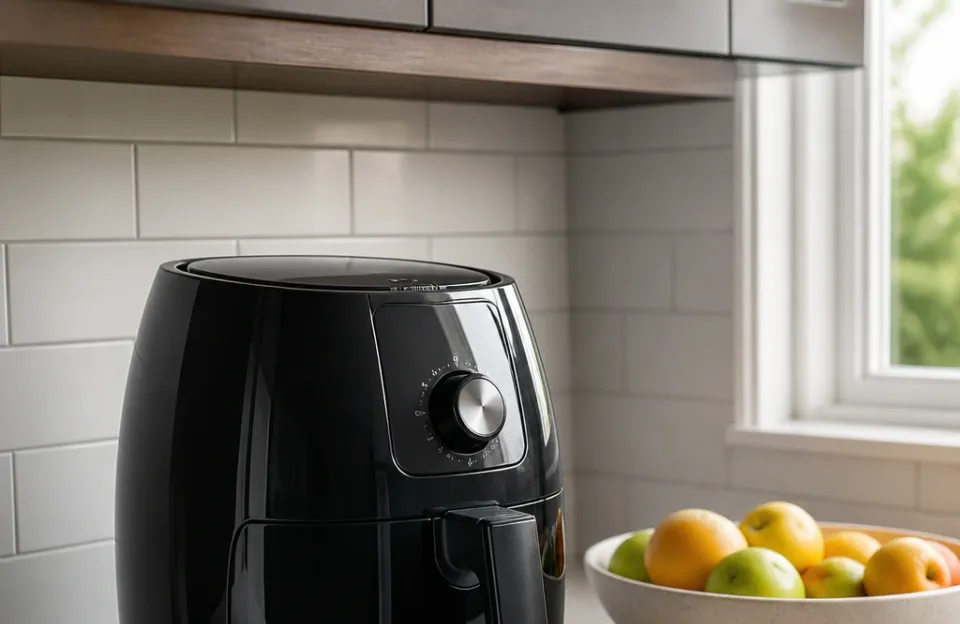
People tend to shop strictly by quart capacity. They assume a 5-quart model from Brand A takes up the same space as a 5-quart model from Brand B. That assumption is wrong.
The shape of the basket dictates the external dimensions.
Round baskets require a cylindrical housing. A 5-quart round air fryer might be 13 inches wide and 13 inches deep. It forms a perfect circle on your counter.
Square baskets use the corners of the footprint efficiently. A 5-quart square model might be 12 inches wide and 12 inches deep, offering the same internal volume in a tighter external box. Square baskets also fit standard rectangular foods better, like chicken breasts or fish fillets, without forcing you to cut them down.
Dual-basket models change the geometry entirely. Instead of growing deeper, they grow wider. Two 4-quart baskets placed side by side create an 8-quart total capacity.
The depth might only be 14 inches, but the width stretches to 16 or 17 inches. Before buying a dual-basket model, measure the horizontal span of your available counter space. If you only have 14 inches of clear width between the coffee maker and the knife block, a dual-basket machine simply won't fit.
Oven-style air fryers look like miniature toaster ovens. They feature a drop-down door instead of a slide-out drawer. Because they don't need the forward clearance to pull a drawer out, you can push them further back against the wall.
However, they still require the 5-inch rear exhaust gap. Oven styles tend to be taller than basket styles, so check your overhead cabinet clearance carefully before choosing this shape.
Weight and Moving It Around
Counter space isn't just about static dimensions. It's also about how the appliance interacts with your workflow. A compact 2-quart air fryer weighs around 7 pounds.
You can lift it with one hand and slide it out of the way when you need to chop vegetables. A large 10-quart dual-basket model weighs 20 pounds or more. Once you set it down, it stays there.
If you plan to move the unit after every use to reclaim your counter space, factor in the effort. Heavy machines with slick plastic feet can slide unexpectedly if you bump them. Rubberized feet grip the counter better but make intentional sliding harder.
You end up lifting it every time. If you have mobility issues or back pain, a heavy machine stored in a lower cabinet becomes impractical quickly. Choose a size you can comfortably manage based on how often you intend to move it.
Cord Management and Outlet Proximity
We touched on cord length earlier, but the placement of the cord exit point on the machine affects your layout too. Some models route the power cord out of the bottom rear. Others route it out of the middle of the back panel.
If the cord exits the bottom, the machine might rock slightly if the cord bunches up underneath. If it exits the middle, you need a clear path backward to the outlet.
Never drape the power cord over the top of the hot housing or let it hang down the front where it could snag on the drawer handle when you pull it open. Route the cord cleanly along the back edge of the counter. If your outlet is behind the air fryer, remember that the plug itself adds another 1.5 to 2 inches of depth.
A bulky grounded plug might prevent you from achieving the necessary 5-inch exhaust gap if the outlet is recessed shallowly. Check your outlet depth before finalizing the spot.
Common Mistakes People Make With Placement
Even experienced cooks mess up the spatial planning when adding new appliances to a crowded kitchen. A few errors pop up constantly.
- Pushing the unit flush against the backsplash. This is the most frequent mistake. People want to maximize prep space in front of the machine, so they shove it all the way back. Doing this chokes the exhaust vent and risks melting the wall material. Always respect the 5-inch rear gap.
- Placing it under a microwave. Some kitchens have over-the-range microwaves or built-in shelf microwaves. Putting an air fryer directly below one exposes the microwave's underside to rising heat and steam. Microwaves aren't designed to withstand external heat from below.
- Ignoring the drawer swing radius. People measure the width and depth of the base but forget to simulate pulling the drawer out. If your kitchen island has bar stools tucked in, or if the counter faces a narrow walkway, opening the basket might hit someone standing there. Test the full extension of the drawer before committing to a spot.
- Using flimsy shelf inserts. To save space, some people put air fryers on wire shelving racks placed over the counter. Unless the rack is rated for high heat and heavy loads, the vibrations from the fan can cause the unit to rattle or shift dangerously.
- Forgetting about grease splatter. Air fryers vent grease particles along with hot air. Placing the exhaust vent directly toward an open spice rack or a stack of paper towels will coat those items in a fine layer of oil over time. Point the back of the machine toward a blank wall, not toward your dry goods.
Frequently Asked Questions
Can I put my air fryer inside a cabinet while it is running?
No. You should never operate an air fryer inside a closed cabinet. The machine generates intense heat and requires constant airflow to function safely.
Enclosing it traps the exhaust, rapidly raises the internal temperature, and creates a severe fire hazard. Only store it in a cabinet when it is completely unplugged and cooled down.
Do air fryers damage laminate countertops?
They can if placed directly on the surface for extended periods. The bottom of the unit transfers heat downward during long cook cycles. Laminate is susceptible to bubbling and scorching under sustained high temperatures.
Using a thick, heat-resistant silicone mat under the appliance prevents this damage entirely.
How far away from the wall should the exhaust vent be?
Leave a minimum of 5 inches between the rear exhaust vent and the wall. This distance allows the superheated air to dissipate safely without blistering paint, warping vinyl backsplashes, or causing the machine's internal components to overheat from blocked airflow.
Will a dual-basket air fryer fit under standard upper cabinets?
Usually yes, regarding height. Standard upper cabinets hang 18 inches above the counter. Most dual-basket models are 14 to 15 inches tall.
However, you still need 5 inches of vertical clearance for rising heat, which makes a tight squeeze. The bigger issue with dual-basket models is width. They often span 16 to 18 inches horizontally, requiring significant uninterrupted counter length.
Is it safe to put an air fryer next to a gas stove?
Keep it at least 12 inches away from an active gas burner. While the air fryer's plastic exterior is heat-resistant, direct exposure to an open gas flame or extreme radiant heat from a large pot can warp the housing. Grease splatter from the stove can also coat the air fryer's intake vents, restricting airflow over time.
What size air fryer fits in a dorm room?
Compact models between 1.5 and 2.5 quarts are ideal for dorm rooms. They typically measure 10 by 10 inches and weigh under 8 pounds. These fit easily on small desks or mini-fridge tops.
Just verify your dorm's electrical policies first, as some restrict high-wattage heating appliances.
Planning Your Kitchen Layout Before Buying
Knowing how much counter space does an air fryer need stops being a guessing game once you grab a tape measure. Write down the width, depth, and height of your available spot. Subtract 5 inches from the depth for the rear vent.
Subtract another 3 inches from the width for side clearance. Whatever number is left tells you the maximum exterior dimensions you can shop for.
Don't buy a massive 10-quart dual-basket machine because you liked the idea of batch cooking if your counters barely hold a toaster. Pick the largest capacity that fits within your measured safety clearances. A 4-quart model used efficiently will always yield better results than an 8-quart model shoved into a dangerous corner where you can't open the drawer properly.
Measure first, check your outlets, protect your surfaces, and pick the shape that matches your actual kitchen geometry.