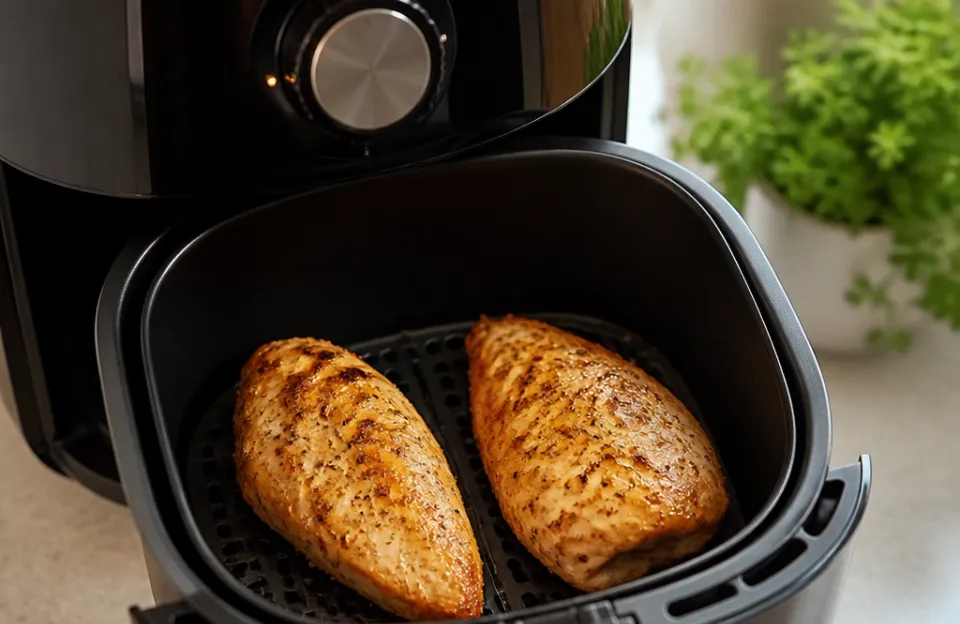
A 5-quart air fryer hits the sweet spot for most households. It cooks enough food for two to four people without taking up your entire countertop. If you are shopping for one, this buying guide covers what matters: basket shape, wattage, control types, and real tradeoffs between popular models.
We picked five widely available 5-quart air fryers based on heating consistency, ease of cleaning, noise levels, and daily usability. Every model here has a specific strength and a clear limitation. Read through them to find the one that fits how you actually cook.
What Makes a 5-Quart Air Fryer the Right Size

Capacity in air fryers is measured by the volume of the cooking basket. A 5-quart basket holds roughly 2 pounds of french fries or about six chicken drumsticks in a single layer. Crowding the basket blocks airflow and leads to soggy food.
If you routinely cook for three or four people, 5 quarts gives you enough room to spread ingredients out. Smaller 3-quart models force you to cook in batches. Larger 8-quart units take up significant counter space and use more electricity.
The physical footprint varies even within the same capacity. Square baskets use corner space better than round ones. A round 5-quart basket might require a wider base, while a square design stacks food more efficiently.
Pay attention to the external dimensions if your kitchen space is tight. You can check slim-profile countertop appliances if cabinet clearance is a major concern.
Wattage directly affects how fast the unit recovers heat after you open the basket. Most 5-quart air fryers run between 1500 and 1700 watts. Higher wattage means faster preheating and crispier results, especially for dense foods like root vegetables.
Lower wattage models save energy but might leave you waiting an extra few minutes per batch.
Heating Elements and Airflow Design
Air fryers work by circulating hot air rapidly around food. The heating element sits above the basket, and a fan pushes the air down and around the perforated walls. In a 5-quart unit, the distance between the element and the food matters.
If the basket is too deep, the top layer browns quickly while the bottom stays pale. Shallow, wide baskets promote even cooking.
Some brands use dual heating elements or specialized fan blades to improve circulation. Others rely on a basic coil and a standard fan. When you look at specifications, check if the manufacturer mentions a specific airflow technology.
Basic models still work well, but they often require you to shake the basket halfway through cooking. Knowing how long potatoes take to cook helps you plan when to pull the basket out for that mid-cook shake.
The US Food and Drug Administration regulates the materials used in these appliances. Nonstick coatings must meet safety standards for food contact surfaces. You can review FDA guidelines on cookware safety if you have concerns about specific chemical coatings.
Most modern 5-quart air fryers use PTFE or ceramic nonstick finishes that are safe when used below their maximum temperature ratings.
Digital Touchscreens vs Manual Dials
Controls change how you interact with the machine every day. Digital touchscreens give you exact temperatures in 5-degree increments and precise timers down to the minute. They often include preset buttons for common foods.
Manual dials use a mechanical timer and a continuous temperature knob.
Digital panels look modern and offer precision. The downside is longevity. Touchscreens can fail if grease seeps behind the glass, and electronic boards are more expensive to replace than a mechanical dial.
Manual dials are simpler. You turn the knob, hear the tick, and walk away. They lack precision, though.
Setting exactly 375 degrees Fahrenheit on a dial requires guesswork.
If you cook a lot of different foods at varying temperatures, digital controls save time. If you mostly reheat leftovers or cook simple proteins at 400 degrees, manual dials are perfectly fine. Some users prefer detailed timing guides for specific cuts regardless of which control type they own.
| Control Type | Precision | Durability | Ease of Use | Typical Cost Impact |
|---|---|---|---|---|
| Digital Touchscreen | Exact degrees and minutes | Moderate; sensitive to grease | High once learned | Adds $20 to $50 |
| Manual Dials | Approximate settings | High; fewer parts to break | Immediate, no learning curve | Keeps base price lower |
Basket Materials and Cleanup Realities
The basket takes the most abuse in any air fryer. You drag it in and out, scrape it with tongs, and wash it repeatedly. Most 5-quart models come with a nonstick coated metal basket and a separate crisper plate.
The crisper plate elevates the food so fat drips away.
Nonstick coatings wear out over time. Using metal utensils accelerates this process. Silicone-tipped tongs protect the finish.
Hand washing with a soft sponge extends the life of the coating significantly compared to dishwashers, even if the manufacturer claims the parts are dishwasher safe. Dishwasher detergents are abrasive and degrade nonstick surfaces faster.
Ceramic coatings are an alternative to traditional PTFE. They resist scratching slightly better and don't release fumes if accidentally overheated. However, ceramic loses its nonstick properties faster than PTFE if not seasoned or cared for properly.
When you cook items that need a light dusting, like chicken wings tossed in flour, a good nonstick surface prevents the breading from welding itself to the metal.
Some 5-quart models use stainless steel mesh baskets instead of solid nonstick pans. Stainless steel lasts longer and avoids coating concerns entirely. Food sticks to it more easily, though.
You need to use cooking spray or oil to prevent sticking, which adds a step to prep and cleanup.
Noise Levels and Counter Space

Air fryers are essentially compact convection ovens with powerful fans. That fan makes noise. A typical 5-quart air fryer operates between 55 and 65 decibels.
That is comparable to a normal conversation or a running microwave. Cheaper models with unbalanced fans tend to rattle and hum louder. Premium units usually have better sound dampening.
Counter space is another practical constraint. A 5-quart air fryer needs at least 5 inches of clearance behind it for the exhaust vent. Placing it flush against a wall or under low cabinets traps heat and creates a fire hazard.
Measure your available space before buying. Check the external dimensions listed in the product specs, not just the basket capacity.
Weight matters if you plan to store the appliance in a cabinet between uses. A 5-quart unit typically weighs between 10 and 14 pounds. Lifting it in and out daily gets tedious.
Leaving it on the counter is easier, provided you have the space.
Five 5-Quart Air Fryers Worth Considering
Ninja AF101 Air Fryer
The Ninja AF101 is a 4-quart model that frequently gets grouped into 5-quart buying guides because its square basket holds nearly as much food as round 5-quart competitors. It uses a 1550-watt heating element and reaches 400 degrees Fahrenheit quickly. The ceramic-coated crisper plate is dishwasher safe, and the basket has a wide, flat bottom that fits four chicken thighs without overlapping.
This model is ideal for someone who wants fast preheating and consistent browning. The digital interface responds instantly, and the presets for air frying, roasting, reheating, and dehydrating cover most daily tasks. Dehydrating at low temperatures works well for fruit slices or jerky.
The main limitation is the true capacity. While the square shape maximizes space, it maxes out at 4 quarts. If you regularly cook for four adults, you will need to run two batches.
The exterior plastic also gets quite hot during extended cooking sessions, so keep it away from children. For a deeper look at this specific Ninja model's performance, check dedicated reviews before committing.
Cosori Pro LE 5-Quart Air Fryer
Cosori designed the Pro LE specifically for smaller kitchens. It holds exactly 5 quarts and uses a sleek, angled touchscreen built into the top rather than the front face. This saves vertical space and makes it easy to slide under standard upper cabinets.
It runs at 1500 watts and includes nine one-touch presets.
The angled display is genuinely useful if you place the unit on a low counter. You don't have to bend down to read the screen. The nonstick basket is PFOA-free, and the square shape accommodates a small pizza or a full bag of frozen fries.
Where the Pro LE falls short is power. At 1500 watts, it takes slightly longer to crisp thick cuts of meat compared to 1700-watt rivals. It also lacks a dedicated dehydrate function.
If you only want to roast vegetables and reheat leftovers, the lower wattage keeps energy use down. But if you expect rapid searing on steaks, you might find it slightly underpowered. Cooking delicate items like salmon fillets works beautifully here due to the gentler heat distribution.
Instant Vortex Plus 6-in-1 (6-Quart Base, 5-Quart Usable)
Instant Brands markets this as a 6-quart air fryer, but the usable cooking area beneath the heating element functions closer to 5 quarts when you account for necessary headroom. It stands out because of its EvenCrisp technology, which uses a specialized fan blade design to push air more uniformly across the basket. It handles air frying, roasting, broiling, baking, reheating, and dehydrating.
This is the right pick if you want one appliance to replace a toaster oven for most tasks. The broil function gets hotter than standard air fry modes, giving you actual char on peppers or melting cheese evenly. The stainless steel accents feel durable, and the drip tray catches excess grease effectively.
The tradeoff is size and weight. It is bulky. The footprint demands significant counter real estate, and the lid hinges upward, requiring clearance above the unit.
Cleaning the intricate fan guard inside the ceiling of the unit is awkward. Grease splatters up there during high-fat cooking, and wiping it out takes patience.
Chefman TurboFry 5-Quart
Chefman focuses on simplicity with the TurboFry. It uses analog dials for both time and temperature. There is no digital board to malfunction.
You set the dial, the machine ticks, and a bell rings when the cycle ends. It draws 1500 watts and features a nonstick, dishwasher-safe basket.
This model suits buyers who distrust touchscreens or want something foolproof for older family members. The tactile feedback of turning a heavy dial feels reliable. It costs less than digital equivalents because the internal electronics are basic.
Precision is the obvious drawback. You cannot set it to exactly 375 degrees. You estimate somewhere between 350 and 400.
The mechanical timer is accurate to about two minutes, which is fine for roasting broccoli but risky for delicate baked goods. Also, the analog timer mechanism tends to get louder as the unit ages. If you plan to make crispy bacon strips, the lack of exact temperature control means you need to watch it closely near the end.
Cuisinart TOA-60 Convection Toaster Oven Air Fryer
While technically a toaster oven hybrid, the interior capacity aligns with large 5-quart basket fryers. Cuisinart built this for people who refuse to buy single-use appliances. It bakes, broils, toasts, and air fries using a 1800-watt heating system.
The wire rack setup allows air to circulate above and below the food simultaneously.
Choose this if you want to eliminate your traditional toaster oven. The viewing window lets you monitor browning without opening the door and losing heat. It fits a 12-inch pizza or six slices of bread alongside its air frying duties.
The stainless steel build matches most kitchen hardware.
Cleaning is harder than with a pull-out basket model. Fat drips onto the bottom heating element or the floor of the oven cavity. Wiping out a box shape is clumsier than washing a removable bucket.
It also takes longer to preheat because the interior volume is larger than a dedicated pod-style fryer. Fans of traditional Cuisinart heating performance appreciate the build quality, but be prepared for the maintenance difference.
| Model | Wattage | Controls | Best Suited For | Primary Limitation |
|---|---|---|---|---|
| Ninja AF101 | 1550W | Digital | Fast, even crisping | True capacity is 4 quarts |
| Cosori Pro LE | 1500W | Digital | Small counter spaces | Slower heat recovery |
| Instant Vortex Plus | 1700W | Digital | Multi-function cooking | Bulky, hard to clean top |
| Chefman TurboFry | 1500W | Analog | Simplicity and budget | Imprecise settings |
| Cuisinart TOA-60 | 1800W | Analog/Digital | Replacing a toaster oven | Messy interior cleanup |
Edge Cases Where a 5-Quart Model Falls Short
A 5-quart air fryer handles daily meals for small families well. It struggles with large batch meal prep. If you cook for six or more people regularly, pulling out multiple batches defeats the speed advantage of air frying.
You would spend 40 minutes cooking chicken pieces sequentially. In that scenario, moving up to an 8-quart dual-basket model or using a conventional oven makes more sense.
Whole chickens present another issue. A standard 5-pound bird barely fits inside a 5-quart basket. Even if you force it in, the proximity to the top heating element burns the skin before the internal meat reaches a safe temperature.
Spatchcocking the bird helps, but a 5-quart round basket limits how flat you can press it.
Baking cakes or breads in a 5-quart air fryer requires specific pans that fit the dimensions. Standard 8-inch round cake pans often jam into square 5-quart baskets, blocking the side airflow vents. You have to buy specialized smaller bakeware designed for air fryers.
If your primary goal is baking, a standard oven remains superior.
Frequently Asked Questions
How many people does a 5-quart air fryer feed?
A 5-quart basket comfortably cooks enough food for two to four people in a single batch. You can fit roughly six chicken thighs or two pounds of potato wedges. For more than four adults, you will likely need to cook in two rounds.
Do I need to preheat a 5-quart air fryer?
Most manufacturers recommend preheating for three to five minutes. Adding food to a cold basket lowers the initial cooking temperature and increases total cook time. Preheating yields crispier exteriors on frozen foods and meats.
Can I put aluminum foil in a 5-quart basket?
Yes, you can use small pieces of foil to catch drips or wrap delicate items. Never line the entire bottom of the basket with foil. Blocking the perforated holes stops air circulation and causes uneven cooking.
Always weigh the foil down with food so the fan doesn't blow it into the heating element.
Are manual dial air fryers less reliable than digital ones?
Manual dials have fewer electronic components to break, making them mechanically robust. However, they are less precise. The timer might drift by a minute or two, and temperature accuracy depends on your ability to read the dial markings.
Digital models offer exact control but carry a higher risk of circuit board failure over many years.
Is a 5-quart air fryer healthier than deep frying?
Air frying uses significantly less oil than submerging food in a vat. You typically use one tablespoon of oil or just a spray coating. This reduces total fat and calorie intake.
The nutritional value of the food itself remains the same. Checking the actual health impact of air-fried poultry clarifies how much fat you really save compared to traditional methods.
Why does my new air fryer smell like burning plastic?
New heating elements and factory coatings release odors during their first few uses. Run the empty air fryer at 400 degrees for 15 to 20 minutes in a well-ventilated area before cooking food. This burn-off period eliminates the chemical smell.
If the odor persists after three cycles, contact the manufacturer.
Getting the Most Out of Your Purchase
Choosing a 5-quart air fryer comes down to matching the machine to your habits. If you value precision and cook varied recipes, get a digital model like the Cosori or Ninja. If you want something indestructible for basic roasting, the Chefman analog dials will last for years.
If you want to clear counter space by combining appliances, the Cuisinart or Instant Vortex hybrids do the heavy lifting.
Measure your counter depth before ordering. Leave room for the rear exhaust vent. Buy silicone tongs to protect whatever nonstick coating your chosen model uses.
Once you dial in the timing for your favorite meals, a 5-quart capacity handles weeknight dinners with minimal effort and very little oil.