Digital thermometers generally offer higher resolution and faster readings, while analog dial thermometers can be accurate when properly calibrated but are harder to read precisely. The answer to which is more accurate depends less on the display and more on calibration, probe placement and how you use the tool.
Digital models translate heat electronically and show an exact number on a screen. Analog dial thermometers rely on a mechanical needle moving across a printed scale. That core difference shapes speed, readability and where each type makes sense.
This breakdown separates accuracy from precision, explains how each type senses heat, and gives conditional guidance so you can match the thermometer to your actual measuring task.
Accuracy, Precision and Resolution: What the Question Really Asks
Accuracy refers to how close a measured value is to the true value. Precision describes repeatability, meaning how consistently an instrument produces similar results under the same conditions, even if those results are off. Resolution is the smallest increment an instrument can display.
These are related but not interchangeable. A thermometer can show readings to a tenth of a degree and still be inaccurate if it is miscalibrated. A coarse dial can be repeatable yet too imprecise to confirm a specific target.
So when the title asks which type is more accurate, the honest answer is that both types can be accurate within their stated tolerance after calibration. Digital wins on resolution and ease of reading, which reduces human interpretation error. Dial thermometers depend more on the user reading between printed marks and on periodic recalibration.
Most food thermometers give an accurate reading within 2 to 4 degrees F, according to USDA guidance. That range is the practical benchmark, not a claim that every model meets it.
How Each Type Reads Heat
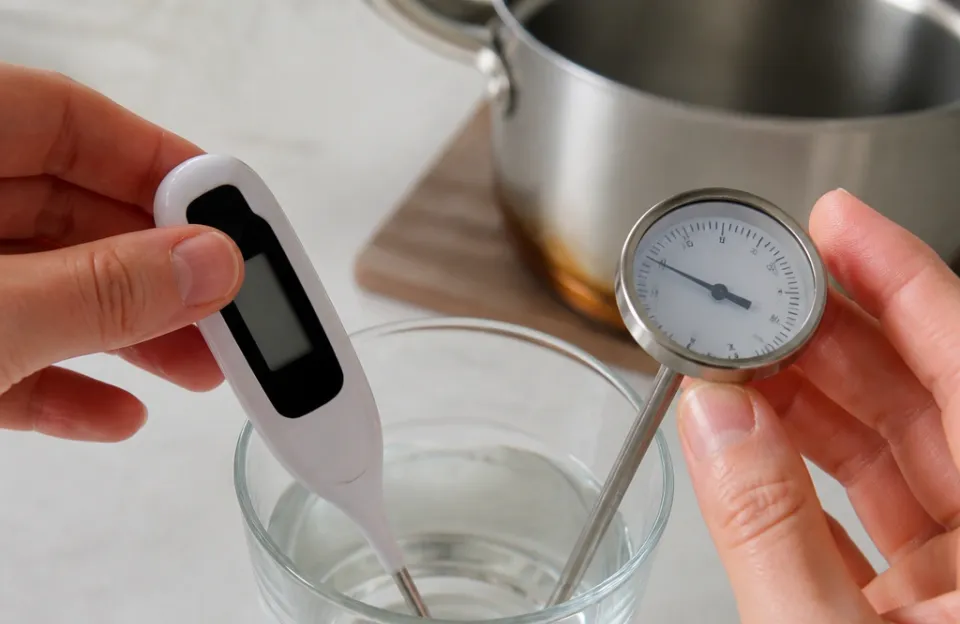
A digital thermometer uses a sensor, usually a thermistor or thermocouple, at the tip of its probe. That sensor changes electrical resistance as heat rises. A microchip translates the change into a number on an LCD screen.
Many kitchen models read quickly, and some high-end wireless setups track food continuously while it cooks. If you want hands-free monitoring over a long smoke, a dual-probe wifi setup handles that job without you standing by the grill.
An analog dial thermometer works differently. A bonded metal strip or coil twists as temperature changes, and that motion moves the pointer on the dial. Because the response is mechanical, the needle needs time to settle before you read it.
The core difference is electronic translation versus mechanical movement. One calculates; the other reacts physically.
Speed and Precision in the Kitchen
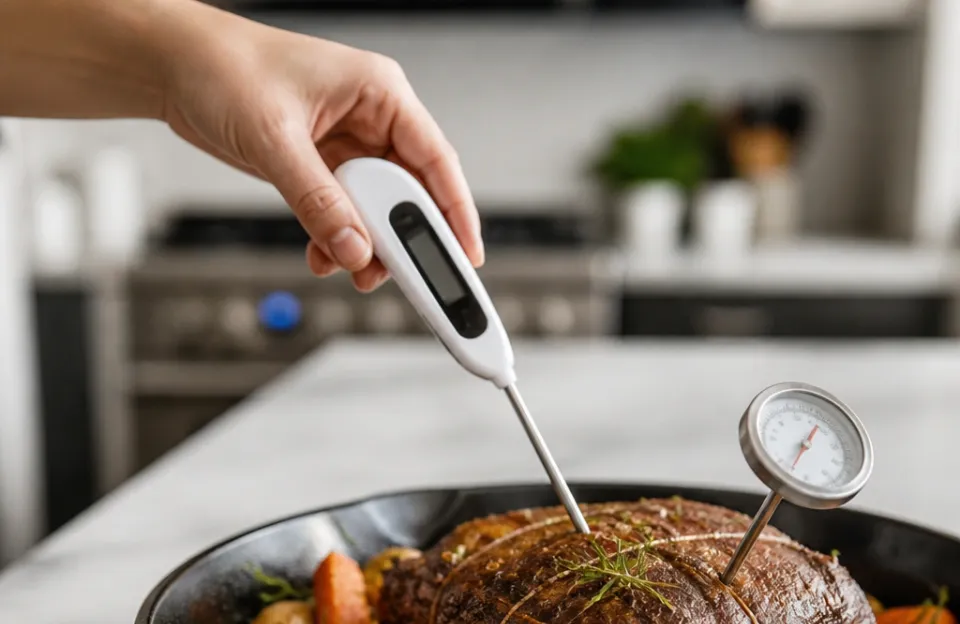
Speed matters most when you are checking thin cuts or pulling something off high heat. A fast digital instant-read lets you get a number without holding the oven door open or the grill lid up for long. When you are searing steaks, a quick reading reduces the risk of overcooking while you wait.
Dial thermometers lag behind because the bimetallic coil needs sustained contact with the heat to move fully. If you pull a dial probe out too early, you can get a false low reading.
Precision favors digital as well. A digital display can show a fine increment, whereas dial faces are printed with wider markings, so you have to estimate where the needle sits between them.
For targets like 165 degrees F for poultry, that estimation matters. USDA states that all poultry, including whole birds, pieces and ground poultry, should reach 165 degrees F. Ground meats should reach 160 degrees F. Beef, pork, veal and lamb steaks, chops and roasts should reach 145 degrees F and rest for at least 3 minutes. Fish and shellfish should reach 145 degrees F. Leftovers and casseroles should reach 165 degrees F.
The USDA safe minimum internal temperature chart is the reference for these values, measured with a food thermometer before removing food from the heat source. USDA also notes that most food thermometers give an accurate reading within 2 to 4 degrees F. Whether a specific model meets that depends on its stated tolerance.
| Attribute | Digital Thermometer | Analog (Dial) Thermometer |
|---|---|---|
| Sensing method | Electronic sensor (thermistor or thermocouple) | Bimetallic strip or coil moving a needle |
| Resolution | Fine digital increments | Printed increments, needle read between marks |
| Typical tolerance | Model-specific; check manufacturer | Often stated as a percentage of full-scale span |
| Insertion depth | Follow manufacturer instructions | About 2 to 3 inches |
| Calibration | Model-specific; some fixed, some adjustable | Manual adjustment on models that include a nut |
| Power source | Battery or rechargeable | None required |
Durability and Maintenance Needs
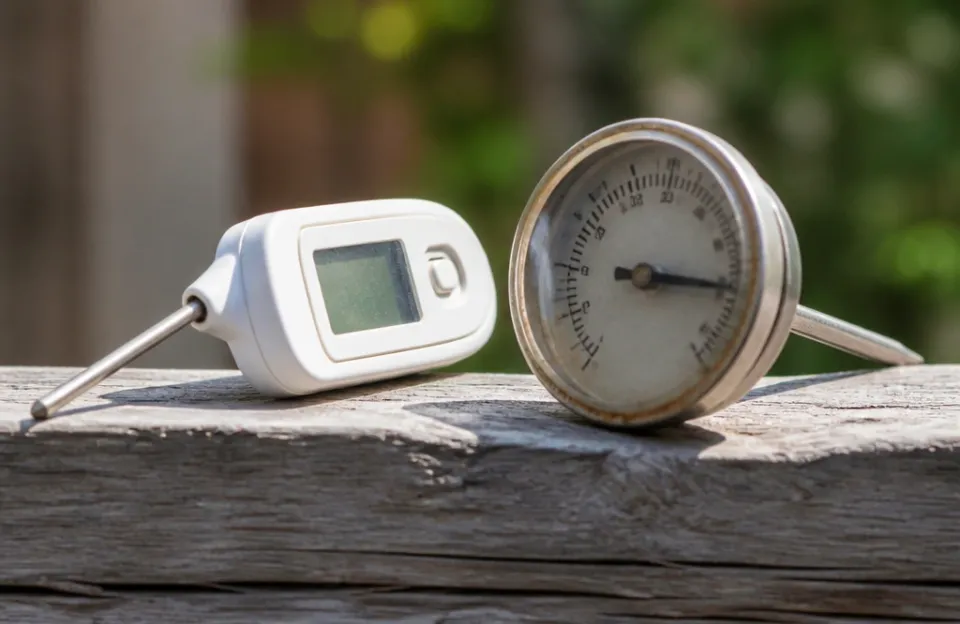
Analog dial thermometers have a practical toughness advantage: no screens to crack and no battery compartment to leak. They generally tolerate knocks and washing better than electronic models, though that is a general trade-off rather than a measured outcome.
You can leave many dial thermometers in place to monitor oven or fryer conditions over time. Leaving a heavy-duty dial unit inside your oven during baking lets you watch ambient heat without worrying about electronic components.
Digital thermometers demand more care. Standard instant-read models are not built for sustained high heat, and moisture can damage the battery compartment or display. Unless a model is explicitly rated for continuous oven use, keep it out of the cavity.
Maintenance also differs. Over time, impact, vibration, rapid temperature cycling and normal mechanical wear can shift a bimetallic thermometer’s reading. Recalibration is only possible on models that include an adjustment feature; some sealed or permanently assembled units cannot be adjusted.
Digital models are less prone to mechanical drift, but their field-calibration options vary. Some allow an offset adjustment, while others are fixed and must be replaced if they fall out of tolerance. Check the manufacturer’s instructions for your specific model. Battery dependence is also a real consideration for long cooks.
Calibrating an Analog Dial with an Ice Bath
A properly prepared ice-water slurry provides a stable 32 degrees F (0 degrees C) reference for calibration checks. For a proper ice-point check, pack the container with crushed ice, then add just enough cold water to fill the spaces between the ice particles. A few cubes floating in excess water will not do.
Insert the probe according to the manufacturer’s instructions for your model, keeping it away from the container walls. Wait until the needle stops moving, then read the value.
On many adjustable dial thermometers, the calibration mechanism is a small hex nut under the dial head, where the stem enters the dial assembly. If your unit has one, adjust it per the manufacturer’s method until the needle reads 32 degrees F. Do not force a nut on a sealed model, because that can damage the instrument.
Digital calibration options vary by model. Some allow a field adjustment; others require factory service. Follow the manufacturer’s manual rather than assuming a universal procedure.
Real-World Error Sources That Affect Both Types
Placement is the most common cause of a wrong reading, regardless of display type. USDA states that a thermometer reading is only correct if the probe is placed in the proper location of the food. Insert it into the thickest part, away from bone, fat or gristle. For thin foods, insert it through the side until it reaches the center.
Insertion depth matters too. Dial thermometers must be inserted about 2 to 3 inches into the food. Check the manufacturer’s instructions for how far any thermometer must go to give an accurate reading.
Large or irregularly shaped foods can have uneven internal temperatures, so check several places, such as with a beef roast. Each piece should be checked individually, because pieces reach temperature at different times depending on size, quantity and distribution.
Color and grill marks are not reliable indicators that food is safe. A hamburger cooked to 160 degrees F, as measured with a food thermometer, is safe regardless of color. USDA also notes that consumers may choose to cook food to higher temperatures for personal preference.
These checks apply to digital and dial alike. A precise display cannot compensate for a probe in the wrong spot.
Where Analog Dials Still Belong
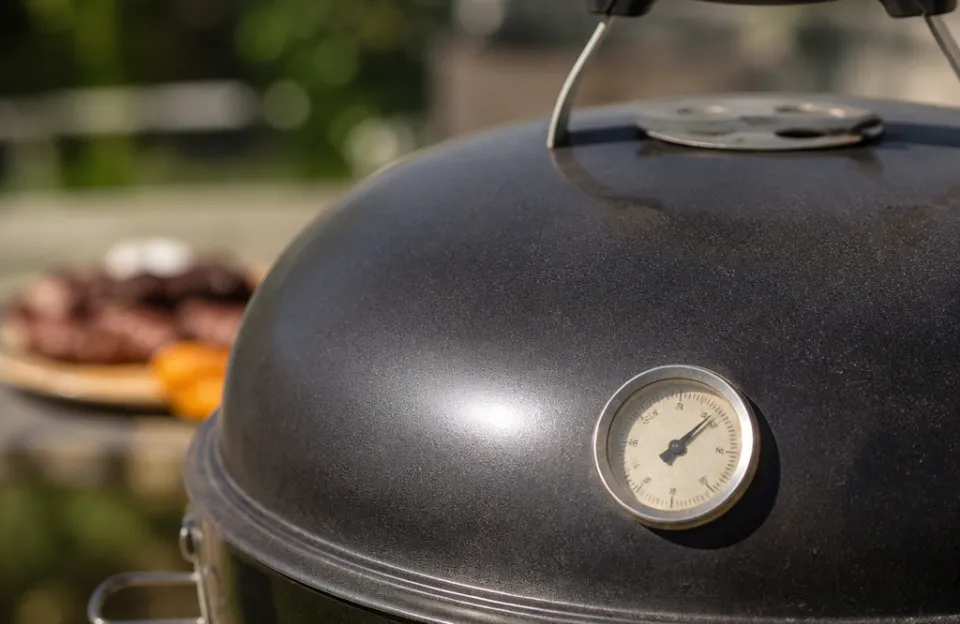
Digital dominates for spot-checking food. Dial thermometers hold specific niches where their traits shine.
Oven monitoring is the biggest one. An analog oven thermometer can sit on the rack and show whether your oven’s built-in thermostat is accurate. It stays there permanently with no batteries to die and no plastic to melt.
Deep frying and candy making present another case. While fast digital models work here, some cooks prefer a steady analog setup. A stainless steel analog model clipped to the pot edge can track oil temperature continuously. Watch cross-use carefully, because swapping a sugar tool for raw chicken requires strict sanitation steps.
Some commercial and industrial settings use dial stem thermometers for their simple mechanics and immunity to power failures. Their suitability still depends on calibration, so verify tolerances against your operation’s requirements.
When Digital Is the Better Choice

If you need to confirm a specific internal temperature for food safety, a digital thermometer is the practical default. Smoking brisket, cooking sous vide or roasting expensive cuts benefits from the finer resolution a printed dial face cannot provide.
Wireless tracking also belongs entirely to digital technology. You cannot transmit a mechanical needle position via Bluetooth. If you want alerts sent to your phone when a roast hits its target, you need a smart digital system.
For everyday weeknight cooking, speed helps you check more often, and checking more often means fewer ruined dinners. Having a reliable digital option in your drawer removes the friction of waiting for a slow mechanical response.
Picking Between Digital vs Analog (Dial) Thermometers
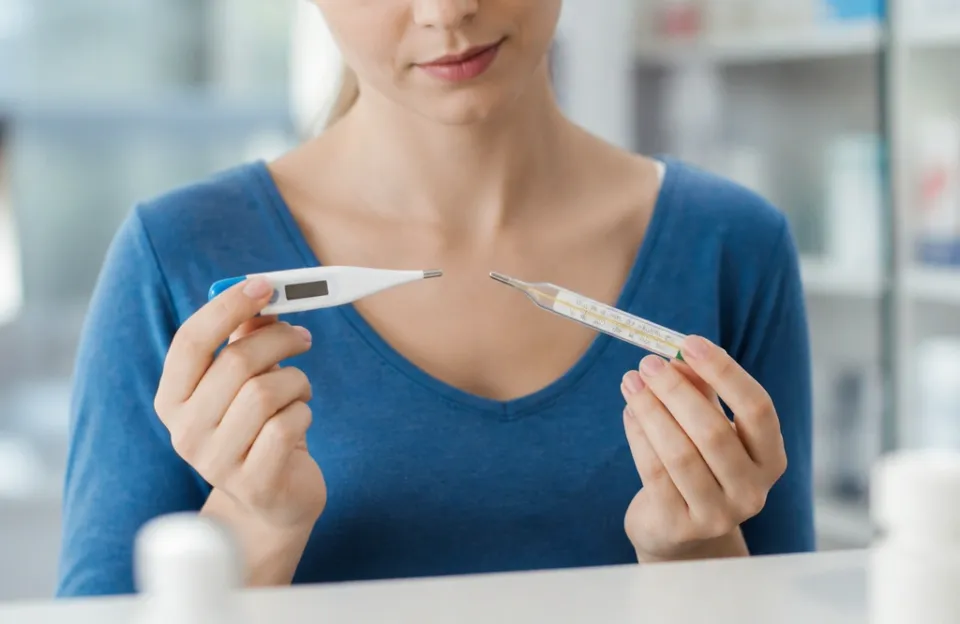
Choosing between digital and analog dial thermometers depends on your specific task. Buy a digital instant-read for checking meats, fish and baked goods. Buy an analog dial thermometer to leave inside your oven, clip to a deep fryer or keep in a commercial prep kit where power is unreliable.
Many serious cooks own both. They use the dial to monitor the cooking environment and the digital to check the food itself.
Frequently Asked Questions

Are Dial Thermometers Less Accurate Than Digital Ones?
Dial thermometers are generally less precise because you read a needle pointing between printed lines. Digital models display exact numbers. Both types can be accurate within their stated tolerance if calibrated properly, since accuracy is about closeness to the true value, not display type.
Can I Leave a Digital Thermometer in the Oven While Cooking?
Most standard digital instant-read thermometers will melt or break if left in a hot oven. Only specific models designed for continuous oven use, usually with braided metal cables and remote displays, can stay inside. Analog dial thermometers generally tolerate prolonged oven heat better, but confirm the model’s rating.
How Do I Calibrate an Analog Dial Thermometer?
Pack a container with crushed ice and add just enough cold water to fill the spaces. Insert the probe per the manufacturer’s instructions and wait for the needle to settle. If it does not read 32 degrees F, adjust the nut under the dial head only on a model that has one.
Which Thermometer Type Is Better for Grilling Outdoors?
Digital thermometers are better for grilling because they read fast, keeping the grill lid closed to retain heat. Extreme cold can drain digital batteries quickly, which is one scenario where a mechanical dial still functions reliably.
Do Analog Thermometers Require Batteries?
No. Analog dial thermometers operate on the physical movement of a bimetallic element inside the probe. They never run out of power, making them reliable for long cooks or emergency kits.
Before You Buy Your Next Probe
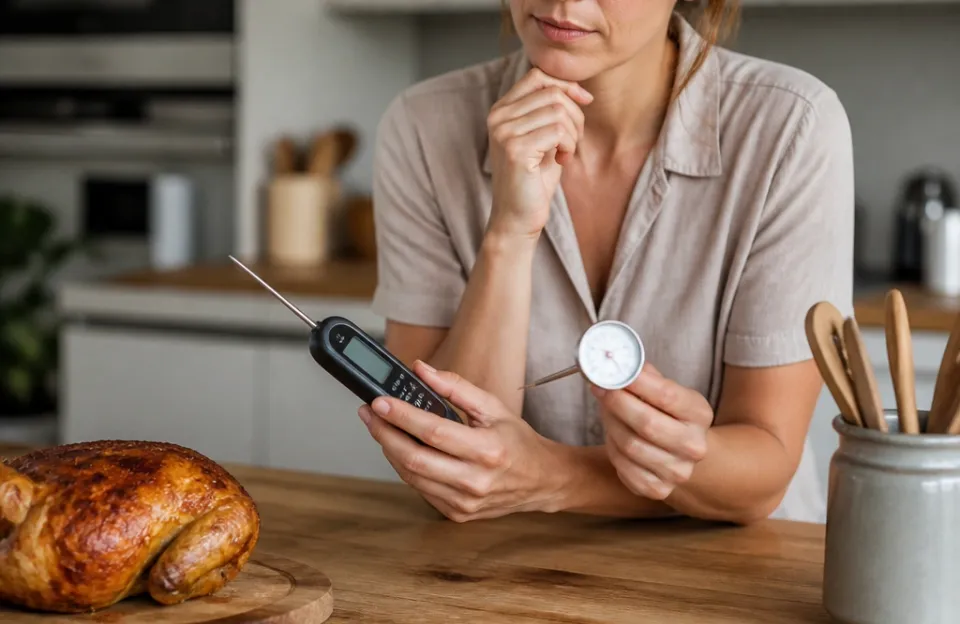
Digital and analog dial thermometers solve different problems. The mechanical dial survives harsh environments and monitors spaces continuously without power. The digital sensor delivers the resolution and speed required to confirm a target temperature, provided the model is calibrated and used correctly.
Neither type is automatically accurate. Check the manufacturer’s stated tolerance, confirm the probe goes deep enough, and calibrate on a schedule. Then stock your kitchen based on what you actually measure: the environment or the food.