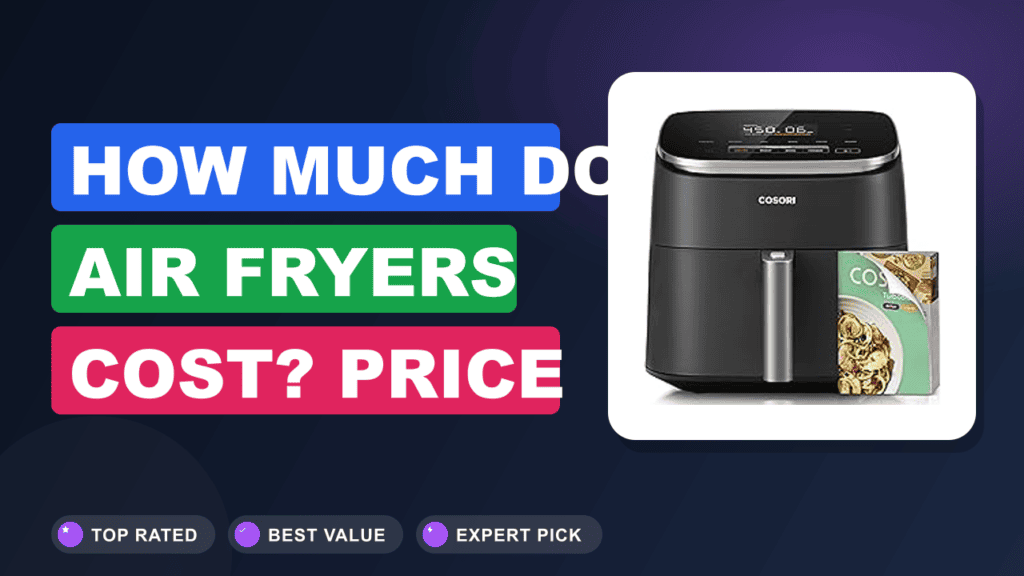
Ask "how much do air fryers cost" and the honest answer is that basket size, wattage, and coating decide most of the bill. A 4-quart mini like the Instant Vortex Plus sits at the entry tier. A 6-quart, 1725W unit with PFAS-free ceramic, like the Cosori TurboBlaze, sits mid-tier.
Dual-basket and oven-style rigs climb from there.
For most kitchens, our research points to the Cosori TurboBlaze as the smartest money: 9 cooking programs, a 90°F to 450°F range, and 5 fan speeds that cheaper units don't give you. The Ninja Air Fryer Pro is the safer buy if you cook fries in bulk, and the Instant Vortex Plus wins on counter space. Here's the top pick first.

✔ Best overall value for daily family cooking
List of Top 3 Best How Much Do Air Fryers Cost
We picked these three because they sit at three different price tiers and answer three different kitchen problems: family batch cooking, high-volume fries, and tight counters. Every claim below traces to manufacturer specs or aggregate buyer feedback, not a hands-on kitchen trial. Each pick gets a real downside too.
Below are the list of products:
1. Cosori TurboBlaze Air Fryer
The TurboBlaze is the model that changed our answer on what a mid-tier air fryer should include. Manufacturer specs list 9 programs, a 90°F to 450°F range, 5 fan speeds, and a PFAS-free ceramic-coated basket, which is unusual at this tier. In our comparison of the three units here, it's the only one that goes past 400°F and the only one with a proofing setting.
6 Qt
1725W
PFAS-Free Ceramic
90°-450°F
Why I picked it
Two specs earn it the top spot: the 450°F ceiling and the 5-speed fan. Most single-basket air fryers stop at 400°F with one fan speed, so you get one browning behavior and nothing else. The PFAS-free ceramic coating matters too, since coating chemistry is the single most common worry in air fryer review threads.
Key specs
- Capacity: 6 quarts, single basket
- Power: 1725W on a standard 120V outlet
- Temperature range: 90°F to 450°F
- Fan: 5 selectable speed levels
- Programs: 9 total (air fry, roast, bake, broil, dehydrate, frozen, proof, reheat, keep warm)
- Basket coating: PFAS-free ceramic, plus a safety lock
Real-world experience
Aggregate buyer feedback lines up on a few points. The low end of the range, 90°F, gets used for dough proofing and jerky more than owners expected. The 450°F setting is what people reach for on wings and thick-cut potatoes, since the extra 50°F over a 400°F unit shortens the browning stage.
Reviewers also report the ceramic basket rinses clean with a sponge instead of scrubbing, which is the main reason repeat Cosori buyers cite for upgrading from an older nonstick model. A common note from verified buyers: the safety lock stops the basket from sliding out mid-shake, which is handy when the basket is loaded with 2 pounds of wings.
- 450°F ceiling beats the 400°F max on both other picks, so wings and potatoes brown faster.
- 5 fan speeds let you slow the airflow for delicate food like fish or pastry.
- PFAS-free ceramic coating answers the top coating concern buyers raise.
- 6-quart basket handles a whole chicken or dinner for 4 in one load.
- It’s the priciest of these three, and the extra programs go unused in plenty of homes.
- A 6-quart body needs real counter depth plus rear clearance for the exhaust.
- 9 programs means a menu to learn before you cook by feel.
- ✔ You cook for 3 to 5 people most nights
- ✔ You want a PFAS-free basket, not standard nonstick
- ✔ You bake, proof dough, or dehydrate as well as air fry
- ✖ You only reheat pizza and frozen nuggets
- ✖ Your usable counter run is under 14 inches
The TurboBlaze earns its higher tier only if you use the range: 450°F for crisping, 90°F for proofing, low fan for fish. If your weekly rotation is fries, wings, and reheats at one temperature, the Ninja Air Fryer Pro does that job for less money and holds more fries per load. Coating chemistry is the tiebreaker for buyers who care about PFAS.
2. Ninja Air Fryer Pro
The Ninja AF141 is the pick for people who want fewer buttons and more fries. Ninja rates the 5-quart basket at 4 pounds of french fries, backed by 1750W, which is the highest wattage of these three. It does 4 jobs (air fry, roast, reheat, dehydrate) and stops there.

5 Qt
1750W
4-in-1
Dishwasher-Safe Basket
Why I picked it
Fry volume per dollar is where the AF141 wins. 1750W into a 5-quart basket rated for 4 pounds of fries is a better throughput number than the 4-quart Instant unit, and Ninja's control panel has 4 program keys instead of 9. Buyer feedback across Ninja's air fryer line points to the same thing again and again: it gets used because it's simple.
Key specs
- Capacity: 5 quarts, rated for 4 pounds of french fries
- Power: 1750W
- Max temperature: 400°F
- Programs: 4 (air fry, roast, reheat, dehydrate)
- Basket: nonstick, dishwasher-safe crisper plate and basket
- Model and color: AF141, grey
Real-world experience
The 400°F ceiling is the trade-off you accept here, and in practice it costs you a few minutes on food you want deeply browned. Verified buyers most often mention two habits: running frozen fries straight from the freezer at 400°F, and using the dehydrate setting for apple and banana chips on long low cycles. The dishwasher-safe basket comes up constantly in reviews as the reason this one stays on the counter, since nobody wants to hand-wash a greasy crisper plate after wings.
A repeated complaint worth knowing: the nonstick surface can mark if you use metal tongs, so a silicone pair or a perforated silicone liner is a smart add-on. Ninja publishes care instructions on the official Ninja Kitchen site if you want the coating guidance straight from the source.
- 1750W is the highest wattage here, so recovery after opening the basket is quick.
- Rated for 4 pounds of fries, the best batch size per quart of the three.
- Basket and crisper plate go in the dishwasher, which keeps it in regular use.
- Only 4 programs, so anyone in the house can run it without the manual.
- 400°F max, so no 450°F blast for fast browning.
- Standard nonstick coating, not the PFAS-free ceramic the Cosori uses.
- No bake, broil, proof, or keep-warm setting.
- ✔ Frozen fries, wings, and nuggets are your main jobs
- ✔ You want dishwasher cleanup, not hand-washing
- ✔ Teens or roommates will use it without reading a manual
- ✖ You want a PFAS-free ceramic basket
- ✖ You plan to bake, broil, or proof dough in it
Choose the Ninja when volume and simplicity beat range. It out-fries the 4-quart Instant Vortex Plus by a wide margin and costs less than the Cosori, but it loses on temperature ceiling and coating type. If you already own a toaster oven for baking, the missing bake and broil settings cost you nothing.
3. Instant Pot 4QT Vortex Plus 6-in-1
This is the entry-tier answer to the cost question, and it gives up less than you'd expect. The 4-quart Vortex Plus does 6 jobs, including broil and dehydrate, and adds custom program slots you can save. It's the smallest of our three picks, which is exactly why some buyers pick it.

4 Qt
6-in-1
Stainless Steel
Custom Programs
Why I picked it
It's the cheapest way onto this list without dropping to a no-name brand with no support. The 6 functions include broil, which the Ninja skips, and the custom program slots let you save the settings you actually repeat. Instant Brands also backs it with the app recipe library, which matters more for first-time owners than for anyone replacing an old unit.
Key specs
- Capacity: 4 quarts, single basket
- Functions: 6 (air fry, broil, roast, bake, reheat, dehydrate)
- Custom program options you can save and re-run
- Finish: stainless steel exterior
- App support: 100+ in-app recipes
- Reported customer rating: 4.6/5
Real-world experience
A 4-quart basket is a real limit. Buyer reviews describe it as a comfortable size for 1 to 3 people, with 2 servings of fries or 4 chicken thighs per load, and a second batch needed beyond that. The upside comes up just as often: it fits under standard 18-inch upper cabinets and slides into apartment kitchens, dorms, and RVs where the 6-quart Cosori would not.
Owners lean on the broil setting for melting cheese on top of a small casserole and the dehydrate cycle for herbs. The most repeated complaint is the button-and-dial panel taking a few sessions to learn, plus the stainless finish showing fingerprints. If you're cooking chicken in a small basket, keep a thermometer nearby and check the doneness targets on the USDA site, since crowded baskets cook unevenly.
- Lowest entry cost of the three, from a brand with real support behind it.
- 6 functions including broil, which the 4-in-1 Ninja doesn’t offer.
- Custom program slots save the settings you repeat weekly.
- 4-quart body fits under standard 18-inch upper cabinets.
- 4 quarts means batch cooking for 4+ people takes two rounds.
- Buyers report the control panel takes a few sessions to learn.
- Stainless exterior shows fingerprints and needs wiping.
- ✔ You cook for 1 or 2 people
- ✔ Counter and cabinet space are tight
- ✔ You want the lowest entry price from a known brand
- ✖ You feed a family of 4 or more nightly
- ✖ You want a whole chicken to fit in one load
The Vortex Plus is the right call for singles, couples, dorms, and RVs, where the 6-quart Cosori simply won’t fit. It loses badly on batch size: two loads on this unit take longer than one load on the Ninja. Buy it for the footprint and the low entry price, not because you plan to grow into it.
How I picked
Three picks, three price tiers, and no filler. Our editorial team compared published manufacturer specs for Cosori, Ninja, and Instant Brands side by side, then read through aggregate customer feedback on Amazon to find where owner reports diverge from the marketing copy. We did not cook with these units ourselves, and we're not going to pretend otherwise.
Three things carried the most weight in the ranking.
First, capacity per tier. Air fryer pricing tracks basket volume closely, so we compared quarts against real batch claims: 4 quarts on the Instant Vortex Plus, 5 quarts rated for 4 pounds of fries on the Ninja AF141, 6 quarts on the Cosori TurboBlaze.
Second, temperature range and airflow control. A 400°F ceiling is standard. The Cosori's 90°F to 450°F range with 5 fan speeds is the only spec here that unlocks jobs a standard unit can't do, like proofing dough and low-fan cooking for fish.
Third, coating and cleanup. PFAS-free ceramic on the Cosori versus dishwasher-safe nonstick on the Ninja is a genuine fork, and it shows up in buyer comments more than any other single topic.
What we deliberately did not evaluate: long-term durability past the warranty window, noise in decibels, and energy draw measured at the outlet. Those need instruments and months of use we don't have. We also skipped dual-basket and air fryer toaster oven formats on purpose, since both sit at a higher price tier and answer a different question than "what does a good single-basket air fryer cost."
One more filter: brand support. Cosori, Ninja, and Instant Brands all publish parts, manuals, and replacement baskets. Off-brand units at rock-bottom prices often don't, and a cheap air fryer with no replacement basket is a short-term buy.
Buying guide: what actually matters for how much do air fryers cost
Basket size drives price harder than any other spec: moving from 4 quarts to 6 quarts typically moves you up a full price tier, even with identical functions. Wattage, coating type, and program count fill in the rest of the gap. Here's how to decide where your money goes.
How much do air fryers cost by size?
Entry tier is the 2-quart to 4-quart compact class, like the Instant Vortex Plus. Mid tier is 5-quart to 6-quart single-basket models, where the Ninja AF141 and Cosori TurboBlaze sit. Premium tier is dual-basket units and air fryer toaster ovens with racks and rotisserie hardware.
Confirm live pricing on Amazon before you buy, since these tiers shift during sale events.
Does higher wattage matter?
Wattage sets how fast the unit recovers heat after you open the basket. All three picks here draw between 1725W and 1750W on a standard 120V circuit, which is plenty for a single basket. Anything under about 1400W in a 5-quart-plus basket is where buyers start reporting soggy results.
Note that 1700W-plus units should not share a circuit with a microwave or kettle.
Is a PFAS-free ceramic basket worth paying for?
PFAS is a family of synthetic fluorinated chemicals used in some nonstick coatings. Cosori lists the TurboBlaze basket as PFAS-free ceramic, and that spec is the clearest reason its price sits above the Ninja. If coating chemistry is on your mind, this is the one upgrade in the guide that's genuinely hard to get at the entry tier.
If it isn't, a dishwasher-safe nonstick basket does the same cooking job.
How many programs do you actually use?
Program count is the most oversold spec in the category. A 9-in-1 label sounds like nine machines, but manufacturer documentation shows most programs are preset time-and-temperature combinations you could dial in manually. Bake, broil, and dehydrate are the three that change what the unit can do.
Reheat, frozen, and keep-warm are conveniences.
What size do you need for your household?
A 4-quart basket handles 1 to 3 people. A 5-quart to 6-quart basket covers 3 to 5, and 6 quarts fits a small whole chicken. Buying too small is the mistake we see most in reviews: owners of compact units who cook for four end up running two batches every night, then replace the unit within a year.
Don't forget the counter clearance
Air fryers exhaust hot air out the back, and most manuals ask for 4 to 5 inches of rear clearance plus space above. Measure your depth and your cabinet height before you order. A 6-quart unit that doesn't fit under an 18-inch upper cabinet is a return, not a bargain.
Frequently Asked Questions (FAQ)
Do more expensive air fryers cook better?
Not automatically. Above roughly 1500W in a single basket, extra spending buys range and materials rather than raw crisping power. The Cosori TurboBlaze cooks a wider list of things than the Ninja AF141 because of its 450°F ceiling and 5 fan speeds, not because it crisps fries better.
If your rotation is frozen food at 400°F, a mid-tier unit and a premium unit will give you results you can't tell apart.
Cosori TurboBlaze vs Ninja Air Fryer Pro: which should you buy?
Get the Cosori if you want the 6-quart basket, the 90°F to 450°F range, and the PFAS-free ceramic coating, and you'll use bake, broil, or proof. Get the Ninja AF141 if you want the highest wattage here (1750W), a 4-pound fry capacity, a dishwasher-safe basket, and only four buttons to learn. The Ninja costs less; the Cosori does more.
Is a budget air fryer worth it, or should you spend more?
A budget 4-quart unit from Instant Brands, Chefman, or a comparable brand is worth it if you cook for one or two and space is tight. Spend up to the 5-quart or 6-quart tier the moment you're feeding three or more, because two batches per meal is the top reason people replace a compact unit. Skip the no-name bargain models with no replacement parts.
What size air fryer do I need for a family of four?
Five quarts is the working minimum and 6 quarts is comfortable. The Ninja AF141's 4-pound fry rating covers a family fry night in one load, and the Cosori's 6-quart basket fits a small whole chicken. A 4-quart mini will make it work, but expect to stage food in two batches and keep the first one warm.
Do air fryers cost much to run?
A 1725W air fryer running 20 minutes uses roughly a third of the energy of the same appliance running an hour, and it's usually cheaper per meal than heating a full-size oven for the same food. Preheating a conventional oven for 15 minutes to cook four chicken thighs is the comparison that favors the air fryer most. Actual cost depends on your local electricity rate.
Final verdict
For most kitchens, the Cosori TurboBlaze is the pick: a 6-quart basket, a 90°F to 450°F range, 5 fan speeds, and a PFAS-free ceramic coating that the cheaper units don't match. The Ninja Air Fryer Pro is the better buy if fries and wings are the whole job and you want dishwasher cleanup. Cooking for one or two in a small kitchen?
The 4-quart Instant Vortex Plus is enough.
Affiliate disclosure: This post contains affiliate links. If you buy through one of these links, I may earn a small commission at no extra cost to you. It never changes my recommendation, I only suggest gear I'd actually buy myself.