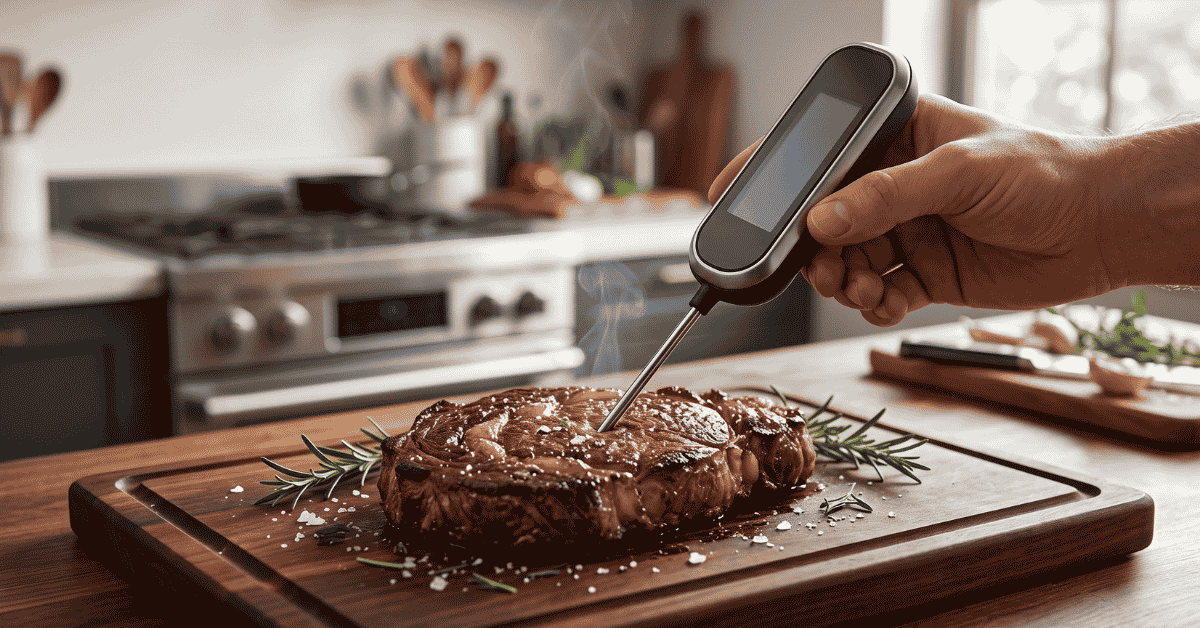
You’re standing in the kitchen, hovering over a pot of bubbling sugar for a batch of sea-salt caramels. Suddenly, you realize your old glass candy thermometer broke, and the only tool left in the drawer is the digital probe you used for Sunday’s roast beef. You pause, wondering if the lingering scent of garlic will ruin the candy, or if the high heat of the syrup will snap the sensor meant for a steak.
It’s a common moment of doubt that every home cook faces when switching between the savory world of proteins and the precision world of confectionery.
Quick Answer:
Yes, you can use the same thermometer probe for candy and meat as long as the device is rated for high temperatures (at least 400°F) and is thoroughly sanitized between uses. While most digital instant-read thermometers handle both tasks easily, traditional analog meat thermometers often lack the temperature range needed for candy making. Cross-contamination is the biggest risk, so a deep cleaning is mandatory to prevent fat or savory flavors from ruining your sweets.
Temperature range and sensor limits
Sanitation and flavor transfer concerns A thermometer is only as good as the range it can actually read without melting or failing. Meat thermometers are built to track internal temperatures that rarely exceed 200°F. For example, a medium-rare steak is pulled at 135°F, and even a well-done brisket only goes up to about 205°F.
Because of this, many basic analog meat thermometers only have dials that go up to 220°F.
Candy making operates on a much higher plane of heat. You’ll often need to reach the “hard crack” stage, which happens between 300°F and 310°F. If you try to use a standard meat thermometer for this, the needle will simply hit the pin at the end of the dial, or the internal spring might lose its calibrate due to the extreme heat.
Using a tool outside its intended range leads to inaccurate readings, which can result in burnt sugar or soft, sticky toffee that never sets.
Digital probes are usually different. Most high-quality instant-read thermometers, like those from Thermoworks or similar brands, are designed to read from well below freezing up to 572°F. These are the versatile workhorses of the kitchen.
If your digital probe has a wide range, it can jump from a cold turkey to a boiling pot of fudge without a hitch. Just check the manufacturer’s manual to confirm the upper limit before you dip it into a 350°F vat of oil or sugar.
Precision and graduation increments
Candy making is a science where two or three degrees make the difference between a chewy caramel and a tooth-cracking hard candy. Most meat thermometers are calibrated to show five-degree increments because a few degrees don’t usually ruin a roast. When you look at a dial, it can be hard to tell if you are at 242°F or 245°F.
Digital probes solve this by showing decimal points or single-degree increments. This level of detail is vital for recipes like Italian meringue or tempering chocolate. If you use a probe for both, the digital interface gives you the exact data you need for the high-stakes world of sugar work, whereas a clunky meat dial might leave you guessing.
Response time and safety
When sugar hits a specific stage, it stays there for only a few seconds before moving to the next. You need a probe that reacts instantly. Meat thermometers used for “leave-in” monitoring are often slow because meat temperatures rise gradually over hours.
If you use a slow probe in candy, the sugar might overcook by ten degrees while the thermometer is still “catching up.”
Sanitation and flavor transfer concerns
The biggest hurdle isn’t the technology; it’s the leftovers. Meat thermometers spend their time shoved into raw poultry or seasoned beef. They collect microscopic particles of animal fat, protein, and spices like garlic, onion, and cumin.
Even if the probe looks clean, a thin film of oil can cling to the stainless steel.
Sugar is extremely sensitive to fats and impurities. If you dip a probe that hasn’t been scrubbed into a syrup base, you might introduce oils that prevent the sugar from crystallizing correctly. Worse, you might end up with “taco-flavored” brittle.
Sugar absorbs odors and flavors quickly, so any hint of Sunday’s roast will be front and center in your dessert.
To avoid this, you must go beyond a quick rinse. A soak in hot, soapy water followed by an alcohol wipe is the best way to ensure the probe is chemically clean. Pay special attention to the “junction” where the metal probe meets the handle or the wire, as this is where meat juices tend to hide and harden.
Why sanitation matters for food safety
It isn’t just about taste; it’s about bacteria. Cross-contamination between raw meat and other foods is a leading cause of foodborne illness. According to the USDA Food Safety and Inspection Service, surfaces that touch raw meat must be sanitized before touching “ready-to-eat” foods.
Even though boiling sugar (above 212°F) kills most bacteria, you shouldn’t rely on the heat of the candy to do the cleaning for you.
Handling the probe wire
Many meat thermometers use a remote probe with a braided metal wire that leads to a base unit. If you use this setup for candy, be careful. The wire is often coated in a material that can degrade if it’s submerged in hot liquid or exposed to steam for too long.
While the tip of the probe is fine, the spot where the wire enters the probe is the “Achilles’ heel.” If sugar gets into that joint, it can dry, harden, and break the internal sensor wires.
Practical steps for using one probe for both
If you’ve decided to use your digital meat probe for your next baking project, follow these steps to make sure it goes smoothly.
-
Check the Heat Rating: Look at the back of the device or the box. If it doesn’t clearly state it can handle at least 400°F (204°C), don’t use it for candy.
-
Deep Clean: Use a grease-cutting dish soap (like Dawn) and scrub the entire length of the metal. If the probe is not waterproof, don’t submerge the top part or the wire. Use a cotton ball dipped in rubbing alcohol to finish the job.
-
Calibrate: Perform an ice water test. Fill a glass with crushed ice and a little water, then insert the probe. It should read 32°F (0°C). If it’s off by more than a degree, your candy might fail.
-
Use a Pot Clip: Most candy thermometers come with a clip to hold them against the side of the pot. Meat probes usually don’t. You may need to hold the probe manually, but be careful, steam burns are painful. Do not let the tip touch the bottom of the pan, or you’ll get a “false high” reading from the burner heat.
-
Clean Immediately After: Once the candy is done, wipe the probe with a hot, damp cloth immediately. Hardened sugar is much harder to remove later and can damage the sensor if you try to scrape it off.
Variations in thermometer types
Not all thermometers are created equal, and understanding the sub-types helps you decide if your specific tool is up to the task.
Instant-Read Digital Thermometers
These are the best candidates for dual-use. They are designed for speed and usually have a wide temperature range. Because they are meant to be dipped in and out, they are easy to clean and don’t have many crevices for food to get stuck in.
Leave-In Meat Probes
These are the ones with the long wires that stay in the oven. You can use them for candy, but they are clunky. The wires can get in the way of your whisk or spatula.
Also, these probes are often calibrated for slower response times, which isn’t ideal for the fast-paced nature of boiling sugar.
Infrared (No-Touch) Thermometers
Many people try to use infrared lasers for candy. This is risky. Infrared thermometers only measure surface temperature.
In a pot of sugar, the surface might be cooler than the center, or the steam rising from the pot might interfere with the laser. For meat, they are useless for checking internal doneness. While they are great for checking the temp of a frying pan, they aren’t a reliable substitute for a probe in either meat or candy.
Common mistakes or misconceptions
-
Assuming all digitals are the same: Some cheap digital meat thermometers max out at 300°F. If your recipe calls for 310°F, the screen might go blank or show an error code right when you need it most.
-
Touching the bottom of the pan: This is the #1 reason for failed candy. The metal of the pot is much hotter than the liquid inside. If your probe tip rests on the bottom, you’ll pull the candy off the heat too early.
-
Ignoring the “Cold Water Test”: Before digital probes were common, cooks dropped sugar into cold water to see if it formed a ball. If you don’t trust your meat probe’s accuracy, use this old-school method as a backup.
-
Forgetting to sanitize the handle: You touch meat, then you touch the thermometer handle, then you touch the handle again while making candy. Sanitize the whole tool, not just the metal tip.
Temperature Stages for Candy vs. Meat
Food Type Goal Temp (°F) Temp (°C)
Beef (Rare) Internal Doneness 125°F 52°C
Chicken Food Safety Limit 165°F 74°C
Syrup Thread Stage 230-235°F 110-113°C
Caramel Firm Ball Stage 245-250°F 118-121°C
Toffee Soft Crack Stage 270-290°F 132-143°C
Hard Candy Hard Crack Stage 300-310°F 149-154°C
Frequently asked questions
Can a glass meat thermometer be used for candy?
Usually no. Most glass meat thermometers use a different liquid expansion rate and have a very low maximum temperature. They are also prone to shattering if moved from a cold meat surface to a boiling sugar pot due to thermal shock.
Will the meat smell ever go away?
Yes, but it requires a surfactant. Soap breaks down the fat molecules that carry the smell of meat. If a smell persists, soak the metal probe in a mixture of baking soda and water for ten minutes.
Is it better to just buy two separate thermometers?
If you cook both often, yes. It prevents the stress of cleaning and eliminates the risk of using a tool outside its temperature range. However, for the occasional baker, one high-quality digital probe is enough.
Can I use a candy thermometer for meat?
You can, but it’s awkward. Candy thermometers are often large and have a metal cage to protect the glass. They aren’t designed to be poked deep into a turkey, and the scale usually starts at 100°F, making them useless for checking chilled or room-temperature foods.
Worth remembering
Using one probe for both meat and candy is a great way to save drawer space and money, provided you own a high-quality digital model. The technology inside a premium probe doesn’t care if it’s measuring a brisket or a batch of peanut brittle, it only cares about the molecular movement of heat. The real work lies in your hands.
You must be diligent about hygiene and aware of the physical limits of your gear. If you treat your probe well and keep it spotless, it will serve you across every course of the meal.





1 thought on “Can You Use the Same Thermometer Probe for Candy and Meat?”