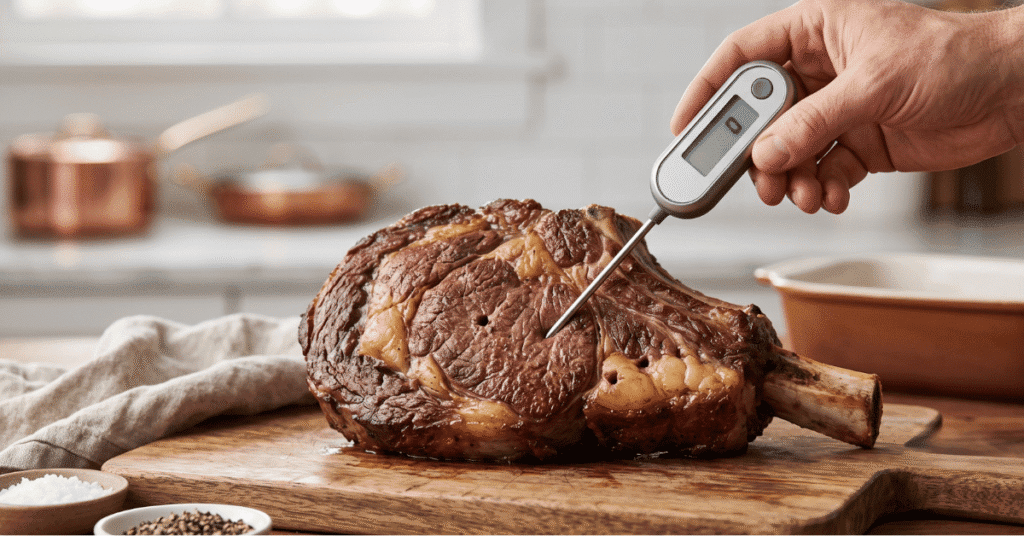
You just pulled a thick ribeye off the grill. You poke the center, and the digital display says 130°F, a perfect medium-rare. Just to be sure, you slide the probe half an inch to the left, and suddenly it reads 145°F.
Now you’re staring at the steak, wondering if it’s overcooked, undercooked, or if your expensive thermometer is simply broken.
Quick Answer: Meat thermometers give different readings because heat does not distribute evenly through muscle, fat, and bone. These variations happen due to the “thermal gradient,” where the outside of the meat is hotter than the center, as well as proximity to bone or pockets of insulating fat.
Why Temperature Variance Happens in Meat
When you cook a piece of meat, you aren’t heating a uniform block of plastic or metal. You are heating an organic structure made of water, protein, fat, and sometimes bone. Each of these components conducts heat at a different speed.
The most common reason for different readings is the thermal gradient. Heat moves from the outside in. The surface of a turkey or roast might be 325°F (the oven temp), while the very center is still 40°F.
As the heat travels toward the middle, it creates “rings” of different temperatures. If your probe is even a few millimeters off from the geometric center, the reading will change.
Another factor is heat sink vs. insulation. Bone acts as a heat sink; it conducts heat differently than muscle. In some cases, the bone stays cooler longer, while in others, it can carry heat deeper into the meat faster than the surrounding flesh.
Conversely, large pockets of fat act as insulators. Fat takes longer to heat up and can give you a “cold spot” reading that doesn’t reflect the rest of the cut.
The Role of Air Pockets and Moisture
Meat is porous. As it cooks, moisture moves around. Steam can collect in small gaps between muscle fibers or near the bone.
If your thermometer probe hits a pocket of hot rendered fat or trapped steam, the temperature will spike instantly. This doesn’t mean the whole steak is that temperature; it just means that specific cubic millimeter is hot.
Sensor Placement and Probe Depth
Most digital instant-read thermometers have a tiny sensor located at the very tip of the needle. However, some older dial-style thermometers (bimetallic coils) measure the average temperature along the first two inches of the probe. If you use a dial thermometer on a thin chicken breast, part of the sensor might be in the meat while the rest is exposed to the air.
This leads to wildly inaccurate and inconsistent numbers across different parts of the meat.
How to Get an Accurate Temperature Reading
To get a reliable number, you have to find the “thermal center.” This isn’t always the physical center of the meat, but rather the part that is farthest from any heat-conducting surface or bone.
- Find the thickest part: Always aim for the center of the largest muscle mass. For a turkey, this is the deepest part of the breast. For a steak, it’s the dead center of the thickest point.
- Avoid the bone: Keep the probe at least half an inch away from any bone. Touching the bone will give you a false reading because the bone density differs from the meat.
- The “Slow Pull” method: Insert the probe all the way through the meat, then slowly pull it back toward you. Watch the digital display as you pull. The lowest number you see is the true internal temperature of the “coldest” part of the meat.
- Check multiple spots: For large items like a whole chicken or a brisket, check at least two or three different locations. If one side of your grill is hotter than the other, the meat will cook unevenly. Averaging these numbers (or going by the lowest) helps prevent foodborne illness.
The Impact of Carryover Cooking
It is helpful to remember that the temperature you see on the screen isn’t the final temperature of the meal. Once you remove meat from the heat, the hotter exterior continues to push energy toward the cooler center. This is called carryover cooking.
For a large roast, the temperature can rise by 10°F or even 15°F while resting. If you see different readings in different spots, those variations will often “level out” during the rest. The heat moves from the hot spots to the cool spots until the internal temperature is more uniform.
According to USDA food safety standards, you should always base your safety timing on the lowest temperature found in the thickest part of the meat. If the breast of a chicken is 165°F but the thigh is 150°F, the bird stays in the oven.
USDA Food Safety and Inspection Service guidelines suggest that these variations are normal and emphasize using a calibrated thermometer to find the lowest internal point.
Common Mistakes with Meat Thermometers
Many people blame their equipment when the real issue is technique or physics. Here are a few ways readings get skewed:
- Measuring too shallow: If only the tip of the probe is in the meat, it will pick up the temperature of the air inside the grill or oven.
- Hitting the pan: If you push the probe all the way through the meat and touch the hot metal of the cast iron skillet or roasting pan, the reading will jump to 400°F+ instantly.
- Ignoring calibration: Thermometers can drift over time. If you get different readings in the same spot using two different thermometers, one (or both) might need an ice-water calibration.
- Checking too early: If the meat hasn’t had time for the heat to penetrate the core, you will see massive gaps (50°F or more) between the surface and the center.
Frequently Asked Questions
Why does my thermometer read 212°F in one spot and 140°F in another?
You likely hit a pocket of boiling liquid or a gap where steam has collected. Alternatively, you might be too close to the surface where the meat is in direct contact with the pan or grill grates. Always pull the probe back toward the center of the meat to find the true internal temp.
Can a bone make the reading higher or lower?
It can do both depending on the cooking method. In an oven, bones often act as insulators and keep the nearby meat cooler. On a high-heat grill, bones can conduct heat and make the surrounding meat cook faster, giving you a higher reading than the center of the muscle.
Should I trust the highest or lowest temperature?
For safety, always trust the lowest temperature. You want the “coldest” part of the meat to reach the safe minimum internal temperature (like 165°F for poultry). For texture and preference (like a medium-rare steak), most cooks aim for the lowest reading to be their target “pull” temp.
Is my thermometer broken if it changes by 5 degrees every time I move it?
No, that’s actually a sign of a high-quality, sensitive thermometer. Meat is not a uniform material; it has different densities and moisture levels. A 5-to-10-degree variance across a large piece of meat is completely normal and expected.
Worth Remembering
Inconsistent readings are rarely a sign of a broken tool. They are usually a “map” of how heat is moving through your food. By using the slow-pull method and avoiding bones or fat pockets, you can find the most accurate number.
If the readings vary wildly, give the meat a few minutes to rest, physics will often do the work of balancing those temperatures out for you.