If your air fryer is taking longer than the recipe promises, the problem is usually one of three things: the basket is overcrowded, the temperature is set too low, or the food went in cold or wet. Air fryers are essentially countertop convection ovens that cook food faster and use less energy than larger ovens, but only when hot air can move freely around the food. Fix the airflow, preheat when it helps, and check the unit for grease buildup, and most cooking times come back in line. Recipe times are baselines, not guarantees, so expect to adjust.
How Air Circulation Controls Cooking Speed
An air fryer cooks by releasing hot air through a heating mechanism and circulating it rapidly around the food, which is what produces the crisp exterior. The appliance is airtight, so hot air stays inside and heats food intensely and rapidly. That design explains both the speed and the failure mode: anything that blocks circulation also blocks heat.
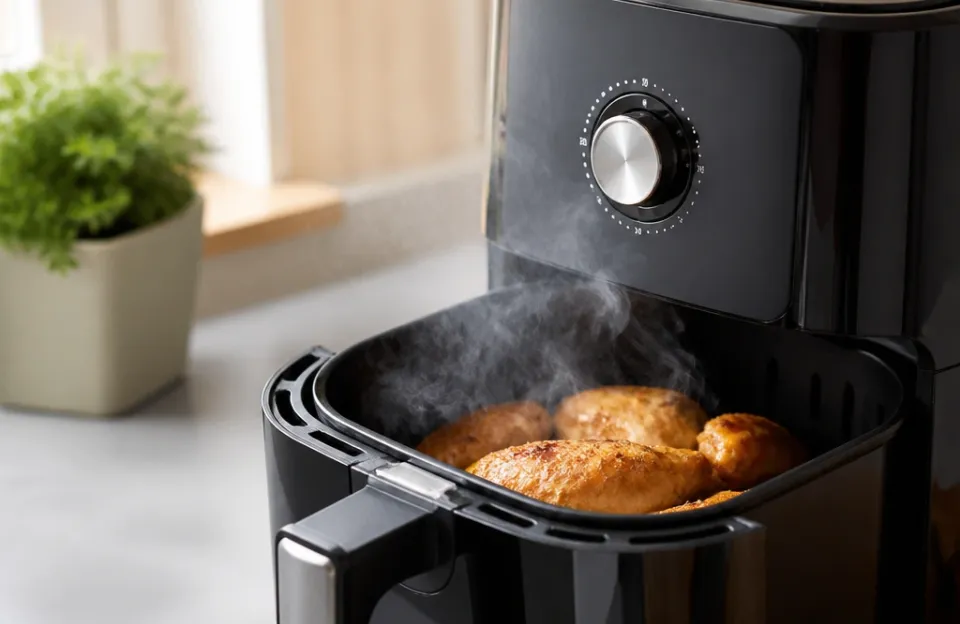
When hot air can’t reach the surface of the food, moisture stays put, the exterior never crisps, and the interior cooks unevenly. The air fryer keeps running, the timer keeps counting, and dinner is late.
Why Overcrowding Kills the Crisp
This is one of the most common causes of slow cooking, and it is the first thing to check. Air fryers generally don’t have much room inside, and overcrowding prevents enough air circulation to properly cook the food. When you pile food on top of itself, the pieces in the middle get less moving air, so they cook slowly while the outer pieces finish ahead of them.
The fix is straightforward: cook in batches rather than all at once when you’re working with a large amount of food. You should also avoid overfilling the basket, which leads to uneven cooking and undercooking. Test whether your basket is overloaded by giving it a shake: if the food can’t tumble and rearrange, it’s too full.
A single layer with a little breathing room between pieces is the target for anything you want crisp. For foods like wings ready for the week, batch cooking and combining at the end works better than one overloaded run.
Frozen vs Thawed: the Temperature Gap
Cold food lowers the temperature inside the basket the moment it goes in, and the air fryer has to recover before it can cook. Cold versus room-temperature food can change cooking time by a few minutes, and a cold start adds time to most recipes compared with preheating.
Frozen food widens that gap further because the surface has to warm before it can brown. The USDA’s air fryer food safety guidance notes that air fryers are airtight and cook food intensely, but they also recommend following the manufacturer’s instructions on food packages when those are available. If a package gives air fryer directions, use them as your baseline rather than a generic recipe time.
Practical adjustments for frozen food:
- Add a few minutes to the recipe time and check early rather than late.
- Shake or flip partway through so the pieces that were sitting in the coldest spot rotate to the outside.
- Don’t stack frozen pieces, since they release moisture as they thaw and that moisture has to cook off before browning starts.
Food-Specific Delay Factors and Fixes
Different foods slow down for different reasons, and knowing which one applies saves you from adjusting the wrong variable. Foods generally require 5 to 25 minutes in an air fryer at 350°F to 400°F, but that wide range exists because density, moisture and coating all change the timing.
| Food | Why It Runs Slow | Practical Fix |
|---|---|---|
| Root vegetables | Dense interior, high water content | Cut into even, smaller pieces so heat penetrates faster |
| Poultry (bone-in) | Thickness slows heat transfer to the center | Use a thermometer and check the thickest part |
| Fish fillets | Thin, delicate, overcooks quickly once thawed | Cook from a similar starting temperature each time for consistency |
| Breaded items | Coating traps moisture that has to cook off | Don’t stack; leave space so the coating can dry and crisp |
One safety rule worth flagging: raw, stuffed breaded chicken breast products should not be cooked in the air fryer. For everything else, treat recipe times as a starting point and adjust based on what you actually see in the basket.
Getting Root Vegetables Done on Time
Potatoes and similar dense vegetables run slow because the heat has to travel all the way to the center before the middle is tender, even after the outside looks done. Smaller, uniform cuts solve most of this. If you’re working out timing for how long spuds actually need, use that as a baseline and add a few minutes if your pieces are larger than the guide assumes.
Why Poultry Takes Longer Than Expected
Chicken and other poultry have to reach a safe internal temperature at the thickest point, and that point is always the last to get there. Air fryer models vary in cooking time because of size and power, but the safe internal temperature is the same regardless of which unit you own. For cooking whole drumsticks, bone-in pieces will run slower than boneless, so don’t swap one for the other without adjusting time.
Fish Fillets and Delicate Proteins
Fish is quick compared with poultry, but it also goes from done to overcooked fast. Fish is safe at an internal temperature of 145°F. If you’re timing a standard salmon fillet, check it a minute or two before the recipe suggests, since fillet thickness varies more than most recipes account for.
Hardware Limitations That Slow Things Down
Once you’ve ruled out loading and temperature, the appliance itself becomes the suspect. Two units with the same basket size can perform differently, and the reason is usually power, calibration or maintenance rather than technique.
Wattage Differences Between Models
Higher wattage means faster heating and better temperature recovery, but the difference in actual cooking time once the unit is at temperature is smaller than most people expect. The bigger effect shows up at the start: a 1,200W air fryer may take 5 to 6 minutes to reach 400°F, while an 1,800W model may take 2 to 3 minutes. Low-wattage units can take 3 to 5 minutes to recover after cold food is added, which extends effective cooking time. These figures come from independent wattage guides rather than manufacturer testing, so treat them as rough estimates.
That said, overcrowding is a more common and more fixable cause of slow cooking than low wattage. If you’re choosing between fixing your loading habits and upgrading to a higher-wattage machine, fix the loading first. For a comparison point on what a typical mid-size unit looks like, this a reliable mid-size option gives you a sense of the spec range, though wattage alone won’t tell you how a specific model performs in your kitchen.
Grease Buildup Blocking the Fan
Grease that collects on the heating element or fan may reduce airflow and can affect how evenly the unit heats. There’s no precise figure for how much buildup it takes to slow cooking noticeably, but it’s a maintenance factor worth ruling out. Follow your user manual for cleaning instructions, and stop using the unit if it malfunctions rather than trying to service internal components yourself.
Basket Design and Perforation Size
Basket-style and oven-style air fryers have different airflow patterns and heat intensity, so recipe times written for one format often need adjustment for the other. If you’re following a recipe developed for a drawer-style basket and you own an oven-style tray model, expect to check earlier and adjust. The same applies if you line your basket: a solid liner can block the perforations that hot air passes through, so check your manual and use perforated parchment or skip the liner entirely when you want maximum airflow.
Temperature Calibration
Some air fryer models may run off the set temperature regardless of wattage, which can affect cooking speed. If your unit consistently runs slow even with proper loading, check your manual for the manufacturer’s guidance on temperature accuracy before assuming a fault.
Technique Adjustments to Speed Up Dinner
Before you change any equipment, work through these adjustments in order. Each one addresses a different bottleneck, and most slow-cooking complaints resolve after the first two.
Preheat When It Matters
Modern air fryers typically heat up in 2 to 3 minutes, compared with 10 to 15 minutes for conventional ovens, so preheating isn’t the time cost it is with a full-size oven. Preheating improves results for frozen foods, baked goods, breaded items, small delicate items and reheated leftovers. It’s generally not required for thick cuts of meat, longer-cooking vegetables, casseroles or foods cooked from scratch. About 3 to 5 minutes is a common starting range for many basket-style models, but it isn’t a rule for every machine, so check your manual. If your manual gives a specific preheat time, follow that instead.
Drying Ingredients Before They Go In
Patting food dry before it goes in the basket helps the surface crisp rather than steam. This is primarily a texture technique rather than a verified speed fix, but drier surfaces brown more evenly. It also pairs well with how long cured pork needs, since bacon releases its own moisture as it cooks and benefits from a dry start.
Shake, Flip, Rotate
Shaking the basket partway through redistributes food so the pieces that were shielded by others rotate into the airflow. For anything stacked more than one layer deep, this step does more for even cooking than any temperature change.
Adjust Time, Not Temperature, First
If food is browning too fast on the outside while the inside lags, the issue is usually loading or starting temperature rather than the setting. Add time rather than raising the temperature, since a higher setting can burn the exterior before the center catches up. Only adjust the temperature if your unit runs consistently hot or cold and you’ve confirmed it with a thermometer.
Food Safety Check for Poultry and When to Stop Adjusting
Timing adjustments shouldn’t come at the expense of safety. Use a food thermometer to confirm doneness, since color and texture are unreliable indicators of safety and a thermometer is the only reliable way to check meat, poultry, seafood and egg products.
Safe internal temperatures to aim for:
- All poultry, including ground poultry: 165°F
- Ground meat products: 160°F
- Fish: 145°F
- Whole cuts of beef, pork, veal and lamb: 145°F with a 3-minute rest
If you’re cooking ahead, refrigerate leftovers within 2 hours to keep them out of the Danger Zone, which is the range between 40°F and 140°F.
Stop adjusting your technique and consider servicing or replacing the unit if:
- Food consistently undercooks even in a single, uncrowded layer at the correct temperature.
- The heating element or fan shows visible damage or the unit makes unusual noises.
- The unit shuts off mid-cycle or won’t hold temperature.
These point to a hardware problem rather than a technique problem, and continuing to add time won’t fix them.
Conclusion: Check Loading Habits First, Then Hardware
When your air fryer is running slow, work through the causes in order of how often they’re the culprit. Start with the basket: if it’s overcrowded, that alone explains most slow cooks, and cooking in batches fixes it. Next, check your starting temperature and whether the food went in cold or wet. Then confirm the temperature setting matches what the recipe intends. Only after those are ruled out should you look at wattage, calibration and grease buildup, since overcrowding slows cooking far more than low wattage does.
Recipe times are baselines, not guarantees, because air fryers vary by size and power even though safe internal temperatures stay the same. Once you know your unit’s tendencies and load it properly, you can predict timing instead of guessing at it.