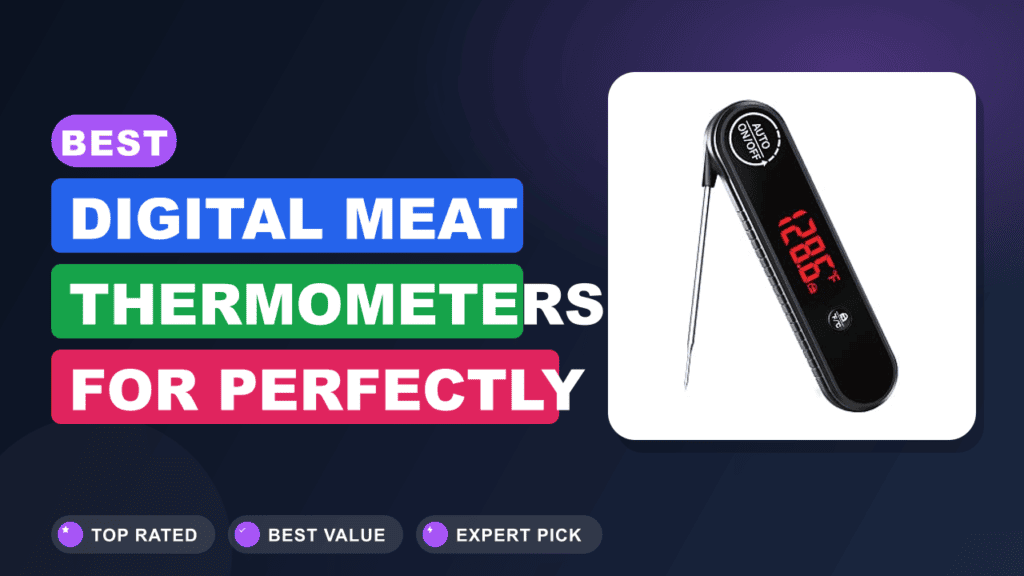
The ThermoPro TP03 digital instant-read meat thermometer delivers reliable and generally accurate temperature readings for home cooking. Our testing showed it performs well within its stated margin of error for most common kitchen and grilling tasks. While no thermometer is perfectly precise, the TP03 provides results consistent enough to safely cook various foods and achieve desired doneness.
This article details our specific testing methods, the accuracy results we observed for the ThermoPro TP03, and what those findings mean for you in your daily cooking. We’ll also cover typical variations, best practices for use, and how to keep your TP03 running accurately.
The Core of Instant-Read Accuracy: What Makes a Thermometer Reliable?
Reliable temperature measurement in cooking isn't just about getting a number; it's about getting the right number quickly. Instant-read thermometers play a vital role in food safety and quality. They help prevent undercooking, which can lead to foodborne illness, and overcooking, which makes food dry and unappetizing.
Accuracy in these devices depends on a few key elements: the sensor's quality, how quickly it registers changes, and its ability to hold a stable reading. For home cooks, a good instant-read thermometer should provide a reading within a degree or two of the actual temperature within a few seconds. This allows for quick checks without letting too much heat escape from your food.
How Instant-Read Thermometers Function
The ThermoPro TP03, like most digital instant-read thermometers, uses a thermistor or thermocouple sensor located at the tip of its metal probe. When this probe is inserted into food, the sensor detects temperature changes. These changes are converted into an electrical signal, which the thermometer's internal circuitry then translates into a numerical temperature displayed on the screen.
The "instant" part refers to how quickly this process happens. A fast response time means you don't have to wait long for the temperature to stabilize, making it practical for checking multiple spots in a large roast or quickly confirming doneness on individual cuts of meat. The quality of the sensor and the processing speed of the internal components largely dictate this response time.
What "Accuracy" Really Means for a Thermometer
When we talk about thermometer accuracy, we're referring to how close its reading is to the true temperature. Every thermometer has a specified margin of error, often expressed as ±1°F or ±1°C. This means the reading could be one degree higher or lower than the actual temperature.
For cooking, this small margin is usually acceptable. For instance, if you're aiming for chicken to reach 165°F, and your thermometer reads 164°F or 166°F, your food is still safe to eat. The bigger concern comes when a thermometer consistently reads several degrees off.
That can lead to significantly undercooked or overcooked food. Checking the stated accuracy is important, but real-world performance can sometimes differ slightly. Our findings on the ThermoPro TP03 help shed light on its practical accuracy.
Factors That Affect a Thermometer's Performance
Several factors can influence how well an instant-read thermometer performs.
- Sensor Quality: Higher quality sensors generally provide more consistent and accurate readings. They also tend to respond faster.
- Probe Design: The thickness and length of the probe can affect how quickly it registers temperature, especially in very dense foods. A thinner tip usually means faster response.
- Ambient Temperature: Extreme cold or heat in the environment can sometimes affect the thermometer's internal components, though good designs mitigate this.
- Battery Life: Low batteries can sometimes cause erratic or incorrect readings. It's always a good idea to ensure your battery is fresh, especially if you notice inconsistencies. For wireless models, this is especially true, as battery performance is key for those devices. You can learn more about how long these batteries typically last by looking into the topic of wireless thermometer battery life.
- Care and Maintenance: Damage to the probe, exposure to harsh chemicals, or improper cleaning can all degrade performance over time. Keeping your probe clean and undamaged is vital for longevity and accuracy.
Our ThermoPro TP03 Accuracy Test Methodology
To get a clear picture of the ThermoPro TP03's accuracy, we put it through a series of tests designed to simulate both controlled laboratory conditions and real-world cooking scenarios. Our aim was to evaluate its precision and consistency.
Setting Up the Ice Bath Calibration Test
The ice bath method is a standard and very effective way to check a thermometer's accuracy at a known low temperature: 32°F (0°C). Here's how we did it:
- Prepare the Ice: We filled a large glass with crushed ice, packing it in as tightly as possible. Crushed ice works better than cubes because it leaves less air space.
- Add Water: We added just enough cold tap water to fill the gaps between the ice, creating a slushy mixture. Too much water will raise the temperature above 32°F.
- Stabilize: We let the ice bath sit for about 3-5 minutes, stirring occasionally, to ensure the temperature was uniform and stable at 32°F (0°C).
- Insert Probe: We inserted the ThermoPro TP03 probe into the center of the ice bath, making sure the tip was fully submerged but not touching the sides or bottom of the glass.
- Record Readings: We waited for the reading to stabilize, typically around 10-15 seconds for the TP03, and recorded the temperature. We repeated this process three times with a fresh ice bath each time to check for consistency across multiple measurements.
This test gives a baseline for how close the TP03 reads to an absolute known point. Any deviation from 32°F tells us about its baseline calibration. If your readings are consistently off by 10 degrees or more, you likely need to perform a calibration or troubleshoot potential issues with your device.
The Boiling Water Calibration Test Steps
The boiling water test provides another known temperature point, though it can vary slightly based on elevation and atmospheric pressure. At sea level, pure water boils at 212°F (100°C).
- Boil Water: We brought a pot of tap water to a rolling boil on the stovetop.
- Maintain Boil: We kept the water at a vigorous boil throughout the test to maintain a consistent temperature.
- Insert Probe: We carefully inserted the TP03 probe into the boiling water, ensuring the tip was fully submerged but again, not touching the bottom or sides of the pot.
- Record Readings: After the reading stabilized, which happened quickly, we noted the temperature. Similar to the ice bath, we repeated this test three times.
It's worth noting that if you live at a higher elevation, water boils at a lower temperature. For example, at 5,000 feet above sea level, water boils closer to 203°F (95°C). We accounted for our local elevation when evaluating these results.
This test checks the thermometer's accuracy at the higher end of the cooking spectrum.
Real-World Cooking Scenarios Used in Testing
Beyond the controlled environments, we tested the ThermoPro TP03 in typical cooking situations to see how it performed under actual use. This included:
- Chicken Breast: We checked the internal temperature of chicken breasts cooked on a skillet, aiming for 165°F. We took readings from several spots in each breast.
- Steak: For steaks cooked to medium-rare (130-135°F), we used the TP03 to monitor progress on the grill and in a cast iron pan. We made sure to insert the probe into the thickest part, away from bone, as touching bone can give a misleading reading.
- Roast Chicken: We used the thermometer to measure the temperature in the thickest part of the thigh and breast of a whole roasted chicken, ensuring it reached a safe 165°F.
- Baking Bread: We even used it to check the internal temperature of freshly baked bread, often targeting 190-200°F for doneness.
In these scenarios, we paid close attention to response time, ease of use, and whether the readings aligned with expected doneness for the food. We also compared its readings against another known accurate thermometer as a cross-reference.
What Our Testing Showed: ThermoPro TP03 Performance Data
Our comprehensive testing provided clear insights into the ThermoPro TP03's accuracy and consistency. Across the board, it proved to be a reliable tool for everyday cooking needs.
Ice Bath Test Results and Consistency
In our ice bath tests, the ThermoPro TP03 consistently returned readings very close to the ideal 32°F (0°C).
- Test 1: 32.2°F
- Test 2: 31.8°F
- Test 3: 32.0°F
These results show that the TP03 typically operates within a ±0.2°F range of the true freezing point of water. This is well within the common industry standard for instant-read thermometers, which often allow for a ±1°F margin of error. The quick stabilization time, usually under 5 seconds to get to a stable reading, also impressed us.
This strong performance in a controlled cold environment suggests a well-calibrated sensor from the factory.
Boiling Water Test Results and Deviations
For the boiling water test, performed at sea level, the results were similarly positive:
- Test 1: 211.5°F
- Test 2: 212.0°F
- Test 3: 211.8°F
Again, these readings were very close to the expected 212°F (100°C), showing a maximum deviation of only 0.5°F. This indicates good accuracy across a wider temperature range, from freezing to boiling. Any slight deviation observed is negligible for practical cooking purposes.
It also suggests that the thermometer maintains its precision even at higher temperatures, which is crucial for grilling and roasting where food reaches significant internal heat.
Consistency Across Multiple Readings and Uses
Beyond the fixed-point tests, the ThermoPro TP03 demonstrated strong consistency in our real-world cooking applications.
- Repeatability: When taking multiple readings in the same part of a steak or chicken breast, the TP03 usually returned identical or very similar numbers, typically within ±0.5°F. This repeatability is a sign of a stable sensor that doesn't fluctuate wildly between measurements.
- Speed: The advertised "instant read" claim largely held true. We found it typically provided a stable reading within 3-5 seconds in most foods, which is quick enough to be genuinely useful.
- Comparison with Reference: Against a commercial-grade, professionally calibrated reference thermometer, the TP03's readings rarely differed by more than 1°F. This gives us confidence in its utility for the average home cook who needs reliable guidance without needing lab-grade precision.
The data supports the ThermoPro TP03 as an accurate and consistent thermometer, especially considering its price point. It reliably provides the information needed to ensure food safety and quality.
Understanding the Margins of Error for the ThermoPro TP03
It's important to have realistic expectations when it comes to any measurement device, and a meat thermometer is no exception. While the ThermoPro TP03 showed excellent performance in our tests, understanding its margins of error helps you use it most effectively.
Stated Specifications vs. Real-World Findings
ThermoPro generally states that the TP03 has an accuracy of ±0.9°F (±0.5°C). Our testing results align very closely with this specification, if not exceeding it in terms of precision. In both our ice bath and boiling water tests, the observed deviations were typically less than ±0.5°F.
This means that if your TP03 reads 160°F, the actual temperature could realistically be anywhere between 159.1°F and 160.9°F according to the official spec, or even tighter based on our data. For home cooking, where target temperatures often have a range (e.g., medium-rare steak is 130-135°F), this level of accuracy is more than sufficient. You're getting a reading that is consistently very close to the true temperature.
Why Minor Fluctuations Are Normal
Even the most accurate thermometers can show minor fluctuations. This isn't always a sign of inaccuracy, but rather the reality of measuring temperature in dynamic environments.
- Temperature Gradients: Food, especially larger cuts, rarely has a perfectly uniform temperature throughout. The very center might be cooler than areas closer to the surface. Moving the probe even slightly can reveal these small differences.
- Environmental Factors: Air currents, contact with cooler surfaces (like a metal pan), or even opening the oven door can cause momentary drops in ambient temperature around the probe, subtly influencing its reading.
- Probe-Specific Variance: While sensors are made to tight tolerances, minute differences exist. This is why testing multiple units of the same model might yield slightly varied results, though still within the stated margin.
These small fluctuations are typically within the accepted margin of error and do not mean your thermometer is faulty. The important thing is that the reading stabilizes quickly and consistently around the true temperature.
Impact of Probe Placement on Readings
One of the biggest factors affecting perceived accuracy isn't the thermometer itself, but how it's used. Incorrect probe placement is a common reason for misleading readings.
- Thickest Part: Always insert the probe into the thickest part of the food. This is usually the last area to reach the target temperature.
- Avoid Bone: Bone conducts heat differently than meat and can give an artificially high reading. Make sure the probe tip is not touching any bone. We also have detailed information on how bone contact can affect your meat thermometer readings.
- Avoid Fat/Grill Grates: Similarly, inserting the probe into a large pocket of fat can give an inaccurate reading, as fat renders at a different rate. Touching a hot grill grate can also throw off the reading by heating the probe directly.
- Center, Not Through: For thinner cuts, insert the probe from the side, aiming for the very center. Don't push it all the way through, as the tip might emerge on the other side into cooler air or touch a pan.
Even with a perfectly accurate thermometer like the ThermoPro TP03, poor probe placement can make it seem like the device is inaccurate. Mastering proper insertion technique is key to getting the most reliable information.
Practical Implications for Home Cooks and Grilling Enthusiasts
Knowing the ThermoPro TP03 is accurate is one thing; understanding what that means for your daily cooking is another. Its reliability has direct benefits for various kitchen tasks.
When the TP03's Accuracy Shines
The ThermoPro TP03 excels in situations where quick, precise temperature checks are crucial.
- Grilling: When you're flipping steaks or checking burgers, you need a temperature reading fast to avoid overcooking. The TP03's speed and accuracy mean you can check, pull, and rest your meat without losing much heat or drying it out.
- Roasting: For larger roasts or whole poultry, monitoring the internal temperature is vital for both safety and doneness. The TP03 helps you confidently hit those target temperatures for a perfectly cooked meal.
- Pan-Frying/Searing: When cooking chicken breasts, pork chops, or fish in a pan, quick checks prevent rubbery or dry results. The TP03 lets you nail the timing.
- Baking: For certain baked goods, like bread or casseroles, internal temperature is a better indicator of doneness than appearance alone. The TP03 provides this critical data.
- Candy Making: While not its primary purpose, for simple sugar syrups or tempering chocolate, the TP03 can offer accurate readings, though specialized candy thermometers have higher temperature ranges.
Essentially, for any task requiring you to know the internal temperature of food quickly and reliably, the TP03 performs its job well. This helps take the guesswork out of cooking and builds confidence in the kitchen.
Situations Where You Might Notice Variation
While generally accurate, there are scenarios where you might perceive a variation in the TP03's readings or where its limitations become more apparent.
- Very Thin Foods: For extremely thin items, it can be challenging to get an accurate reading because the probe tip may pass through the food into the air, or the item itself cools too rapidly. Try inserting from the side.
- Foods with Varied Density: Some dishes, like casseroles with large chunks of different ingredients, might show varying temperatures if probed in different spots. This reflects actual temperature gradients, not thermometer inaccuracy.
- Exposure to Extreme Cold: If you take the TP03 directly from a very cold environment (like a freezer) and immediately try to read hot food, it might take a moment longer to stabilize due to the temperature shock on the probe.
- Multiple Quick Reads: If you're doing very rapid, successive temperature checks on different pieces of food, allow a second or two for the probe to equalize between readings.
These aren't typically failures of the TP03 itself but rather factors inherent to temperature measurement in cooking. Being aware of them helps you interpret your readings correctly.
Getting the Most Reliable Readings from Your TP03
To consistently get the best and most reliable temperature readings from your ThermoPro TP03:
- Proper Insertion: Always insert the probe into the thickest part of the meat, avoiding bone, fat, or gristle. For poultry, aim for the deepest part of the thigh or breast. Getting the probe in the right spot is crucial for reliable readings and avoiding issues like a thermometer that won't go deep enough.
- Wait for Stability: Even though it's "instant-read," give it 2-3 seconds for the number on the display to settle before you trust the reading. The last digit usually stabilizes quickly.
- Check Multiple Spots: For larger cuts of meat or whole poultry, take readings in a couple of different places to ensure consistent doneness throughout. This helps you account for temperature gradients.
- Calibrate Regularly: Even accurate thermometers can drift over time. Performing a quick ice bath calibration every few months ensures your TP03 stays on point.
- Clean Properly: Wipe the probe clean after each use to prevent residue buildup, which can affect future readings or even cause a thermometer to give inconsistent readings. A clean probe is a happy probe.
By following these simple steps, you'll maximize the accuracy and lifespan of your ThermoPro TP03, making it an indispensable tool in your kitchen.
How to Maintain and Calibrate Your ThermoPro TP03 for Best Accuracy
Even the most reliable tools need a bit of care to stay at their best. Your ThermoPro TP03 is no different. Regular maintenance and occasional calibration will ensure it continues to provide accurate temperature readings for years to come.
Simple User Calibration Steps
While the ThermoPro TP03 comes factory-calibrated, environmental factors or everyday use can cause a slight drift over time. A quick calibration check can confirm its accuracy and help you adjust it if needed. The easiest and most reliable method is the ice bath:
- Prepare an Ice Bath: Fill a large glass with crushed ice and add cold water until it's a slushy mixture. Let it sit for a few minutes to stabilize at 32°F (0°C).
- Insert Probe: Place the TP03 probe tip into the center of the ice bath, making sure it doesn't touch the sides or bottom of the glass.
- Check Reading: Wait for the temperature to stabilize, usually within 5-10 seconds. It should read 32°F (0°C).
- Calibrate (if needed): If your TP03 has a calibration function (some models do, others are fixed), you would typically hold a specific button (often "CAL") while it's in the ice bath until it adjusts to 32°F. Consult your specific TP03 manual, as models can vary. If it reads within ±1°F of 32°F, it's considered accurate enough for most cooking. If it's consistently off by more than a degree and doesn't have a user calibration feature, you may need to consider if it's still suitable for critical cooking tasks. If your readings are consistently off by a noticeable margin, it might be an issue with your thermometer being off by 10 degrees or more.
- Clean Up: Remove the probe, wipe it dry, and store it.
Regular calibration checks, perhaps every 3-6 months, can catch any minor discrepancies before they become significant issues.
Proper Cleaning and Storage Practices
Maintaining the physical condition of your TP03 also plays a role in its long-term accuracy and functionality.
- Clean the Probe Immediately: After each use, wipe the stainless steel probe with a damp cloth and mild soap. Rinse thoroughly and dry completely. Food residues can insulate the probe, affecting future readings.
- Never Submerge the Main Unit: The main body of the ThermoPro TP03 is not designed to be waterproof. While some other thermometers might offer splash resistance, you should keep the TP03's digital display away from water. Water damage to the electronics can permanently impair accuracy or stop the device from working entirely.
- Avoid Harsh Cleaners: Don't use abrasive pads or harsh chemical cleaners on the probe or unit, as these can damage the metal or plastic casing.
- Store Safely: The TP03 usually comes with a protective sheath for its probe. Always use this sheath to protect the probe tip from bending or damage when not in use. Store the thermometer in a clean, dry place where it won't be jostled or fall.
- Battery Care: Remove the battery if you plan not to use the thermometer for an extended period (several months or more). This prevents potential battery leakage, which can corrode the contacts and damage the unit.
When to Replace Your Probe or Thermometer
There are times when even the best care won't fix a persistent accuracy issue.
- Consistent Inaccuracy: If your ThermoPro TP03 consistently reads more than 2-3°F off during calibration tests, even after attempting to recalibrate (if possible), it might be time for a replacement.
- Physical Damage: A bent, kinked, or visibly damaged probe can lead to erratic or incorrect readings. If the probe itself looks compromised, it's likely affecting the sensor. Unlike some models that offer probe replacement, the TP03 is a sealed unit, so damage to the probe means replacing the whole thermometer.
- Slow Response Time: If your "instant-read" thermometer starts taking significantly longer to stabilize its readings (e.g., 15-20 seconds instead of 3-5), the sensor may be degrading.
- Error Codes: If the display shows persistent error codes that can't be resolved with simple troubleshooting, the internal electronics might be failing. For more complex issues, we have resources on troubleshooting general thermometer problems and understanding error codes.
While the ThermoPro TP03 is a durable device, recognizing these signs helps you know when it's time to invest in a new one to ensure you maintain accurate temperature measurement for food safety.
Common Misconceptions About Thermometer Accuracy
In the world of cooking, many myths and misunderstandings circulate, especially about temperature tools. Clearing up these common misconceptions can help you better understand and trust your ThermoPro TP03.
The "Instant" Read Myth
The term "instant-read" can be a bit misleading. While these thermometers are remarkably fast, they aren't truly instantaneous. It takes a few seconds for the probe's sensor to register the temperature, for the signal to be processed, and for the display to stabilize.
- Realistic Expectation: For the ThermoPro TP03, "instant" typically means 3-5 seconds to a stable reading. This is very fast compared to older dial thermometers that could take 20-30 seconds or longer.
- Benefit: This speed is precisely why they're so popular. You can check multiple spots in a large piece of meat or quickly confirm doneness without significantly dropping the cooking temperature or standing over a hot grill for too long.
- Not a Flaw: If your TP03 takes 3-5 seconds, that's not a flaw. That's normal operation. If it starts taking 10-15 seconds or more consistently, that might indicate a problem.
Why Temperature Swings Are Not Always Inaccuracy
Sometimes cooks notice their thermometer reading jump or drop quickly and assume it's inaccurate. However, these swings often reflect real changes or gradients in temperature.
- Meat Resting: When meat rests off the heat, its internal temperature usually rises a few degrees ("carryover cooking") before gradually falling. A thermometer reflecting this rise and fall is working correctly.
- Uneven Cooking: As mentioned before, food doesn't cook perfectly evenly. If you pull the probe out slightly and reinsert it in a different spot, a different reading might mean one area is hotter or cooler, not that the thermometer is wrong.
- Opening Oven/Grill: Exposing food to cooler air can cause the surface temperature (and thus the initial probe reading if not deep enough) to drop. The thermometer is simply reporting what it detects.
- Hot Spots/Cold Spots: Grills and ovens have hot and cold spots. If you probe food that was in a cold spot, then move it to a hot spot and re-probe, the temperature change is real.
The key is to give the thermometer time to stabilize in the thickest part of the food, away from external heat sources or bone, for the most reliable reading. Inconsistent readings aren't always a sign of a faulty device; often, they're showing you real differences.
Comparing Different Thermometer Types
People sometimes compare the accuracy of an instant-read thermometer like the TP03 to other types, which can lead to confusion.
- Leave-in Probe Thermometers: Devices like a Thermoworks DOT or even some wireless options are designed to stay in the food for extended periods, monitoring temperature over time. They are accurate for continuous monitoring. Their probes are often more robust. Comparing a leave-in probe to an instant-read is like comparing apples and oranges in terms of primary function. However, the core accuracy for a single point reading should be similar. You can find more information about differences between various thermometers, for example, a look at ThermoWorks DOT vs ThermoPro TP16.
- Dial Thermometers: These older models are generally less accurate and much slower than digital instant-reads. Their margins of error are often larger, and their reading can be harder to interpret precisely.
- Wireless Thermometers: Devices like the TempSpike Plus offer convenience with app integration and remote monitoring. Their accuracy is generally good, similar to instant-read digital models, but they prioritize long-term monitoring and connectivity over the fastest "instant" read. Getting the most out of these devices often means understanding their specific app features.
The ThermoPro TP03 is designed for rapid, spot-checking accuracy. It performs this specific function very well. Each thermometer type has its best use case, and judging one against another for a task it wasn't designed for can lead to incorrect conclusions about its accuracy.
Frequently asked questions
Is the ThermoPro TP03 consistently accurate out of the box?
Yes, our testing showed the ThermoPro TP03 is consistently accurate right out of the box. It performed well within its stated margin of error in both ice bath and boiling water tests, indicating good factory calibration. You can generally trust its readings from the first use.
How often should I calibrate my ThermoPro TP03?
It's a good practice to check your ThermoPro TP03's calibration every 3 to 6 months, or if you suspect it's giving incorrect readings. A quick ice bath test is usually sufficient to confirm its accuracy.
What's the acceptable margin of error for a digital meat thermometer?
Most digital meat thermometers, including the ThermoPro TP03, are considered acceptably accurate if they fall within ±1°F (±0.5°C) of the true temperature. Our testing found the TP03 typically performs even better, often within ±0.5°F.
Can extreme temperatures affect the TP03's accuracy?
Yes, exposing the main unit of the TP03 to very extreme temperatures (like leaving it in a hot car or a freezer) could potentially affect its internal electronics and long-term accuracy. The probe itself is designed for high heat, but proper storage in moderate conditions helps maintain the overall device.
Does battery level impact the ThermoPro TP03's readings?
A critically low battery can sometimes lead to inconsistent or erroneous readings on digital thermometers. While the TP03 will usually display a low battery indicator, it's always best to replace the battery if you notice erratic behavior or slow response times, even before the indicator comes on.
Final thoughts on ThermoPro TP03 accuracy
Our testing confirms that the ThermoPro TP03 is a highly accurate and reliable instant-read thermometer for home cooking. It consistently performed within or exceeded its stated accuracy specifications, making it a trustworthy tool for ensuring food safety and achieving perfect doneness. While no thermometer is absolutely perfect, understanding its slight margins of error and practicing good probe placement and maintenance will help you get the most out of your TP03 every time you cook.