There is no single cleaning schedule that fits every espresso machine. Daily care covers the parts that touch coffee and milk: rinse the basket and portafilter, wipe and purge the steam wand, empty the drip tray, and use fresh water. Group cleaning or backflushing follows your manual, and only on machines whose manual documents it. Descaling follows the interval or indicator your manufacturer specifies, which depends on your model and your water hardness.
That short answer leaves out the detail that decides whether your machine lasts. Cleaning schedules and cleaning chemistry differ between models, so the machine manual governs. Use the guidance below as a framework for planning, then confirm each procedure and product against your own manual before you start.
Why Cleaning Frequency Matters: Oils and Scale
Two separate problems drive espresso machine maintenance, and they need different treatments.
The first is coffee oil. Every shot leaves oils and fine grounds in the basket, the group, and the shower screen. Left in place, those oils go rancid and taint later shots. Backflushing removes coffee oils from the group head and three-way valve.
The second is mineral scale. Hard water deposits calcium and other minerals inside boilers, lines, and valves. Breville manuals warn that scale reduces brewing flow, brewing temperature, machine power, and espresso taste. Descaling removes mineral scale from the water path and uses completely different chemistry from backflushing, so neither task substitutes for the other.
Daily Cleaning Tasks
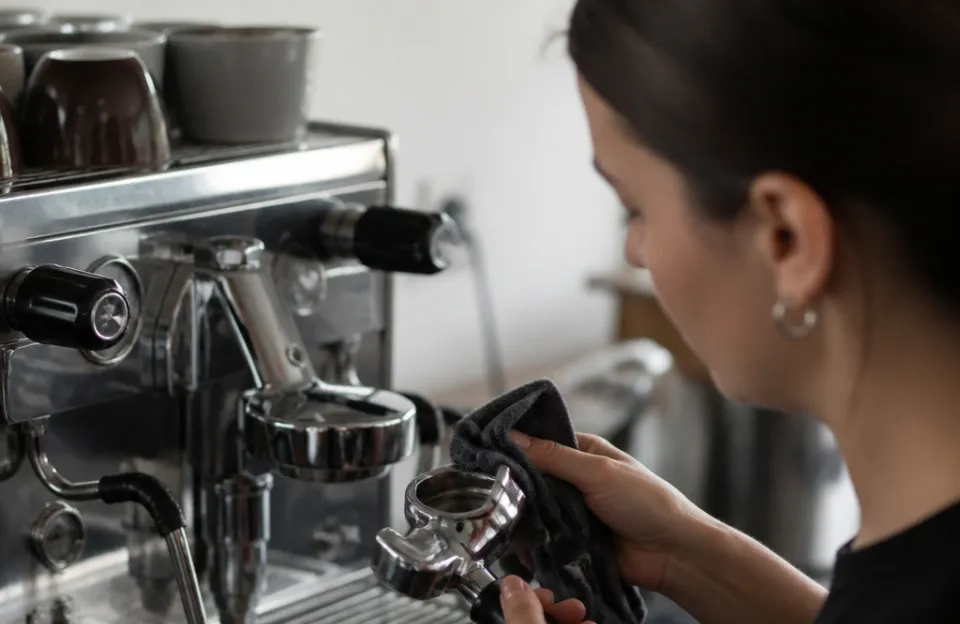
Daily care is the part of the routine that most manuals share. It takes a few minutes and prevents the worst buildup.
- Rinse the basket and portafilter. Breville advises rinsing them under hot water right after use to remove coffee oils, and says not to put the portafilter in the dishwasher.
- Wash the filter holder. Gaggia says to take the filter out of the filter holder every day and wash it in warm water.
- Wipe the steam wand. Breville says the Bambino’s wand should always be cleaned after texturing milk, with a damp cloth. Gaggia’s E24 manual says to wipe it after each frothing and open the steam knob for a second or two to clear the nozzle.
- Empty the drip tray and refresh the water. Breville’s Barista Express manual says to replace the water daily.
If you want a fuller walkthrough of the daily routine, see this guide to how to clean an espresso machine. It covers the same daily wipe-and-rinse habits in more detail.
Weekly Cleaning and When Backflushing Applies
Backflushing is the task most often done wrong, usually by doing it at all on a machine that does not support it.
A backflush locks a blind filter, or a cleaning disc, into the group: a basket with no holes. Pump pressure forces water and cleaner backward through the group and out into the drip tray. The task requires a three-way valve that routes pressure back through the group head. Machines without one, including many entry-level espresso machines, capsule brewers, super-automatics, and drip machines, must never be backflushed.
Do it only if your manual includes it, with the cleaner it names. If your manual has no backflush step, don’t add one. The backflushing guide from Coffee Machine Care Finder explains the three-way valve requirement in more depth.
Cadence varies by model. Gaggia’s Classic Pro E24 calls for monthly backflushing with a quarter of a Gaggia Coffee Oil Remover tablet in the blind filter, with repeated pump cycles until clean water comes out, then a rinse without a tablet. Rancilio’s Silvia manual calls for daily backflushing with a blind filter disk and espresso machine detergent. Follow your own manual rather than either example.
How Often to Descale, Based on Water Hardness and Your Manual
There is no universal descaling interval. Some makers give a fixed one, some count cups, and some build a signal into the machine. Water hardness shifts the timing further: harder water scales a boiler faster, so the same model in two homes can need different schedules.
Three manufacturer approaches show how much the trigger varies:
| Machine | Descaling trigger | Descaler specified |
|---|---|---|
| Gaggia Classic Pro E24 | Every 2 months; the manual warns never to use vinegar or other descaling agents | Gaggia descaling product only |
| De’Longhi Stilosa EC260BK | About every 200 coffees | De’Longhi descaler |
| De’Longhi Dedica Duo EC890M | When the B5 indicator lights; the cycle takes about 30 minutes | Follow the manual |
A commonly cited range for average home use is every 1 to 3 months, more often in hard-water areas, but that is a general figure rather than a manufacturer specification. Treat your manual’s method as the trigger and use water hardness to decide where in that range you sit.
Performing the Descale
The procedure itself is model-specific. Dilution ratios, dwell times, rinse volumes, and the descaler itself all vary, and using the wrong one can damage components or affect your warranty. Run the descaling program built into your machine, or follow the step-by-step descaling sequence in your manual, using the product the manufacturer names.
DIY descalers carry trade-offs. De’Longhi’s own materials state that DIY descalers including vinegar, lemon juice, and baking powder can leave residue and a lingering aftertaste, and the company steers buyers toward its EcoDecalk descaler. Breville’s guidance mentions a diluted vinegar ratio as an option but recommends a store-bought descaling solution for a proper deep clean. Neither Breville nor De’Longhi states outright in consumer materials that vinegar destroys seals or gaskets. The practical rule is simpler than the debate: use what your manual approves, at the strength it specifies.
If you are setting a schedule and want more detail on intervals, this guide to how often to descale an espresso machine expands on water hardness and timing.
Cleaning Schedules by Machine Type
Machine type determines which tasks apply and which are off-limits.
Manual and semi-automatic machines with a three-way valve can be backflushed if the manual documents it. The specific cadence is model-specific, as the Gaggia and Rancilio examples show.
Machines without a three-way valve need group head rinsing and basket cleaning instead. The Breville Bambino has no separate backflush step; it has a group head rinse from the 2 Cup button and a combined clean and descale cycle. The Bambino Plus has a flushing cycle due after 200 extractions, using the cleaning disc and one cleaning tablet.
Super-automatic machines are cleaned through rinse programs, tablets, or removable brew groups rather than backflushing. JURA’s E8 requests its cleaning program after 180 preparations or 80 switch-on rinses, using a JURA cleaning tablet, for about 20 minutes. The Philips 3200 LatteGo’s brew group comes out so you can rinse it under the tap.
If you are choosing between machine types and want to understand how their maintenance demands compare, this comparison of an espresso machine versus a coffee maker covers the trade-offs.
Commercial and professional espresso machines follow different schedules from home equipment, and those schedules were not part of the sources used here.
Tools, Cleaners and Water Filtration
You need less equipment than the shelves suggest.
- Cleaner for oils: a backflush detergent or cleaning tablet named by your manual. Cleaning tablets and descalers are not interchangeable.
- Descaler for scale: the product your manufacturer specifies.
- Soft cloths and a small brush for the group, basket, and steam wand.
- Water filtration if your tap water is hard, since scale is what descaling removes.
Never mix cleaning products, and rinse thoroughly as directed after cleaning or descaling. Unplug the machine and let it cool before any user-serviceable maintenance, and follow the machine manual and the consumable label, which take priority over general advice.
Common Mistakes and Stop Conditions
Most espresso machine damage from cleaning comes from four mistakes:
- Backflushing a machine without a three-way valve. This can damage the pump, and machines without the valve must never be backflushed.
- Adding a backflush step the manual omits. If your manual has no backflush step, don’t add one.
- Using an unapproved descaler. Gaggia’s manual, for example, warns never to use vinegar or other descaling agents.
- Mixing products or skipping the rinse. Never mix cleaning products, and rinse thoroughly as directed.
Stop and check your manual, or contact the manufacturer, if you see leaks, error codes, or any behavior the manual does not describe. Do not improvise a fix on a pressurized, heated machine. Unplug it first and let it cool.
Signs Your Espresso Machine Needs Cleaning or Descaling Now
Several signals suggest maintenance is overdue. Signs a machine needs descaling include slower shot flow, less crema, gurgling or sputtering during brewing, inconsistent temperature, and a lit or flashing descale indicator light. Scale itself reduces brewing flow, brewing temperature, machine power, and espresso taste, so declining shot quality is a reasonable prompt to check your schedule.
A descale light is a trigger, not proof of the exact scale level, since some machines count cups or time rather than measure hardness. If the light comes on well ahead of your usual interval, check your water source before assuming the machine is wrong.
The Practical Routine
Build your schedule from three layers. Do the daily tasks every day: rinse the basket and portafilter, wash the filter, wipe and purge the steam wand, and refresh the water. Add group cleaning or backflushing only if your manual documents it, at the cadence it gives. Descale on your manufacturer’s trigger, adjusted for how hard your water is.
Your manual settles every remaining question: which cleaner, what dilution, how long to dwell, and how much to rinse. Read it once, note the intervals on your calendar, and the routine becomes automatic.