Set your air fryer to about 350°F, arrange the nuggets in a single layer with a little space between them, and start checking at around 4 minutes. Add time in short increments, up to roughly 6 minutes, until a food thermometer inserted into the center reads 165°F. The clock gives you a starting point; the thermometer decides when they are done.
Timing shifts with the appliance, the load, the size of the pieces and how cold they are to begin with, so treat 4 to 6 minutes as a range to work within rather than a fixed rule.
Why an Air Fryer Works Well for Leftover Nuggets
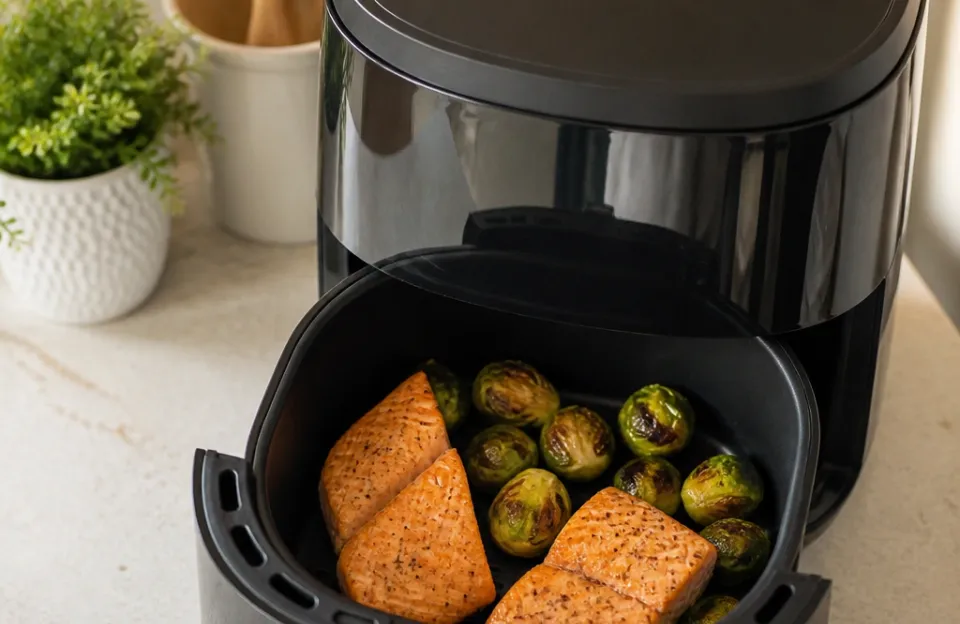
An air fryer is essentially a countertop convection oven, and it cooks faster while using less energy than a full-size oven. Food turns crisp because hot air circulates quickly around it. That circulation is also why air fryers can reheat food without the sogginess a microwave often produces, and chicken nuggets are among the foods suited to them.
That is a practical judgment about texture, not a tested ranking. If crispness matters more to you than speed, the air fryer is the better tool for this job.
Step-by-Step: Reheating Nuggets Without Drying Them Out
- Preheat only if your manual says to. Some models call for a short preheat, others do not require one. Follow the instructions for your specific appliance rather than assuming.
- Arrange in a single layer. Give each nugget a little breathing room. Overcrowding blocks air circulation and leads to uneven heating.
- Set about 350°F and start at 4 minutes. This sits inside the general 350°F to 400°F range air fryers typically use, with most foods taking somewhere between 5 and 25 minutes.
- Flip or shake partway through. Turning the pieces helps the exposed surfaces crisp evenly.
- Check at 4 minutes, then add time in short bursts. Nuggets that are still cold in the middle need more time, not more heat. Add a minute at a time and recheck.
- Pull them as soon as the center hits 165°F. Extra time past that point dries the meat out without improving safety.
How to Confirm the Nuggets Are Safely Hot
Color and appearance are not reliable indicators of doneness or safety; a food thermometer is the dependable check. Poultry, including ground poultry, is safe once it reaches an internal temperature of 165°F. The same 165°F target applies to reheated leftovers.
Insert the thermometer into the thickest part of a nugget, avoiding bone, fat or gristle. If it reads below 165°F, return the nuggets to the basket and check again after another minute or two. Do not rely on how hot they feel to the touch.
Reheating Larger Batches Without Overcrowding
A big pile of nuggets will steam rather than crisp, and some pieces will lag behind others. Overcrowding prevents enough air circulation to heat the food properly, so it is best to work in batches when you have a large amount.
Do one single layer at a time, keep the finished rounds warm, and check each batch with the thermometer. Because appliance size and power vary, later batches may behave slightly differently, so keep using short increments and the 165°F reading rather than assuming a fixed time.
Sauce, Oil and Other Practical Questions
Should I add oil? No. The breading already contains fat, and the circulating hot air is what restores crispness. A drizzle of oil can make the coating greasy rather than crunchy.
When should I add sauce? After reheating. Sauce on the outside during cooking traps moisture against the breading and works against the texture you are trying to recover.
Can I stack them to fit more in? Not if you want even results. A single layer is the point of the method.
Leftover Safety: the Two-Hour Rule and Storage Limits
Refrigerate perishable leftovers within two hours of serving. After that, food sits in the Danger Zone between 40°F and 140°F, where bacteria multiply quickly. If the food was exposed to temperatures above 90°F, such as in a hot car or at a summer picnic, refrigerate within one hour. Perishable food left out longer than two hours should be thrown away rather than reheated.
Once stored, leftovers keep for 3 to 4 days in the refrigerator or 3 to 4 months in the freezer. To cool food quickly, divide large amounts into shallow containers so it reaches 40°F or below as fast as possible. These are general leftover rules, not McDonald’s-specific storage instructions.
Reheated Leftovers vs. Frozen Nuggets: Don’t Mix Them Up
Reheating already-cooked nuggets is a different task from cooking frozen store-bought nuggets from raw. Frozen breaded products should be cooked according to their package directions, which specify their own temperature and time. The guidance here covers leftovers that were already cooked and refrigerated.
Common Mistakes to Avoid
- Skipping the thermometer. Appearance alone cannot confirm safety.
- Overloading the basket. Crowding blocks airflow and produces uneven results.
- Cooking by the clock instead of the reading. Different air fryers need different times for the same food, but the safe internal temperature stays the same.
- Leaving them in after they hit 165°F. Once they are safely hot, further cooking only dries them out.
The Bottom Line: Stop at Heat-Through
Reheating McDonald’s nuggets in an air fryer comes down to three things: a single layer, a moderate temperature of around 350°F, and a thermometer reading of 165°F in the center. Start at 4 minutes and add time in short increments until you get there. Check that the leftovers were refrigerated within the two-hour window before you reheat them at all, and discard anything that sat out longer.