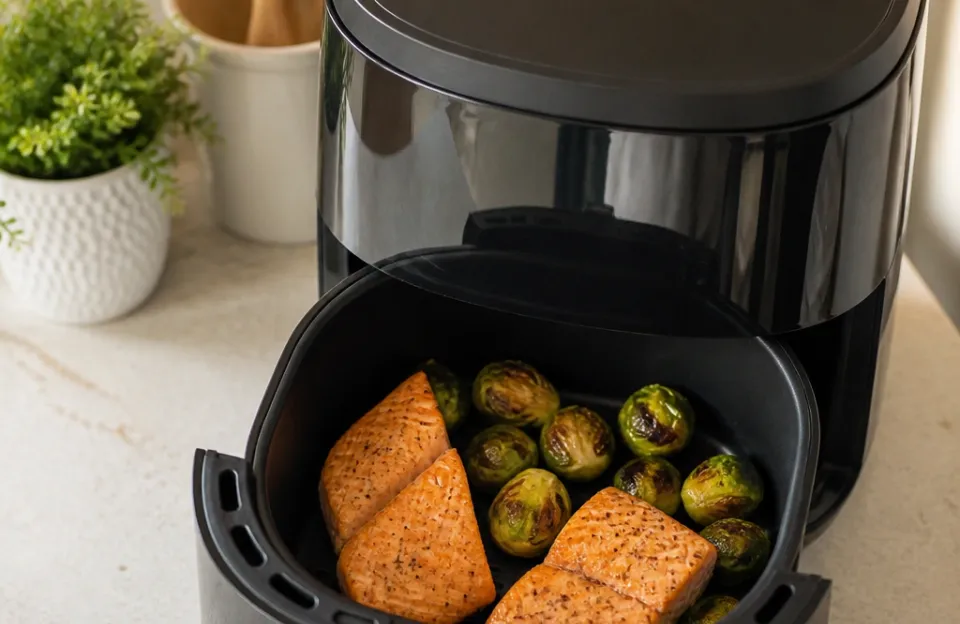
Air fryer kebabs generally cook at 400 °F (200 °C) for about 10 to 15 minutes, though the exact time depends on the protein, the size of the pieces and your machine. No supplied source provides air fryer cooking times, so treat every minute range in this guide as a starting point rather than a verified figure. What the official sources do establish are the safe minimum internal temperatures: poultry needs to reach 165 °F (73.9 °C), whole-cut beef, pork, lamb and veal need 145 °F (62.8 °C) plus a 3-minute rest, ground meats need 160 °F (71.1 °C), and fish needs 145 °F (62.8 °C) or flesh that is opaque and separates easily. Confirm doneness with a food thermometer.
Air Fryer Kebab Timing and Temperature by Protein
The times below assume pieces roughly 1 inch thick, a preheated air fryer set to 400 °F (200 °C), and a single layer with space between the kebabs. These are practical starting points, not verified per-model figures. Larger pieces, a crowded basket or a lower-wattage model will need longer. The safe minimum internal temperatures in the table come from official US guidance; the minute ranges do not.
| Kebab Type | Approximate Time at 400 °F (200 °C) | Safe Minimum Internal Temperature | Rest Time |
|---|---|---|---|
| Chicken (breast or thigh) | 12–15 minutes (starting point) | 165 °F (73.9 °C) | None required |
| Beef, lamb or veal steak cubes | 8–12 minutes (starting point) | 145 °F (62.8 °C) | At least 3 minutes |
| Ground meat kebabs (kofta) | 10–14 minutes (starting point) | 160 °F (71.1 °C) | None required |
| Pork tenderloin cubes | 10–13 minutes (starting point) | 145 °F (62.8 °C) | At least 3 minutes |
| Fish cubes | 8–11 minutes (starting point) | 145 °F (62.8 °C), or opaque and flaking | None required |
| Shrimp | 5–7 minutes (starting point) | Cook until flesh is pearly or white and opaque | None required |
| Vegetable-only kebabs | 12–16 minutes (starting point) | Not applicable; judge by texture | None required |
Sources: USDA FSIS safe temperature chart and FoodSafety.gov. The safe minimum temperatures and the 3-minute rest for whole cuts come from that official guidance. The minute ranges are practical starting points, not figures taken from those sources. Shrimp is the exception in this table: federal guidance describes a visual cue rather than a numeric internal temperature. Poultry is also the one row where no rest period applies, because the 165 °F (73.9 °C) target already provides the safety margin.
Safety Minimums vs Preferred Doneness
A safe minimum internal temperature is the point at which harmful bacteria are destroyed. Doneness is a separate, subjective quality covering appearance, texture and flavor. That distinction matters for beef and lamb in particular: 145 °F (62.8 °C) with a 3-minute rest is the safety floor for whole cuts, not a promise that the meat will look the way you prefer.
If you like beef more well done, you are free to cook it higher. USDA FSIS explicitly notes that consumers may choose to cook meat and poultry to higher temperatures for personal preference. What you should not do is aim below the minimum and rely on browning, juice color or firmness to judge safety.
Resting is part of the safety instruction for whole cuts, not just a culinary nicety. The 3-minute rest is written into the official guidance alongside the 145 °F (62.8 °C) target.
Preparing Kebabs for Even Cooking
Most uneven results start before the food reaches the basket. These preparation choices do the heaviest lifting.
Cut pieces to a consistent size. Uniform 1-inch cubes cook at roughly the same rate. A mix of large chunks and thin slivers makes it likely that some pieces dry out while others stay underdone. This is a practical cooking principle rather than a figure from the official sources cited here.
Pat the surface dry. Wet marinade or rinse water on the outside of meat steams rather than browns, and excess liquid pooling in the basket slows the whole batch.
Choose and handle skewers sensibly. Bamboo and wooden skewers are common and inexpensive. Soaking them is a widely used habit, but no supplied source sets a verified soaking duration or confirms fire behavior in an air fryer, so treat soaking as a practical preference rather than a safety guarantee. Metal skewers do not burn, but they get hot, so use tongs and let them cool before handling. In a basket-style air fryer, check that your skewers actually fit and can be rotated before you thread them.
Leave gaps between kebabs. Air fryers work by moving hot air around the food. Kebabs touching each other shield those surfaces, so arrange them in a single layer with visible space between them.
Handle marinades safely. Marinate meat and poultry in a covered dish in the refrigerator, not on the counter. Never reuse marinade that has touched raw meat as a finishing sauce unless you boil it first, or set aside a portion of unused marinade before the raw meat goes in. Juices from raw meat, poultry and fish should be kept away from other food, and boards, knives and counters washed with hot, soapy water afterward. Use separate plates and utensils for raw and cooked kebabs. Wash hands with soap and warm water for 20 seconds before and after handling food.
Plan dense vegetables around the meat. Potatoes, carrots and other dense vegetables need more time than peppers, onions or zucchini. Par-cooking dense vegetables, or threading them onto separate skewers, prevents the classic problem of raw potato next to overcooked chicken.
Step-by-Step Air Fryer Cooking Process
- Preheat the air fryer at 400 °F (200 °C) for a few minutes if your model has a preheat setting. A hot basket starts the browning sooner, though preheat times vary by model and no verified figure applies across machines.
- Assemble the kebabs with uniform pieces and a little space between items on each skewer. Avoid packing pieces tightly against each other.
- Arrange in a single layer. Work in batches rather than stacking kebabs. A full basket cooks more slowly and less evenly than a half-full one.
- Cook for the lower end of the time range in the table above, then start checking.
- Flip or rotate at the halfway point. This exposes the underside to the heating element and helps both sides brown.
- Begin thermometer checks a minute or two before the low end of the range. Pull the basket, check the thickest piece, and return the kebabs if they need longer.
- Rest whole-cut meat for at least 3 minutes before carving or eating. Resting also lets the internal temperature even out.
- Serve promptly. Perishable food should be refrigerated within 2 hours, or within 1 hour if the ambient temperature is above 90 °F. Hold hot food at 140 °F or warmer and cold food at 40 °F or colder.
Checking Doneness Safely with a Thermometer
Appearance and color are not reliable indicators of safety or doneness, and a food thermometer is the only reliable way to tell whether harmful bacteria have been destroyed. Research cited by USDA FSIS found that the color of meat and juices is not an accurate indicator, and that ground beef can turn brown before it reaches a temperature at which bacteria are destroyed.
For whole poultry, check the innermost part of the thigh and wing and the thickest part of the breast. For kebab cubes and ground-meat kebabs, insert the probe into the center of the thickest piece, away from bone and fat, and clean the thermometer between checks to avoid cross-contamination. Check more than one piece per batch, especially any pieces that sat at the edge of the basket.
A thermometer reading is strong evidence, not absolute proof: probe placement matters, and a thermometer that is out of calibration can mislead you. Confirm the reading in a second thick piece before you call the batch done.
Troubleshooting Uneven or Failed Results
Kebabs are taking much longer than the table suggests. The usual causes are pieces larger than 1 inch, an overcrowded basket, a wet surface on the meat, or a lower-wattage air fryer. Fix the load size first, then extend the time in 2-minute increments and recheck with the thermometer. Because the minute ranges are starting points rather than verified figures, a longer first batch is expected on some machines.
The outside is browning while the center is still raw. The heat is too aggressive for the piece size. Reduce the temperature to 375 °F (190 °C), extend the cook time, and flip more often. Sugary marinades and glazes are a common culprit because they scorch before the interior catches up; brush them on near the end instead of at the start. Keep checking the center with a thermometer rather than judging by the crust.
Vegetables are done before the meat, or the reverse. Dense vegetables need longer than quick-cooking ones. Par-cook potatoes and carrots, or put them on their own skewers so each batch can come out when it is ready.
Ground-meat kebabs look done but read low. Color is not a reliable guide here specifically. Take the temperature in the center of the thickest kebab and keep cooking until it reaches 160 °F (71.1 °C).
Shrimp turn rubbery before the chicken is ready. Shrimp cook in 5 to 7 minutes, far faster than chicken. Cook them as a separate batch rather than threading them onto the same skewer as poultry, and judge shrimp by the visual cue of pearly, white and opaque flesh. The 5 to 7 minute range is a starting point, not a figure from the official sources.
Air Fryer and Ingredient Limitations to Keep in Mind
Times in this guide are starting points, not verified per-model figures. Air fryer wattage, basket shape, fan strength and load size all shift results, and no supplied source gives model-specific timings. Use the first batch to learn your machine: note how the kebabs look and read at the low end of the range, then adjust for the next batch. The safe minimum internal temperatures, by contrast, do not change with your machine.
The official temperatures here are US federal minimums. If you are cooking outside the United States, your local food authority may publish different guidance, and that guidance should take precedence for your jurisdiction. The minute ranges, which are not from those sources, are unaffected by jurisdiction.
Federal guidance does not give a numeric internal temperature for shrimp, so the doneness cue is visual: pearly, white and opaque flesh. Vegetable kebabs likewise have no safety temperature, and their doneness is a matter of texture and browning.
Bottom Line: Adjusting Times for Your Air Fryer
Start at 400 °F (200 °C), use the per-protein ranges above as starting points, and treat the thermometer reading as the decision point rather than the timer. Chicken and other poultry must hit 165 °F (73.9 °C). Whole-cut beef, pork, lamb and veal need 145 °F (62.8 °C) plus a 3-minute rest. Ground meats need 160 °F (71.1 °C). Fish needs 145 °F (62.8 °C) or opaque, flaking flesh, and shrimp are done when the flesh is pearly and opaque. The 400 °F (200 °C) starting temperature is a practical recommendation, not a figure from the official sources.
If your first batch runs long or browns too fast, adjust the temperature and the load size before you adjust the target temperature. Safety minimums stay fixed; only the route to them changes.