There is no single verified drying time for beef jerky in an air fryer. Timing depends on your model’s dehydrate range, slice thickness, marinade moisture, kitchen humidity and batch size, so treat any time figure as a starting estimate. For most home batches, expect roughly 4 to 9 hours at a low drying temperature, usually somewhere between 145°F and 160°F when your machine supports that range. More important, drying temperature is not the same thing as a pathogen-lethality step: low dehydrator temperatures can let bacteria survive, so you need a separate verified heating step to make shelf-stored jerky safe.
This guide explains how to check your air fryer, prepare the meat, estimate timing, judge doneness, troubleshoot texture problems, and store the finished jerky safely.
Understand the Drying Process Before You Start
The goal of jerky making is to remove enough moisture that the meat becomes shelf stable, while keeping it tender enough to chew. An air fryer circulates warm air around the strips, pulling water vapor off the surface. The process needs steady low heat and airflow over several hours, not fast high heat.
Most modern air fryers include a dedicated Dehydrate or DRY mode or a genuinely low manual temperature range. Ranges vary by model: COSORI’s Dehydrate setting adjusts between 100°F and 180°F, KitchenAid’s dehydrate function runs a preset 150°F for 6 hours on at least one countertop model, and a PowerXL Air Fryer + manual lists 95°F to 200°F with times from 30 minutes to 24 hours. These examples apply only to the named models, so confirm the settings in your own owner’s manual.
If the temperature runs too high, the meat cooks or browns instead of drying. A related problem is case hardening, where the exterior dries hard while the center stays moist, usually because airflow is weak or uneven. That matters for both texture and safety.
Separate Drying Heat from Pathogen Control
Food-safety guidance for home dehydration warns that pathogens are likely to survive the dry heat of a warm oven and especially the 130°F to 140°F temperature of a food dehydrator. That is why the drying step alone cannot be trusted to make shelf-stored jerky safe, and why the USDA FSIS jerky guidance covers a separate lethality step. If your machine cannot hold a true low dehydrating temperature, or you cannot complete a verified heating step, consider a different method rather than improvising.
Check Your Equipment Before You Start
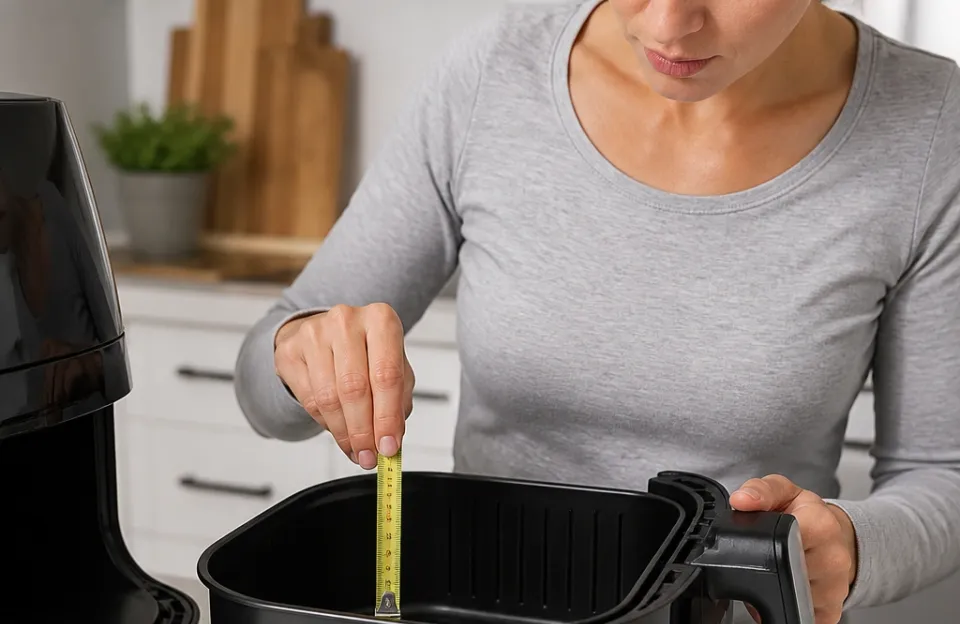
Not every air fryer has a true dehydrate function, and some cannot dehydrate at all. Before buying meat, run this quick check:
- Confirm your model has a Dehydrate or DRY mode, or a manual setting that reaches at least 95°F to 160°F.
- Read your specific manual for the temperature and time ranges, since these differ between models.
- Check that the basket or racks allow single-layer spacing with room for air to move.
- Verify that moisture can escape. In basket-style models, a small vent gap can help, and the basket should never be covered with foil during dehydration.
- If your model’s minimum temperature is 200°F, it will cook and crisp food rather than slowly dry it, which makes it unsuitable for jerky.
Prepare the Meat for Even Drying
Your prep work drives how long the batch takes.
Slice Uniformly
Thick or uneven slices dry at different rates, so some pieces finish while others stay moist. Uniform, thinner cuts help every strip reach a similar texture at the same time. Partially freezing the beef for about an hour before slicing makes it easier to cut consistent strips.
Trim Fat and Manage the Marinade
Fat does not dehydrate, so highly marbled meat spoils faster at room temperature; lean cuts such as eye of round are the safer choice. Trim visible fat before slicing.
Salt, sugar, vinegar and acidic ingredients affect the water activity and pH of beef jerky, which influences shelf life. Those ingredients add flavor, but surface liquid still adds drying time. Pat strips dry with paper towels and keep raw meat and used marinade cold until they go into the machine.
Estimate Timing by Slice Thickness
The table below gives starting estimates only. Your air fryer, the meat’s moisture and your kitchen conditions will shift these numbers, so begin checking early and rely on the doneness checks below rather than the clock.
| Beef Slicing Thickness | Drying Temperature | Estimated Time Range |
|---|---|---|
| 1/8 inch (thin) | 145°F to 150°F | 4 to 5 hours |
| 1/4 inch (standard) | 150°F to 160°F | 5 to 7 hours |
| Thick-cut or strip | 160°F | 7 to 9 hours |
Drying temperature is one part of the picture: too high a setting can make jerky too dry and brittle, while too low a setting may leave it insufficiently dried, with higher water activity and greater risk of microbial growth. Because home cooks generally cannot measure water activity directly, treat these times as a scheduling aid and follow the safety step separately.
Judge Doneness by Texture, Not the Clock Alone
When the timer is close, pull one piece out and let it cool completely. Warm jerky always feels softer than it is. A finished piece typically shows these signs:
- The fat is rendered and the surface looks dry and leathery.
- The jerky bends and eventually breaks, but does not snap.
- It tastes dried rather than raw or juicy.
If a cooled piece bends and cracks but does not snap, and no moisture squeezes out when you press it, it is close. A clean snap usually means over-dried.
Texture is a useful dryness indicator, but it does not by itself confirm that pathogens were destroyed. That is why the separate heating step matters, especially for jerky you plan to store at room temperature.
Troubleshoot Soft, Brittle or Uneven Jerky
Jerky Still Soft After the Estimated Time
Thick or uneven slices dry at different rates, so some pieces finish while others stay moist. Check each piece individually, remove finished strips, and keep checking the rest every 30 minutes. If the batch stays damp despite a low, steady temperature, drying conditions or slice thickness are the likely culprits.
Jerky Turns Out Brittle
Brittle jerky usually means too much heat or too much time. Push the temperature down within your machine’s dehydrate range and start checking earlier on the next batch.
Some Pieces Dry, Others Stay Moist
Several factors cause this. Thick or uneven slices dry at different rates. Overcrowding blocks airflow, so stacked or piled pieces defeat the cycle; space them out so air can move. Weak or inconsistent airflow can also produce case hardening, where the outside dries while the center stays moist. Cut more uniformly, leave gaps between strips, and rotate racks if your model has more than one.
When to Stop and Reconsider
If your air fryer cannot hold a temperature low enough to dry without cooking the meat, or you cannot complete the separate pathogen-killing step, stop rather than guessing. Store any partially dried meat in the refrigerator and finish it in a suitable appliance or oven method.
Manage Humidity, Rack Space and Airflow
Moisture must be able to escape during dehydration. In basket-style air fryers, slightly propping or venting the basket can help, and the basket should never be covered with foil.
Overcrowding is a common cause of uneven results, so keep pieces in a single layer with space between them. If your air fryer has multiple racks, use them, but expect the rack nearest the heating element to finish faster. Rotate racks from top to bottom and front to back partway through the dry.
Cool and Store the Jerky Safely
Cool finished jerky completely on a rack before packaging, because residual heat creates condensation that can lead to mold. Then follow storage guidance that matches your preparation method.
Home-dried jerky should be refrigerated or frozen for storage beyond 2 months. One secondary source puts properly prepared homemade beef jerky at 1 to 2 months at room temperature when dried below a water activity of 0.85 and stored in an airtight container, while another suggests 1 to 2 months in a sealed container if cured and only 1 to 2 weeks if uncured. Because these figures depend on preparation, packaging and storage temperature and are not universal, use the shorter end of the range unless you have verified your process, and refrigerate or freeze for longer storage.
For comparison, opened commercial jerky remains safe for roughly 3 days at room temperature or 7 to 10 days when refrigerated. Those figures apply to commercial products, not home-dried meat.
Know When an Air Fryer Is Not Suitable
Not every air fryer can dehydrate food at all, and not every model that can will produce shelf-stored jerky safely without a separate heating step. If your machine’s minimum temperature is 200°F, it cooks and crisps food rather than slowly drying it. Running an air fryer too hot during dehydration also cooks or browns food instead of drying it.
For occasional batches, an air fryer with a real dry mode is fine. A stand-alone dehydrator pulls ahead when you dry often or in volume, because it offers more trays and more even airflow.
Frequently Asked Questions
What Temperature Should I Set for Beef Jerky in an Air Fryer?
Use your model’s dehydrate range. The examples in this guide run from 95°F to 200°F depending on the model, and typical jerky drying temperatures fall between 145°F and 160°F when your machine supports them. Keep in mind that the drying temperature does not replace a separate pathogen-lethality step.
Can I Make Beef Jerky in an Air Fryer Without a Dehydrate Setting?
Only if your model offers a genuinely low manual range. If your lowest setting is 200°F, the machine will cook and crisp the meat instead of drying it. Check your manual before starting, and do not rely on a short, hot cycle as a substitute for proper drying plus the safety heating step.
How Do I Know the Jerky Is Dry Enough?
Check texture once a test piece has cooled completely. Finished jerky looks dry and leathery, bends and eventually breaks without snapping, and tastes dried. Texture signals dryness, not pathogen control, so complete the separate heating step for shelf-stored jerky.
Why Does My Jerky Dry Unevenly?
The usual causes are thick or uneven slices, overcrowding that blocks airflow, and weak or inconsistent airflow that creates case hardening. Slice uniformly, leave space between pieces, and rotate racks if you have them.
How Long Does Homemade Jerky Last?
One source gives 1 to 2 months at room temperature for properly prepared jerky stored airtight below a water activity of 0.85, and another gives 1 to 2 months if cured but only 1 to 2 weeks if uncured. Home-dried jerky should be refrigerated or frozen for storage beyond 2 months. Because these figures depend on your preparation and packaging, lean toward refrigeration for anything you plan to keep longer.
Closing Decision
Making beef jerky in an air fryer comes down to two separate jobs: drying the meat evenly at a genuinely low temperature, and completing a verified heating step for safety. Confirm your model’s dehydrate range in its manual, slice uniformly and trim fat, space pieces for airflow, start timing on the early side, and judge doneness by texture on a cooled piece. If your machine cannot hold a low drying temperature or you cannot complete the safety step, use a different method rather than risking a batch.