Food scale decimal places explained: 1, 2 & 3 decimal accuracy refers to the smallest weight increment a digital kitchen scale can display. A one-decimal scale reads in 0.1-gram steps. A two-decimal scale reads in 0.01-gram steps.
A three-decimal scale reads in 0.001-gram steps. The number of decimals determines how precisely you can measure ingredients, which directly impacts baking consistency, dietary tracking, and recipe development.
This article breaks down what each level of precision means for everyday cooking. It covers where extra decimals matter, where they waste money, and how load cell technology limits what these scales can do. You will also find practical guidance on choosing the right accuracy for your specific kitchen tasks.
How Load Cells Determine Scale Readability
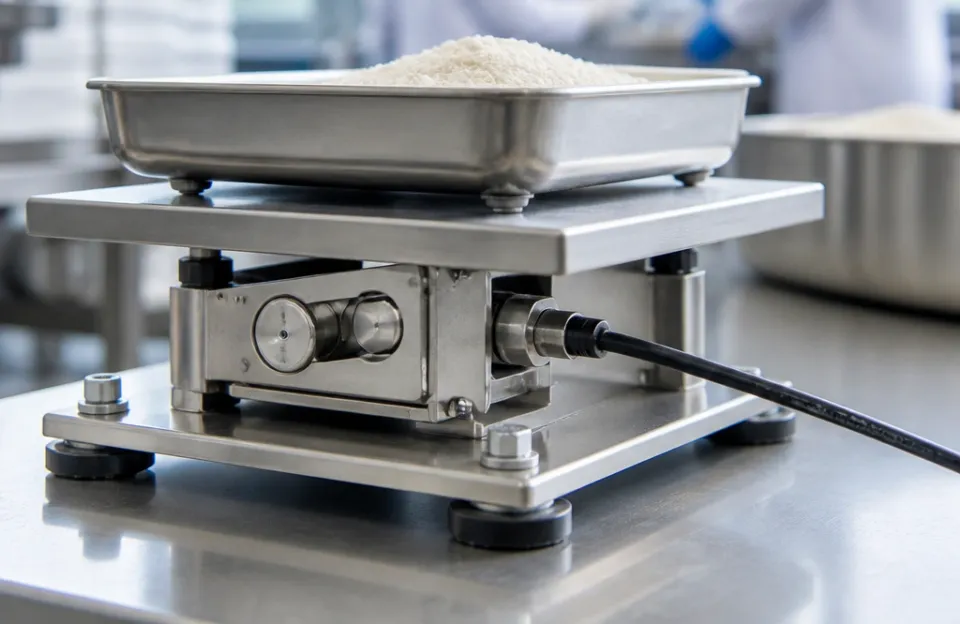
Every digital food scale relies on a load cell to convert physical force into an electrical signal. That signal passes through an analog-to-digital converter, which translates it into a number on the screen. The number of decimal places you see depends entirely on the quality of that converter and the stability of the load cell.
A standard kitchen scale uses a basic strain gauge load cell. It bends slightly under weight, changing its electrical resistance. Cheap converters read this change in large chunks, giving you whole grams or tenths of a gram.
Expensive converters slice that same bending motion into thousands of tiny increments.
Higher readability requires better environmental control. Drafts from an air vent, vibrations from a running dishwasher, or even the static electricity from a plastic bowl can scramble the reading on a sensitive scale. Manufacturers build shielding and software filters into higher-end models to handle this noise.
Those additions drive up the cost. This is why a three-decimal scale costs significantly more than a basic model you keep next to your oven temperature dial for daily roasting.
The National Institute of Standards and Technology sets strict tolerances for commercial weighing devices under NIST Handbook 44. While home kitchen scales fall outside legal-for-trade requirements, reputable manufacturers still use NIST standards as a baseline for sensor calibration. A scale claiming 0.01g readability should reliably detect that difference without drifting.
Readability and accuracy are separate concepts. Readability is the smallest number the screen displays. Accuracy is how close that number is to the true weight.
A scale might show 0.001g increments but drift by 0.05g due to poor calibration. Always check both specifications before buying.
One Decimal Place Scales For Everyday Kitchen Tasks
A scale with one decimal place displays weights like 15.3g or 120.8g. The smallest change it registers is one-tenth of a gram. This is the most common precision level found in modern digital kitchen scales.
For general cooking, 0.1g resolution is plenty. Measuring salt for a soup, portioning butter for cookies, or weighing chicken breasts for dinner does not require microscopic exactness. A tenth of a gram of table salt contains roughly 60 milligrams of sodium.
Human taste buds cannot detect a difference that small in a finished dish.
Baking benefits from this level of detail. Professional bakers formulate recipes in grams because volume measurements fluctuate based on humidity and packing density. When a bread recipe calls for 7.5g of salt, a one-decimal scale gets you exactly there.
Dropping down to whole grams forces you to round up or down, which alters the dough hydration and fermentation rate over multiple batches.
Dietary tracking also relies heavily on this tier. People logging macros for fitness goals need reliable numbers. Weighing 145.2g of cooked rice gives a much tighter calorie estimate than guessing "about a cup." If you track nutrition closely while monitoring the safe internal temperatures of your proteins, a 0.1g scale handles the food prep side perfectly.
The main limitation of one-decimal scales is their maximum capacity. Most top out around 3,000 to 5,000 grams. The load cell has to balance range against sensitivity.
Pushing the capacity to 10 kilograms usually forces the manufacturer to drop the resolution back to whole grams.
Two Decimal Places For Precision Baking And Coffee
Two decimal places mean the scale reads down to 0.01g. A display might show 4.52g or 18.05g. This level of precision crosses the line from casual cooking into specialized technique.
Specialty coffee brewing is the biggest driver of two-decimal scale adoption. Pour-over methods like the V60 or Chemex rely on strict coffee-to-water ratios. A standard starting point is 1 gram of coffee to 16 grams of water.
If you brew a single cup using 15.00g of coffee, adding or missing 0.05g changes the extraction yield. Over-extracted coffee tastes bitter. Under-extracted coffee tastes sour.
Dialing in a new bean requires adjusting the dose by hundredths of a gram until the flavor balances out. Many baristas pair this precise weighing with a fast-response probe to monitor water temperature simultaneously, since heat and ratio work together during extraction.
Advanced pastry work also demands this resolution. Hydrocolloids like xanthan gum, agar agar, and gellan gum thicken liquids at incredibly low concentrations. A recipe might call for 0.35g of xanthan gum per 500g of liquid.
Using 0.50g turns a smooth sauce into a snotty gel. You cannot measure 0.35g on a scale that only reads to 0.1g. You would have to guess between 0.3 and 0.4, risking a ruined batch.
Saffron, vanilla bean paste, and potent extracts fall into the same category. These ingredients are expensive and highly concentrated. Weighing them to the hundredth of a gram prevents waste and keeps flavors balanced.
Two-decimal scales usually have lower maximum capacities than their one-decimal counterparts. Expect a limit between 500g and 2,000g. The sensors are tuned for micro-measurements, so placing a heavy mixing bowl on the platform can overload the cell or cause permanent drift.
You often need to weigh small items in lightweight containers, taring the scale between additions.
Environmental factors become a real problem here. A ceiling fan blowing across the weighing platform will make the last digit jump constantly. You need a draft-free counter space to get stable readings.
Three Decimal Places In Molecular Gastronomy And Labs
Three decimal places deliver 0.001g readability. The screen shows numbers like 1.005g or 0.125g. These are analytical-grade instruments adapted for culinary use.
Molecular gastronomy pioneered the use of three-decimal scales in kitchens. Chefs working with sodium alginate for spherification, calcium lactate for reverse spherification, or transglutaminase (meat glue) deal with chemical reactions. These reactions fail if the reagent ratios are off by even a few milligrams.
Creating perfect caviar spheres out of olive juice requires dissolving exactly 0.500g of sodium alginate into the liquid. Too little, and the skin tears. Too much, and the sphere turns into a solid rubber ball.
Flavor extraction and distillation also use this tier. When creating custom bitters or essential oil infusions, botanical compounds vary wildly in potency. Linalool from coriander seeds or eugenol from cloves can overpower a blend if measured carelessly.
Weighing aromatics to the milligram guarantees repeatable results across different production runs.
Supplement formulators and people micro-dosing specific compounds rely on 0.001g scales for safety. A dosing error of 0.05g might be harmless with flour, but dangerous with concentrated caffeine powder or pure citric acid.
These scales are fragile. They belong in a dedicated workspace, far away from heavy pots, splashing liquids, or vigorous kneading. The weighing pan is usually small, designed for weighing powders inside tiny boats or capsules.
Cleaning them requires care. Spilling sticky syrup into the sensor housing destroys the unit. If you work with volatile techniques that generate intense localized heat, you might also keep a non-contact infrared tool nearby to monitor surface temperatures without touching the delicate scale platform.
Purchasing a three-decimal scale for normal baking is a mistake. The extreme sensitivity makes it frustrating to use for anything heavier than a few grams. The display flickers when you breathe on it.
Stick to tools built for your actual workflow.
Comparing Resolution, Capacity, And Practical Use
Choosing the right scale means matching the decimal places to your typical ingredient list. Higher resolution always trades off against maximum capacity and physical durability.
| Attribute | 1 Decimal (0.1g) | 2 Decimals (0.01g) | 3 Decimals (0.001g) |
|---|---|---|---|
| Smallest Reading | 0.1 gram | 0.01 gram | 0.001 gram |
| Typical Max Capacity | 3,000g to 5,000g | 500g to 2,000g | 100g to 500g |
| Best Suited For | Daily cooking, bread baking, macro tracking | Pour-over coffee, hydrocolloids, pastry | Molecular gastronomy, micro-dosing, lab work |
| Draft Sensitivity | Low | Moderate | Extreme |
| Platform Size | Large | Medium | Very small |
This tradeoff exists because of how load cells function. A sensor engineered to flex enough to register 5 kilograms cannot simultaneously detect the microscopic strain caused by a single grain of salt. Manufacturers solve this by limiting the total travel distance of the spring element in high-resolution scales.
Less travel means finer detection, but it also means the sensor hits its physical stop much sooner, capping the weight limit.
If you need both high capacity and high precision, you need two separate scales. Attempting to find a single device that weighs 5kg accurately down to 0.01g leads to massive price tags and frequent calibration failures. Professional kitchens maintain a bulk scale for flour and sugar, and a precision scale for yeast, salt, and spices.
Home cooks doing serious recipe testing follow the same logic.
When shopping, verify whether the listed capacity applies to the entire platform or just a specific zone. Some two-decimal scales advertise a 2,000g capacity, but the 0.01g readability only functions below 200g. Above that threshold, the scale automatically switches to 0.1g increments.
Read the manual carefully before assuming full-range precision.
Calibration Drift And Why Extra Decimals Sometimes Lie
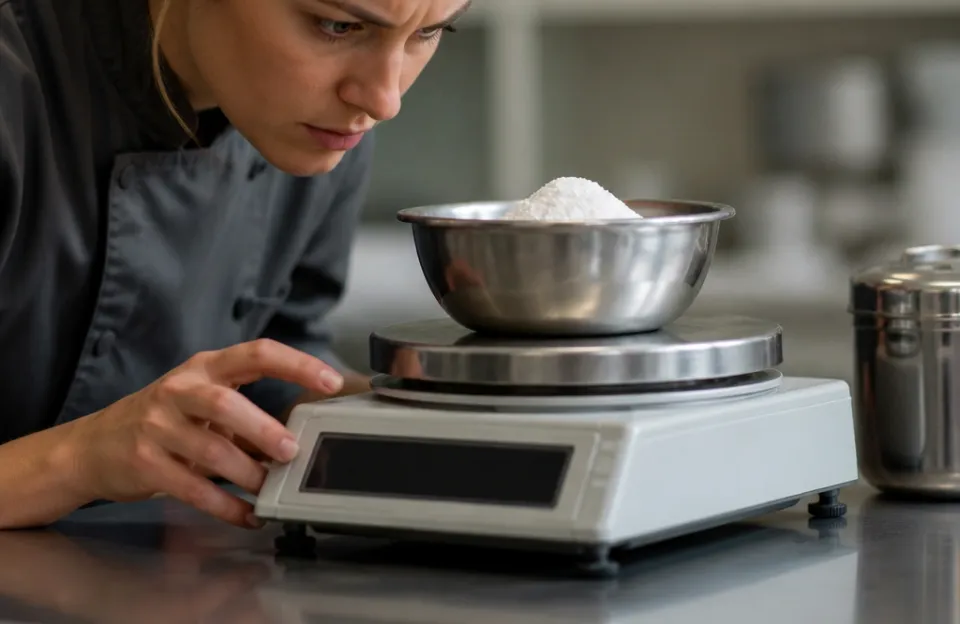
More decimal places do not automatically guarantee better data. Sensor noise and calibration drift create false precision, where the screen displays numbers that fluctuate without any actual weight change.
Every electronic component generates thermal noise. As the circuit board warms up during use, electrons move unpredictably. On a one-decimal scale, this noise stays hidden below the 0.1g threshold.
On a three-decimal scale, that same electrical chatter causes the last digit to bounce between 0.001 and 0.003 continuously. You are watching the sensor's internal confusion, not measuring your ingredient.
Calibration weights must match the scale's resolution. Calibrating a 0.01g scale requires a certified weight accurate to at least 0.005g. Using a cheap stamped metal disc from a hardware store introduces errors larger than the scale's own readability.
If your reference weight is off by 0.02g, every subsequent measurement carries that flaw.
Temperature swings affect the metal inside the load cell. Moving a precision scale from a cold pantry to a warm counter near the stove causes the metal to expand. Expansion changes the electrical resistance, shifting the zero point.
High-end models include automatic temperature compensation circuits. Budget models do not. Letting the scale sit powered on for ten minutes allows the internal components to reach thermal equilibrium before you start weighing.
Air currents exert measurable force on the weighing pan. A 0.001g scale detects the pressure differential created by someone walking past the counter. Using a draft shield, typically a clear plastic box that fits over the platform, eliminates this variable.
Without one, the readings on a three-decimal scale remain unreliable in an active kitchen.
Battery voltage drops also impact performance. As batteries drain, the power supplied to the analog-to-digital converter fluctuates. This manifests as sluggish response times or drifting zeros.
Replacing batteries before they die completely maintains consistent accuracy. If you prefer rechargeable setups for your precision gear, similar to how many cooks now use a rechargeable temp probe to avoid battery waste, look for scales with regulated power delivery circuits.
Matching Scale Accuracy To Your Cooking Style
Figuring out which tier you need comes down to the recipes you cook most often. Buying excess precision wastes money and adds frustration to simple tasks.
Casual home cooks and meal preppers. If you mostly roast vegetables, portion meats, or bake simple cakes from standard recipes, a one-decimal scale is all you need. Rounding salt to the nearest tenth of a gram never ruins a stew. Focus your budget on a sturdy build, a large stainless steel platform, and a high weight capacity rather than chasing extra digits.
Serious bakers and sourdough enthusiasts. Bread making relies on baker's percentages. Small shifts in yeast or salt alter fermentation timelines drastically. A one-decimal scale handles this well.
However, if you experiment with enriched doughs requiring tiny amounts of commercial yeast or specialized enzymes, stepping up to two decimals provides better control. Keep your primary scale near your main prep area, perhaps stored alongside other durable kitchen instruments that see daily abuse.
Coffee hobbyists. Anyone pulling espresso shots or brewing pour-overs needs two decimal places. Dose adjustments happen in hundredths of a gram. A one-decimal scale forces you to guess between 18.1g and 18.2g of coffee, which is enough to shift an espresso shot from balanced to sour.
Recipe developers and food scientists. Writing cookbooks or developing products for commercial sale requires absolute repeatability. If you test a recipe ten times, the results must be identical every time. Two decimals cover most culinary development.
Three decimals become necessary only when working with hydrocolloids, potent extracts, or nutritional fortification.
Molecular gastronomy practitioners. Spherification, gelation, and emulsification rely on precise chemical ratios. Three decimal places are mandatory here. Measure your reagents in a quiet room, away from the stove, using dedicated weighing boats.
Treat the scale as laboratory equipment rather than a kitchen appliance.
Understanding food scale decimal places explained: 1, 2 & 3 decimal accuracy helps you avoid overspending on features you will never use. It also prevents the disappointment of buying a scale that lacks the resolution your specific technique demands.
Common Mistakes When Using Precision Food Scales
Even experienced cooks mishandle sensitive scales. Avoiding a few bad habits keeps your measurements trustworthy.
- Ignoring the tare function sequence. Taring the scale with a heavy bowl already on it eats into the load cell's available range. If your scale maxes out at 500g, and your glass bowl weighs 350g, you only have 150g of usable capacity left. The sensor struggles near its limits, reducing accuracy. Always use the lightest container possible for high-resolution work.
- Placing the scale on uneven surfaces. Granite countertops with natural pits, cutting boards that rock, or silicone mats that compress unevenly all introduce mechanical stress. The load cell expects force applied straight down through its center. Angled pressure skews the reading. Set the scale directly on a flat, hard surface.
- Pouring ingredients directly over the sensor. Spilled flour or dripped honey falls into the gaps around the weighing platform. Once debris reaches the load cell mechanism, it creates friction. Friction prevents the sensor from returning to true zero. Clean spills immediately with a dry brush. Never submerge a precision scale in water.
- Trusting the last digit blindly. On a 0.01g scale, the first decimal is usually rock solid. The second decimal might fluctuate slightly depending on room conditions. Record the stabilized average rather than chasing a jumping number. If the display cycles between 4.51 and 4.52, the true weight sits somewhere in between.
- Mixing hot items on the platform. Placing a freshly boiled pot or a hot skillet directly onto a precision scale damages the adhesive bonding the strain gauge to the metal beam. Heat expansion permanently alters the calibration. Let items cool to room temperature before weighing them on sensitive equipment. If you need to monitor something actively heating, rely on a proper wireless dual-sensor setup designed for high temperatures instead of improvising with your baking scale.
Frequently Asked Questions
Does a 0.01g food scale actually improve baking results?
Yes, for specific ingredients. Standard flour and sugar measurements rarely benefit from hundredths of a gram. But leavening agents like baking powder, commercial yeast, and salt absolutely do.
A difference of 0.05g of yeast in a small batch of dough changes the rise time noticeably. Precision matters most for the ingredients used in the smallest quantities.
Can I use a jewelry scale for cooking ingredients?
Technically yes, as jewelry scales often offer 0.01g or 0.001g resolution. Practically, they are a poor choice. Jewelry scales have tiny platforms meant for rings and gemstones.
Balancing a ramekin or a small bowl on them is difficult. They also lack food-safe materials and splash resistance. Buy a scale designed for culinary environments instead.
Why does my high-precision scale reading keep jumping?
Jumping numbers indicate environmental interference. Air drafts from HVAC vents, vibrations transmitted through the countertop, or electromagnetic interference from nearby appliances cause the sensor to fluctuate. Move the scale to a solid, isolated surface away from fans and motors.
If the jumping persists, the load cell might be damaged or the batteries are failing.
Is a 3-decimal scale worth the money for home coffee brewing?
No. Espresso and pour-over coffee require 0.01g resolution to dial in doses effectively. Going down to 0.001g offers no practical advantage because coffee beans themselves vary in moisture content and density far more than a single milligram.
A three-decimal scale slows down your morning routine without producing a better cup.
How often should I calibrate a digital food scale?
For daily home cooking, once every few months is sufficient. For professional recipe development or molecular gastronomy, calibrate weekly or before any critical session. Always use a certified calibration weight that matches your scale's specific resolution class.
Storing the scale in a temperature-stable environment reduces how often calibration drifts.
Picking The Right Resolution For Your Counter
Matching your scale's decimal places to your actual cooking habits saves money and prevents frustration. A 0.1g scale handles ninety percent of kitchen tasks effortlessly. Stepping up to 0.01g opens doors for specialty coffee and advanced pastry work.
Dropping down to 0.001g belongs strictly in the realm of food science and molecular techniques.
Pay attention to capacity limits, platform size, and build quality alongside resolution. A highly readable scale is useless if it cannot hold your mixing bowl or survives a minor spill. Keep the sensor clean, calibrate it periodically, and let it stabilize before trusting the final digit.
Understanding food scale decimal places explained: 1, 2 & 3 decimal accuracy gives you the framework to buy exactly what your recipes demand, nothing more.