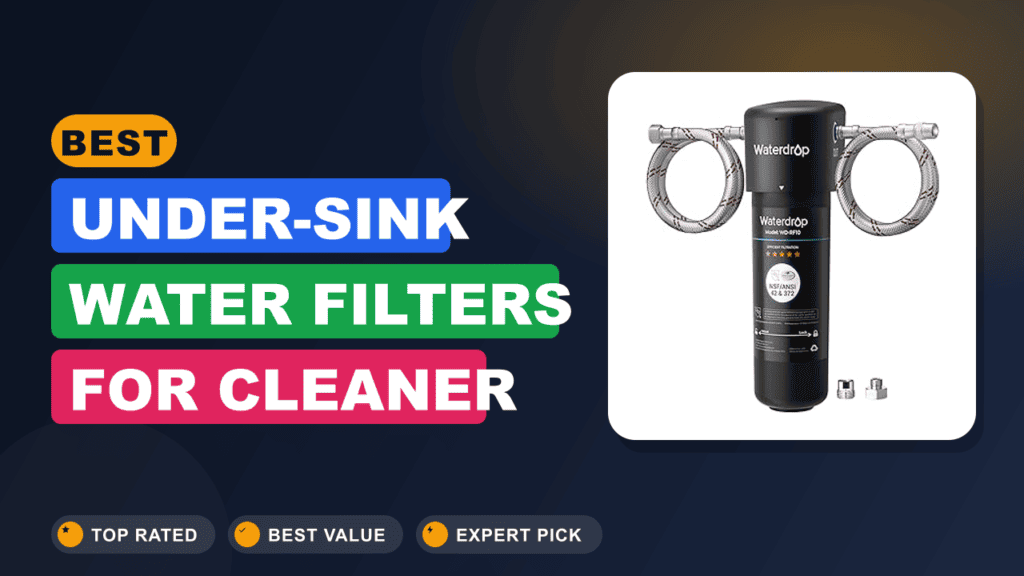
I've spent hours comparing under sink filtration methods, certification claims, replacement schedules, and buyer feedback for Best Under Sink Water Filters (Top Picks for Clean Water). The key split is simple: carbon filters improve taste and odor with less plumbing, while reverse osmosis removes more dissolved contaminants but takes more space and creates wastewater.
My top recommendation is the Waterdrop 10UA for most city-water kitchens because it combines a compact design, NSF/ANSI 42 certification, and a simple replacement plan. The CuZn UC-200 is the better fit if you want a much longer filter life. Here is the quick comparison before the detailed picks.

List of Top 5 Best Under Sink Water Filters (top Picks for Clean Water)
These picks cover the main buying situations: straightforward carbon filtration, long replacement intervals, low upfront cost, layered carbon filtration, and reverse osmosis. I compared manufacturer specifications, certification language, installation style, filter-life claims, and recurring patterns in buyer feedback. This guide relies on product specifications and available buyer feedback, not hands-on testing.
Below are the list of products:
1. Waterdrop 10UA Under Sink Water Filter
Manufacturer specifications indicate that the Waterdrop 10UA is a compact direct-connect carbon filter for a regular cold-water line. Its NSF/ANSI 42 certification applies to aesthetic contaminants such as chlorine and taste, which makes it a practical choice for municipal water that is safe but unpleasant to drink.
The one-year filter interval is easier to remember than a flow-based replacement schedule. Buyer feedback often praises the small footprint and simple setup, though some reports mention that cramped cabinet plumbing can make any under sink installation frustrating.
Why we included it
The Waterdrop 10UA earns the top spot because it keeps the installation and maintenance plan simple. NSF/ANSI 42 is the relevant certification for its stated taste and odor work, not a blanket claim that it removes every contaminant.
Key specs
- NSF/ANSI 42 certification for aesthetic water claims.
- One-year replacement interval listed by the manufacturer.
- Under sink direct-connect format.
- Carbon filtration for chlorine, taste, and odor concerns.
- Compact housing that leaves room for cleaning supplies.
What to expect
This is the pick I would place under a busy kitchen sink where the filtered faucet is used for drinking water, coffee, ice, and cooking. It makes more sense for treated municipal water than for a private well with an unknown contaminant profile. If your concern is lead, nitrates, bacteria, or high total dissolved solids, arrange water testing before relying on an NSF/ANSI 42 carbon filter.
The FDA explains the broader role of food and drinking-water safety oversight, but certification still needs to match the contaminant you care about.
- NSF/ANSI 42 certification supports chlorine and taste claims.
- One-year replacement timing is easy to track.
- Direct-connect design avoids adding a separate filtered faucet.
- Compact housing leaves useful cabinet space.
- NSF/ANSI 42 does not cover every contaminant.
- Replacement parts add a recurring maintenance cost.
- Existing shutoff valves may need attention during installation.
- ✔ You have treated municipal water.
- ✔ You want a compact drinking-water filter.
- ✔ You prefer a yearly maintenance reminder.
- ✖ You need reverse osmosis filtration.
- ✖ You have a private well without test results.
2. CuZn UC-200 Under Sink Water Filter
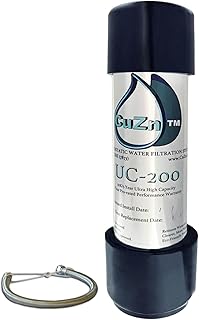
The CuZn UC-200 is the long-maintenance option in this group. Its stated five-year filter life, NSF/ANSI 42 certification, and NSF/ANSI 372 material claim make it attractive to households that want to avoid annual cartridge changes.
Buyer feedback often points to improved taste and a sturdy canister. The trade-off is that a long-life filter is still not a reason to ignore water testing or manufacturer replacement guidance.
Why we included it
The CuZn UC-200 makes sense for a buyer who dislikes recurring filter chores. Its five-year life claim is the main reason to choose it, while its certification language gives a clearer basis for the taste and material claims than an uncertified generic cartridge.
Key specs
- NSF/ANSI 42 certified.
- NSF/ANSI 372 certified.
- Five-year filter-life claim.
- Under sink point-of-use design.
- Intended for cold-water use.
What to expect
This is a strong fit for a rental kitchen or a household that does not want to track annual cartridge purchases. The canister may be less convenient than a small inline filter in a very tight cabinet, so measure around the shutoff valve and drain plumbing first. It is also a better value for steady daily use than for a rarely used guest bar sink.
- Five-year life claim reduces replacement chores.
- Two NSF/ANSI standards clarify the certification scope.
- Buyer feedback often reports better taste.
- Good choice for steady household use.
- Canister size may challenge cramped cabinets.
- Long life does not equal universal contaminant removal.
- Installation needs careful leak checking.
- ✔ You want fewer cartridge changes.
- ✔ Your cabinet fits a canister system.
- ✔ You use filtered water every day.
- ✖ You need reverse osmosis.
- ✖ You cannot verify your water supply.
3. Waterdrop 15UA Under Sink Water Filter
The Waterdrop 15UA is the budget-friendly pick for a buyer who wants a high stated capacity without moving to reverse osmosis. Its manufacturer lists a 19,000-gallon capacity and a two-year period, giving it a longer service plan than the 10UA.
That capacity is useful for a large household, but it should not be treated as a guarantee for every water condition. Sediment, usage, and source-water quality can shorten practical filter life.

Why we included it
The 15UA gives budget buyers more stated capacity than a one-year filter while keeping the basic carbon-filter format. It is a sensible choice for treated city water when you want a lower maintenance burden without paying for a larger reverse osmosis installation.
Key specs
- 19,000-gallon capacity listed by the manufacturer.
- Two-year service period.
- Under sink carbon filtration.
- Inline installation format.
- Reported rating of 4.5 out of 5.
What to expect
A family that fills reusable bottles, cooks pasta, and runs a coffee maker daily can use the capacity advantage. The filter still needs a clean inlet and a secure connection, and a high-sediment supply may reduce flow or shorten its useful life. Keep the replacement date written inside the cabinet rather than relying only on the gallon figure.
- 19,000-gallon capacity supports heavy use.
- Two-year period reduces maintenance frequency.
- Carbon design keeps installation less complex.
- Budget-friendly alternative to reverse osmosis.
- Capacity claims depend on source-water conditions.
- Does not provide the broad reduction profile of RO.
- Buyer feedback includes occasional connection concerns.
- ✔ You want a budget carbon filter.
- ✔ Your household uses lots of filtered water.
- ✔ You want a two-year reminder.
- ✖ You need contaminant-specific RO treatment.
- ✖ Your water has heavy sediment.
4. Waterdrop TSA 8 Layer Under Sink
The Waterdrop TSA 8 Layer is aimed at buyers who want a more involved carbon filtration design than a basic single-stage inline unit. Its NSF/ANSI 42 certification supports the stated aesthetic filtration category, while the eight-layer construction gives the product its main point of difference.
Layer count alone does not tell you which contaminants are reduced. Check the exact certification and performance claims before choosing it for a specific water problem.

Why we included it
The TSA 8 Layer belongs on this list because it gives buyers a middle option between a basic carbon cartridge and an RO system. The eight-layer design may appeal to people focused on taste, odor, and general drinking-water quality, but the certification scope matters more than the layer count.
Key specs
- Eight-layer filtration design.
- NSF/ANSI 42 certification.
- Under sink point-of-use format.
- Carbon-based filtration system.
- No electricity requirement listed in the supplied product details.
What to expect
This model fits a kitchen where the owner wants a dedicated filter but does not want a storage tank or powered pump. It can work well for drinking water, tea, and cooking, provided the cold-water connection is sound. The main limitation is decision clarity: if your laboratory report names lead, arsenic, nitrate, or another contaminant, match that result to a certified reduction claim rather than assuming eight layers cover it.
- Eight-layer design gives a broader carbon approach.
- NSF/ANSI 42 certification supports aesthetic claims.
- No tank or electrical outlet is needed.
- Useful middle ground for drinking water.
- Layer count does not identify every reduction claim.
- Not a substitute for reverse osmosis.
- Replacement timing must be tracked.
- ✔ You want layered carbon filtration.
- ✔ You have limited cabinet space.
- ✔ Taste and odor are the main concerns.
- ✖ You need a tank-based RO system.
- ✖ You need a contaminant-specific certification.
5. iSpring RCC7AK-BN NSF Certified
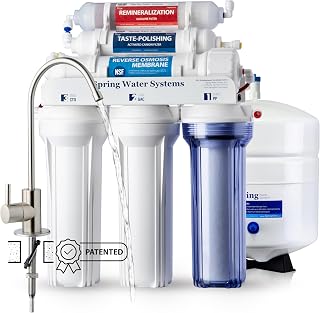
The iSpring RCC7AK-BN is the specialist pick for shoppers who want reverse osmosis and alkaline remineralization in one under sink system. Its six-stage design, 75 GPD rating, and top-mounted faucet make it much more involved than the carbon filters above.
Reverse osmosis can address a wider range of dissolved contaminants, but the system needs more cabinet room, more connections, and regular filter changes. Its performance depends on correct installation and adequate incoming water pressure.
Why we included it
The iSpring is the only pick here designed around reverse osmosis rather than basic carbon filtration. The 75 GPD rating and six-stage configuration make it the logical choice when a water test points toward dissolved contaminants and you have room for a tank and extra tubing.
Key specs
- 75 gallons per day rating.
- Six-stage reverse osmosis system.
- Alkaline remineralization stage.
- NSF certified product designation supplied by the manufacturer.
- Top-mounted faucet design.
What to expect
This system suits a homeowner who wants a dedicated faucet for drinking and cooking water and accepts more maintenance. The storage tank takes cabinet space, and the drain connection means installation is more involved than the direct-connect Waterdrop models. Reverse osmosis also rejects water during operation, so check the installation instructions and local plumbing requirements before starting.
If you are not comfortable working under a sink, a licensed plumber is the safer choice.
- 75 GPD rating suits regular household drinking use.
- Six stages provide a broader filtration approach.
- Alkaline stage adds remineralization after RO.
- Top-mounted faucet can simplify faucet access.
- Tank and tubing use more cabinet space.
- RO creates wastewater during operation.
- Installation and maintenance are more involved.
- ✔ Your water report calls for RO.
- ✔ You have room for a tank.
- ✔ You want a dedicated filtered faucet.
- ✖ You only need chlorine taste reduction.
- ✖ Your cabinet has very little space.
How I picked
I compared these filters on three practical benchmarks: the stated filtration method, the maintenance burden, and the fit between the product’s certification claims and common household water problems. I also compared the listed filter-life periods, gallon capacities, installation style, faucet requirements, tank requirements, and the amount of cabinet space each design is likely to use.
The first distinction is carbon filtration versus reverse osmosis. Carbon filters are usually simpler, do not need electricity, and are well suited to chlorine taste and odor. Reverse osmosis uses a membrane and several stages to reduce a broader group of dissolved substances, but it needs more connections and produces reject water.
The second benchmark was certification language. NSF/ANSI 42 relates to aesthetic effects such as chlorine, taste, and odor. NSF/ANSI 372 relates to lead content in plumbing components, not proof that the complete system removes every lead contaminant from water.
A certification should always match the contaminant claim you need.
The third benchmark was ownership. A one-year cartridge is easy to plan for, but a five-year stated life can reduce maintenance. A 19,000-gallon claim may suit a high-use kitchen, although source-water quality and flow conditions can change actual service life.
I used the manufacturer information supplied for each product and considered recurring themes in reported buyer feedback. I did not physically install or operate these filters, measure flow rates, verify contaminant reduction, inspect fittings, or test long-term durability beyond the supplied product information. I also did not treat reported star ratings as laboratory results.
Before choosing any model, check the water report for your home or order a certified lab test. A filter that improves flavor may still be the wrong tool for a specific contaminant.
Buying guide: what actually matters for Best Under Sink Water Filters (Top Picks for Clean Water)
The best filter is the one whose certified claim matches your water problem and whose installation fits your cabinet. Start with the water, then check the plumbing, replacement plan, and available space.
Which contaminants do you need to reduce?
A carbon filter is a filter that uses activated carbon media to adsorb some chemicals and improve taste and odor. Reverse osmosis is a membrane-based system that reduces many dissolved substances, but its exact performance depends on the membrane, water pressure, and certification.
For chlorine taste, the Waterdrop 10UA, Waterdrop 15UA, and TSA 8 Layer are the most straightforward options here. For a wider dissolved-contaminant concern, the iSpring RCC7AK-BN is the more relevant design. Do not select by the words “multi-stage” or “8 layer” alone.
Find the exact reduction claim.
Do you have room under the sink?
Measure the clear space around the cold-water shutoff, drain line, garbage disposal, and cabinet floor. Inline filters such as the Waterdrop models generally leave more open room than a reverse osmosis system with a storage tank.
A tank-based system may also need a dedicated faucet hole. If your sink has no spare opening, confirm whether the top-mounted faucet can replace an existing accessory or whether drilling is required. A tight cabinet can turn a simple filter change into a frustrating plumbing job.
How often do you want to replace filters?
The Waterdrop 10UA lists a one-year period. The Waterdrop 15UA lists two years and 19,000 gallons. The CuZn UC-200 lists five years.
These are useful planning figures, not promises that apply equally to every household.
High sediment, heavy use, and poor source-water quality can shorten cartridge life. Write the installation date on the housing or set a calendar reminder. Waiting for a bad taste is a poor replacement strategy because some contaminants do not change taste or odor.
Do you need a separate faucet?
Direct-connect systems can send filtered water through the existing cold-water faucet, depending on the installation arrangement. Reverse osmosis systems commonly use a dedicated faucet because the filtered water comes from a storage tank.
A dedicated faucet keeps filtered water separate from unfiltered hot and cold water, but it takes counter or sink-deck space. If you rent, confirm that drilling or faucet replacement is allowed before buying.
What does certification tell you?
Certification is a product claim checked against a defined standard. NSF/ANSI 42 is commonly associated with aesthetic effects, while NSF/ANSI 372 addresses lead content in materials. Neither term means a system removes every possible contaminant.
Look for a certification that names the reduction you need. If your concern is lead, PFAS, nitrate, arsenic, bacteria, or fluoride, check the exact product documentation rather than relying on a general “clean water” phrase.
Is reverse osmosis worth the extra work?
Reverse osmosis is worth considering when testing identifies dissolved contaminants that a basic carbon filter is not designed to address. It is less attractive when your only complaint is chlorine flavor and you want the simplest installation.
You will trade cabinet space and simpler plumbing for broader filtration potential. The iSpring’s 75 GPD rating describes production capacity under specified conditions, not a promise that 75 gallons will flow instantly from the faucet. RO systems also send some water to the drain and need several replacement filters.
Frequently Asked Questions (FAQ)
Are under sink water filters worth it for city water?
Yes, an under sink filter can be worthwhile when city water is safe but has an unpleasant chlorine taste or odor. Carbon models are usually the easiest choice because they need no storage tank and use less cabinet space. Check your local water report first, then select a certification that matches the issue you want to address.
Is reverse osmosis better than a carbon filter?
Reverse osmosis is better for some dissolved-contaminant concerns, while carbon filtration is simpler for taste and odor. The iSpring RCC7AK-BN uses six stages and a 75 GPD rating, but it needs more installation space and maintenance. The Waterdrop models are easier choices when your goal is better-tasting municipal water.
How do I choose between these five filters?
Choose the Waterdrop 10UA for the simplest overall setup, the CuZn UC-200 for its stated five-year life, and the Waterdrop 15UA for high-use value. Choose the TSA 8 Layer for layered carbon filtration and the iSpring for reverse osmosis. Cabinet space and your water test should settle close decisions.
Will these filters work with well water?
They may work for taste improvement, but well owners should test the water before choosing a filter. Well water can contain sediment, iron, sulfur, bacteria, nitrate, or other concerns that a basic NSF/ANSI 42 carbon filter may not address. A water professional can recommend pretreatment when the test shows a specific problem.
Does a higher gallon rating mean the filter is better?
No. A higher gallon rating mainly describes the manufacturer’s stated capacity under its conditions. The Waterdrop 15UA lists 19,000 gallons, but that does not make it a better choice than the iSpring for every contaminant.
Certification, water chemistry, flow, and installation matter more than one capacity number.
Do under sink filters remove all contaminants?
No, no general under sink filter claim means all contaminants are removed. Carbon, reverse osmosis, sediment filters, and specialty media each address different substances. Match the product’s certified reduction claims to a water test, and replace cartridges on schedule even if the water still tastes normal.
Final verdict
The Waterdrop 10UA is the best overall choice for most households that want better-tasting municipal water without a tank or complicated plumbing. Choose the CuZn UC-200 instead when its stated five-year filter life matters more than the smallest housing. For a broader reverse osmosis approach, the iSpring RCC7AK-BN is the specialist pick, but it demands more space and upkeep.
Affiliate disclosure: This post contains affiliate links. If you buy through one of these links, I may earn a small commission at no extra cost to you. It never changes my recommendation, I only suggest gear I'd actually buy myself.