Air fryer replacement baskets are necessary when your original basket has peeling non-stick coating, structural damage, or persistent odors that cleaning cannot fix. Most manufacturers sell official replacements that match your specific model number exactly, and these are always the safest choice for fit and food safety. Third-party options exist for popular models but require careful verification of dimensions and material certifications before purchase.
Finding the correct air fryer replacement basket starts with locating your appliance’s full model number, usually found on a sticker on the back or bottom of the unit. This number is the only reliable way to confirm compatibility because basket sizes, handle attachments, and airflow patterns vary significantly even between similar-looking models from the same brand. Skipping this step often leads to buying a basket that physically fits the drawer but blocks proper air circulation or fails to lock into place during cooking.
Why Coating Failure Means It Is Time for a New Basket
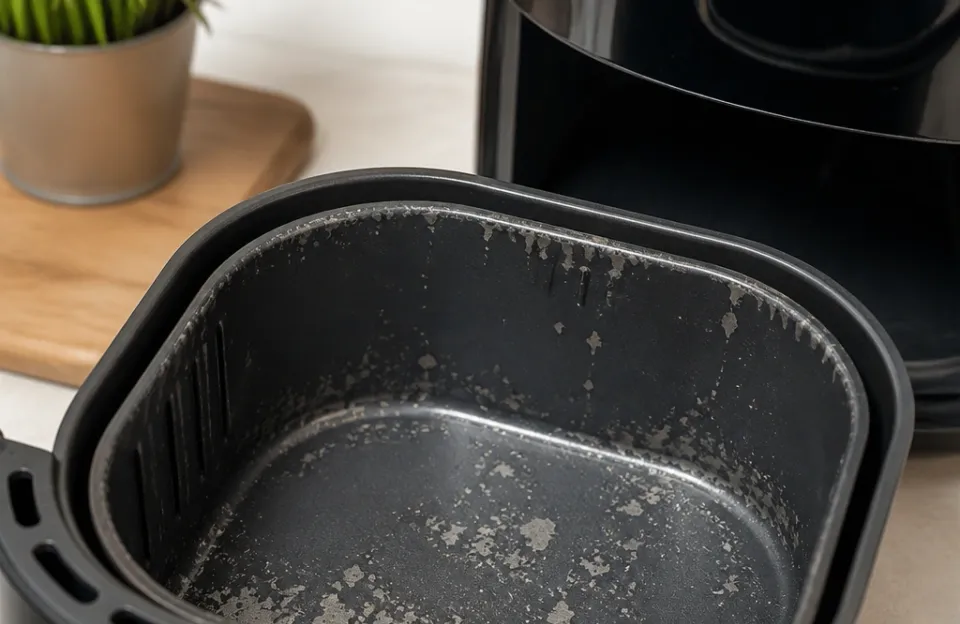
The non-stick coating on an air fryer basket is a consumable component, not a permanent surface. Over time, heat cycles, abrasive cleaning, and acidic foods degrade the PTFE or ceramic layer. Once you see flaking, bubbling, or bare metal spots, the basket has reached the end of its safe service life.
Cooking on exposed base metal can cause food to stick aggressively and may introduce coating particles into your meals.
Manufacturers generally rate non-stick coatings for one to three years of regular use depending on quality and care. Heavy users who cook daily often need air fryer replacement baskets sooner than occasional cooks. The degradation accelerates if you frequently use metal utensils, stack foods improperly, or clean with harsh scouring pads.
Even with perfect care, thermal stress eventually breaks down the bond between the coating and the metal substrate.
Health and Safety Concerns With Damaged Coatings
Ingesting small flakes of intact PTFE coating is generally considered inert and passes through the digestive system without harm according to current toxicological understanding. However, a damaged basket presents other risks. Exposed metal can rust or corrode, especially in high-humidity environments or after washing.
Rust particles and oxidation byproducts are not intended for food contact. Additionally, uneven surfaces create hot spots where oil polymerizes into stubborn residue that harbors bacteria and affects flavor transfer between dishes.
The U.S. Food and Drug Administration regulates food-contact materials and sets standards for non-stick coatings used in cookware. When a basket’s coating fails beyond minor wear, it no longer meets the intended use parameters established during manufacturing compliance testing.
Replacing the basket restores the appliance to its certified safe operating condition rather than continuing to use a compromised component.
Performance Loss Before Visible Damage Appears
Sometimes a basket needs replacement before obvious flaking occurs. If food consistently sticks despite using oil spray, or if browning becomes uneven across the batch, the non-stick properties have degraded at a microscopic level. You might also notice increased smoke production as old oil residues trapped in micro-cracks burn off during preheating.
These performance issues indicate the basket can no longer deliver the results the appliance was designed to produce.
Tracking cooking performance helps identify replacement timing before complete failure. Keep notes on sticking incidents, cleaning difficulty, and texture consistency. When maintenance efforts like seasoning or deep cleaning stop restoring function, the physical asset has depreciated fully.
Continuing to compensate for a worn basket wastes energy, ingredients, and time.
Matching Your Exact Model Number to Avoid Fitment Issues
Every air fryer manufacturer uses proprietary basket designs tailored to their heating element placement, fan speed, and internal cavity dimensions. A basket from a 5.8-quart Cosori will not work in a 5.8-quart Ninja even though the capacity appears identical. The shape of the corners, the position of the release button, and the height of the sidewalls all affect whether the basket seats correctly and allows adequate airflow underneath.
Locate your model number before shopping. Check the product label on the rear or underside of the main unit. Some brands print it inside the door frame or on the bottom of the original basket itself.
Write down the complete alphanumeric code including any dashes or suffixes. Partial numbers often correspond to multiple variants with incompatible accessories. Use this exact string when searching retailer sites or contacting customer support.
Understanding Capacity Versus Physical Dimensions
Quart capacity is a volume measurement that tells you nothing about the basket’s footprint or profile. Two 4-quart baskets can have completely different length, width, and height measurements. Always verify physical dimensions in millimeters or inches against your existing basket or the manufacturer’s specification sheet.
Measure the outer rim including any protruding tabs or handles, not just the interior cooking surface.
Pay special attention to the locking mechanism. Many air fryers use a two-part system where the inner basket separates from the outer drawer for serving. Replacement baskets must engage both the drawer rails and the handle release catch precisely.
A millimeter difference in tab placement prevents secure attachment and creates a safety hazard during removal. Test fit immediately upon receipt while return windows remain open.
Brand-Specific Compatibility Patterns
Major brands maintain distinct ecosystems for air fryer replacement baskets. Philips Airfryer models typically use standardized sizing within generation families but changed designs significantly between the original HD9220 series and newer XXL versions. Ninja uses different basket shapes for their single-zone versus dual-zone appliances.
Instant Pot branded air fryers share some components with Instant Vortex lines but not universally.
Third-party compatibility claims should be treated skeptically unless the seller provides dimensional drawings or explicit model cross-reference lists. Generic “universal” baskets rarely fit properly because true universality does not exist in this category. The market does offer legitimate aftermarket options for high-volume models like certain Cosori and GoWISE USA units, but these represent exceptions validated by community testing rather than rule.
Verify through user reviews showing actual installation photos before purchasing non-OEM parts.
Material Options and Their Practical Tradeoffs
Most replacement baskets use either PTFE-based non-stick coating or ceramic-based alternatives over a steel or aluminum base. Each material behaves differently under sustained heat and mechanical stress. Your choice depends on cooking habits, cleaning preferences, and longevity expectations rather than marketing claims about superiority.
PTFE coatings provide superior initial release properties and tolerate higher peak temperatures suitable for searing proteins. They respond well to light oil application and clean easily with soft sponges. The tradeoff is lower abrasion resistance and eventual breakdown requiring future replacement.
Ceramic coatings offer better scratch tolerance and appeal to buyers avoiding synthetic polymers, but they typically lose non-stick effectiveness faster and require more diligent oiling to prevent sticking.
| Material Type | Release Performance | Durability Rating | Max Safe Temp | Cleaning Ease | Typical Lifespan |
|---|---|---|---|---|---|
| PTFE Non-Stick | Excellent | Moderate | 500°F / 260°C | Easy | 1-3 Years |
| Ceramic Coating | Good (declines) | High Scratch Resistance | 450°F / 230°C | Moderate | 6-18 Months |
| Uncoated Steel | Poor (requires oil) | Very High | No Limit | Difficult | Indefinite |
| Stainless Mesh | Variable | High | No Limit | Moderate | Indefinite |
When Uncoated or Alternative Materials Make Sense
Some users opt for uncoated stainless steel baskets despite the sticking risk. These eliminate coating degradation concerns entirely and withstand metal utensils, oven broiling, and dishwasher cycles without damage. The tradeoff is mandatory fat usage and longer cleanup involving soaking or scrubbing.
This option suits those who prioritize durability over convenience or who have chemical sensitivity concerns regardless of regulatory safety assessments.
Stainless mesh baskets serve specialized purposes like dehydrating or reheating fried foods where maximum airflow matters more than containment. They do not replace standard solid-bottom baskets for general cooking but complement them as secondary accessories. Verify your air fryer supports mesh inserts before purchasing since reduced mass affects thermal inertia and may trigger error sensors in some smart models equipped with advanced diagnostics like the Chef iQ Sense.
Verifying Food-Safe Certifications
Any air fryer replacement basket you buy should carry documentation confirming compliance with FDA food-contact regulations or equivalent regional standards. Legitimate sellers provide test reports or certification marks upon request. Avoid unbranded baskets lacking traceable manufacturing origin or safety documentation.
Price savings mean nothing if the product introduces contaminants or fails catastrophically during use.
Check for California Proposition 65 warnings if applicable to your jurisdiction. While many compliant products carry this warning due to trace substances below harmful thresholds, its absence on unregulated imports signals missing testing rather than superior safety. Prioritize suppliers who transparently publish material composition and testing protocols over those making vague “food-grade” claims without substantiation.
Installation and Breaking In Your New Basket Correctly
Installing a new basket takes seconds but requires attention to orientation markings. Align the basket’s front indicator with the drawer’s corresponding notch before sliding home. Force indicates misalignment.
Listen for the audible click confirming the latch engagement. Test the release mechanism several times empty before first cook to build muscle memory and verify smooth operation.
New baskets benefit from an initial seasoning cycle even if labeled ready-to-use. Wash thoroughly with warm soapy water to remove manufacturing oils and dust. Dry completely.
Apply a thin coat of high-smoke-point oil to all interior surfaces using a paper towel or silicone brush. Run the empty basket at 375°F for ten minutes. This process fills microscopic pores and establishes a baseline release layer that extends functional lifespan.
Adjusting Cooking Times After Replacement
Fresh non-stick coatings conduct heat differently than worn ones. Expect slightly faster browning and potentially shorter cook times during the first few weeks of use. Monitor doneness closely using reliable tools rather than relying solely on previous timing habits.
An accurate digital meat thermometer removes guesswork when adapting to new thermal characteristics.
Document adjustments made during the transition period. Note temperature reductions or time cuts that produced optimal results for staple recipes. This record prevents repeated trial-and-error waste and establishes new baselines faster.
Share findings with household members who also use the appliance to maintain consistency across users.
Maintaining the Replacement to Maximize Longevity
Protect your investment through disciplined care practices. Never use aerosol cooking sprays containing lecithin or propellants that leave gummy residues impossible to remove without abrasion. Use pump-style oil sprayers or brushed application instead.
Allow the basket to cool before washing to prevent thermal shock warping. Hand wash whenever possible despite dishwasher-safe claims since detergent chemicals and rack vibration accelerate coating wear.
Store the basket dry and separated from metal utensils or stacked cookware that could scratch the surface. If stacking is unavoidable, place a cloth barrier between items. Inspect monthly for early wear signs and address minor issues before they compound.
Proper maintenance typically doubles effective service life compared to neglectful treatment. For meal prep enthusiasts who batch cook weekly, consistent care routines directly impact long-term cost per use and reduce replacement frequency. Those following specific dietary approaches like our healthier wing preparations will find that maintaining basket integrity ensures predictable nutrition outcomes since degraded surfaces absorb excess oil unpredictably.
Frequently Asked Questions
Can I use a different brand’s basket if the quart size matches?
No. Quart capacity measures volume, not physical dimensions or attachment mechanisms. Baskets from different brands almost never interchange safely even at identical capacities.
Always match the exact manufacturer model number to ensure proper fit, airflow, and latch security. Using mismatched parts risks appliance damage, poor cooking results, and potential injury from detached components during handling.
How do I know if my basket is still safe to use?
Inspect the cooking surface monthly under good lighting. Replace immediately if you see peeling, bubbling, deep scratches exposing base metal, rust spots, or persistent odors after thorough cleaning. Minor cosmetic discoloration without texture change is usually acceptable.
When in doubt, err toward replacement since continued use of compromised cookware carries cumulative risk that outweighs the cost of a new basket.
Are ceramic-coated replacement baskets safer than PTFE?
Both materials are considered safe when intact and used within temperature limits according to current regulatory standards. Ceramic avoids synthetic polymer concerns but loses non-stick properties faster and may require more oil to prevent sticking. PTFE offers superior release and easier cleaning but degrades sooner under abuse.
Choose based on your priorities for longevity versus convenience rather than perceived safety differences that lack strong scientific differentiation at normal cooking temperatures.
Why does my new basket smell strange during first uses?
Manufacturing residues and protective oils burn off during initial heating cycles causing temporary odors. This is normal and resolves after two to three seasoning runs at moderate temperature. Ensure adequate ventilation during break-in.
If odors persist beyond five uses or smell acrid rather than oily, discontinue use and contact the seller as this may indicate defective materials or contamination rather than standard break-in behavior.
Can I put my replacement basket in the dishwasher?
Many manufacturers claim dishwasher safety but hand washing significantly extends coating life. Dishwasher detergents are highly alkaline and degrade non-stick surfaces faster than mild soap. Rack vibration causes micro-abrasions against other items.
If you must use a dishwasher, place the basket alone on the top rack away from heating elements and skip heated dry cycles. Accept that this convenience comes at the cost of reduced service interval compared to gentle hand care.
Getting the Most From Your Replacement Investment
Replacing an air fryer basket restores your appliance to intended performance levels and eliminates safety concerns associated with coating failure. The key to success lies in precise model matching, realistic material expectations, and disciplined maintenance habits going forward. Treat the basket as a wearable component with finite lifespan rather than permanent hardware and budget accordingly for periodic renewal.
Keep your model number documented digitally alongside purchase receipts and warranty information. This preparation simplifies future replacements and helps track actual service intervals for your specific usage pattern. When shopping for your next air fryer, consider basket availability and cost as selection criteria equal to capacity or preset functions since long-term ownership depends on sustainable parts access.
Reliable temperature monitoring tools like an instant-read thermometer paired with a fresh basket ensure consistent results that justify the replacement expense through improved meal quality and reduced food waste.